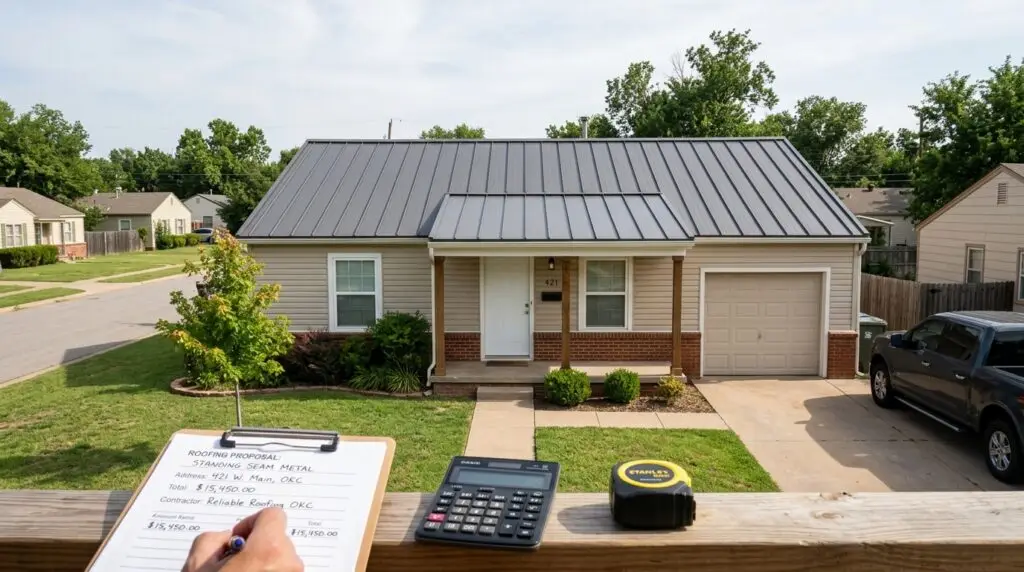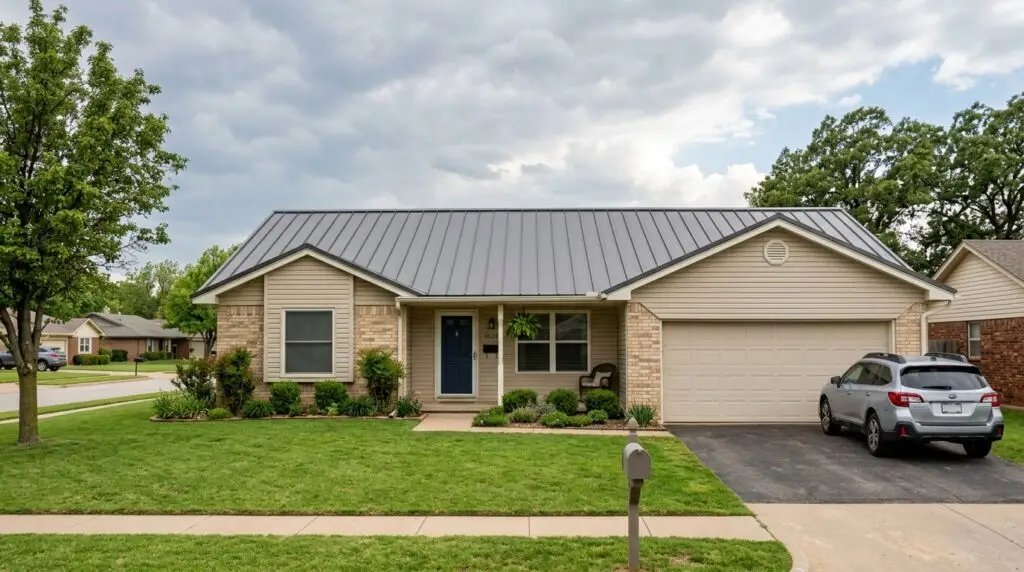
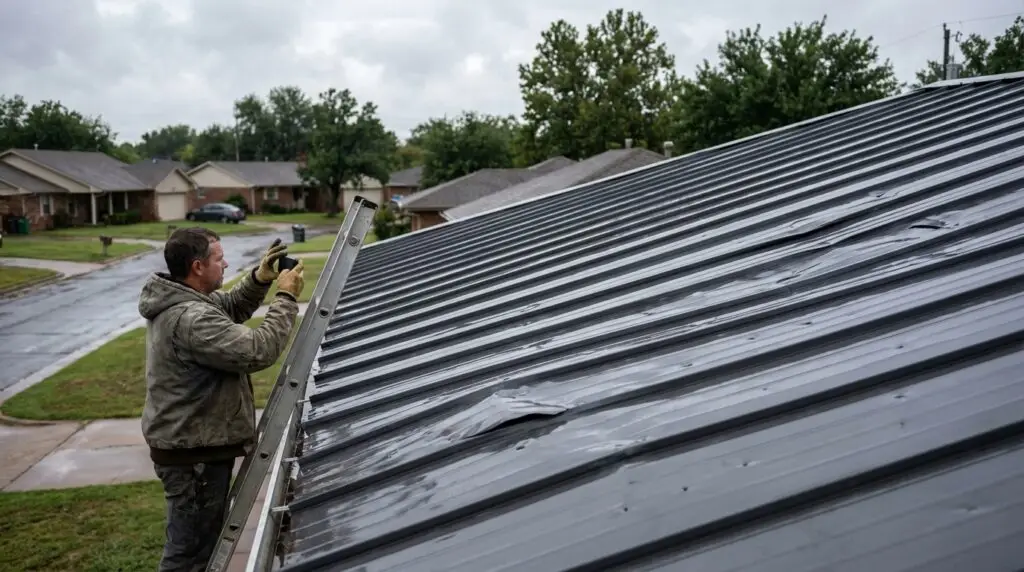
If a storm has rolled through your neighborhood and you’re standing in the driveway staring up at your roof wondering what to do next you’re not alone. Oklahoma City homeowners deal with this more than most. We sit right in the middle of Hail Alley, one of the most storm-active corridors in the entire country, and our roofs take a beating year after year.
Here’s the thing: the way you document roof damage in the first 24 to 48 hours after a storm can be the single biggest factor in whether your insurance claim gets approved, denied, or underpaid. Most homeowners focus on the damage itself and completely overlook the documentation side of the process.
This guide walks you through every step, written specifically for OKC homeowners with metal roofing in mind. Whether you’re in Edmond, Moore, Yukon, Midwest City, or right in the heart of Oklahoma City, the same principles apply and the stakes are just as high.
Why Proper Roof Damage Documentation Determines Your Claim Outcome
Let’s be direct about something. Insurance adjusters are not on your side. They work for the insurance company, and their job whether they’ll admit it or not is to evaluate claims in a way that limits what the company pays out. That’s not cynical, it’s just business.
Your documentation is your counter-argument. It’s the difference between getting the full repair or replacement covered and walking away with a check that barely covers half the job.
What Insurance Companies Are Actually Looking For
Before an insurer approves a claim, they need to confirm three things: the damage occurred during a covered event (like a hailstorm or windstorm), the damage isn’t pre-existing wear and tear, and the financial loss is clearly quantifiable. Every piece of documentation you gather is designed to prove those three points.
Incomplete documentation gives adjusters an easy exit. Vague photos, no timestamps, no written record these are all reasons to reduce or deny a payout. Don’t give them the opening.
Why Metal Roofs Create Unique Documentation Challenges
In our experience, one of the biggest gaps in standard roof documentation advice is that it’s almost entirely written for asphalt shingles. Metal roofing is different, and that matters when it comes to claims.
Hail damage on a standing seam or exposed fastener metal roof doesn’t look like bruised granules. It shows up as denting, creasing, coating fractures, and in more severe cases, punctures or seam separation. These damage patterns are subtle and require close-up, angled photography to capture properly. Many insurance adjusters are not trained to assess metal roofing which means they can miss legitimate damage entirely.
| Expert Tip: Always request an adjuster with metal roofing experience, or better yet, have your metal roofing contractor present during the adjuster visit. You have the legal right to do this in Oklahoma. |
Step 1 Prioritize Safety Before You Touch Anything
Before you document a single thing, stop and think about safety. After a storm, your roof especially a metal roof can be extraordinarily dangerous to walk on. Wet metal is slippery. Wind-damaged sections may be structurally compromised. And frankly, a fall from a roof isn’t worth any insurance payout.
When to Stay Off the Roof Entirely
The honest advice here: most homeowners should not get on their roof after a storm. Instead, do your initial inspection from the ground with binoculars. Walk the perimeter of your property and note what you can see. Look at the roofline, the gutters, the fascia and soffit, and any visible roof penetrations like vents or skylights.
A professional metal roofing contractor has drone inspection capability, safety equipment, and insurance to do what you shouldn’t. Let them handle the detailed roof-level documentation.
What Ground-Level Damage Tells Adjusters
Here’s something most homeowners don’t realize: the damage around your home is often just as important as the damage on top of it. Dented HVAC condenser units, dings on gutters and downspouts, cracked siding, pockmarked yard soil all of this tells a story about hail size, impact force, and storm intensity.
In OKC storms, if your vehicles show dents and your mailbox is dinged up, your roof almost certainly took a hit too. Photograph all of this. Photograph hailstones next to a coin or ruler immediately after the storm hail melts fast, and that size measurement matters more than you’d think.
| Expert Tip: Hailstones larger than one inch in diameter are generally the threshold that causes functional damage to roofing systems. Capturing their size in a photo can be critical evidence for your adjuster. |
Step 2 Build Your Photo and Video Evidence File
Photography is the foundation of your claim. The goal isn’t just to take pictures it’s to tell a clear, sequential visual story of what happened to your roof and why it needs repair or replacement. Here’s the exact sequence that works.
The Correct Photo Sequence for a Metal Roof Insurance Claim
- Establishing shots Full roofline from all four corners of the property. These wide-angle images show the overall scope of damage across the entire system.
- Mid-range shots Each roof section or slope photographed individually. Cover every pitch, every side.
- Close-up shots Every visible dent, crease, lifted seam, damaged fastener, or puncture. On metal panels, photograph at an angle to catch surface deformation the camera might miss straight-on.
- Comparison shots A damaged panel next to an undamaged one. This is powerful because it visually demonstrates the difference between your pre-storm condition and current state.
- Interior shots Attic moisture, water staining on ceiling sheathing, any visible daylight penetration. These document consequential damage from the roof breach.
- Collateral damage shots HVAC units, gutters, siding, skylights, solar panels, and anything else the storm hit.
Timestamp and Geotag Every Image
Before you take a single photo, enable location and timestamp settings in your smartphone camera. Insurance companies want proof that your documentation was captured shortly after the storm not two weeks later after you’d already made repairs.
The moment you’ve taken your photos, back them up to cloud storage immediately: Google Photos, iCloud, or email them to yourself. You want multiple copies in multiple locations. Phones get lost. Memory cards fail.
Video Walkthrough Best Practices
A narrated video walkthrough adds context that static photos can’t. As you record, call out what you’re seeing: which slope you’re documenting, what the damage pattern looks like, how widespread it is. This creates a real-time record that’s much harder for an insurer to dismiss than a photo album without captions.
If your contractor uses drone photography, that footage carries significant weight with adjusters. Drone imagery provides objective, comprehensive aerial coverage that no homeowner on the ground can replicate.
See also: Roof Inspection After a Storm in Oklahoma City
Step 3 Create a Written Damage Log With a Clear Timeline
Photos capture what the damage looks like. Your written record explains the story around it. Insurance adjusters review dozens of claims at a time the ones that are organized, clearly structured, and easy to follow get processed faster and with less pushback.
What Your Written Record Needs to Include
- The date and time of the storm event that caused the damage
- The date you first discovered or were able to inspect the damage
- A description of each damaged area, referenced by compass direction (north slope, south fascia, east ridge cap)
- Any emergency measures you took tarping, temporary boarding and the dates you took them
- Dates and summaries of every communication with your insurance company, including representative names if possible
How to Structure the Report Like a Contractor Would
Start with a simple cover page: your name, address, policy number, and the storm date. Then break the report into sections by roof area North Slope, Ridge and Cap, Gutter System, HVAC and Accessories. For each section, write a description of the damage and reference the corresponding photo numbers.
This structure makes the adjuster’s job easier. And when the adjuster’s job is easier, your claim tends to move faster.
| Expert Tip: National Weather Service storm reports for Oklahoma City events are publicly available at weather.gov. Download and include the report that matches your storm date it’s free corroborating evidence that the storm happened exactly when you say it did. |
Step 4 Gather Supporting Evidence Beyond Photos
This is where most homeowners stop. They take pictures, write a few notes, and call it done. But the most successful insurance claims particularly in Oklahoma, where carriers know our storm frequency and look for reasons to push back include a full evidence package.
Official Weather and Storm Reports
The National Weather Service (NWS) publishes storm event data that includes hail size, wind speed, and storm track by county and zip code. For homeowners in Edmond, Norman, Yukon, and Midwest City, NOAA hail maps can confirm exactly how large the hailstones were in your specific area on the date in question. This data removes a key avenue of dispute from the insurer’s playbook.
Your Maintenance and Repair History
One of the most common tactics Oklahoma insurers use to reduce or deny hail damage claims is arguing that the damage is really just age-related wear and tear. Your maintenance records are the direct rebuttal to that argument.
Pull together any past repair invoices, inspection reports, or contractor receipts. This documentation establishes your roof’s pre-storm condition and demonstrates that any new damage is, in fact, new.
Neighbor Documentation and Area Damage
If your neighbors on the same street filed claims or had visible damage after the same storm, that’s relevant context. Area-wide storm damage events are significantly harder for insurers to dispute than isolated single-property claims. Ask your roofing contractor whether they’ve inspected other homes in your neighborhood following the same storm that information can be included in your claim file.
See also: Wind Damage on Metal Roofs
Step 5 Get a Professional Metal Roofing Inspection Before the Adjuster Arrives
Between you and me, this is the step that makes the biggest difference between a fair settlement and a frustrating one. Most homeowners wait for the insurance adjuster to tell them what’s damaged. That’s backwards.
Get your own professional inspection first. Know exactly what’s wrong with your roof before the adjuster shows up. Then you’re in a position to confirm their findings or challenge them.
Why a Contractor Inspection Comes First
An independent inspection from a licensed metal roofing contractor confirms whether you have enough damage to make a claim worthwhile. In Oklahoma, filing a claim that doesn’t result in coverage can affect your policy, so it’s smart to know your odds before you file.
More importantly, a professional report adds credibility that self-taken photos simply cannot provide. An adjuster might question your photo angles. They’re unlikely to dispute a detailed written inspection report from a licensed contractor.
What a Professional Inspection Report Should Include
- Damage diagrams or sketched roof plan with measurements
- Drone or roof-level photographs taken from access points most homeowners can’t safely reach
- Itemized damage list by component: panels, ridge cap, flashing, gutters, penetrations, skylights, and HVAC equipment
- Written repair vs. replacement recommendation with professional justification
- Cost estimate using Xactimate the same software Oklahoma insurance companies use internally, which ensures your numbers are directly comparable to theirs
Your Right to Have Your Contractor Present During the Adjuster Visit
Oklahoma homeowners have the legal right to have their own roofing contractor on-site when the insurance adjuster inspects the property. Exercise this right. It’s one of the most powerful tools you have.
Adjusters who know a contractor is watching tend to be more thorough. More importantly, your contractor can point out damage the adjuster might miss especially on metal roofing systems where impact damage isn’t always obvious to someone who doesn’t inspect them regularly.
See also: Free Metal Roof Inspection in Oklahoma City
Understanding RCV vs. ACV How It Affects Your Metal Roof Claim in Oklahoma
This is one of the most important financial details in your insurance policy, and it’s one that most homeowners don’t fully understand until after a claim goes sideways.
RCV Replacement Cost Value means your insurer pays what it actually costs to replace your roof with comparable materials, minus your deductible. ACV Actual Cash Value means they subtract depreciation from that amount based on your roof’s age and condition. On an older asphalt shingle roof, that depreciation deduction can be significant.
Many Oklahoma policies have quietly shifted roofs over a certain age to ACV coverage sometimes without homeowners realizing it. Check your declarations page. Look specifically at the section covering wind and hail losses, because Oklahoma policies commonly carry separate deductibles for those events, often calculated as a percentage of your home’s insured value rather than a flat dollar amount.
Here’s where metal roofing actually works in your favor over the long run: metal roofs have dramatically longer lifespans than asphalt typically 40 to 70 years compared to 15 to 25 years for asphalt shingles. That means depreciation schedules hit metal roofs differently. If you’re considering a metal roof replacement after a storm claim, talk to your insurance agent about how the material upgrade affects your coverage and future depreciation calculations.
See also: Is Metal Roofing Worth It in Oklahoma Weather? | Metal Roof Installation in OKC
Common Mistakes That Get Oklahoma Homeowners’ Roof Claims Denied or Underpaid
We’ve seen the same mistakes cost homeowners thousands of dollars in denied or reduced claims. These are the ones that come up most often.
Waiting Too Long to Document or File
Insurance policies require ‘prompt’ reporting after a storm event. What counts as prompt varies by insurer, but filing weeks or months after the fact gives the carrier grounds to question whether the damage is truly from the storm you’re citing. Oklahoma law gives you up to two years to pursue legal action on a claim dispute but your policy filing deadline is almost certainly much shorter than that.
Document within 24 to 48 hours of the storm when it’s safe. File your claim within days, not weeks.
Making Permanent Repairs Before the Adjuster Inspects
Emergency tarping to prevent further water intrusion is acceptable and often reimbursable keep every receipt. But replacing panels, flashing, ridge caps, or gutters before the adjuster has inspected and signed off can void coverage for those specific areas. The adjuster needs to see the damage to quantify it.
Document everything before and after any emergency repairs. Photograph the damaged area, then photograph the temporary repair. This protects you and shows good faith.
Relying Solely on the Insurance Company’s Assessment
The insurer’s adjuster works for the insurer. Their job is to assess claims accurately but ‘accurate’ from their perspective may look different than from yours, especially on a metal roof they may not be well-trained to assess. You have the right to an independent inspection, a second opinion, and if necessary, a public adjuster who works exclusively for you.
Missing Secondary Damage Areas
Adjusters document what they see. If you haven’t pointed out your HVAC condensers, your skylights, your gutters, your soffits, or your solar panels those may not end up on the damage report. Go through your complete documentation checklist before the adjuster arrives and walk them through every affected area.
After You File What Happens Next and How to Protect Your Settlement
How to Handle a Lowball Settlement Offer
It happens more often than it should. You file a claim, the adjuster visits, and the settlement offer comes back well below what your contractor estimated. Don’t accept it automatically.
Compare the insurer’s estimate line by line against your contractor’s Xactimate report. Are materials priced accurately? Are current labor costs in Oklahoma City reflected? Is a full replacement recommended while the insurer is only offering partial repair? Request a re-inspection with your contractor present and provide your professional report as a counter.
Supplemental Claims for Hidden Damage
Metal roofs can hide impact damage under panel overlaps, behind trim pieces, and along fastener rows. Sometimes the full extent of damage only becomes clear during the actual repair or replacement process. When that happens, you can file a supplemental claim for damage that wasn’t captured in the initial assessment. Document any newly discovered damage immediately with photos and have your contractor note it formally.
When to Consider a Public Adjuster or Attorney
If your claim has been denied without a clear valid reason, or if the settlement offer is significantly lower than the documented cost of repair, a public adjuster or Oklahoma insurance attorney can advocate on your behalf. Oklahoma law requires insurers to handle claims fairly and promptly failure to do so can constitute bad faith, which carries legal consequences beyond just the original claim value.
See also: How Insurance Handles Metal Roof Storm Damage in Oklahoma City
How to Prepare Before the Next Storm Hits The OKC Homeowner’s Pre-Storm Checklist
The best time to start documenting your roof is before it’s ever damaged. In Oklahoma City, storm season is a reality we plan for not something that catches us by surprise. Here’s how to get ahead of it.
Create a Pre-Storm Roof Condition Baseline
Photograph your entire roof at least once a year, ideally before severe weather season, which peaks in Oklahoma between April and June. Store those photos in a cloud-backed album labeled with the date something like ‘Roof Condition April 2025.’ When you need to prove your post-storm damage is new and not pre-existing, these baseline photos are your most powerful evidence.
Know Your Policy Before You Need It
Pull out your insurance declarations page today and find your deductible amount, your coverage type (RCV or ACV), and any separate wind or hail deductible provisions. Know your insurer’s claim hotline number. Understand how long you have to file after a storm event. None of this should be a surprise in the middle of a crisis.
Why Metal Roofing Simplifies Future Claims
It depends on several factors, but in general, a properly installed metal roof gives you a meaningful long-term advantage in Oklahoma’s storm environment. Metal panels resist hail and wind far better than asphalt shingles, meaning fewer claims over the life of the roof. When documented installation quality panel gauge, profile type, fastener pattern, underlayment spec is on file, it can also support replacement cost arguments with insurers who might otherwise challenge material values.
Over a 40-to-70-year metal roof lifespan, the math on storm resilience tends to favor the investment particularly in a market like OKC where severe weather events have become more frequent, not less.
See also: Metal Roofing OKC | Metal Roof Repair Services | Service Areas
Frequently Asked Questions
Q: How soon after a storm should I document roof damage for my insurance claim?
Document damage as soon as it is safe to do so ideally within 24 to 48 hours of the storm. Insurance policies typically require ‘prompt’ reporting, and photos timestamped shortly after the event are far stronger evidence than documentation gathered days or weeks later. File your claim within days of the storm, not weeks.
Q: Can I document roof damage myself, or do I need a professional?
Do both. Take your own photos and video immediately to preserve evidence while it’s fresh. Then hire a licensed metal roofing contractor for a professional inspection. Insurance companies give significantly more weight to a certified contractor’s report complete with measurements, damage diagrams, and a repair or replacement estimate than to homeowner photos alone.
Q: What if the insurance adjuster says there is no damage, but I know there is?
Request a re-inspection and submit additional documentation from your own contractor. In Oklahoma, you may also file a complaint with the Oklahoma Insurance Department if you believe your claim is being handled unfairly. Consider hiring a public adjuster or consulting an insurance attorney who handles storm damage claims in the OKC area.
Q: Does having a metal roof make an insurance claim harder to get approved?
Not necessarily but it does require an adjuster who understands how hail and wind damage appear on metal panels. Denting and coating damage on a metal roof look very different from granule loss on asphalt shingles. Having a metal roofing specialist present during the adjuster’s inspection ensures all legitimate damage is properly identified and included in the claim.
Q: How many photos should I take for a roof damage insurance claim?
There is no upper limit more is always better. Aim for at minimum 20 to 30 photos covering wide shots of the full roofline, mid-range shots of each slope, and close-ups of every visible damage point. Professional inspections often include 50 to 100 or more photos. Include interior shots, collateral damage, and hailstones next to a size reference.
Q: What is the difference between RCV and ACV coverage for a roof claim in Oklahoma?
RCV Replacement Cost Value pays what it costs to replace your roof with comparable materials, minus your deductible. ACV Actual Cash Value subtracts depreciation from that amount based on your roof’s age. Many Oklahoma policies have moved older roofs to ACV coverage. Review your declarations page or speak with your insurance agent to confirm which coverage you currently carry before you file a claim.
Q: Will filing a storm damage roof claim raise my insurance premiums in Oklahoma?
Storm-related claims are generally classified as Acts of God and typically do not affect your individual premium the same way an at-fault loss would. However, multiple claims over a short period can influence your policy. Speak with your insurance agent before filing if you have concerns particularly if the damage may be minor.
Ready to Document Your Roof Damage? Start With a Free Metal Roof Inspection
If you’ve had a storm roll through your neighborhood or if you just want to establish a baseline before the next one a professional metal roof inspection is the smartest first step you can take. Our team serves Oklahoma City, Edmond, Moore, Norman, Yukon, Mustang, and Midwest City, and we’re familiar with exactly what Oklahoma insurers need to see to approve a claim.
We’ll document your roof the right way, work alongside your adjuster, and make sure you don’t leave money on the table. Contact us today to schedule your free inspection.