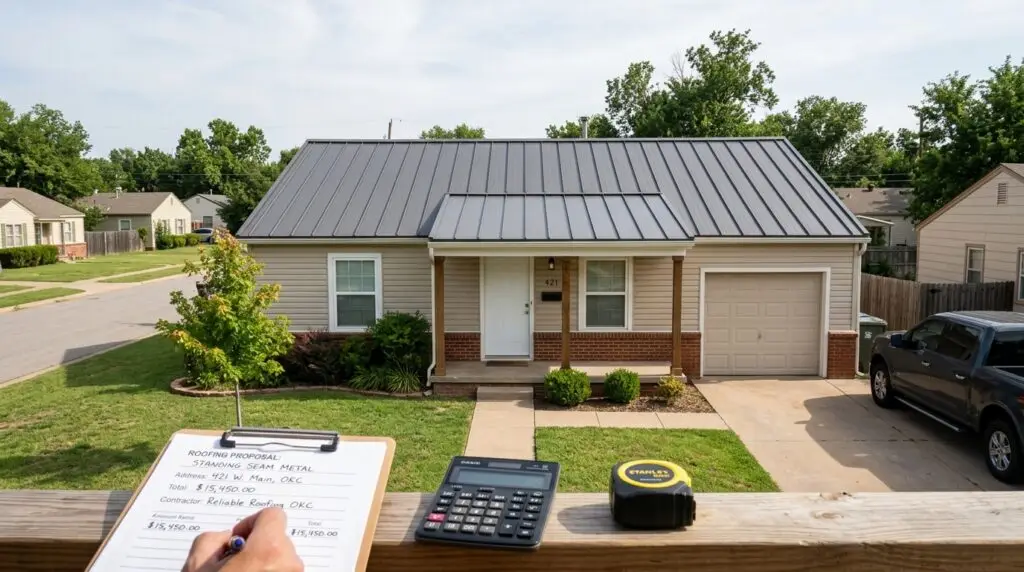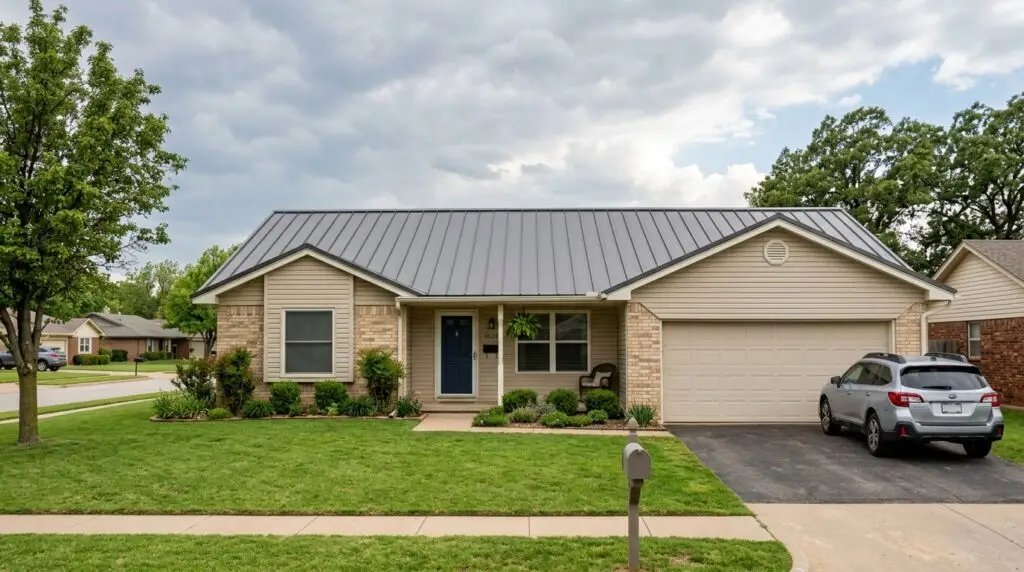
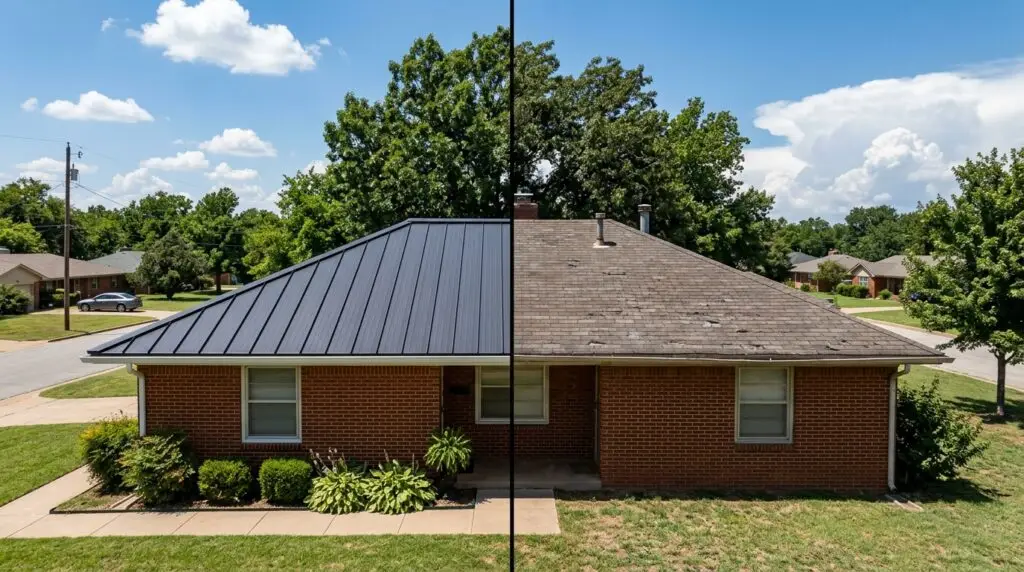
If you own a home in the Oklahoma City metro, you already know the roof is not just a cosmetic decision. It is one of the most consequential calls you will make as a homeowner. Between the hailstorms rolling through Moore and Midwest City, the brutal July heat baking everything in sight, and insurance premiums that rank among the highest in the country, the choice between a metal roof vs. asphalt shingles in Oklahoma City carries real financial weight.
Most roofing articles on this topic give you a generic national comparison and call it a day. This one does not. Everything here is grounded in what actually happens on Oklahoma City roofs, in Oklahoma weather, with Oklahoma insurance carriers.
Why This Decision Hits Differently in Oklahoma City
Oklahoma City is not a normal roofing market. Most parts of the country deal with weather as an occasional concern. Here, severe weather is part of the annual calendar. OKC sits in one of the most hail-active corridors in the entire country, and homeowners in areas like Moore, Yukon, Edmond, and south OKC can realistically expect multiple hail events every few years that are large enough to cause measurable roof damage.
On top of that, Oklahoma homeowners pay some of the highest property insurance premiums in the nation. That is not an accident. It reflects the documented storm exposure that insurers price into every policy. What most homeowners do not realize is that the material sitting on top of their house has a direct effect on what they pay every year. That changes the math on this comparison considerably.
Add in summer heat that routinely pushes past 100 degrees, temperature swings that can drop 40 or 50 degrees between seasons, and a housing stock that ranges from 1960s brick ranches in Edmond to newer construction in Yukon and Mustang, and you have a market where roof material choice genuinely matters more than it does almost anywhere else.
A Straight Look at Both Materials
Asphalt Shingles: Where They Work and Where They Fall Short in OKC
Asphalt shingles have dominated the residential metal roofing market for decades for a reason. They are affordable upfront, fast to install, and there is no shortage of contractors in the OKC area who can put them on. For a homeowner with a tight budget or a short time horizon on their property, that accessibility matters.
Here is the thing, though. Not all asphalt is equal. Standard three-tab shingles are the bottom of the barrel in a market like Oklahoma City. Architectural shingles perform meaningfully better. Class 4 impact-resistant shingles are the serious option for OKC homeowners who want to stay in asphalt territory but need real storm protection. The jump in cost from standard to Class 4 is real, but so is the performance gap.
The honest weakness of asphalt in this market comes down to lifespan under stress. UV degradation in Oklahoma summers accelerates granule loss. Repeated hail events nick and bruise shingles in ways that are sometimes invisible but allow water infiltration. In our experience, asphalt roofs in high-storm-corridor areas around OKC often need replacement closer to the 15-year mark, not the 25-30 years a manufacturer might suggest under ideal conditions.
Metal Roofing: What the Marketing Gets Right and What It Does Not Tell You
Metal roofing has come a long way from the corrugated panels you see on rural outbuildings. For residential applications in OKC, the primary options are standing seam metal, metal shingles, and stone-coated steel. Each has a different profile and a different price point.
Standing seam is the gold standard for storm performance. The panels lock together with concealed fasteners, which eliminates one of the main failure points in other metal systems. Metal shingles and stone-coated steel give homeowners who want something that looks closer to a traditional roof a strong middle-ground option.
The word of caution here is that metal roofing requires a contractor who actually specializes in it. This is not the same skill set as installing asphalt. Poor flashing, improper expansion joint placement, and wrong fastener patterns create problems that show up years later and are expensive to fix. The material is only as good as the installation.
The Real Cost Comparison: Upfront Price vs. 30-Year Reality
What Replacement Actually Costs in OKC Right Now
Asphalt shingle replacement in the Oklahoma City metro typically runs in the range of several dollars per square foot installed, with architectural and Class 4 products landing higher in that range. Metal roofing installs at roughly two to three times that cost, depending on the profile and the complexity of the roof.
Those numbers are one piece of the picture. They are not the whole picture.
The ‘Replace Asphalt Twice’ Calculation OKC Homeowners Should Run
Here is the math most competitors skip. A metal roof installed today on an OKC home can reasonably be expected to last 40 to 50 years with proper maintenance. A quality asphalt roof in this market, given the storm exposure and UV conditions, realistically lasts 15 to 20 years before it needs full replacement.
That means if you are a 45-year-old homeowner planning to stay in your house, you will likely pay for two full asphalt replacements before a metal roof would need attention. Add the labor cost of each replacement, the insurance deductible from the storm claims that typically trigger those replacements, and the disposal costs for the old shingles, and the lifetime cost gap between the two narrows considerably. In many cases it flips.
Energy costs factor in too. Metal roofing with reflective coatings consistently reduces summer heat gain in the attic. Oklahoma City summers are long and hot. That difference shows up on utility bills every year the roof is on the house.
What the Insurance Premium Difference Looks Like Over Time
This is the conversation most roofing articles avoid entirely. Metal roofing, particularly Class 4 rated material, can qualify for homeowners insurance discounts that meaningfully reduce your annual premium. The exact discount varies by carrier and policy, but it is a real number that compounds over time.
Beyond the premium discount, there is the claim exposure question. Every hail claim you file affects your insurability and your rates going forward. A roof that handles hail without filing a claim is worth something that does not show up in a simple cost-per-square-foot comparison. Talk to your insurance carrier before making a final decision. Get the actual numbers for your policy.
Oklahoma City Storm Season: How Each Material Performs When It Counts
Hail: The Difference Between a Dent and a Claim
This distinction matters and almost nobody explains it clearly. When hail hits a metal roof, it may leave a dent. When hail hits asphalt shingles, it bruises or cracks the granule surface, which accelerates deterioration and can create pathways for water infiltration that show up as interior damage months later.
A dent in a metal panel is a cosmetic issue. It does not compromise the roof’s ability to shed water. Asphalt shingle damage, particularly from repeated events, is a functional issue. It degrades the roof’s core purpose over time. That is a meaningful difference when you are deciding what goes on a house in Moore or south OKC where hail events happen regularly.
High Wind Performance in OKC’s Storm Corridors
Straight-line winds, derechos, and tornado-adjacent conditions are part of the Oklahoma weather reality. Standing seam metal roofing holds a genuine advantage in high-wind conditions because there are no exposed fasteners to pull through and the interlocking panel system resists wind uplift at a level that standard asphalt cannot match.
Asphalt shingles are rated for specific wind speeds, and quality architectural or Class 4 shingles hold up reasonably well in typical severe weather. The failure mode for asphalt in extreme wind is edge lifting and granule loss, which is repairable but adds up over time.
Thermal Shock: The Damage Nobody Talks About
Oklahoma temperature swings are extreme. A late January cold snap can follow a stretch of 60-degree days. Summer heat stresses materials in the opposite direction. This repeated expansion and contraction cycle is genuinely hard on roofing materials over time.
Asphalt shingles become more brittle as they age, which makes them increasingly vulnerable to cracking from thermal stress. Metal roofing is engineered to handle expansion and contraction. The expansion joints in a properly installed standing seam system are there specifically for this reason. It is one of those installation details that makes a real difference over a 30-year span in Oklahoma’s climate.
Energy Efficiency: What Metal Roofing Actually Does for Your Utility Bill in Oklahoma
Oklahoma City summers are not kind to poorly insulated attics. Standard asphalt shingles absorb heat and transfer it into the attic space, which your HVAC system then works to overcome. Aged shingles that have lost granule coverage perform even worse.
Metal roofing with quality reflective coatings bounces a significant portion of solar radiation back off the roof surface. Paired with adequate attic ventilation and insulation, homeowners in OKC typically see measurable reductions in cooling costs during peak summer months. The effect is consistent and shows up every year the roof is on the house. It is not a dramatic overnight change, but across the lifespan of the roof it adds up to a real number.
Home Value, Curb Appeal, and the OKC Neighborhood Context
The curb appeal question is one of the most common hesitations homeowners have about metal roofing, and it is based on an outdated mental image. Standing seam metal and stone-coated steel options available today look nothing like the corrugated barn roofing people picture. On a well-matched house, a metal roof can genuinely improve the look of the property.
In neighborhoods with active HOAs, particularly in parts of Edmond, Nichols Hills, and newer Yukon and Mustang developments, it is worth checking HOA guidelines before committing. Some associations have specific rules about roofing profiles and colors. That is a practical step, not a reason to avoid metal, just a box to check early in the process.
On resale value, buyers in Oklahoma City are increasingly aware of what a metal roof means in terms of reduced future maintenance, insurance implications, and storm performance. In high-storm-exposure areas especially, a metal roof is a genuine selling point with informed buyers.
The Myths That Are Still Costing OKC Homeowners Money
Metal Roofs Attract Lightning
This one refuses to die and it is completely wrong. Lightning strikes the tallest object in an area. It does not seek out metal. Your roof material is irrelevant to lightning behavior. What metal roofing does offer if lightning strikes is a non-combustible surface that does not catch fire, which is actually a safety advantage over asphalt in that scenario.
Metal Roofs Are Too Loud in the Rain
This is an installation and insulation issue, not a material issue. A properly installed metal roof with adequate underlayment and attic insulation is not meaningfully louder than asphalt during rain. Where the noise complaint comes from is usually older metal roofing on metal buildings with minimal insulation, not properly installed residential systems. Ask your contractor specifically about underlayment and solid decking to make sure this is handled right.
It Is Not Worth It If You Are Selling in 10 Years
Between you and me, this one depends on the numbers. If you are selling in five years, the math probably does not favor metal. If you are selling in ten to fifteen years, you need to factor in what an asphalt roof will look like to buyers at that point given OKC’s storm history, and whether you will face a pre-sale replacement anyway. In many cases, a metal roof actually becomes a negotiating advantage at sale time in this market.
Choosing the Right Metal Roofing Contractor in OKC: Why This Matters as Much as the Material
This section is missing from every competitor article and it is the one that causes the most real-world problems. Metal roofing installation is a different trade than asphalt shingle installation. A crew that is excellent at asphalt may have limited experience with standing seam panel locking, penetration flashing for metal systems, and proper expansion joint placement. When those details go wrong, the problems show up years later and can be expensive to correct.
Before signing any contract for metal roofing in Oklahoma City, ask directly: how many metal roofing installations has this crew completed specifically? Can they show completed projects? Do they have manufacturer training or certification for the specific product they are installing? What does the labor warranty cover and for how long?
Post-storm surge is a real issue in OKC. After major hail events, the area gets flooded with out-of-state contractors who have no stake in the quality of their work and no way to be reached if problems develop. Be cautious about any contractor offering to manage your insurance claim as part of their pitch. That arrangement has legal implications and is worth understanding fully before you agree to it.
An Honest Decision Framework: Who Should Choose Metal and Who Should Choose Asphalt
Metal roofing is the stronger choice if you:
- Plan to stay in your home for 15 or more years
- Have had repeated hail claims with asphalt roofing in the past
- Want to lower long-term insurance premium exposure
- Live in a higher-exposure storm corridor such as Moore, south OKC, or Midwest City
- Are doing a full replacement and want to avoid the process again in 15 to 20 years
- Are focused on energy efficiency and long-term total cost of ownership
Asphalt shingles may still make sense if you:
- Have a firm short-term budget ceiling that metal exceeds
- Are planning to sell within five to seven years and neighborhood comps do not support the investment
- Need a fast turnaround and current metal installation lead times are not workable
- Are addressing a limited repair area where a full system change is not warranted
Neither material is the right answer for every homeowner or every situation. The right answer comes from running the actual numbers for your house, your insurance, and your timeline.
Frequently Asked Questions
Is a metal roof worth it in Oklahoma City?
For most OKC homeowners planning to stay long-term, yes. The combination of reduced hail claim exposure, lower long-term insurance premiums, energy savings from summer heat reflection, and a lifespan that outlasts two or three asphalt replacements makes the math work, especially in high-storm areas like Moore, Midwest City, and south OKC.
How much more does a metal roof cost than asphalt shingles in OKC?
Metal roofing typically runs two to three times the upfront installed cost of architectural asphalt shingles in Oklahoma City. That gap narrows considerably over a 30-year window when you account for the replacement cycle and repair costs that asphalt accumulates in a high-hail environment.
Will a metal roof lower my homeowners insurance in Oklahoma?
Potentially yes. Some Oklahoma insurers offer discounts for metal roofing, particularly for Class 4 rated materials, because of their reduced hail and wind claim risk. Eligibility and discount amounts vary by carrier. Contact your insurer before installation to get the actual numbers for your specific policy.
Does a metal roof hold up to Oklahoma hail?
Yes, with an important distinction. Metal roofing may dent in a severe hail event, but denting is a cosmetic issue, not a functional one. The roof continues to shed water properly. Asphalt shingle hail damage is a functional issue that degrades the roof’s weather integrity over time. That difference matters in a market with OKC’s hail frequency.
What type of metal roof is best for Oklahoma City homes?
Standing seam metal roofing is the strongest performer for OKC storm conditions due to its concealed fastener system and superior wind uplift resistance. Stone-coated steel is a solid option for homeowners who want traditional aesthetics with metal performance. The best choice for your home depends on architecture, budget, and the contractor’s specific expertise.
How long does a metal roof last in Oklahoma?
A properly installed metal roof in Oklahoma can last 40 to 70 years depending on material type and coating quality. That compares to a realistic 15 to 20 years for architectural asphalt shingles in OKC’s high-UV, high-hail environment, well below the 25 to 30-year figures often cited under ideal conditions.
Can you put a metal roof over existing asphalt shingles in OKC?
In some cases, yes. It depends on local building codes, the condition of the existing roof deck, and the weight characteristics of the new metal system. A licensed OKC roofing contractor should inspect the deck and structure before any re-roofing decision is made. Never skip this step.
Ready to Get a Straight Answer for Your Specific Roof?
Every roof in Oklahoma City is different. Roof pitch, attic structure, neighborhood, age of the home, and your insurance situation all affect which direction makes the most sense for you. Generic advice only goes so far.
Our team specializes in metal roofing installation, metal roof repair, metal roof inspection, and storm damage assessment for homeowners across the Oklahoma City metro, including Newcastle, Tuttle, El Reno, Choctaw, Guthrie, Shawnee and surrounding areas. We are happy to walk through the real numbers for your specific property.
Contact us today for a free roof estimate. No pressure, no storm-chaser tactics. Just straight talk from a team that works in this market every day.