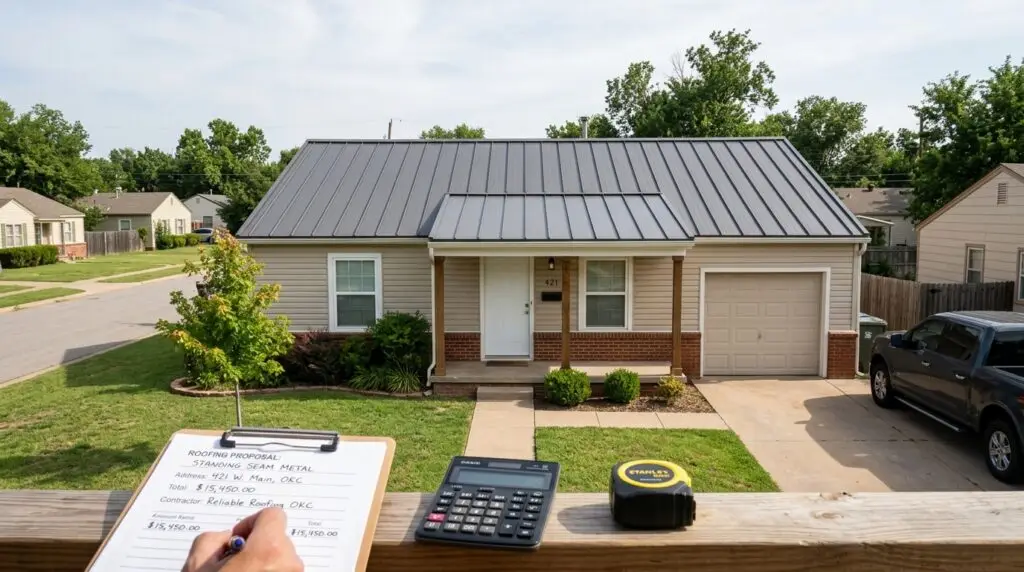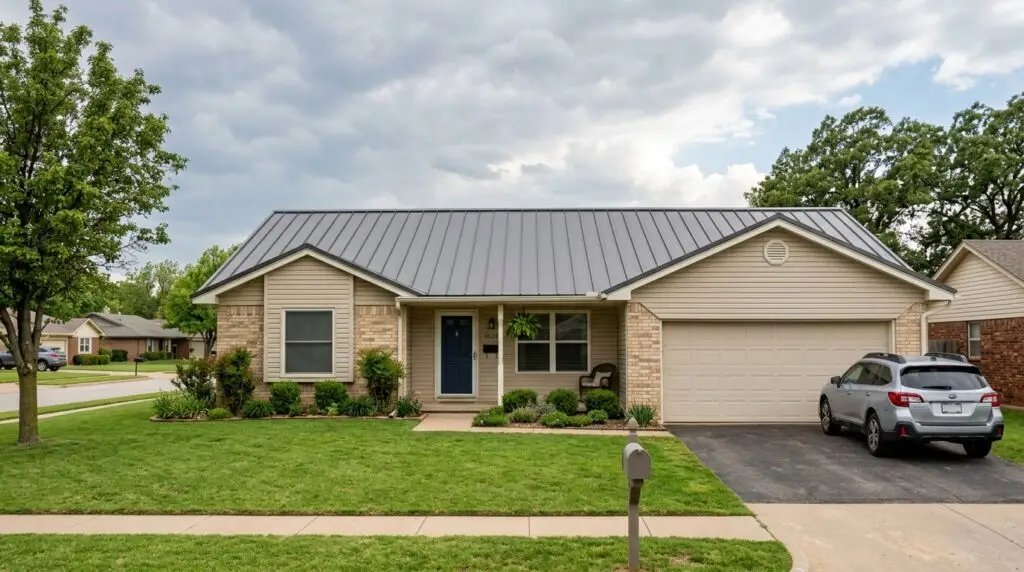
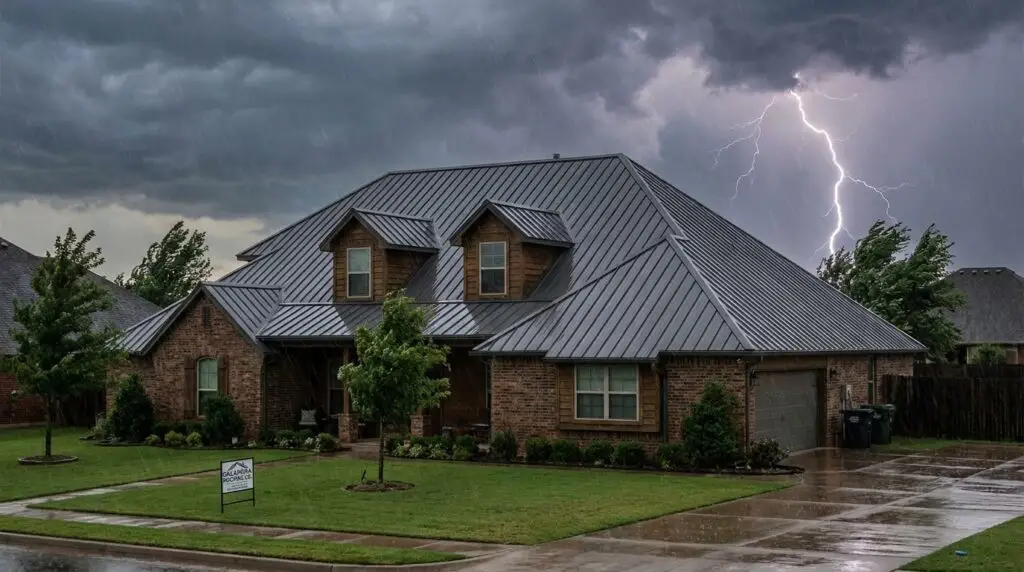
No, metal roofs do not attract lightning. And if a storm rolls across the plains and lightning does strike, a metal roof is one of the safer things you can have over your head. That surprises a lot of people, because the myth runs deep. But the physics is settled, the building science backs it up, and here in Oklahoma City, where the sky turns green a few times every spring, it matters more than most homeowners realize.
Let’s walk through what actually happens, what the research says, and how it all plays out for a home in central Oklahoma.
Do Metal Roofs Attract Lightning? The Short, Science-Backed Answer
No. Lightning is not drawn to metal. It is drawn to the easiest path from the cloud to the ground, and that path is decided by height, shape, and how isolated a structure is. A tall tree, a chimney, a utility pole, or a home standing alone in an open field will all draw a strike long before the roofing material does.
The Metal Construction Association puts it plainly: on any given building, a metal roof is no more or less likely to be struck than a roof made of asphalt, wood, or tile. The material sitting on top of your rafters simply does not change the odds.
Why This Myth Refuses to Die
Here’s the thing. Metal conducts electricity, so people assume it must “pull” lightning down. That instinct feels right, but it mixes up two different ideas. A material can conduct a charge without attracting one. Lightning has already traveled miles through the air before it gets anywhere near your house. Whether your last few feet of roof are steel or shingle makes no difference to where that bolt decides to land.
What Actually Happens When Lightning Strikes a Metal Roof
This is where metal earns its keep. Metal is non-combustible and carries a Class A fire rating, the highest there is. If lightning strikes, the metal spreads that energy across a wide surface and moves it toward the ground instead of concentrating heat in one spot. There is no fuel for a fire to catch.
Compare that to a wood-shake or asphalt roof. Lightning produces intense heat, and combustible materials can ignite when that heat has nowhere to go. Many house fires blamed on lightning actually start on the roof and jump inward. A metal roof removes that fuel from the equation.
Safer During a Strike, Not More Dangerous
Most homeowners don’t realize that the same conductivity they worry about is exactly what protects the structure. A broad metal surface behaves a little like a shield, dispersing the charge rather than trapping it. In our experience talking with Oklahoma homeowners, this is the single fact that flips their opinion the fastest.
Are You Safe Inside a Home With a Metal Roof During a Storm?
Yes. Being indoors during a thunderstorm is the safe place to be, and a metal roof does not change that. You will not get shocked by touching a wall or a faucet because of the roof, and standing under a metal roof does not put you at greater risk than any other roof.
A fair question people ask is about noise. A metal roof installed over solid decking, underlayment, and attic insulation is not the drum some folks imagine. During a hailstorm you may hear more than a neighbor with thick asphalt shingles, but it is far from the tin-shed sound the myth promises.
Smart Habits During Severe Oklahoma Thunderstorms
Roof aside, basic storm sense still applies. Stay off corded electronics and plumbing during close lightning. Keep away from windows when hail and straight-line wind pick up. And if your area is under a tornado warning, the roof over your head is not the concern anymore. Get to your safe room or an interior space on the lowest floor.
Metal Roofs, Grounding, and Lightning Rods: What OKC Homes Actually Need
For most Oklahoma City homes, a metal roof needs no special grounding beyond what your home’s electrical system and local building code already require. The roof does not have to be directly bonded to be safe, and a standard residential install meets code without any lightning-specific hardware.
Dedicated lightning protection systems, the kind with air terminals and ground wires, are usually reserved for taller or more exposed buildings, commercial structures, and homes in unusually high-risk spots. If your house is the tallest thing on a bare stretch of land near the metro’s edge, that conversation is worth having with a qualified installer. For a typical neighborhood home in Edmond, Moore, or Yukon, it is rarely necessary.
How a Grounded System Works When It Is Used
When a lightning protection system is installed, air terminals intercept the strike and send that energy through heavy conductors straight to grounding rods in the soil. Done to the NFPA 780 standard, it gives the charge a controlled path to ground and keeps it away from the structure’s interior. The metal roof itself is not the protection system. It works alongside one when the situation calls for it.
A Contractor Note on Corrosion
Between you and me, this is where cheap work shows up years later. Lightning protection components must match your roof metal. Copper terminals paired with a coated steel or aluminum roof invite galvanic corrosion, and that quietly eats connections over time. Aluminum components belong with steel, zinc, or aluminum roofs. If you ever add a system, insist the installer follows dissimilar-metal guidance. It is a small detail that decides whether the setup lasts.
Lightning Is Only Part of the Storm Equation in Oklahoma
Oklahoma City sits squarely in Tornado Alley, in a zone where dry air from the west, cold air from the north, and Gulf moisture collide over and over each spring. That combination produces severe thunderstorms, large hail, damaging winds, and tornadoes at a frequency you simply do not see in most of the country. Lightning is real, but it is rarely the thing that damages a roof here.
So the smarter question is not just “will it survive a strike.” It is “how does this roof handle everything a central Oklahoma storm throws at it.”
Hail
Hail is the wallet-drainer in this region. A well-built standing seam or stone-coated steel roof shrugs off the hail that shreds asphalt shingles. Only abnormally large stones will dent quality metal, and even then the damage is usually cosmetic rather than a leak. That resilience is a big reason metal keeps gaining ground across the metro.
Wind
Metal roofing systems are commonly rated for high wind, with many products holding up in the range of roughly 120 to 140 mph when installed correctly. Note that phrase, installed correctly. A metal roof’s wind performance lives and dies with the fastening pattern and the edge details. This is not a place to hire the cheapest crew that answered the phone.
Best Metal Roof Types for Storm-Prone OKC Homes
It depends on several factors, but three options come up most often for Oklahoma homes.
Standing seam is the premium pick. The fasteners hide beneath the panels, so there are fewer exposed points for wind and water to work on, and the clean lines suit newer builds across the metro.
Stone-coated steel blends steel strength with a textured finish that reads more like traditional shingles or tile. It handles hail well and appeals to homeowners who want durability without the industrial look.
Exposed-fastener panels cost less and work fine on outbuildings, shops, and some homes, but the visible screws need periodic checking because gaskets wear over the years.
For the combined lightning, hail, and wind threat we live with here, standing seam and stone-coated steel are the ones we point most homeowners toward. If you are weighing a full replacement, our metal roof installation team can match the panel type to your home’s pitch and exposure.
What a Storm-Ready Metal Roof Costs in Oklahoma City
Let’s talk money honestly. A residential metal roof in the Oklahoma City area generally runs somewhere in the range of $9,000 to $24,000 installed, which works out to roughly $7 to $14 per square foot. Standing seam sits near the top of that band. Exposed-fastener panels sit lower.
That is a real jump over asphalt up front. The trade is lifespan. Quality metal can last 40 to 70 years, often outliving two or three shingle roofs, while resisting the sun, hail, and rot that age other materials fast in this climate.
What Moves the Price
Your final number depends on roof size, pitch and complexity, the metal type and gauge you choose, tear-off of the old roof, and whether you add any lightning protection hardware. Steeper and more cut-up roofs cost more to install safely. A straightforward ranch is at the friendlier end.
Insurance and Deductibles: The Oklahoma Wrinkle
Here is a detail out-of-state blogs miss. In Oklahoma, wind and hail deductibles are frequently written as a percentage of your home’s insured value rather than a flat dollar amount. On a storm claim, that can mean a much larger out-of-pocket share than homeowners expect, so read that line on your policy before the next hail season, not after.
Some insurers also treat impact-resistant and metal roofing favorably, and a few offer premium considerations for it. I will not throw out a number, because it varies by carrier and policy. Call your agent and ask directly whether your roof choice affects your rate.
If a Storm Already Hit
Document everything fast. Photos, dates, and a professional inspection strengthen a claim. Our storm damage services crew handles this constantly and can spot damage an untrained eye misses, which matters when an adjuster is deciding what gets covered.
Installation and Maintenance That Protect You Long-Term
I will say it again because it is the most important line in this article. Installation quality matters more than the metal itself. A premium panel fastened wrong will fail before a modest panel installed right. Proper fastening schedules, sealed flashing, and tight edge details are what carry a roof through an Oklahoma wind event.
Maintenance is light but not zero. Once a metal roof is on, keep an eye on flashing, sealants, and any exposed fasteners, and address scratches on steel panels before rust finds a foothold. If a lightning protection system is present, its connections should be checked periodically to confirm they are secure and continuous. A quick annual metal roof inspection catches small issues while they are still cheap to fix.
What a Good Install Looks Like
Honest observation from the field: the roofs that hold up are the ones where the crew did not rush the edges and penetrations. Clean flashing around chimneys and vents, consistent fastening, and proper underlayment. If you can, look at a company’s finished work or ask how they detail the tricky spots before you sign.
Common Mistakes OKC Homeowners Make
A few patterns come up again and again.
Believing the lightning myth and choosing a combustible roof for that reason. That logic is backward, and it can push people toward a less fire-safe option.
Skipping proper grounding or an appropriate system on a genuinely high-risk structure, or worse, bolting on a homemade lightning rod. Do that wrong and you create the very hazard you were trying to avoid.
Underestimating a percentage-based hail deductible until a claim lands.
Hiring a non-local crew unfamiliar with Oklahoma wind detailing and code. Storm country is not the place to learn on the job. If a small repair is all you need, our metal roof repair team can handle it without an unnecessary upsell.
Expert Tips for Choosing the Right Metal Roof in OKC
A short checklist before you commit:
- Hire local. Choose a crew that installs in central Oklahoma every week and knows how our storms behave.
- Ask for the hail and wind ratings of the specific product, not vague reassurances.
- Match the panel type to your home and exposure, not just your budget.
- Read the warranty on both the material and the workmanship.
- Get grounding and lightning protection advice in writing if your home sits tall or isolated.
If you want a straight answer for your specific home, we cover the whole metro and beyond. See our service areas and book a free inspection. We will tell you what your roof actually needs, not what pads an invoice.
Frequently Asked Questions
Do metal roofs attract lightning?
No. Lightning is drawn to height, shape, and isolation, not roofing material. A metal roof is no more likely to be struck than asphalt or tile.
Is it safe to be inside during a lightning storm with a metal roof?
Yes. Metal is non-combustible and disperses electrical energy, so a metal roof is one of the safer options during a storm. Standard indoor storm precautions still apply.
Do I need a lightning rod or special grounding for a metal roof in Oklahoma City?
Usually no. Most residential metal roofs meet code without extra grounding. Dedicated lightning protection is mainly for tall, isolated, or commercial buildings.
Can a metal roof handle Oklahoma hail and wind?
Yes. Standing seam and stone-coated steel resist typical Oklahoma hail, and metal systems are commonly rated for high winds when installed correctly.
How much does a metal roof cost in Oklahoma City?
Most homeowners pay roughly $9,000 to $24,000 installed, or about $7 to $14 per square foot, depending on size, pitch, and metal type.
Does a metal roof lower home insurance in Oklahoma?
It may. Some carriers view metal and impact-resistant roofing favorably, so ask your agent. Also check whether your policy uses a percentage-based hail deductible.
What is the best roofing material for lightning-prone areas?
Metal. Its Class A fire resistance and ability to disperse energy make it one of the safest choices where lightning is common.