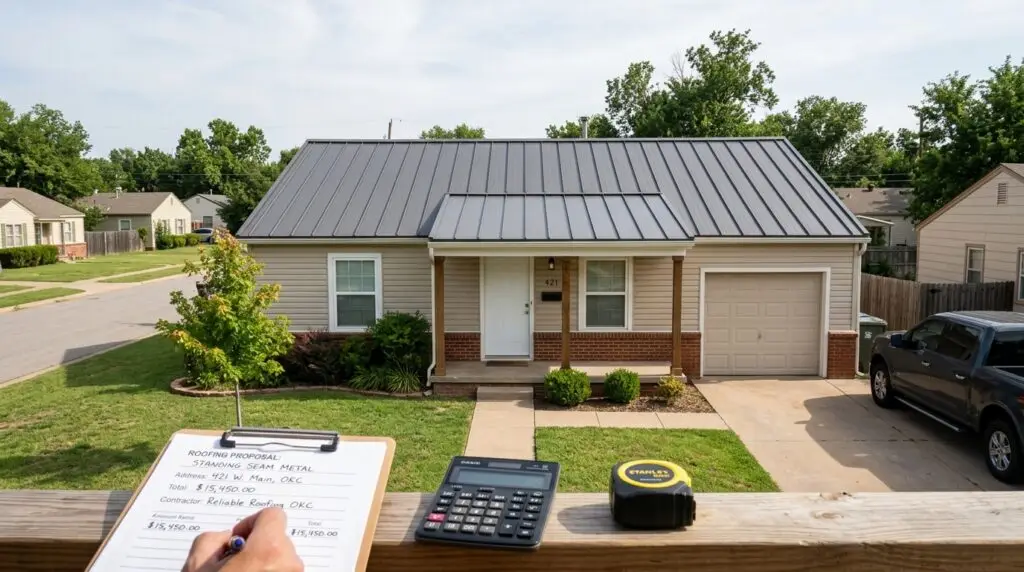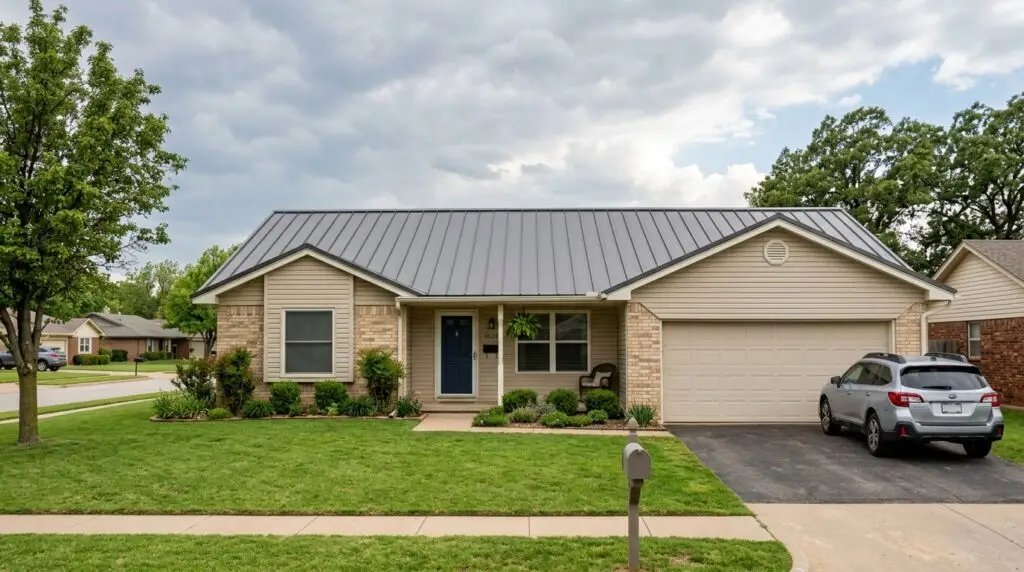
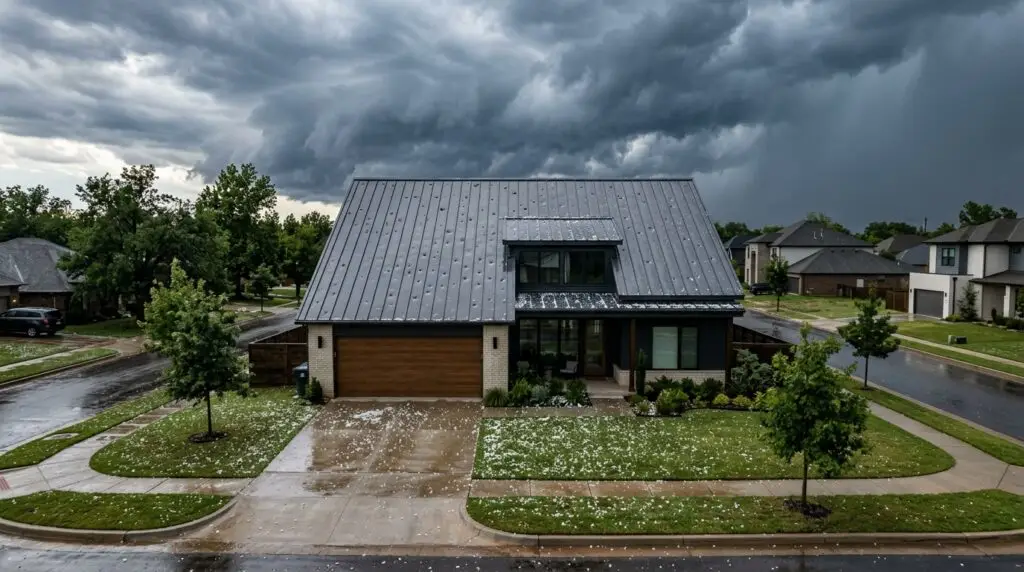
If you own a metal roof in Oklahoma City and you’ve just lived through a hailstorm, you’re probably asking one question: will my insurance cover this? It’s a fair question and the honest answer is: it depends on several factors that most homeowners don’t fully understand until they’re already in the middle of a claim.
Here’s the thing metal roofs handle storm damage very differently than asphalt shingles. They don’t crack, they don’t lose granules, and in the majority of OKC hail events, they keep performing exactly as designed. But that doesn’t mean there’s no damage to document, and it absolutely doesn’t mean your insurance process will be simple. In fact, because most insurance adjusters are trained to assess asphalt systems, metal roof claims come with a unique set of complications that can cost you real money if you’re not prepared.
This guide walks you through exactly how insurance handles metal roof storm damage from what’s covered to what’s not, how to protect your claim, and what decisions to make when the adjuster shows up at your door.
Why Metal Roofs and Insurance Work Differently Than Most Homeowners Expect
Most homeowners assume that if there was a storm and their roof took a hit, insurance will step in and cover the cost. With asphalt shingles, the damage pattern is familiar cracked shingles, granule loss, bruising and most adjusters can spot it quickly. Metal roofing systems don’t follow that same pattern.
What Makes Metal Roofing Claims Unique in Oklahoma City
Metal panels flex, shed hail, and resist penetration far better than asphalt. That’s a genuine performance advantage. But it creates a specific challenge during the insurance claim process: the damage that does occur isn’t obvious to the untrained eye. Compromised seams, loosened fasteners, displaced flashing around chimneys or plumbing vents these are the real failure points on a metal system, and they require system-specific knowledge to identify correctly.
Oklahoma City sits in a particularly intense storm corridor. Hailstorms here frequently combine hail with strong, shifting winds, which means impacts don’t always strike straight down. That matters because it changes where damage concentrates on a metal panel and where an adjuster using a standard checklist is likely to look.
The One Thing Adjusters Trained on Asphalt Often Get Wrong
In our experience, the biggest issue with metal roof insurance claims in OKC isn’t coverage it’s assessment. Adjusters working compressed post-storm schedules after a major event may not know what to look for on a standing seam or exposed fastener metal system. They look for the signs they know: granule loss, cracking, bruising. None of those apply to metal.
That’s why having a metal roofing contractor present during the adjuster’s inspection isn’t optional. It’s one of the most protective steps you can take.
What Oklahoma City Homeowners Insurance Typically Covers After Metal Roof Storm Damage
Most standard homeowners insurance policies in Oklahoma cover sudden, storm-related damage to your roof. Here’s how that applies specifically to metal roofing.
Covered Perils: Hail, High Wind, Tornado, and Wind-Driven Debris
Hail impacts, straight-line winds, tornado activity, and debris strikes from storm events are all typically covered perils under Oklahoma homeowners policies. For metal roofing, this means insurance can cover damage to panels, fasteners, ridge caps, flashings, gutters, and in cases where storm damage causes water intrusion, the resulting interior damage.
The Oklahoma Insurance Department confirms that wind and hail are covered perils under standard policies but coverage limitations, deductible structures, and exclusion riders vary significantly between insurers. Reviewing your specific declarations page is essential, not optional.
Secondary Coverage: Interior Water Damage After a Storm Opening
If storm damage creates an opening a compromised seam, a displaced flashing and water enters the home as a result, most policies will cover that interior damage as a secondary consequence of the covered peril. The key word is “sudden.” The leak must trace directly to the storm event, not to prior deferred maintenance.
What Is NOT Covered and Why It Trips Up OKC Homeowners
Insurance does not cover damage that develops gradually. Rust progression from a previously scratched coating, seam separation caused by years of thermal cycling without maintenance, or pre-existing installation defects are all outside the scope of a storm damage claim. Insurance carriers look for physical evidence that damage occurred during a specific identifiable storm event. If they can’t establish that connection through documentation, the claim is at risk.
| Oklahoma City Local Note
Because OKC experiences multiple hail events per season, insurance carriers here apply tighter scrutiny to documentation particularly when a roof has been through several storm seasons without prior claims. High claim volume in this market does not mean claim approval is automatic. |
The Cosmetic vs. Functional Damage Distinction Oklahoma’s Most Misunderstood Insurance Issue
This is where most metal roof insurance claims in Oklahoma City get complicated and where most homeowners lose money without realizing it. Understanding the difference between cosmetic and functional damage isn’t just helpful. It may be the difference between a full payout and a denied claim.
What Counts as Cosmetic Damage on a Metal Roof
Cosmetic damage includes dents, dings, and surface coating scuffs that don’t affect the roof’s ability to shed water or maintain panel attachment. The roof looks worse. It doesn’t perform worse. After a hailstorm where stones ranged roughly 0.75 to 1.75 inches in diameter a common OKC scenario cosmetic denting on metal panels is frequently the primary outcome. The Roofing Industry Committee on Weather Issues (RICOWI) conducted an investigation following an Oklahoma City hailstorm and found that metal roofing in that size range sustained almost exclusively cosmetic damage, with no structural compromise.
What Counts as Functional Damage and Why It Matters for Your Claim
Functional damage means the storm affected how the roof performs. This includes loosened or pulled fasteners, distorted seams that allow water infiltration, displaced or cracked flashing at penetration points, or panel movement that alters drainage flow. This is the threshold most Oklahoma insurers use when evaluating whether a metal roof claim qualifies for coverage. Functional damage increases the risk of leaks. It should be documented and addressed promptly.
The Cosmetic Damage Waiver: What Oklahoma Homeowners Should Know Before Signing
Here’s something most homeowners in OKC don’t realize until it’s too late: some insurance carriers ask homeowners to sign a cosmetic damage waiver as a condition of policy issuance or renewal. By signing, you may receive a modest premium reduction. By signing, you also surrender your right to claim for denting and surface damage that represents the majority of metal roof hail outcomes in this market.
Given Oklahoma City’s storm frequency and hail intensity, most homeowners with metal roofing are better served by retaining full cosmetic coverage even at slightly higher premium cost. Read that waiver carefully before you sign anything.
Understanding Your Policy Before You File ACV vs. RCV and Oklahoma’s Wind/Hail Deductibles
Before a storm ever touches your roof, the most valuable thing you can do is understand exactly what kind of policy you hold. Two policy features will determine how much money you actually receive after a metal roof storm damage claim.
Actual Cash Value (ACV) vs. Replacement Cost Value (RCV) Which One Do You Have?
An Actual Cash Value policy pays the depreciated value of your roof at the time of the claim. A Replacement Cost Value policy pays what it actually costs to replace the roof with comparable materials. The difference on a metal roof claim can be substantial.
Here’s a practical consideration: metal roofs carry long service lifespans often 40 to 50 years when properly installed. That means a well-maintained metal roof holds more value over time than asphalt, and depreciation on an RCV policy is calculated accordingly. Homeowners with older metal roofs may find their ACV payout significantly lower than anticipated. If you’re not sure which policy you hold, check your declarations page or call your agent before storm season not after.
Oklahoma’s Wind and Hail Deductibles Are Different From Your Standard Deductible
Oklahoma is classified as a high-risk hail market. As a result, many OKC homeowners carry a separate wind and hail deductible that is expressed as a percentage of their dwelling coverage limit not a fixed dollar amount. A 1% wind/hail deductible on a $400,000 home is a $4,000 out-of-pocket cost before insurance pays anything. Most homeowners discover this for the first time when they file a claim.
Check your policy’s declarations page specifically for a wind/hail deductible line item. It may be listed separately from your standard deductible.
How Roof Age Affects Your Payout on a Metal Roof Claim
The age and condition of your roof at the time of the storm affects how adjusters calculate payout. Newer roofs on RCV policies face less depreciation. Older roofs even well-maintained ones may see depreciation applied under ACV terms. One advantage of metal: when maintained correctly, it doesn’t degrade the way asphalt does, which can support a stronger condition argument during claims review.
The OKC Storm Damage Claim Process Step by Step for Metal Roof Owners
The claim process after a metal roof storm event in Oklahoma City follows a predictable sequence but how you manage each step determines how well it ends.
Step 1 Document Everything from the Ground Up Before Anyone Touches the Roof
Immediately after the storm, document from the ground. Don’t climb onto the roof. Instead, photograph gutters, downspouts, A/C condensing unit fins, window frames, metal vents, and any other soft metal surfaces on the property. These show hail impact clearly and serve as corroborating evidence that a damaging hail event occurred at your specific address. Time-stamp every photo and video. Log the date of the storm.
Step 2 Schedule a Metal-Specific Inspection Before the Adjuster Arrives
Scheduling a professional inspection from a contractor with genuine metal roofing experience before the adjuster’s visit gives you a documented scope of damage to compare against the adjuster’s findings. This is not about pressure it’s about accuracy. Metal roof damage assessment requires knowledge of panel systems, seam types, fastener patterns, and coating integrity. A contractor-prepared damage report gives you a factual baseline.
Most Oklahoma policies allow up to 12 months from the date of the storm to file a claim. But waiting weakens your documentation. The sooner you schedule an inspection, the cleaner the evidence.
Step 3 Have Your Contractor Present During the Adjuster’s Visit
This one step protects your claim more than almost anything else. When your contractor is present during the adjuster’s inspection, they can point out compromised seams, fastener issues, and flashing damage that a generalist adjuster might walk right past. Oklahoma adjusters working post-storm surge schedules after a major OKC event are often moving quickly having a knowledgeable advocate at the inspection ensures nothing gets missed.
Step 4 Review the Statement of Loss Before Accepting Any Payout
The Statement of Loss is the insurer’s documented calculation of what they owe you. On metal roofing claims, the initial figure often underestimates repair scope particularly for flashing replacement, specialized coatings, and labor associated with metal systems. Compare it carefully against your contractor’s scope report. Supplemental claims for items not captured in the initial assessment are a legitimate part of the process.
What OKC Adjusters Look For on a Metal Roof and What They Often Miss
High-Priority Inspection Points on Metal Roofing Systems
A thorough post-storm inspection of a metal roofing system should cover the following areas specifically:
- Panel seams check for distortion, separation, or sealant failure
- Fastener condition look for pullout, over-compression, or loosening
- Ridge caps and hip caps highest exposure points; frequently first to show damage
- Flashing at all penetrations chimneys, plumbing vents, skylights, HVAC curbs
- Coating integrity bare steel exposed by impact will oxidize in OKC’s humidity within months
- Panel edges and drip edges often impacted by wind-driven debris
Why Flashing, Seams, and Fasteners Matter More Than Panel Dents
Between you and me most OKC homeowners focus on the visible dents on their metal panels after a hailstorm. That’s understandable. But in our experience, dents are rarely where the functional damage lies. It’s the flashing at the chimney base, the seam that took an angled hit during wind-driven hail, and the fastener that was torqued by the impact those are the failure points that lead to water intrusion months later.
Punctures are rare on properly installed 24-gauge steel. Denting is the realistic outcome of most OKC hail events. But coating breach at impact sites that is left unaddressed allows surface oxidation to develop and bare steel in Oklahoma’s humidity will begin to corrode if coating damage isn’t touched up after storm exposure.
Oklahoma City Storm Insurance Mistakes That Cost Homeowners Real Money
Waiting Too Long to Document or File
OKC sees multiple significant storm events per season. The longer you wait to document damage, the harder it becomes to tie specific damage to a specific storm. Your insurer needs to establish causation. Delayed documentation weakens that case significantly.
Signing a Cosmetic Damage Waiver Without Understanding It
This may be the single most costly mistake metal roof owners in Oklahoma make. If you signed a cosmetic damage waiver and didn’t fully understand what coverage you were giving up, review your current policy now before the next storm.
Hiring Out-of-State Storm Chasers After an OKC Event
After a major OKC hailstorm, out-of-state roofing crews arrive quickly. Some do good work. Many don’t know Oklahoma building codes, local HOA requirements, or how Oklahoma insurance adjusters evaluate metal roof claims. Use a contractor with a permanent, established local presence who will still be reachable when issues arise six months later.
Accepting the First Payout Without a Contractor Review
The first offer from your insurer is based on the adjuster’s assessment which, on a metal system, may have missed key damage points. Always compare the Statement of Loss against a contractor-prepared scope before accepting. Supplemental claims are standard in OKC’s insurance environment and are a legitimate part of getting your roof fully covered.
Should You Use Insurance or Pay Out of Pocket for Metal Roof Storm Damage?
Not every storm event warrants a claim. It depends on several factors and being strategic here protects your long-term insurance position.
When Filing a Claim Makes Clear Financial Sense
File when the estimated repair or replacement cost significantly exceeds your deductible, when damage is functional rather than cosmetic, and when there’s clear documented evidence of storm causation. In OKC’s hail environment, these conditions arise regularly for metal roof owners.
When It Might Be Better NOT to File
If the damage is minor and repair cost approaches or falls below your deductible, filing may not make sense. Similarly, if you’ve filed multiple claims recently, adding another can affect your renewal terms. Get a professional inspection to understand the actual scope before making that call don’t guess.
The Premium Impact Question Will Filing Raise My OKC Homeowners Rate?
In Oklahoma, hail and wind events are classified as Acts of God. Filing a storm-related claim typically does not trigger a premium increase in the same way an at-fault claim would. That said, multiple claims within a short period can influence how your insurer views your renewal. Your specific policy language and carrier practices determine the actual outcome ask your agent directly.
Using an Insurance-Covered Replacement to Upgrade to a Class 4 Metal Roof
Most homeowners don’t realize this, but an insurance-funded roof replacement is the best possible moment to upgrade roofing materials. Here’s why that matters specifically in Oklahoma City.
What Class 4 Impact Resistance Means for OKC Homeowners
The UL 2218 Class 4 rating is the highest impact-resistance classification available for roofing materials. Metal roofing panels that meet this standard have been tested to withstand simulated large hail impacts without functional damage. Unlike asphalt shingles, which lose impact resistance as they age, a Class 4-rated metal roof performs the same on installation day as it does two decades later.
In OKC’s hail corridor which extends through Edmond, Moore, Yukon, Midwest City, and Norman that long-term consistency is a meaningful advantage. Many Oklahoma insurance carriers recognize Class 4 impact ratings and offer premium reductions to homeowners who install qualifying materials.
Can Upgrading to Metal During a Claim Save You Money on Premiums?
Insurance pays for like-for-like replacement what you had before the storm. If you had asphalt shingles and they’re being replaced under a claim, insurance covers the asphalt equivalent. If you want to upgrade to a Class 4-rated metal system, you cover the cost difference. Given that labor and tear-off are already covered under the claim, the incremental out-of-pocket cost for the upgrade is often smaller than homeowners expect and the long-term ROI in an Oklahoma storm environment is genuinely compelling.
How to Find a Qualified Metal Roofing Contractor for an OKC Insurance Claim
The contractor you choose for a metal roof insurance claim isn’t just a vendor they’re your technical advocate throughout the process. Choosing the wrong one costs you.
Look for a contractor with a permanent local presence in the Oklahoma City metro, demonstrated specific experience with metal roofing systems (not just general residential roofing), and a willingness to be present during the adjuster’s inspection. Ask directly whether they have experience preparing damage scope reports for metal systems specifically.
Red flags to watch for: out-of-state license plates arriving the day after a storm, door-to-door pressure tactics, and any contractor offering to “waive your deductible” that practice is illegal in Oklahoma and is a strong indicator of fraud risk.
We serve homeowners throughout the Oklahoma City metro, including Edmond, Moore, Yukon, Midwest City, Norman, Mustang, and Choctaw. If you’ve recently experienced storm damage to a metal roof in this area, a professional inspection is the right first step before making any insurance decisions.
Frequently Asked Questions
| Q: Does homeowners insurance cover metal roof hail damage in Oklahoma City?
A: Most Oklahoma homeowners insurance policies cover metal roof hail damage when it causes functional damage meaning damage that affects the roof’s ability to keep water out. Cosmetic denting without functional impact may be excluded if a cosmetic damage waiver was signed at policy issuance. Always review your policy’s declarations page before filing a claim. |
| Q: What is the difference between cosmetic and functional damage on a metal roof?
A: Cosmetic damage includes dents or surface marks that don’t affect waterproofing or panel attachment. Functional damage includes compromised seams, displaced flashing, loosened fasteners, or any condition allowing water intrusion. Functional damage is the threshold most Oklahoma insurers use to approve a claim. |
| Q: How long do I have to file a metal roof storm damage claim in Oklahoma?
A: Most Oklahoma homeowners insurance policies allow up to 12 months from the storm date to file a claim. However, the sooner you document and report damage, the stronger your claim evidence. Check your specific policy for the exact filing deadline. |
| Q: Will filing a hail damage claim raise my homeowners insurance premium in OKC?
A: Hail and wind events are classified as Acts of God in Oklahoma. Filing a storm-related claim typically does not automatically increase your premium. However, multiple claims within a short period can affect your renewal terms. Your specific insurer’s practices determine the actual outcome. |
| Q: Should I get a roofing inspection before or after calling my insurance company?
A: Getting a professional metal roof inspection before calling your insurer helps you understand the damage scope whether it’s cosmetic or functional before the adjuster arrives. A contractor-prepared damage report often strengthens your claim and reduces the risk of underpayment. |
| Q: Does insurance cover upgrading from asphalt to metal roofing after storm damage?
A: Insurance pays for like-for-like replacement. If you had asphalt shingles, insurance covers the equivalent asphalt value. If you upgrade to metal, you cover the cost difference. With labor and tear-off already covered by the claim, many OKC homeowners find the upgrade cost manageable and worthwhile. |
| Q: What should I look for after a hailstorm on a metal roof in Oklahoma City?
A: From the ground, check gutters, vents, A/C caps, and other soft metal surfaces for hail strike evidence. Inside, inspect the attic for water staining. Professionally, the critical inspection points are seam integrity, fastener condition, flashing at all penetrations, and any coating breach at impact sites that could allow oxidation. |
Related Resources
→ [Metal Roof Installation Oklahoma City] Service Page: New Installation
→ [Metal Roof Storm Damage Inspection] Service Page: Inspections & Assessments
→ [Metal Roof Repair OKC Metro] Service Page: Storm Damage Repair
→ [Metal Roof Cost Guide for Oklahoma City Homeowners] Blog: Pricing & ROI
→ [Service Areas OKC, Edmond, Moore, Yukon, Midwest City, Norman] Service Area Page