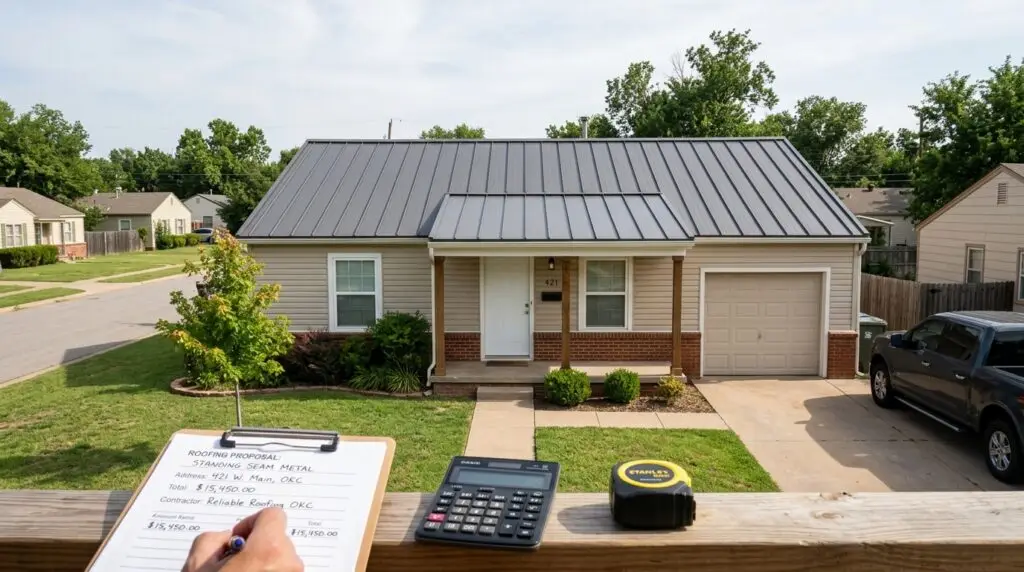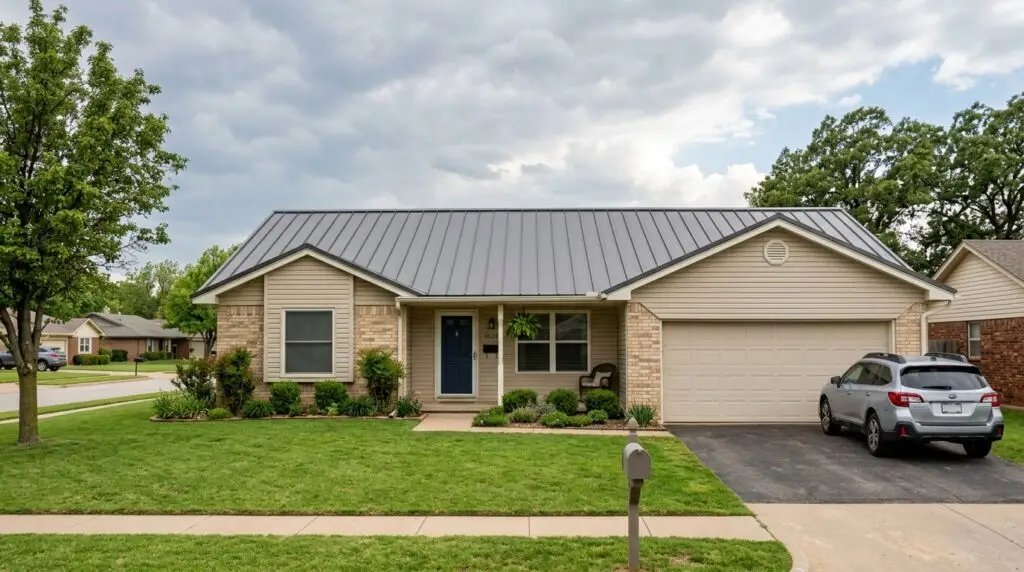

A metal roof is a forty to seventy year decision that gets made in about a week. You sign a contract, a crew shows up, and by Friday the thing that protects your house is finished. The panels almost never fail first. The installation does.
That is the part most homeowners do not think about until something leaks.
Here in Oklahoma City, the stakes climb higher. We sit in Hail Alley, and every spring storm season sends a wave of crews through the metro looking for claims. Homeowners end up making a decades long choice under pressure, with a clipboard in their face and a storm still fresh in their mind. So let’s slow it down. This guide covers how to choose the right roofing contractor, how to tell a real metal crew from a shingle crew with a sheet metal brake in the trailer, and how to compare three bids that look nothing alike.
How to Choose the Right Roofing Contractor: The Short Answer
To choose the right roofing contractor, verify state registration along with current general liability and workers’ compensation coverage, confirm a permanent local address, require metal specific experience backed by photos and references, collect at least three itemized written bids, compare materials and warranties line by line, and never pay for the whole job up front.
That is the compressed version. Here is the shortlist we would use ourselves:
- Registered and insured. Current Oklahoma registration, general liability, workers’ compensation, verified by you rather than claimed by them.
- Locally rooted. A permanent address in the metro and a history here, not a storm season pop up.
- Metal specific. Installs metal every week, not once in a while, and can name the panel profile, gauge, clip system, and coating without hesitating.
- Documented. An itemized proposal covering scope, materials, timeline, and payment schedule.
- Warranty clear. Separate workmanship and manufacturer warranties, both in writing.
- Permit forward. Pulls the permit in their own name and welcomes the city inspection.
- Reachable later. Answers the phone when you call about one loose panel in year eight.
Start With Credentials: Registration, Insurance, and Permits in Oklahoma
This part is boring and it is also where most bad outcomes get prevented.
Registration you can actually verify
Oklahoma requires roofing contractors to register with the Construction Industries Board. Ask for the registration number and check it yourself. A laminated card in a truck console and a decal on a tailgate prove nothing. Any legitimate contractor will hand over the number without a speech.
The two policies that protect your house
General liability covers damage to your property. Workers’ compensation covers a crew member who gets hurt on your roof, which keeps that injury from turning into a claim against your homeowners policy. Most homeowners don’t realize how exposed they are on that second one.
Here is the practical move: ask for the certificate of insurance, then call the agent listed on it and confirm the policy is active through your install dates. Coverage that lapsed in March does you no good in June.
Who is actually going to be on your roof
Ask whether the crew is in house or subcontracted, whether the subs carry their own coverage, and who supervises the job every day. Subcontracting is not automatically a problem. Unsupervised subcontracting is. In our experience, the jobs that go sideways are the ones where nobody with authority set foot on the property between the sales call and the final invoice.
Permits and inspections
The contractor should pull the permit under their name. If someone asks you to pull it instead, that shifts the liability onto you, and it usually means they would rather not put their registration in front of a building department. Requirements differ across Oklahoma City, Edmond, Norman, Moore, and Yukon. A local contractor already knows each office. An out of town crew learns on your house.
One line that saves headaches
Request a lien waiver when you make final payment. It keeps a supplier or subcontractor from filing a mechanic’s lien against your home over a bill the contractor never paid.
Metal Is Its Own Trade: How to Spot a Real Metal Roofing Contractor
Here’s the thing. Metal roofing is sheet metal work. Seams, clips, expansion allowance, fabricated flashing, panel gauge, coating systems. Shingle roofing is a different skill set with different failure points. Plenty of companies in the metro will happily quote a metal roof and then send a crew that has installed maybe three of them.
You can find that out in one phone call.
Questions only a metal installer answers well
- Which profile do you recommend for my roof, standing seam or exposed fastener, and why?
- What gauge are you quoting, and what does that change over time?
- Concealed clips or through fasteners, and how does your system allow for thermal movement?
- What coating are you using, PVDF or SMP, and what does the finish warranty cover?
- Do you fabricate flashing on site? Walk me through your detail at valleys, sidewalls, ridges, and pipe penetrations.
- What underlayment goes down, and is it rated for the heat under metal?
A real metal contractor enjoys these questions. That is the tell.
Answers that should stop you cold
Vague material talk like “good heavy metal” with no profile name and no gauge. Screws driven through the flats of a standing seam panel. Sealant used where formed flashing belongs. Plans to reuse the old drip edge and flashing. Any of those, get another bid.
Ask to see metal work, not just roofs
Request close up photos of finished metal jobs. Valleys, sidewall transitions, ridge details, headwall terminations. Not drone shots of a shiny roof from three hundred feet, because a bad install looks great from up there. Then ask for two or three addresses in the metro you can drive past. Sloppy flashing is visible from the street, and you do not need a trained eye to see wavy trim and mismatched hems.
Manufacturer relationships
Ask which manufacturers they buy from and whether they hold current installer certification for that system. Then verify it with the manufacturer. Certifications expire, and some are quietly dropped. This is a two minute check that filters out a lot of noise.
Tear off or install over the old roof
Some crews will lay metal over existing shingles to win on price. Sometimes that is defensible. Often it is not, because nobody looks at the decking underneath. On older homes around the metro we regularly find soft or delaminated sheathing and fasteners that never hit a rafter. A full tear off with a deck inspection and re nailing costs more on paper and less over the life of the roof. If your current roof is already showing trouble, our guide on how to tell if your roof is failing walks through what to look for before you get bids.
Storm Season Reality: What to Do When Someone Knocks on Your Door
Peak hail and straight line wind risk around the OKC metro runs from roughly March into May, with a smaller window in the fall. Within days of a significant event, crews canvass neighborhoods hard. Many are legitimate. Some are out of state operations that sign as many contracts as possible, work fast, and are gone before the first warranty call comes in. The National Weather Service office in Norman is the reliable source for what actually happened and when, and the Oklahoma Insurance Department publishes guidance on claims and contractor scams.
Signals worth noticing
Out of area phone numbers and plates. No permanent address in the metro. Magnetic signs on the truck doors. “We are only in the area this week.” Pressure to sign something on your porch right now. An offer to handle everything with your insurance company. Any offer to absorb, discount, or waive your deductible, which is a serious problem and not a favor.
The form that is not an estimate
Between you and me, this is the one that catches good people. Many door to door forms are not estimates at all. They are contingency contracts that assign the job to that company if your claim gets approved. Read for the word authorize. Then set the clipboard down and tell them you will call after you have had a roof inspection. Nobody legitimate objects to that.
What a clean post storm process looks like
An independent inspection with photo documentation. A written scope that matches the actual damage. The contractor meeting your adjuster on site. Pricing that holds up whether insurance pays or not. Our storm damage services start with documentation for exactly this reason.
An honest note about hail and metal
Most hail marks on metal are cosmetic. Denting looks alarming and often changes nothing about performance. What matters is fractured coating, actual punctures, split sealant, and compressed fastener washers. A contractor pushing a full insurance funded replacement over dents alone, with no evidence of any of that, is selling a claim rather than diagnosing a roof. The repair versus replacement decision deserves real analysis, which we cover in when roof repair is better than replacement.
Reading the Estimate: Compare Roofing Bids Line by Line
Everyone says get three estimates. Almost nobody explains how to compare them. Three bids only help when all three are itemized, and a one page proposal that says “metal roof” with a single number cannot be compared to anything. That is usually the point.
Here is where bids actually diverge:
| Line item | What to look for | Why prices split here |
|---|---|---|
| Panel system | Profile, gauge, coating, named manufacturer | Thinner gauge or an economy coating swings the total by thousands |
| Fastening method | Clip type, fastener spec, expansion allowance | Through fastened jobs bid cheaper and age faster |
| Tear off and decking | Layers removed, deck inspection, re nailing, allowance for bad sheathing | The most common hidden cost gap between two bids |
| Underlayment | Type, high temp rating, ice and water at valleys and eaves | Quietly downgraded or left out entirely |
| Flashing and trim | New or reused, fabricated or stock, kick out included | Reused flashing is a leak with a delayed start date |
| Penetrations | New pipe boots, vents, skylight and chimney details | Excluded up front, then billed as a change order |
| Ventilation | Ridge exhaust, soffit intake, airflow assessment | Skipped by cheap bids, then shows up as attic condensation |
| Cleanup and protection | Magnet sweeps, landscaping and gutter protection, dumpster placement | Where “we are cheaper” often hides |
| Warranties | Workmanship term, manufacturer finish and substrate coverage, transferability | The clearest quality signal in the whole document |
| Payment schedule | Deposit size, milestones, final payment at completion | Big up front demands point to cash flow problems |
What Actually Changes the Price of a Metal Roof in Oklahoma City
It depends on several factors, and the honest ones are easy to name: roof size and pitch, the number of valleys, dormers, and sidewall transitions, panel profile and gauge, coating system, how many layers come off, the condition of the decking underneath, height and access, skylights and chimneys, gutter and trim work, and whether the roof carries solar now or later.
Why the cheapest bid is cheap
There is almost always a reason, and it is usually a substitution rather than efficiency. Lighter gauge. Economy coating. Exposed fasteners instead of concealed clips. Reused flashing. Stock trim where fabricated detail belongs. Thinner underlayment. No ventilation work. No allowance for bad decking, which becomes a change order the morning they find it.
Deposits and financing
A modest deposit is normal. Paying most of the job before material shows up on your driveway is not. Financing availability can be a decent sign, since lenders vet contractors before approving them, but read the actual terms instead of the monthly payment.
The trick that gets you a real answer
Hand the low bid to the higher bidder and ask what is missing from it. Then hand the high bid to the low bidder and ask what they excluded. Those two conversations tell you more than either price does.
Warranties: The Four Coverages Homeowners Mix Up
Asking “what is the warranty” gets you a number and no information. There are four separate things worth understanding.
Finish coverage addresses fade, chalking, and peeling paint. Substrate coverage addresses rust and perforation of the metal itself. Those are two different documents with two different terms.
Workmanship coverage is the one that matters most, because installation error causes the majority of leaks we get called out to fix. Ask for the term in years, what it excludes, whether it transfers when you sell, and what happens if the company closes its doors.
Weathertightness coverage shows up mostly on commercial standing seam projects. On a typical Oklahoma City home it usually is not on the table, so do not let anyone confuse you by waving it around.
Also ask what voids everything. Foot traffic, satellite or solar mounts drilled by another trade, incompatible sealants, dissimilar metals in contact, pressure washing, and skipped maintenance all show up on that list. If you are considering panels, read are metal roofs good for solar panels before anyone drills your roof. A warranty is only as strong as the company behind it, which is why local roots and staying power beat a longer number on paper.
Mistakes We See Homeowners Make
- Choosing on price alone, or on whoever was friendliest at the kitchen table.
- Signing anything at the front door during storm season.
- Letting a contractor skip the permit to save a few days.
- Accepting a verbal scope attached to a written price.
- Paying a large deposit, or paying in full before the final inspection passes.
- Hiring a shingle only crew for a metal roof because they quoted fastest.
- Reading only the five star reviews. Read the one and two star reviews instead, and watch how the company responded when something went wrong.
- Never asking who supervises the job or how to reach that person during the week.
- Letting a solar or satellite installer drill panels without a proper flashing detail, then losing warranty coverage.
- Skipping dated photos of the roof and property before work starts.
What the Right Contractor Does After the Crew Leaves
Choosing a contractor is also choosing who services this roof for the next couple of decades.
A well run install, day to day
Clear start and stop times. Landscaping and AC units protected. Gutters guarded. Material staged instead of dumped. A weather contingency plan, which matters here in April. Magnet sweeps every evening. A walkthrough with photos of concealed details before panels cover them for good.
The closeout package to insist on
Permit and final inspection record. Warranty documents. Panel and coating specifications. Color and batch information, which you will want in year twelve when one panel needs replacing. Photo documentation of flashing and penetrations. Paid invoice with the lien waiver.
Maintenance in this climate
Get an inspection after hail and high wind events. On exposed fastener systems, plan on fastener and sealant attention somewhere in the ten to twenty year window, sooner on the south and west slopes that take the worst sun. Keep valleys and chimney backs clear of debris. Keep gutters flowing. A metal roof inspection once a year catches the small stuff, and small stuff is all that most metal roof repair work needs to be.
Service response is a selection criterion
Ask this directly: if I call in year eight about one loose panel, who comes out and what does it cost? The answer separates a roofing company from a sales operation.
Homes Across the OKC Metro and What They Demand From a Contractor
- 1950s through 1970s ranch homes in Del City, Midwest City, Bethany, and older south Oklahoma City. Simple gable roofs, thinner original decking, sometimes a retrofit layer or two already up there, and aging plumbing boots. These need a contractor who inspects and re nails the deck instead of laying panels over history.
- Mature tree neighborhoods near Nichols Hills and central OKC. Valleys and chimney backs pack with debris, so fabricated valley detail and an honest maintenance conversation matter more than the panel price.
- Newer builds in Edmond, Yukon, Mustang, and Norman. Complex rooflines with more valleys, dormers, and sidewall transitions. Flashing skill decides these roofs, and newer additions on the west side of the metro catch open wind fetch.
- Porches, patio covers, and low slope additions. The most commonly botched metal work around here. Ask specifically how the contractor handles low slope transitions and panel terminations.
- Historic districts and HOA neighborhoods. Color, profile, and reflectivity approvals take time. A local contractor knows the process. A crew from three states away does not.
We work across the metro, and you can see the full list on our service areas page.
Your Vetting Checklist and When to Get Estimates
Run this on every phone call:
- Registration number
- Certificates of insurance, general liability and workers’ compensation
- Permanent local address
- Years operating in the metro
- How much metal work they do, in jobs per month
- Panel profile and gauge being quoted
- Coating and finish warranty
- Workmanship warranty term and transferability
- Who pulls the permit
- In house crew or subcontracted, and who supervises
- Payment schedule
- Service response policy after the warranty period starts
On timing: get bids before storm season rather than during it. Calendars are open, pricing is calmer, and you can take a week to think without a salesperson calling twice a day. If a storm already hit, get an independent inspection before you sign a single form.
That is how to choose the right roofing contractor without gambling on the biggest exterior investment your house will see. If you want a straight assessment of your roof and an itemized estimate you can actually compare against others, we handle metal roof installation throughout Oklahoma City and the surrounding metro, including Edmond, Moore, Norman, Yukon, and Mustang.
Frequently Asked Questions
How do I choose the right roofing contractor?
Verify state registration, general liability, and workers’ compensation yourself. Confirm a permanent local address. Require metal specific experience with close up photos and local references. Get three itemized bids, compare them line by line, and check both the workmanship and manufacturer warranties in writing.
How do I check if a roofing contractor is licensed and insured in Oklahoma?
Ask for their Construction Industries Board registration number and verify it through the state. For insurance, request the certificate of insurance and call the agent listed on it to confirm the policy is active through your installation dates.
Can a shingle roofing company install a metal roof?
Some can, many cannot do it well. Metal is sheet metal work with seams, clips, thermal movement, and fabricated flashing. Ask about panel profile, gauge, clip system, and coating. Vague answers to those questions tell you what you need to know.
Why is one metal roof quote thousands cheaper than another?
Usually because of substitutions rather than efficiency. Lighter gauge, cheaper coating, exposed fasteners instead of concealed clips, reused flashing, thinner underlayment, no ventilation work, and no allowance for replacing bad decking.
Is it a red flag if a roofer knocks on my door after a hailstorm?
Not automatically, but treat it carefully. Walk away from out of area plates, magnetic truck signs, pressure to sign immediately, promises to handle your whole insurance claim, and any offer to cover your deductible. Get an independent inspection first.
Should a roofing contractor ask for money up front?
A modest deposit is normal, especially for custom color or special order panels. Paying most of the project before materials arrive is not. Tie payments to milestones and hold the final payment until the city inspection passes.
Who pulls the permit for a roof replacement?
Your contractor should, in their own name. If they ask you to pull it, the liability shifts to you. Permit and inspection requirements vary between Oklahoma City, Edmond, Norman, Moore, and Yukon, and a local contractor already knows each one.