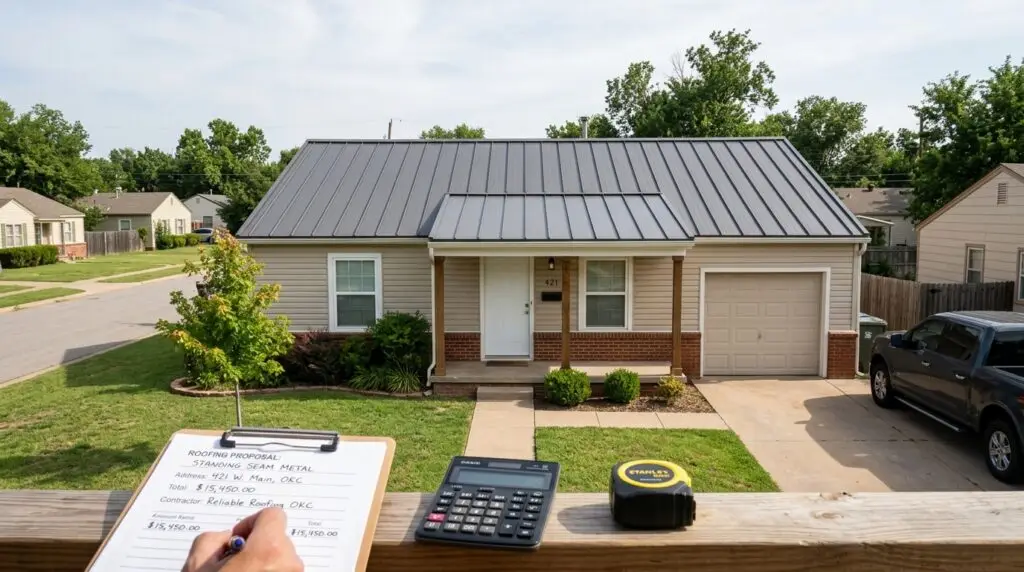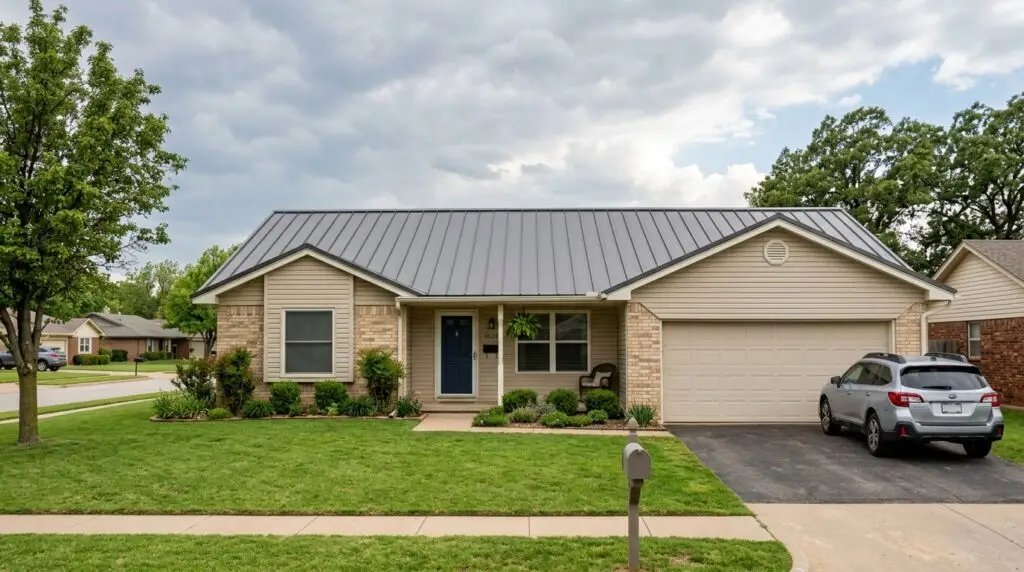
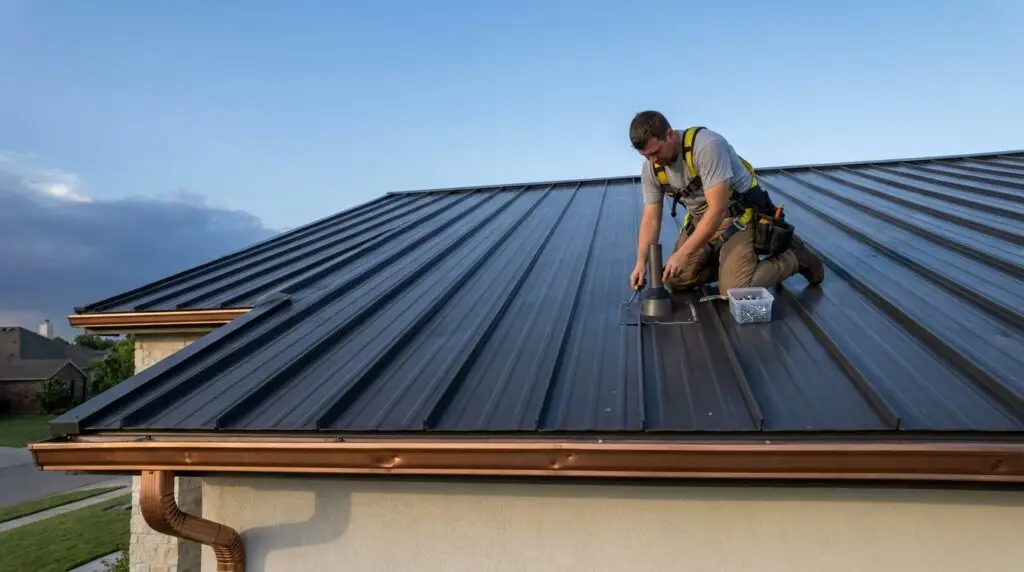
Roof repair is better than replacement when the damage stays in one area, the decking underneath is dry and solid, and the roof still has most of its service life ahead of it. On a metal roof in Oklahoma City, that usually means leaks at fasteners, flashing, seams, or a few dented panels. Not a failed system.
That one paragraph answers the question for most homeowners who land here after a storm. The rest of this guide shows you how to prove it for your own roof, what it costs, how insurance treats it in Oklahoma, and where the line sits between a smart repair and throwing good money at a roof that has already quit.
Here is the thing most homeowners do not realize: almost every article you will read on this topic was written about asphalt shingles. Metal is a different animal. A shingle roof at year eighteen is near the end. A metal roof at year eighteen is barely middle aged. That single difference flips the repair or replace decision more often than anything else.
Repair vs. Replace at a Glance
| What we look at | Points to repair | Points to replacement |
|---|---|---|
| Damage extent | One slope, countable panels | Multiple slopes, system wide |
| Age vs. lifespan | Plenty of years left | Near the end of the material’s life |
| Decking condition | Dry, firm, no sag | Soft spots, rot, visible sagging |
| Repair history | First or second fix | Repeated patches in new spots each time |
The 60 Second Answer: Repair If You Can Say Yes to These Four Questions
- Is the damage limited to a specific area you can point at?
- Is the attic dry, with no staining, soft decking, or wet insulation?
- Does the roof material still have a good stretch of life left?
- Is this the first or second real repair this roof has needed?
Four yes answers means repair, almost every time. Two or more no answers means you should at least price a replacement before you spend anything.
The Repair First Test: Five Points We Run Before Quoting Anything
We use the same five checks on every roof we walk in the Oklahoma City metro. Run them yourself and you will understand your estimate far better than most homeowners do.
- Extent. Is the damage on one slope, or can you count the affected panels on your hands? Contained damage is repairable damage.
- Location. Leaks at penetrations, seams, valleys, and flashing are detail problems. Leaks scattered across the open field of the roof are system problems.
- Substrate. Panels get all the attention, but the deck decides the outcome. Wet or spongy decking turns a small job into a big one.
- Remaining life. Ask how many years the roof realistically has left after the fix. If the honest answer is three, a repair is a stall. If it is twenty five, a repair is a bargain.
- Repair history. One fix is maintenance. A fourth fix in a fresh spot every year is a roof telling you something.
The Rule of Thumb Worth Knowing (And Its Limits)
Plenty of contractors use a simple guideline: once a repair approaches roughly a third of what a full replacement would cost, stop and rerun the numbers. It is a useful prompt. It is not a law, and anyone who treats it like one is being lazy.
A better way to think about it is cost per remaining year. Divide the price by the years of service you realistically buy. A repair that costs a fraction of a replacement but only holds for two years can be worse value than the replacement. A repair that costs the same amount and protects a roof with decades left is one of the best returns in home maintenance.
Why Repair Wins More Often on Metal Than on Shingles
Metal changes the math in three concrete ways.
Lifespan. A properly installed metal roof commonly serves 40 to 70 years, depending on the metal, the coating, and the gauge. Asphalt in Oklahoma heat and hail does well to reach 15 to 25. So the argument “your roof is old, replace it” carries a lot less weight on metal.
Modularity. Metal comes apart in pieces. Individual panels, ridge caps, closures, trim, and flashing can often be swapped without disturbing the rest of the roof. You cannot really do that with a shingle field once the mat gets brittle.
Failure pattern. Most metal roof leaks are detail failures, not material failures. Backed out screws. Worn neoprene washers. Sealant that has aged out at a pipe boot. A seam that separated at a transition. The steel itself is usually fine. Fix the detail, and the roof goes back to doing its job.
Standing Seam vs. Exposed Fastener Panels
Standing seam hides its fasteners under the seam, so there is far less to go wrong and far less to service. When something does fail, it is usually at a penetration or a piece of trim, and that is straightforward work for a crew that knows the system.
Exposed fastener panels put hundreds of screws through the face of the metal. Those screws are the maintenance item. They back out over time, and the rubber washers harden. The upside is that they are easy and cheap to service. The downside is that they need attention on a schedule instead of being ignored for thirty years.
Panel Matching: The Real Limit on Metal Roof Repair
In our experience, this is what actually pushes a repairable metal roof toward replacement, and hardly anyone writes about it.
Two issues come up. First, color fades. A fifteen year old panel and a brand new panel in the same color code will not look identical, especially on a slope facing the street. Second, profiles get discontinued. If the manufacturer no longer rolls your panel, a match may not exist at all.
We tell people the truth on this. If the repair is on a back slope nobody sees, a slight mismatch is a non issue and you save thousands. If it is the front elevation of the house and the difference will bother you every time you pull into the driveway, that is a legitimate reason to consider replacing a slope or the whole roof. It is your house and your eyes.
Oklahoma City Weather: How Hail, Wind, and Heat Decide the Call
Oklahoma City sits in the part of the country that gets hit the hardest by hail, and the severe season generally runs from March into June. If you live in Edmond, Moore, Norman, Yukon, Mustang, or Midwest City, you already know the drill.
What that means for the repair or replace decision:
- Hail. Smaller stones rarely cause functional damage to a solid metal roof. Larger stones can dent panels, crack coating, and beat up the soft metals, which is the bulk of our storm damage work every spring. Denting and leaking are two very different conditions.
- Wind. On metal, wind damage tends to show at the edges, the eaves, and the ridge, because that is where uplift pressure concentrates. Those are exactly the areas a crew can repair without touching the field of the roof.
- Heat. Oklahoma summers cycle metal through a lot of expansion and contraction. On exposed fastener systems, that gradually loosens screws. It is a maintenance repair, not a replacement trigger.
Cosmetic Dents vs. Functional Damage
This is the distinction that saves Oklahoma City homeowners the most money, and it causes the most arguments with adjusters.
A cosmetic dent changes how the panel looks. A functional failure changes how the roof performs: the coating is fractured, the panel is punctured, a seam has opened, or water is getting past a flashing. A dented panel with intact coating and no water intrusion is still doing its job. Replacing a roof over appearance is a choice, not a repair need, and you deserve to be told which one you are looking at.
After a Storm, Look at the Soft Metals First
Here is a trick we use before anyone climbs a ladder. Walk the perimeter and look at the gutters, downspouts, vent hoods, and drip edge. Those thin metals dent easily and honestly. They tell you how big the hail was and which direction it came from, which tells us which slopes to inspect closely. If the soft metals are clean, the odds of serious panel damage drop a long way.
Clear Signs Repair Is the Right Call
Every one of these is normally a repair on a metal roof, not a replacement:
- An isolated leak traced to a pipe boot, vent, skylight, or chimney flashing that our metal roof repair crew can address in a single visit
- Backed out or missing fasteners on a single slope
- Sealant failure at seams, closures, or transitions
- A limited number of dented or wind lifted panels with the coating intact and no perforation
- Damaged gutters, drip edge, or ridge cap with a dry attic underneath
- Surface scratches or small coating chips that can be treated before they corrode
If your estimate lists items like these and still recommends tearing the whole roof off, ask why in writing.
When Replacement Is the Honest Answer
We would rather lose a repair job than sell one that fails. There are roofs we walk where we tell the homeowner not to bother patching, and these are the reasons:
- Panels perforated in multiple places, or seams separating across more than one slope
- Coating failure across the whole roof rather than in spots
- Wet insulation, rotted decking, sagging deck lines, or interior staining that keeps coming back
- Corrosion that has gone through the substrate instead of sitting on the surface
- Three or more repairs in a short span, each one in a new location
- A system that was installed wrong from day one, with the wrong fasteners, missing underlayment, or a panel never suited to the pitch, which is a case for metal roof installation done correctly rather than another patch
That last one stings, because the roof may not be old at all. But repairing a bad installation just moves the leak. Between you and me, that is the situation where a homeowner is most likely to be sold three repairs before somebody finally tells them the truth.
What Repair Costs in Oklahoma City vs. a Full Replacement
It depends on several factors, and any contractor who quotes a metal roof over the phone is guessing. The real cost drivers are the type of repair, the pitch and height of the roof, how easy the panels are to access, whether the material can be matched, how much flashing work is involved, whether the decking is affected, and how busy the market is after a big storm.
In broad terms:
| Scope | Typical range | What you are buying |
|---|---|---|
| Detail repairs (fasteners, boots, sealant) | Low hundreds | Stops a specific leak, resets a maintenance item |
| Panel and flashing work | Low thousands | Replaces damaged sections, restores the weather barrier |
| Full replacement | Tens of thousands | A new system and a fresh service life |
Run the repeat repair math before you decide. Three or four patches on a roof that is genuinely failing quietly pay for the replacement you were trying to avoid, only you get no new roof at the end of it. One repair on a healthy roof is money well spent. Four repairs on a dying one is a payment plan for nothing.
Repair Now, Replace Later
There is a middle option almost nobody mentions. If a replacement is coming in a few years but the budget is not there today, you can stage it. Prioritize the work that keeps water out and protects the deck, since decking damage is what turns a manageable replacement into an expensive one. Skip cosmetic work you will tear off anyway. Ask your contractor which parts of the repair carry forward value and which are throwaway. A straight answer on that question tells you a lot about who you are dealing with.
Insurance in Oklahoma: Claim or Pay Out of Pocket?
This is where Oklahoma homeowners lose the most money by not knowing the rules.
Your deductible is probably a percentage. Many Oklahoma policies apply a separate wind and hail deductible calculated as a percentage of the insured value of the home, not a flat dollar figure. On smaller repairs, the entire job can fall under that deductible, which means filing gains you nothing and puts a claim on your record.
Cosmetic damage may be excluded. A number of policies carry a cosmetic damage exclusion, which matters enormously for metal. Dents that do not affect performance can be exactly what the exclusion was written for. Read that section of your policy before anyone tells you the insurance company is going to buy you a new roof.
RCV and ACV are not the same deal. Replacement cost value pays to restore the roof. Actual cash value subtracts depreciation, which hurts most on older roofs. Know which one you have before you make a plan.
Document first, call second. Take dated photos, note the storm date, and get an independent inspection before the adjuster visit so you are not relying on someone else’s account of your own roof. The Oklahoma Insurance Department publishes plain language guidance on wind and hail claims, and deadlines vary by policy, so check yours early.
If the Adjuster Approves a Repair but You Were Told to Replace
Do not argue with opinions. Supply evidence. Photos of each affected area, a written scope naming specific panels and penetrations, documentation of decking condition, and a statement on whether the panel profile can still be sourced. If the material is discontinued and a matching repair is not possible, that is a factual point worth raising, not a matter of taste.
Mistakes That Turn a Simple Repair Into a Full Replacement
- Living with a slow leak until the decking gives out
- Smearing roofing tar or asphalt based sealant on metal, which accelerates corrosion instead of stopping water
- Letting a shingle crew or a handyman patch metal with the wrong fasteners or mismatched metals, which creates galvanic corrosion
- Walking the panels in the wrong places and denting a roof that was fine
- Signing with a door knocker the week after a storm, before anyone independent has looked at the roof
- Skipping the annual fastener and sealant check, which is the cheapest way to stay out of this decision entirely
How to Get an Honest Repair or Replace Answer
The most common complaint homeowners post about roofers is that everyone says replace. Sometimes that is fair. Replacement is a bigger ticket, and a fair number of crews are not set up to do detailed metal repair work, so replacement is the only tool they have.
Protect yourself with questions:
- Show me photos of the actual damage on my roof.
- Give me a written scope that names the specific panels, penetrations, and materials.
- What happens if I repair this instead, and how long do you expect the repair to hold?
- What condition is the decking in, documented separately from the panels?
- Can my panel profile and color still be sourced?
- What would you do if this were your house?
An estimate that offers only one option, will not put the scope in writing, or needs your signature today is not an estimate. It is a sales pitch.
Maintenance That Keeps You in the Repair Column for Decades
- Inspect fasteners, sealants, boots, and flashing once a year, and again after hail season, or book a metal roof inspection and let us do it
- Keep valleys and gutters clear, because trapped debris holds moisture against the panels
- Touch up scratches and coating chips before they turn into rust spots
- Trim limbs that overhang the roof, which matters in the older neighborhoods around Oklahoma City where the trees are mature
- Service exposed fasteners on a predictable cycle instead of waiting for a leak to schedule it for you
Do those five things and most metal roofs never reach the point where replacement is even on the table.
Get the Roof Assessed Before the Next Storm Cycle
Repair is the better call when the damage is contained, the deck is dry, and the roof has years left. Replacement is the better call when the failures are spread out, the deck is compromised, or the system was wrong from the start. Everything else is detail.
The worst time to sort this out is the week after a hailstorm, when every crew in the metro is booked and the door knockers are out. Get ahead of the spring season instead. We inspect metal roofs across Oklahoma City, Edmond, Moore, Norman, Yukon, and Mustang, and we will tell you plainly which column your roof falls in. Schedule a free metal roof inspection and get photos, a written scope, and an honest recommendation you can hold us to. See our full service areas across the metro.
Frequently Asked Questions
When is roof repair better than replacement?
Repair is better when the damage is limited to one area, the decking is dry and solid, and the roof still has most of its service life left. On metal roofs, that covers most leaks at fasteners, flashing, seams, and pipe boots.
Can you repair just one section of a metal roof?
Yes. Metal is modular, so individual panels, ridge caps, trim, and flashing can usually be replaced without touching the rest of the roof. The main limit is whether your panel profile and color can still be matched.
Does hail damage on a metal roof always mean replacement?
No. Dents that leave the coating intact and do not cause leaks are cosmetic. Replacement is warranted when panels are punctured, coating is fractured across the roof, or seams and flashing have failed and water is getting in.
Will insurance cover a metal roof repair in Oklahoma?
Sometimes. Many Oklahoma policies apply a percentage based wind and hail deductible, so smaller repairs fall below it. Some policies also exclude cosmetic damage, which affects dented metal panels. Check your deductible and exclusions before filing.
How long does a metal roof repair last?
A properly done repair on a sound metal roof can last for years, and detail work like fastener and sealant replacement essentially resets that item. Repairs on a failing or badly installed system tend to hold only until the next weak point gives.
How many times can a roof be repaired before it should be replaced?
There is no fixed number. The pattern matters more than the count. Repeat repairs in the same area can be normal. Repairs that keep appearing in new locations mean the system is failing and replacement is the better spend.
Should I repair or replace if I am selling my home soon?
If the roof is sound and the issue is contained, repair it and keep the documentation. Buyers and inspectors want proof the roof is watertight. A full replacement rarely returns its cost on a metal roof that still has decades of life in it.