If you’ve started getting quotes for a metal roof in Oklahoma City and noticed the numbers vary by thousands of dollars, you’re not imagining things. Metal roofing costs in Oklahoma City aren’t just driven by materials and square footage they’re shaped by a combination of local factors that generic online calculators don’t even consider.
This guide breaks down every real variable that affects what you’ll actually pay, including some that most contractors won’t mention upfront. Whether you’re comparing your first two bids or trying to figure out if a metal roof makes financial sense after a hailstorm, this is the most complete picture you’ll find.
How Much Does a Metal Roof Cost in Oklahoma City? (Setting Realistic Expectations)
Typical Price Ranges for OKC Homeowners
Installed metal roofing in Oklahoma City typically runs somewhere between $8 and $18 per square foot, depending on the system type, roof complexity, and current labor market. That wide range isn’t vague it reflects how dramatically these variables interact.
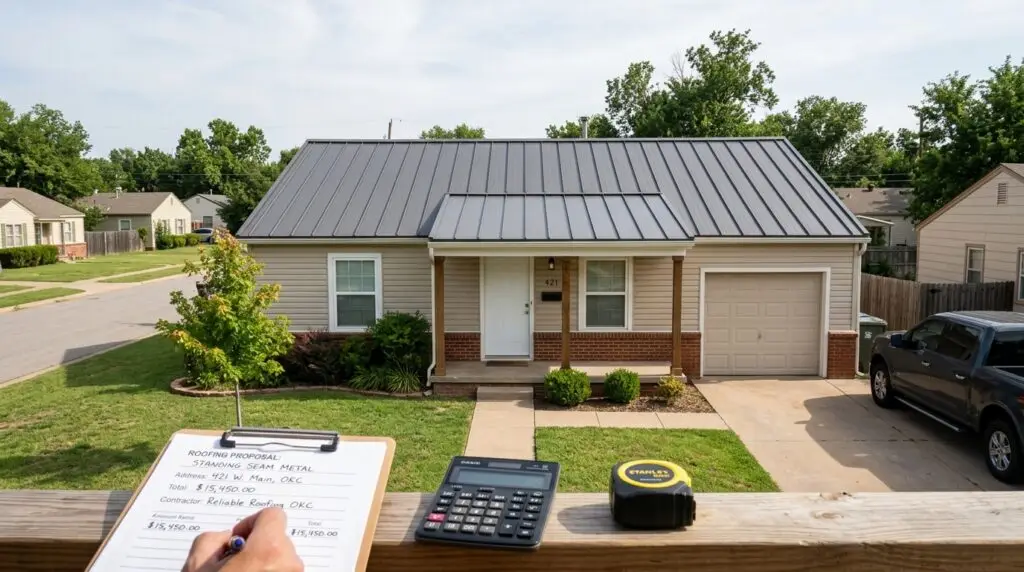
Corrugated steel panels with exposed fasteners sit at the lower end. Standing seam metal the premium system with concealed fasteners and no exposed screws is at the top. Metal shingles designed to mimic the look of traditional asphalt fall in the middle tier.
Important: Prices in the OKC market tend to spike in the weeks after major hailstorms. If storm chasers are flooding your neighborhood, that’s usually not the best time to lock in a quote.
Why Your Final Quote May Look Different Than Online Estimates
National average calculators pull from data across dozens of markets. Oklahoma City’s specific situation aging housing stock in neighborhoods like Capitol Hill and Bethany, a climate that swings from 105-degree summers to ice storms and tornadoes means local pricing has its own logic.
Most homeowners don’t realize that the estimates they find online often exclude permit fees, decking repairs, and underlayment upgrades. By the time those line items get added, the difference between a ‘cheap’ and ‘expensive’ bid often disappears.
Metal Type and Panel Style The Biggest Single Cost Variable
Steel vs. Aluminum vs. Copper What Oklahoma Contractors Recommend
In our experience, Galvalume-coated steel is the dominant choice across Oklahoma City for good reason. It handles hail, UV exposure, and temperature cycling well, and it’s priced accessibly enough that the investment timeline makes sense for most homeowners.
Aluminum performs better in coastal or consistently humid climates it’s less commonly specified for inland OKC. Copper and zinc exist as premium architectural options, but they’re rarely used on standard residential projects here. Expect to pay significantly more if you go that route.
Standing Seam vs. Corrugated vs. Metal Shingles Real Cost and Performance Differences
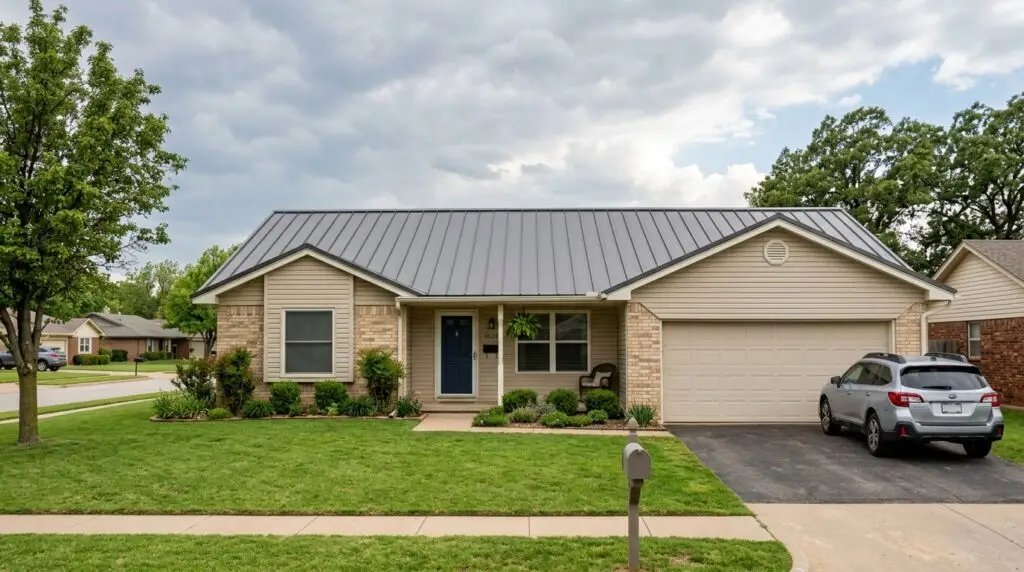
Standing seam is the gold standard. Panels interlock with concealed fasteners, meaning there are no exposed screw points to become leak paths over time. That matters enormously in Oklahoma’s severe weather environment. It costs more but it also performs better and carries longer manufacturer warranties.
Corrugated and exposed-fastener panels are a legitimate option, particularly for outbuildings, shops, or budget-conscious projects where the tradeoffs are acceptable. Metal shingles have become popular in Edmond and newer Norman subdivisions where HOAs or architectural preferences call for a traditional roofline appearance.
Paint System, Gauge, and Coatings The Hidden Upgrade Costs
Here’s the thing two roofs can use the same steel panel system and still perform very differently based on the coating. Kynar/PVDF paint systems hold their color and resist chalking far longer under Oklahoma’s relentless UV exposure compared to standard polyester finishes. That upgrade has a real cost, but it also changes the long-term maintenance picture.
Thicker gauge steel resists hail denting better. Energy-efficient reflective coatings qualify for ENERGY STAR ratings and can meaningfully reduce summer attic heat gain which in an Oklahoma City summer is no small thing.
Roof Size, Pitch, and Complexity Why Your Neighbor’s Quote Won’t Match Yours
How Square Footage Is Measured and Why It’s Always More Than Your Home’s Footprint
Roofing is measured in ‘squares’ one square equals 100 square feet of roof surface. Your roof’s surface area is always larger than your home’s footprint because of slope. A 2,000 sq ft ranch home might have 2,400 to 2,800 square feet of actual roof surface depending on pitch and design.
Contractors also factor in a waste percentage for cuts, especially on complex rooflines with hips, valleys, and dormers. The more intricate the roofline, the higher the material waste and that gets priced into your quote.
Roof Pitch and What It Costs You in OKC Labor
Pitch affects labor more than most homeowners expect. Steep roofs require more safety equipment, slower installation, and more physical effort. Many Oklahoma City homes particularly the ranch-style builds common from the 1970s through 1990s across south OKC, Midwest City, and Del City have relatively walkable pitches that keep labor costs in a reasonable range.
Newer custom homes in Edmond, Yukon, and Mustang increasingly feature steeper architectural pitches. Beautiful rooflines, but plan for the labor cost to reflect that complexity.
Penetrations, Valleys, and Complexity Multipliers
Every skylight, chimney, pipe boot, and HVAC penetration requires custom flashing work. In metal roofing, flashing details are critical they’re often where moisture problems start when work is done poorly. A simple two-plane gable roof installs faster and more predictably than an L-shaped, hip-roofed home with three dormers and two chimney chases. The labor difference is real.
Oklahoma City’s Weather and Why It Directly Affects Your Metal Roofing Price
Hail Season in OKC and Its Impact on Material Specifications
Oklahoma City sits squarely in one of the most hail-active regions in the country. Central Oklahoma sees concentrated storm activity each spring, and the OKC metro has experienced significant hail events with stone sizes that flatten asphalt shingles and leave pockmarks in lesser metal products.
Class 4 impact-resistant metal roofing the highest rating under UL 2218 testing costs more upfront. But it’s the specification that holds up in real Oklahoma weather. Between you and me, specifying anything less in this market is a false economy. You’re paying for durability that will be tested.
Ask your contractor specifically: what is the impact resistance rating of the panels you’re proposing? If they can’t answer that directly, that’s a red flag.
Wind Uplift Ratings and Why 140 MPH Matters in Tornado Alley
Oklahoma City is in Tornado Alley. That’s not marketing copy it’s a material specification requirement. Standing seam metal roofing with properly engineered clip systems can achieve wind uplift ratings that far exceed what standard asphalt can offer.
Moore, Midwest City, and south OKC neighborhoods have experienced direct tornado and severe straight-line wind damage within the last decade. Homeowners rebuilding in those areas who don’t specify wind-rated systems are making a costly gamble. Verify wind ratings before you sign any contract.
Oklahoma’s Heat Cycles and UV Exposure The Silent Cost Driver
OKC summers are punishing. Triple-digit heat is common, and the UV intensity accelerates degradation in lower-quality metal coatings faster than you’d expect. This doesn’t show up on your install invoice it shows up five years later when the paint system is chalking or fading prematurely.
Reflective coatings that carry ENERGY STAR certification can reduce attic heat gain meaningfully. In a climate where cooling costs run high from May through September, that’s a legitimate long-term financial benefit worth calculating into your decision.
Tear-Off, Decking, and What’s Hiding Under Your Current Roof
Overlay vs. Full Tear-Off Oklahoma City Code and Budget Reality
Oklahoma City generally requires a permit for roofing projects that cover more than 500 square feet. That’s most residential roofs. Permitted work means inspections and inspectors will flag decking issues.
An overlay (installing new metal directly over existing shingles) may be structurally permissible in some situations, but it buries whatever problems exist in the decking and eliminates your ability to inspect it. Most reputable contractors in OKC recommend full tear-off. It costs more on day one, but it’s the approach that protects your investment.
Decking Damage and Rot A Common Discovery in Older OKC Neighborhoods
This is one of the most common sources of budget surprises on OKC metal roof projects, and it’s genuinely not a contractor upsell. Homes in Nichols Hills, Mesta Park, older Midwest City stock, and pre-1980s homes throughout central OKC frequently have aging decking original board sheathing, early OSB, or plywood that’s been through decades of Oklahoma weather cycles.
Discovering soft spots, rot, or structural damage during tear-off is common. Build a contingency into your budget for decking repairs. A contractor who doesn’t mention this possibility isn’t doing you any favors.
Underlayment Selection It Matters More Than Most Homeowners Know
Standard felt paper underlayment degrades faster under metal roofing in hot climates because of the heat transfer. Oklahoma summers push significant heat through metal panels, and lower-grade underlayment won’t hold up for the life of the roof.
High-temperature rated synthetic underlayment is the appropriate specification for metal roofing in OKC. It costs a bit more, but it’s the right product for the environment. This is a line item worth asking about specifically when reviewing bids.
Labor Costs and What Drives Contractor Pricing in the OKC Market
How OKC Roofing Labor Rates Compare and When They Surge
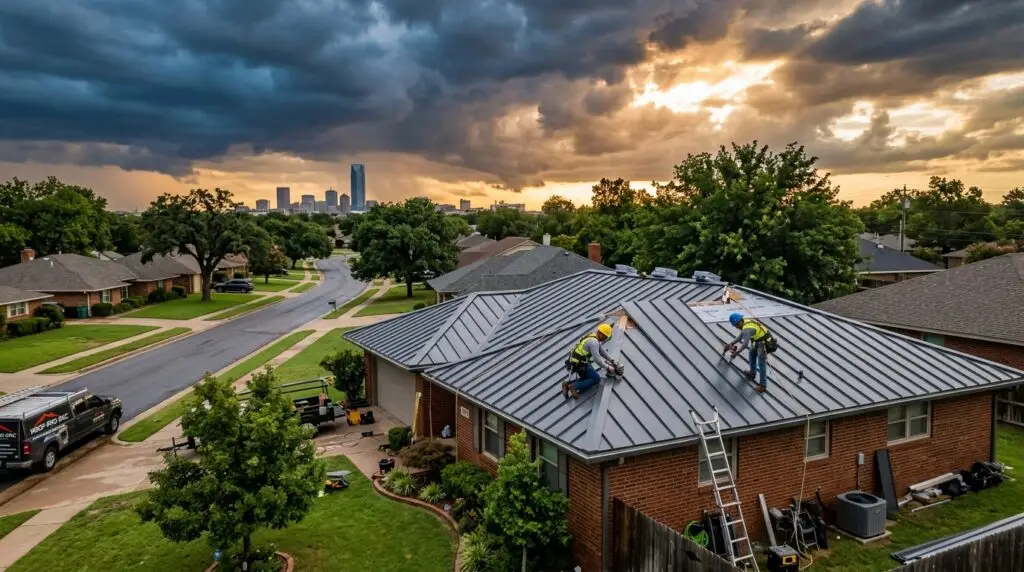
Oklahoma City labor rates generally run slightly below major Texas metro markets like Dallas-Fort Worth. However, that baseline shifts dramatically during and after significant storm events. When a large hail system moves through the OKC metro, local contractor capacity fills up fast and pricing responds to that demand.
Off-season installs late fall and early winter, when storm risk is lower and contractor schedules are more open can sometimes offer better scheduling flexibility and more competitive pricing. Weather creates its own risk during those windows, but for a homeowner not under a storm-related insurance timeline, timing can matter.
Contractor Credentials and Why They Affect Your Bottom Line
Manufacturer-authorized installer certifications aren’t just marketing. They affect warranty eligibility. A standing seam roof installed by an uncertified crew may not qualify for the full manufacturer warranty which can be 30 to 50 years on premium systems. That warranty has real value, and losing it to save a few hundred dollars on labor is a bad trade.
Oklahoma has been strengthening licensing requirements for roofing contractors. Verify your contractor’s license with the Oklahoma Construction Industries Board before work begins. This takes five minutes and protects you significantly.
Getting Multiple Estimates Without Getting Confused
The reason metal roofing quotes vary so widely is that contractors are often proposing different things. One bid might include high-temp underlayment; another uses standard felt. One includes a decking contingency; another doesn’t mention it. One pulls a permit; another quietly skips it.
Request line-item estimates that specify the exact material (manufacturer, product line, gauge, coating system), whether a full tear-off is included, the permit fee, decking contingency allowance, and both manufacturer and workmanship warranty terms. When you compare these side by side, you’ll often find the lowest bid isn’t actually the cheapest option.
Insurance, Permits, and How They Shape Your Out-of-Pocket Cost
How a Hail Damage Claim Can Offset the Cost of Going Metal
This is one of the most financially significant things Oklahoma City homeowners can understand. If your home has sustained qualifying storm damage, your insurance company may owe you a full metal roof replacement not a repair. Upgrading to metal at that point means you’re only paying the difference between the insurance payout and the metal roof cost.
The key variable is whether your policy uses Replacement Cost Value (RCV) or Actual Cash Value (ACV). RCV policies pay the full cost to replace your roof with a comparable new system. ACV policies subtract depreciation which can mean significantly less money in your pocket for an older roof. Know your policy before you start the claims process.
Document damage with photos immediately after a storm. Don’t allow cleanup or debris removal before photos are taken. Timing and documentation matter in Oklahoma insurance claims.
OKC Building Permits for Metal Roofing What Homeowners Need to Know
Unpermitted roofing work creates real problems. If you sell your home, permit records are often reviewed during inspection and title processes. If you file a future insurance claim, unpermitted roof work can complicate coverage. The permit fee is a legitimate line item it’s not optional, and any contractor asking you to skip it to save money is putting you at risk.
Insurance Discounts for Impact-Resistant Metal Roofing
Some Oklahoma insurers offer premium discounts for Class 4 impact-rated roofing systems. This isn’t universal it depends on your insurer and policy. But it’s worth a direct conversation with your insurance agent before you finalize your material specification. In some cases, the annual premium savings can meaningfully shift the long-term ROI of the metal roof investment.
Long-Term Cost Perspective Maintenance, Lifespan, and Real Value in OKC
What Metal Roof Maintenance Actually Costs in Oklahoma
One of the strongest financial arguments for metal roofing is the dramatically reduced maintenance burden compared to asphalt. Annual inspections particularly after OKC storm season focus on fastener integrity, sealant condition at penetrations, and clearing debris from valleys and gutters after wind events. These are straightforward, relatively inexpensive tasks.
The coating system on your panels will eventually need attention on a multi-decade timeline. High-quality Kynar-coated systems in Oklahoma’s climate hold up well, but no exterior finish lasts forever. Budget for a future recoat or panel replacement as part of your long-term ownership calculus.
Lifespan vs. Cost The Math That Makes Metal Worth It (For the Right Homeowner)
Standard asphalt shingles in Oklahoma’s climate typically need replacement on a 15 to 20-year cycle, accelerated by the UV intensity, temperature extremes, and hail exposure. Metal roofing, properly installed and maintained, routinely lasts 40 to 70 years.
If you’re planning to stay in your home for 20 or more years, the math usually favors metal particularly when you factor in avoided replacement costs, reduced insurance claims, and potential HVAC savings from reflective coatings. If you’re planning to sell in three years, the calculus is different. Be honest with yourself about your timeline before making this decision.
Common Mistakes That Inflate Metal Roofing Costs in Oklahoma City
These aren’t theoretical they’re patterns that show up regularly in OKC metal roofing projects that go sideways.
- Choosing a panel system without verifying the wind uplift rating for Oklahoma’s wind zone requirements.
- Hiring post-storm chasers with no local presence, no established warranty support, and no accountability after they leave town.
- Skipping the permit to save a few hundred dollars then facing complications at resale or during a future insurance claim.
- Ignoring a decking inspection before installation, then discovering major structural issues mid-project without a contingency budget.
- Selecting a standard polyester paint system instead of Kynar/PVDF because it saves a small amount upfront then watching it fade and chalk within 10 years in Oklahoma’s UV exposure.
- Confusing manufacturer warranty and workmanship warranty. One covers material defects; the other covers installation quality. You need both to have real protection.
How to Get an Accurate Metal Roofing Estimate in OKC What to Ask Before You Sign
The Questions Every OKC Homeowner Should Ask a Metal Roofing Contractor
A complete, honest estimate should answer all of these without you having to dig:
- What metal system, manufacturer, product line, and gauge are you proposing and why is it right for my home and location?
- Does this price include a full tear-off and a decking inspection? What is your process when you find damaged decking?
- Is pulling the building permit included? Who is responsible for scheduling the inspection?
- What manufacturer warranty comes with this system, and am I eligible for it based on your installer certification status?
- What is your workmanship warranty, and is it backed by your company or a third party?
- Are you licensed with the Oklahoma Construction Industries Board, and can I verify that independently?
Timing Your Metal Roof Project in OKC
Late summer through early fall tends to offer a reasonable installation window in OKC the extreme heat of July and August has eased, the spring storm rush has cleared, and there’s a stretch before late-season weather uncertainty arrives. It’s also a period when contractor schedules are typically more open.
For specialty standing seam panels, ask about lead time. Some manufacturers don’t stock custom colors or profiles locally and require 3 to 6 weeks for fabrication. If you’re working against an insurance deadline, that timeline matters.
One final piece of practical advice: the best time to research contractors is before you need one urgently. The post-storm rush is the worst time to make a considered decision about a major investment.
Frequently Asked Questions About Metal Roofing Costs in Oklahoma City
Q: How much does a metal roof cost in Oklahoma City?
A: Installed metal roofing in Oklahoma City typically ranges from $8 to $18 per square foot, depending on the system type (corrugated vs. standing seam), roof complexity, pitch, and whether storm damage or decking repairs are involved. Always request a line-item estimate that includes permits, underlayment, and a decking contingency.
Q: Does metal roofing hold up to hail in Oklahoma City?
A: Yes Class 4 impact-resistant metal roofing outperforms asphalt shingles significantly in hail resistance under UL 2218 testing. Cosmetic denting can occur in extreme events, but functional damage and leaks are far less common than with standard shingles. For OKC’s hail environment, Class 4 is the recommended specification.
Q: Is a metal roof worth the higher upfront cost in Oklahoma City?
A: For homeowners planning to stay long-term, typically yes. Metal roofs last 40 to 70 years in Oklahoma’s climate significantly longer than the 15 to 20-year cycle of asphalt. When you factor in avoided replacement costs, potential insurance premium discounts, and lower HVAC load from reflective coatings, the long-term math usually favors metal.
Q: Does Oklahoma City require a permit for metal roof installation?
A: Generally yes Oklahoma City requires a building permit for roofing projects covering more than 500 square feet, which includes most residential roofs. Skipping the permit creates problems at resale and can complicate future insurance claims. A legitimate contractor will include permit fees as a line item in their estimate.
Q: Can I use homeowners insurance to pay for a metal roof after a hailstorm?
A: If your roof has qualifying storm damage, your insurance payout may cover a full replacement. Upgrading to metal could cost only the difference above the insurance settlement. Whether your policy uses Replacement Cost Value (RCV) or Actual Cash Value (ACV) significantly affects your out-of-pocket amount check your policy before filing.
Q: Why are metal roofing quotes so different from contractor to contractor in OKC?
A: Quotes vary because contractors are often proposing different things different gauge steel, different underlayment, different warranty terms, and different assumptions about tear-off and decking. Always compare line-item estimates, not just totals. The lowest number usually reflects something left out, not genuine savings.
Q: What is the best type of metal roofing for Oklahoma City weather?
A: For OKC’s combination of hail, high wind, UV intensity, and temperature extremes, Galvalume-coated steel in a standing seam system with Class 4 impact rating, Kynar/PVDF paint coating, and a wind uplift rating appropriate for Oklahoma’s wind zone is the strongest all-around specification. Standing seam’s concealed fastener design is especially valuable in a severe weather environment.