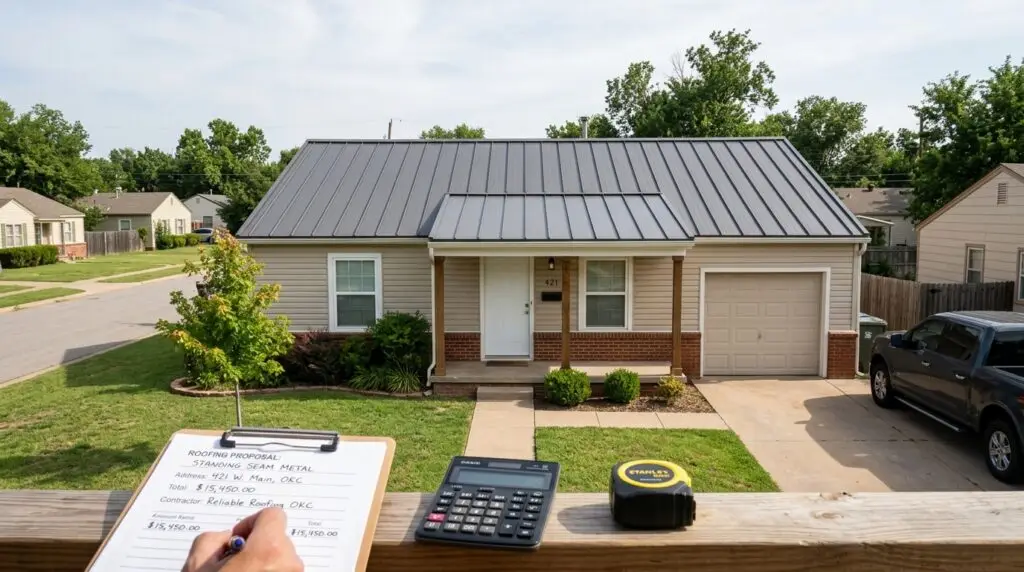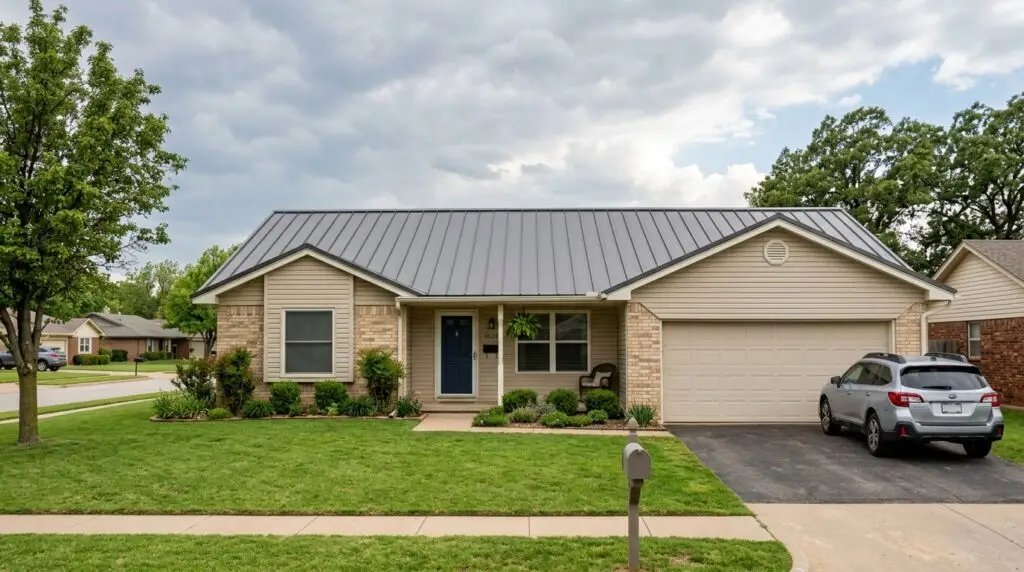
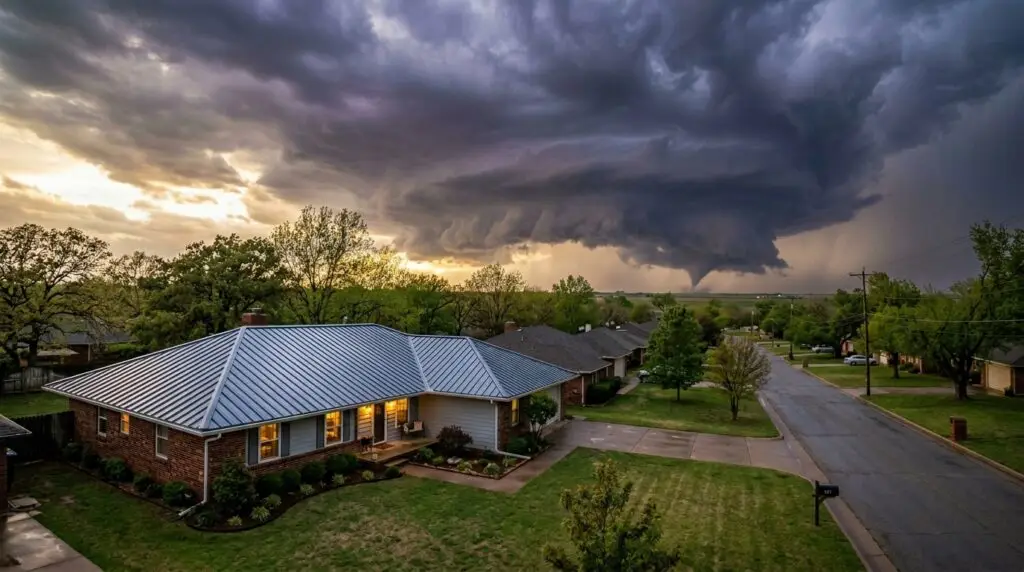
If you live in the Oklahoma City metro, you already know the drill. Spring arrives, and so does the anxiety. Watches turn into warnings, sirens sound, and suddenly you’re wondering whether your roof is going to be on the news tonight.
That question whether a metal roof can actually handle Oklahoma tornado winds comes up constantly in this line of work. And the honest answer is: yes, metal roofing is the strongest residential roofing option available for tornado-prone areas like OKC. But there are important details most homeowners don’t realize, and getting those details right is the difference between a smart investment and a false sense of security.
This guide covers everything you need to know from how metal roofs are engineered to resist wind, to what no roofing material can promise, to the financial benefits that make metal roofing a serious option for central Oklahoma homeowners.
Why Oklahoma City Is Ground Zero for Tornado Roof Damage
Oklahoma City isn’t just tornado-prone it’s statistically one of the most tornado-struck large cities in the United States. According to the National Weather Service in Norman, OKC has recorded more than 190 tornadoes since 1890. Oklahoma as a whole averages around 68 tornadoes per year, and the state holds the record for the most violent (EF3 and above) tornadoes of any state in the country.
Most homeowners think about tornadoes in terms of the dramatic EF4 and EF5 events the kind that leveled Moore in 1999 and again in 2013. Those are real risks. But here’s the thing: the threat to your roof starts long before a storm reaches that intensity.
The Wind Speeds Your Roof Actually Faces
Standard asphalt shingles begin failing at around 90 mph. An EF1 tornado the second-weakest category produces winds between 73 and 112 mph. That means even a relatively minor tornado can strip a standard shingle roof down to the deck before the storm makes it two blocks.
Beyond direct tornadic winds, consider what travels with those storms: golf-ball to baseball-sized hail, wind-driven rain, and airborne debris moving at speeds that turn ordinary objects into projectiles. In the OKC metro, supercell thunderstorms routinely produce all three simultaneously. Communities like Moore, Edmond, Midwest City, and Yukon have experienced this repeatedly.
Three Threats Every Oklahoma Roof Faces in a Major Storm
- Direct wind uplift: Pressure differences between the underside and top of a roof try to peel it away from the structure.
- Hail and debris impact: Hail alone accounts for the majority of insured roofing losses in Oklahoma every year.
- Wind-driven rain infiltration: Once a roof is compromised, even partially, water enters fast and causes compounding interior damage.
Understanding all three threats is critical when evaluating roofing materials. A roof that handles wind well but fails under hail impact still leaves your home exposed.
How Metal Roofs Are Engineered to Resist High Winds
Metal roofing’s wind resistance isn’t accidental it’s the result of deliberate engineering choices that address the specific physics of wind uplift. Let’s break down how it actually works.
The Interlocking Panel System
Quality metal roofing panels are designed to interlock with one another, creating a continuous surface without exposed seams or gaps where wind can gain entry. Standing seam panels connect by snapping or mechanically seaming together, eliminating the loose overlapping edges that make asphalt shingles vulnerable.
Here’s the key distinction: asphalt shingles rely on adhesive strips and gravity to stay in place. Those adhesive strips degrade in Oklahoma’s heat over time. Metal panels rely on mechanical connection they’re physically locked together, which is a fundamentally more reliable system under dynamic wind loading.
The Fastening System Advantage
Traditional roofing uses nails. Metal roofing uses screws or concealed clips. That difference matters enormously in high-wind conditions. Roofing nails can work loose over time, especially under the kind of repeated wind cycling that Oklahoma storms create. Screws maintain their holding power under the same cyclical forces.
Concealed fastener systems go one step further the attachment points are hidden beneath the next panel, meaning wind never makes direct contact with the fastener. No exposed fastener means no direct leverage point for uplift.
The Lightweight Advantage
Most homeowners assume heavier means stronger. In roofing, the opposite is often true. Metal roofing weighs significantly less than clay tile, concrete tile, or slate. During a tornado, the shear forces acting on a structure are intensified by roof weight. A lighter roof reduces the mass that wind forces must overcome to cause structural failure and it places less stress on your walls, trusses, and foundation during the event.
Wind Speed Ratings: What the Numbers Actually Mean for OKC Homes
When contractors and manufacturers talk about wind ratings, it’s easy to throw numbers around without context. Here’s how to interpret what you’re actually being told.
Standard Metal Roof Wind Ratings
Most quality steel metal roofing systems carry wind resistance ratings in the range of 130 to 160 mph. Some systems certified under the TAS-125 standard have been tested at wind speeds above 140 mph. For comparison, a typical 3-tab asphalt shingle is rated to 60–70 mph, and even premium architectural shingles top out at 90–110 mph.
In practical terms: a metal roof is engineered to survive the wind speeds associated with an EF2 tornado (up to about 135 mph) and has meaningful protection into EF3 territory (up to 165 mph) depending on the system and installation quality.
What Each EF Rating Means for Your Roof
- EF0–EF1 (65–112 mph): Metal roofs should perform well. Standard asphalt shingles frequently fail.
- EF2–EF3 (113–165 mph): Properly installed metal holds. Asphalt roofs often sustain catastrophic damage.
- EF4–EF5 (166+ mph): No residential roof is designed to be fully tornado-proof at these intensities.
The Honest Limitation
In our experience, the most important thing we can tell a homeowner is this: no roofing material can guarantee survival of a direct EF4 or EF5 strike. The goal of a metal roof is to outlast surrounding structures, limit your home’s exposure during the storm, and dramatically reduce the probability of a total loss. That’s a meaningful difference even when it isn’t a guarantee.
This is where many roofing articles do homeowners a disservice by overpromising. Metal roofing is the best residential option available. It is not a storm shelter.
Hail and Flying Debris: The Underrated Tornado Threat in Central Oklahoma
Wind gets most of the attention when tornadoes are discussed, but in our area, hail is arguably the more consistent threat to your roof year in and year out. Most homeowners don’t realize that the same supercell thunderstorms that produce Oklahoma’s tornadoes are the same systems dropping golf-ball and baseball-sized hail across the OKC metro.
Oklahoma’s Hail Belt Reality
Central Oklahoma sits squarely in the nation’s hail belt. Spring storm seasons routinely bring large hail to Edmond, Norman, Midwest City, and the southern OKC suburbs. Hail accounts for the majority of insured roofing losses in the state every single year often devastating roofs that survived the wind portion of a storm perfectly fine.
This dual threat tornado-force winds and large hail arriving together is what separates the Oklahoma roofing challenge from almost anywhere else in the country.
The UL 2218 Class 4 Impact Rating Explained
Impact resistance in roofing is measured by the UL 2218 standard. The test involves dropping a 2-inch steel ball from 20 feet onto the same spot twice. Class 4 is the highest rating a material must show no fracturing to achieve it.
Most quality steel metal roofing products achieve Class 4. Most standard asphalt shingles are rated Class 1 to 3. Wood shakes and clay tile typically carry no impact warranty at all.
For Oklahoma homeowners, Class 4 impact resistance isn’t a luxury feature. It’s a baseline requirement.
A Key Buying Distinction: Gauge and Alloy Matter
Not all metal roofing is created equal when it comes to hail resistance. Softer metals like aluminum can dent under large hail a cosmetic problem that can also affect long-term waterproofing integrity. Twenty-four gauge steel performs significantly better under hail impact than 29-gauge, and stone-coated steel options add an additional layer of impact absorption.
Before purchasing any metal roofing system, ask your contractor specifically: What gauge is this panel? What is its UL 2218 class rating? The answers to those two questions tell you most of what you need to know.
Metal Roof vs. Asphalt Shingles in an Oklahoma Tornado: Side-by-Side Comparison
Between you and me, this comparison isn’t particularly close when it comes to storm performance in central Oklahoma. But every homeowner deserves the full picture including the financial considerations that make the decision more nuanced than raw performance data suggests.
| Criteria | Metal Roofing | Standard Asphalt |
| Wind resistance | 130–160 mph rated | 60–110 mph rated |
| Impact rating | UL 2218 Class 4 | Typically Class 1–3 |
| Expected lifespan (OKC) | 40–70 years | 7–15 years real-world |
| Post-storm repair need | Rare, minor | After most major storms |
| Insurance premium impact | Often qualifies for discounts | Standard rates |
| Upfront cost | Higher initial investment | Lower initial cost |
| Long-term value | Excellent | Moderate |
The Real Total-Cost Argument
The upfront cost difference between metal roofing and asphalt shingles is real. But the long-term math looks very different when you factor in replacement frequency, storm repair costs, and insurance premiums.
In Oklahoma’s climate, a standard asphalt shingle roof often needs full replacement within 7 to 15 years due to repeated hail and wind damage cycles well short of the 20-to-25-year warranty those shingles carry under normal conditions. Over the lifespan of a quality metal roof, a comparable home could require two or three shingle replacements.
Add in the insurance premium discounts available to homeowners with Class 4 rated roofing, and the long-term cost gap narrows considerably.
The Strengthen Oklahoma Homes Act
Oklahoma homeowners have a resource worth knowing about: the Strengthen Oklahoma Homes Act, signed in 2024, provides grant funding to help homeowners achieve FORTIFIED roof designation through November 2027. FORTIFIED roofs meet elevated construction standards specifically designed for high-wind regions, and may qualify for larger insurance discounts than Class 4 rating alone. If you’re planning a roof replacement, it’s worth contacting your insurer and a local contractor before you begin to understand what programs you may qualify for.
Roof Shape Matters Too: Why Hip Roofs Outperform Gable Roofs in OKC Storms
Here’s something most homeowners and even some general contractors don’t fully appreciate: the shape of your roof affects wind performance almost as much as the material covering it.
The Aerodynamics of Wind on Your Roof
A hip roof, with four slopes meeting at a central ridge, deflects wind from any direction. When tornado winds shift and they do, unpredictably a hip roof doesn’t present a large flat surface for wind to push against. Research consistently shows that four-slope roofs outperform two-slope gable roofs in high-wind conditions.
Gable roofs, by contrast, create large flat end planes called gable ends that act essentially like sails in high wind. Wind pressure builds against the gable, and uplift forces concentrate at the rake edges and peak. This is why gable roofs the most common style in older OKC neighborhoods tend to suffer more damage than hip roofs in comparable storms.
Wide Overhangs: A Hidden Risk in OKC Ranch Homes
Many ranch-style homes throughout Oklahoma City and its suburbs were built with generous overhangs a popular design feature that also happens to be a wind vulnerability. Upward-blowing winds during a tornado can catch wide overhangs and create significant uplift forces on the entire roof system. When replacing your roof with metal, it’s worth discussing overhang dimensions with your contractor, particularly if your home has overhangs wider than about 18 inches.
What If Your Home Has a Gable Roof?
If your home has a gable roof which is most older homes in the OKC metro you’re not out of options. Gable end bracing, hurricane straps connecting trusses to load-bearing walls, and proper roof deck fastening can substantially improve gable roof performance in high-wind conditions. A metal roof on a reinforced gable structure still significantly outperforms asphalt shingles on the same foundation. It’s an upgrade worth making even without redesigning the roof geometry.
What Proper Metal Roof Installation Looks Like in Oklahoma
This is where things get practical. The best metal roofing panel on the market will underperform if it’s installed incorrectly and in Oklahoma’s storm environment, installation quality is not something to cut corners on.
The Installation Details That Determine Storm Performance
It starts with the deck. Quality metal roof installation requires solid roof decking typically 7/16-inch or 19/32-inch OSB or plywood, secured with ring-shank nails rather than staples. Staples pull through under high-wind loads. Ring-shank nails don’t.
On top of the decking, a synthetic underlayment outperforms traditional felt in both water resistance and tear strength. In Oklahoma’s freeze-thaw climate, ice-and-water shield at eaves and valleys adds an important secondary layer of protection particularly in the colder months when ice damming can force moisture under panels.
Edge and ridge metal must be properly flashed and fastened. These are the most common failure points in any roof during a storm, and they deserve extra attention during installation.
Common Installation Mistakes That Undermine Wind Performance
- Over-torqued screws that strip through the panel and lose holding strength
- Panels not fully seated in the interlocking system leaving gaps that wind can exploit
- Incorrect fastener spacing longer spans between attachment points reduce the panel’s effective wind load capacity
- Skipping attic ventilation pressure buildup in the attic during a tornado can exert outward force on panels from below
- Improper flashing at penetrations vents, pipes, and HVAC equipment create weak points if not correctly sealed
Questions to Ask Your OKC Metal Roofing Contractor
Before signing any contract, get clear answers to these:
- What is the specific wind rating of the panel system you’re recommending?
- Are you using concealed or exposed fasteners, and why?
- What gauge steel is this panel and what is its UL 2218 impact rating?
- Will this installation meet or exceed current Oklahoma building codes?
- What does your workmanship warranty cover, and for how long?
A reputable contractor won’t be bothered by those questions. In fact, they’ll likely have the documentation ready.
Insurance Benefits of Metal Roofing for Oklahoma City Homeowners
Oklahoma’s insurance market has become one of the most difficult in the country for homeowners. Rates have climbed significantly in recent years, and some carriers have begun restricting coverage or tightening underwriting standards in storm-prone zip codes across the OKC metro.
This is precisely why the roofing material you choose matters beyond its physical performance.
How a Metal Roof Affects Your Premium
Class 4 rated metal roofing qualifies for premium discounts with many Oklahoma insurance carriers. The exact discount varies by insurer, but it can be meaningful enough to factor into the long-term cost comparison between metal and asphalt.
FORTIFIED roof designation, available through the Insurance Institute for Business & Home Safety, takes this further. Homes with FORTIFIED-certified roofing often qualify for larger discounts than Class 4 rating alone. The 2024 Strengthen Oklahoma Homes Act is designed specifically to help OKC-area homeowners access grant funding to reach that standard.
Practical Steps Before You Buy
- Contact your insurance carrier before installation and ask specifically which roofing products qualify for their Class 4 or FORTIFIED discount programs.
- Ask your roofing contractor to provide written documentation of the panel’s impact rating and wind certification for your insurance file.
- Understand that some carriers require a third-party inspection to certify FORTIFIED designation your contractor should be able to guide you through this process.
- Get your premium quote updated before and after the roof replacement so you can measure the actual savings.
Most homeowners are surprised to learn how significant the insurance angle is. It doesn’t fully close the cost gap between metal and asphalt, but it changes the math considerably over a 10- to 20-year horizon.
Maintaining a Metal Roof in Oklahoma’s Climate Year-Round
One of the genuine advantages of metal roofing is how little maintenance it requires compared to asphalt. But ‘low maintenance’ doesn’t mean ‘no maintenance,’ and Oklahoma’s climate creates a few specific considerations worth knowing about.
Pre-Storm Season Checklist (April Through June)
Oklahoma’s primary tornado season runs from April through June, with late-summer systems also capable of significant damage. Before the season ramps up, a basic inspection pays dividends:
- Visually inspect panel seams and any visible fasteners for signs of movement or corrosion.
- Check flashing at all penetrations vents, HVAC curbs, chimneys, and pipe boots are the most common leak points on metal roofs.
- Clear debris from valleys and gutters standing debris accelerates corrosion at drainage points over time.
- Look for any areas where sealants have cracked or pulled away common after the thermal cycling of an Oklahoma winter.
Oklahoma-Specific Climate Challenges for Metal Roofs
Oklahoma’s temperature swings are significant 100-plus-degree summers and below-freezing winters create meaningful thermal expansion and contraction in metal panels. Over time, this can stress fasteners and sealants. It’s not a cause for alarm, but it is a reason to include periodic professional inspection in your maintenance plan.
After any storm event with large hail, even a Class 4 rated metal roof should be visually inspected. Panel denting from baseball-sized hail is uncommon, but not impossible, and edge or flashing damage can occur even when the field of the roof is intact.
When to Call a Professional
Ground-level visual inspections after every significant storm are a good habit for any homeowner. A professional inspection every two to three years or after any nearby EF1 or stronger tornado event is a reasonable standard for OKC metro homes with metal roofs. Catching a sealant failure or minor flashing issue early costs a fraction of what deferred water damage will eventually cost.
Is a Metal Roof the Right Decision for Your OKC Home?
It depends on several factors and being honest about those factors serves homeowners better than a blanket recommendation.
Who Benefits Most from Metal Roofing in Oklahoma City
The case for metal roofing is strongest for homeowners who plan to remain in their home for 10 or more years. The long payback period on the higher upfront cost requires time to realize through avoided replacements and insurance savings.
Homes in historically high-tornado-frequency areas Moore, south OKC, Midwest City, eastern Edmond, and the southern suburbs in Cleveland County benefit most from the added wind and impact protection. Homeowners already facing insurance renewal challenges or premium increases have even more incentive to consider the upgrade.
When Asphalt Might Still Make Sense
If you’re planning to sell your home within the next three to five years, the financial return on metal roofing is harder to capture. In that scenario, Class 4 impact-resistant architectural shingles represent a solid middle option they provide meaningful storm protection over standard shingles, often qualify for insurance discounts, and carry a lower upfront cost.
Budget constraints are also a legitimate consideration. A properly installed Class 4 shingle roof will significantly outperform a standard shingle roof in Oklahoma storms, and it’s a better choice than choosing metal based on price and accepting a lower-quality installation or product.
Getting the Decision Right
Get at least two to three quotes from licensed Oklahoma roofing contractors with verifiable local references. Ask each contractor to walk you through the specific panel system, installation specs, and warranty terms not just the price. The quality of the installation and the quality of the panel system matter as much as the material category itself.
The right roof for your OKC home is the best-quality system you can install correctly within your budget and ownership timeline. For most long-term homeowners in central Oklahoma, that answer is a metal roof with Class 4 impact rating and proper installation to current building codes.
Frequently Asked Questions
Can a metal roof survive a tornado?
Metal roofing provides the strongest residential wind and impact protection available. Quality metal roofs are rated for 130–160 mph winds, meaning they perform well in EF0 through EF2 conditions and provide meaningful protection into EF3 range. No residential roof is designed to survive a direct EF4 or EF5 strike but a metal roof dramatically reduces the likelihood of total loss compared to asphalt shingles.
What wind speed can a metal roof withstand?
Most quality steel metal roofing systems are rated for 130 to 160 mph. Systems certified under TAS-125 testing standards have been verified at wind speeds above 140 mph. For comparison, standard asphalt shingles are typically rated for 60–110 mph, depending on grade.
Do metal roofs hold up better than shingles in Oklahoma storms?
Yes significantly. Metal roofing outperforms asphalt in both wind resistance and hail impact protection. In Oklahoma’s climate, where the same storm system often produces high winds and large hail simultaneously, the performance gap between metal and standard asphalt shingles is substantial. Metal roofs also have a much longer real-world lifespan in OKC’s storm environment.
Does a metal roof lower my homeowners insurance in Oklahoma?
Often yes. Class 4 rated metal roofing qualifies for premium discounts with many Oklahoma insurance carriers. Homes that achieve FORTIFIED roof designation supported by the 2024 Strengthen Oklahoma Homes Act may qualify for even larger discounts. Contact your specific insurer before installation to confirm which products and standards qualify under your policy.
What type of metal roof is best for Oklahoma tornadoes?
Standing seam steel panels with concealed fasteners, a minimum 24-gauge thickness, and UL 2218 Class 4 impact rating are the strongest combination for Oklahoma’s storm environment. The concealed fastener system eliminates direct wind exposure at attachment points, and 24-gauge steel provides meaningful hail resistance that thinner gauges and softer metals like aluminum cannot match.
How much does a metal roof cost in Oklahoma City?
Metal roofing carries a higher upfront cost than standard asphalt. For accurate pricing on your specific home, get quotes from at least two or three licensed Oklahoma roofing contractors. The range varies based on roof size, pitch, panel system, and installation complexity. Factor in insurance premium savings and avoided replacement costs when evaluating the long-term investment.
Is a metal roof worth it in Oklahoma?
For homeowners planning to stay in their home for 10 or more years, especially in the OKC metro’s high-storm-risk areas, the long-term value case for metal roofing is strong. Fewer repairs, longer lifespan, potential insurance discounts, and superior storm performance combine to create a meaningful advantage over repeated asphalt replacement cycles in Oklahoma’s climate.