Here’s the truth that most roofing articles won’t tell you: a metal roof doesn’t fail on its own. It fails when small problems get ignored, when installation shortcuts get taken, or when Oklahoma’s storms do damage that nobody bothers to inspect. Preventing roof leaks in metal roofing systems isn’t complicated but it does require knowing what to look for, when to look for it, and what to do when you find a problem.
This guide is written specifically for Oklahoma City homeowners. That matters. What works in a mild Pacific Northwest climate is not the same as what holds up through hailstorms in Moore, straight-line wind events in Edmond, or summer heat cycles that push triple digits across the metro.
Why Metal Roofs in Oklahoma City Face Unique Leak Risks
Metal roofing is genuinely one of the most durable systems available. Long service life, energy efficiency, and storm resistance when installed correctly, it outperforms asphalt shingles in nearly every meaningful way. But Oklahoma City’s climate puts specific stresses on metal roofing systems that homeowners in other parts of the country simply don’t deal with.
Oklahoma’s Weather Is Not Average And Your Roof Knows It
Oklahoma City sits squarely in Tornado Alley. That means your roof faces a combination of threats that few regions match: wind-driven hail from spring supercell storms, sustained summer heat above 100°F, sudden temperature drops in winter, and heavy rainfall that can arrive with little warning. Communities across the OKC metro from Moore and Norman to Yukon, Mustang, Midwest City, and Edmond all share this same high-exposure environment.
Most homeowners don’t realize how differently these conditions affect a metal roof compared to a shingle roof. Shingles fail gradually and visibly. Metal roofs handle stress silently until something gives way, and the leak appears.
The Thermal Expansion Problem Specific to Oklahoma Climates
Every metal roofing system expands in heat and contracts in cold. That’s normal engineering. The problem in Oklahoma is the magnitude of that swing. A metal panel that bakes at 140°F on a July afternoon and drops to near freezing in a winter cold snap moves significantly repeatedly, year after year.
This thermal cycling is the hidden engine behind most metal roof fastener failures. Screws back out fractionally. Sealants get stretched thin at the edges. Seams that were tight on installation day develop micro-gaps over time. None of this is visible from the ground. All of it becomes a leak pathway when rain arrives.
The 6 Most Common Causes of Leaks in Metal Roofing Systems
In our experience, most metal roof leaks trace back to one of six root causes. Understanding them is the first step toward preventing roof leaks in metal roofing systems before they become expensive interior damage.
1. Fastener and Washer Failure
Exposed fastener metal roofing panels are held in place with screws that have rubber EPDM gaskets built into the washer. Over time, those gaskets crack, compress, or shift especially under Oklahoma’s thermal stress. A screw that’s backed out even a fraction of an inch no longer creates a watertight seal.
Installation errors make this worse. Over-tightening a screw during installation crushes the washer immediately, compromising the seal from day one. Under-tightening leaves it loose from the start. Either way, you’re looking at a future leak.
2. Failed Sealants and Deteriorated Caulking
Sealants protect the areas where your metal roofing system can’t be fully mechanically sealed around pipe boots, vent flashings, ridge caps, and HVAC curbs. The problem? Standard silicone caulk loses adhesion to metal surfaces over time. In Oklahoma’s high-UV environment, that degradation happens faster than manufacturer timelines suggest.
By the time you notice a stain on your ceiling, the sealant failure may have been happening for months.
3. Flashing Failures at Penetration Points
Every penetration in your roof every chimney, vent stack, skylight, or wall transition is a potential leak point if the flashing isn’t installed and maintained correctly. Oklahoma wind events regularly apply uplift forces that loosen flashing that appeared secure during dry conditions. Once wind creates even a minor gap, wind-driven rain exploits it immediately.
4. Panel Seam Separation and Capillary Action
This one surprises a lot of homeowners. Water doesn’t need gravity to move through a tight seam capillary action pulls it in sideways. In Oklahoma City, storms regularly deliver wind-driven rain at angles that push water directly into the seam overlaps of exposed fastener panel systems.
Standing seam metal roofs are significantly more resistant to this because the seam is raised above the panel surface and concealed. Exposed fastener systems require more frequent seam inspection to remain reliably watertight.
5. Hail-Initiated Coating Damage and Corrosion
This is the gap most competitors miss entirely. When hail hits a metal panel, it often doesn’t punch through immediately. Instead, it chips the protective coating Kynar, Galvalume, or painted finish exposing bare metal underneath. You can’t always see this from the ground. But exposed bare metal in Oklahoma’s humidity and precipitation cycle begins rusting faster than most homeowners expect.
That rust point eventually becomes a pinhole. The pinhole becomes a leak. The leak appears inside your home many months after the hailstorm that triggered the whole process. By the time you connect the dots, the insurance claim window may have closed.
6. Condensation and Vapor Barrier Problems
Between you and me, this is the most underdiagnosed cause of what homeowners think are roof leaks. Warm, humid Oklahoma air contacts the cold underside of a metal panel and condensation forms. Without a properly installed vapor retarder and adequate attic ventilation, that moisture drips onto the deck below and looks exactly like an active roof leak.
If you’re finding moisture stains but can’t locate an obvious entry point on the roof surface, condensation should be your first suspect not a failed seam.
| OKC Contractor Insight
“When we inspect a metal roof that’s leaking in the Oklahoma City area, installation errors or neglected maintenance are the cause more often than not not the age of the roof or the storm itself.” |
How Oklahoma City Storms Directly Trigger Metal Roof Leaks
Living here, you already know that Oklahoma weather is unpredictable. What most homeowners don’t know is exactly how storm events translate into future leak risks especially on metal roofing systems.
What Hail Actually Does to a Metal Roofing System
Metal roofs handle hail better than asphalt shingles in one critical way: they don’t crack or lose granules. But they have their own vulnerability. Hail chips protective coatings at impact points and can deform panel surfaces, compromise seam integrity, and damage flashing and ridge caps.
The dangerous part is the delay. Hail-initiated leaks on metal roofs frequently don’t appear immediately. The sequence goes: coating damage → UV exposure → surface rust → pinhole → active leak. That process can take six to eighteen months. By the time you’re putting buckets under a ceiling drip, the storm that caused it may feel like old news.
Oklahoma City hailstorms regularly produce stone sizes that far exceed what many metal roofing systems are tested against. The communities of Moore, Norman, and Midwest City have experienced repeated significant hail events, and homeowners there should treat any hailstorm as a trigger for professional inspection not just a visual check from the driveway.
Wind Damage Patterns OKC Homeowners Should Know
OKC metro storms regularly generate straight-line winds well above 60 mph. Those winds don’t just blow shingles off they apply uplift force to metal panels, ridge caps, and foam closure strips at the eaves and rakes. A ridge cap that looks fine from below may have had its sealant bond broken by wind uplift during the last storm.
The next rain event doesn’t have to be severe to exploit that gap. Normal rainfall driven by even light wind is enough to push water into a ridge cap that no longer seats properly. Edmond and Yukon homeowners whose properties sit in more open terrain tend to see higher wind exposure than neighborhoods closer to the urban core.
Why Post-Storm Inspection Timing Matters for Insurance
Oklahoma homeowners insurance policies typically include a mitigation requirement. That means you’re expected to take reasonable steps to prevent additional damage after a storm event. Failure to document and address storm damage promptly can affect your claim outcome and in some cases, reduce what your insurer will pay.
For metal roofing specifically, documentation needs to include: dents on flat panels and ridge caps, chipped or missing coating at impact points, and any seam or flashing displacement. This is different from what adjusters look for on shingle roofs. Working with a metal roofing specialist in OKC who understands what hail damage looks like on a metal system and how to document it can make a significant difference in your claim.
A Practical Maintenance Schedule for Leak Prevention in Metal Roofs
The single most effective strategy for preventing roof leaks in metal roofing systems is consistent, scheduled maintenance. Not reactive repairs after a leak appears proactive inspection before damage occurs.
Twice-a-Year Inspections: What to Look For Each Season
Spring inspection ideally in April before severe storm season peaks should focus on winter’s effects: frost-related sealant cracking, fastener movement from freeze-thaw cycles, and debris accumulation in valleys and gutters that can back up water. Check attic insulation for any moisture that accumulated over winter.
Fall inspection September or October, before winter precipitation should focus on resealing any open fastener holes or sealant gaps before cold weather makes them worse, clearing gutters and downspouts completely, and verifying ridge cap integrity before ice or snow loading begins.
After Every Major OKC Storm: The 5-Point Check
After any storm that produced hail larger than marble size, or sustained winds above 60 mph, run through these five checks before you call it clear:
1. Ground-level visual scan
Look for visible panel deformation, displaced ridge caps, or hanging flashing sections. Don’t climb onto a wet roof assess from the ground first.
2. Gutter and downspout inspection
Check for coating granules or paint chips in gutters. This is one of the most reliable early indicators of hail impact on metal panels.
3. Interior attic check
Look for new moisture stains on decking or rafters, and check whether attic insulation feels damp anywhere. This catches leaks before they reach finished ceilings.
4. Pipe boot and flashing inspection
Walk the perimeter and visually inspect all penetration points for displaced or lifted boots, sealant gaps, or bent flashing edges.
5. Ridge cap and seam review
Pay particular attention to the windward side of the roof this is where wind uplift concentrates. Look for raised or displaced ridge cap sections.
When DIY Inspection Ends and a Professional Starts
Ground-level checks are valuable and appropriate for homeowners. Roof-level inspection on a metal system especially one with any slope is a different matter. Metal panels are slippery when wet, and debris after a storm creates additional hazard.
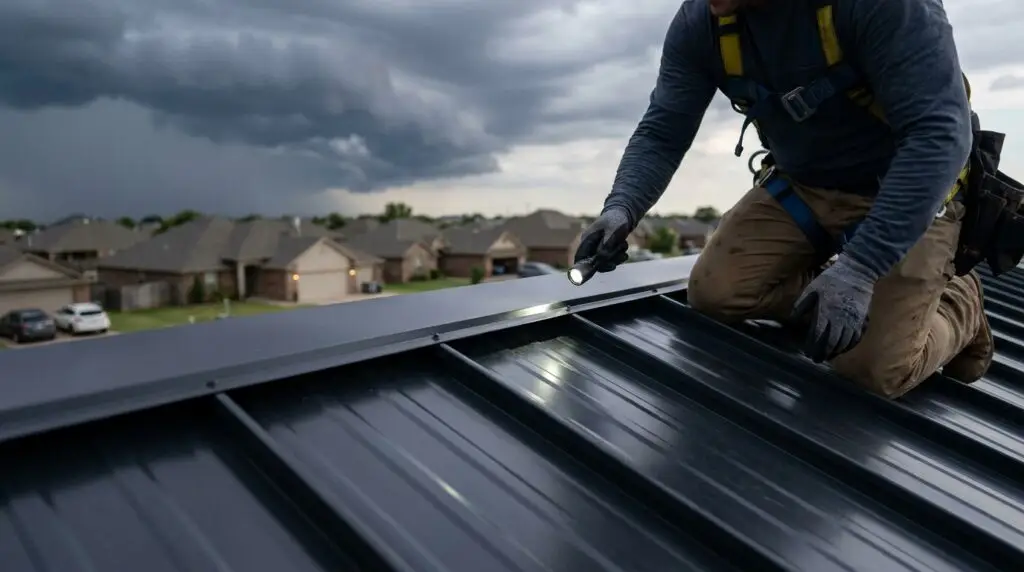
A professional metal roofing inspector can identify things that aren’t visible from the ground: micro-separations in panel seams, fastener backing that’s too subtle to see without a close look, hairline sealant cracks, and coating damage at hail impact points. Schedule a professional inspection after any significant storm event, and at minimum once annually even if no major weather has occurred.
Choosing the Right Sealants, Fasteners, and Materials for Oklahoma Conditions
Not all metal roofing materials perform equally in Oklahoma’s climate. The choices made during installation and during repairs determine how long your roof stays leak-free.
Sealants That Actually Hold in Oklahoma Heat and UV Exposure
Standard silicone caulk is one of the most common mistakes we see on metal roofing systems. It looks fine going on, but it loses adhesion to metal surfaces over time and becomes brittle under UV exposure. Oklahoma’s sun intensity accelerates that failure.
For metal roofing in OKC, specify polyurethane-based sealants or self-leveling butyl tape rated for significant thermal movement. These products maintain flexibility under the temperature swings your roof experiences and bond more reliably to metal substrates than basic silicone.
Fastener Selection: Exposed vs. Concealed Systems
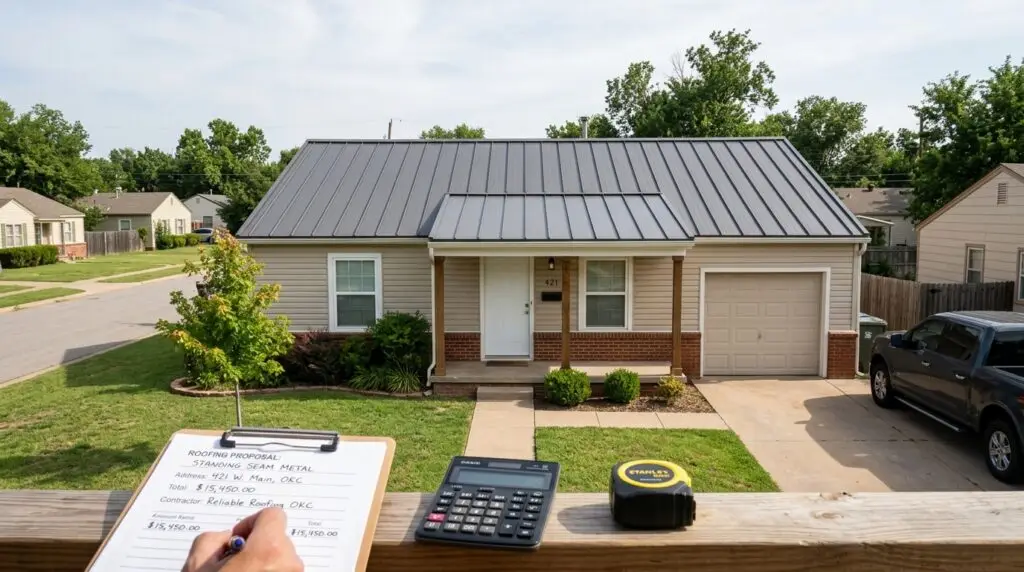
The type of metal roofing system you have determines your leak risk profile significantly. Standing seam panels with concealed floating clips eliminate exposed fastener penetrations entirely which removes the most common point of water entry. These systems are the best choice for Oklahoma City homeowners who want the lowest long-term leak maintenance burden.
Exposed fastener panel systems are less expensive upfront and widely used across the OKC area they’re practical and durable when maintained properly. But they require higher-grade EPDM-gasketed screws, correct torque during installation, and regular inspection to catch washer deterioration before it becomes a leak.
Coatings and Finishes That Resist Oklahoma’s Climate
Kynar 500 (PVDF) finish is the gold standard for Oklahoma City metal roofing. It offers superior UV chalk and fade resistance in high-sun environments and maintains its protective barrier significantly longer than standard paint finishes. Galvalume steel substrate provides the corrosion resistance appropriate for Oklahoma’s humidity levels.
When a coating is compromised by hail impact, by a roofing crew walking the surface without proper footwear, or simply by age bare metal is exposed. That exposure needs to be addressed with rust-inhibiting treatment and compatible coating before it progresses to active corrosion and eventual leak penetration.
Installation Mistakes That Cause Most Metal Roof Leaks
It depends on several factors, but one consistent finding in our inspections is this: when a metal roof in the Oklahoma City area develops leaks, the root cause traces back to installation at least half the time not storm damage, not age, not material failure. Installation errors.
The most common ones worth knowing about:
Misaligned panels poor panel alignment compromises seam overlap and creates irregular gaps that collect water rather than shed it.
Incorrect fastener pattern too few fasteners leave panels with insufficient support against wind uplift, allowing panel flex that opens seam gaps.
Missing or improperly seated closure strips foam closures at eaves and ridges prevent wind-driven rain from entering under panel edges. When these are skipped or compressed incorrectly, that protection disappears.
No secondary sealant at end laps end laps on metal panels need butyl tape or compatible sealant to prevent capillary water intrusion. Skipping this step during installation is one of the most common field errors.
Improper flashing at wall-to-roof transitions this is particularly critical on Oklahoma homes with dormers, additions, or complex rooflines. Poorly executed transition flashing is one of the top failure points we encounter in OKC.
Incompatible metal contact galvanic corrosion occurs when dissimilar metals touch. Aluminum flashing against a steel metal roof, or copper flashing with galvanized components, creates an electrochemical reaction that deteriorates both metals over time.
The lesson here is direct: hiring a contractor with specific metal roofing experience not just general roofing experience matters enormously for long-term leak prevention. Ask your contractor to walk you through how they handle each of these points before work begins.
Repair vs. Replace: Making the Right Decision for Your OKC Metal Roof
Not every leak means a new roof. And not every leak should be patched when replacement is the smarter investment. Here’s a practical framework for thinking through the decision.
Signs Your Metal Roof Can Be Repaired
Isolated fastener failure or sealant breakdown with no widespread panel damage is typically a repair situation. Localized flashing damage following a storm a single pipe boot or a section of ridge cap falls into repair territory. Minor coating chips on otherwise structurally sound panels that can be treated with compatible sealant or touch-up coating are also repair candidates.
In these cases, targeted repairs extend the service life of an otherwise sound system at a fraction of replacement cost.
Signs It’s Time for a Full Replacement
Widespread rust or corrosion affecting multiple panels, multiple recurring leaks across different roof sections, significant panel deformation from wind uplift or hail impact, or a roof approaching the end of its practical service life these all point toward replacement being the wiser investment.
The math changes when the cumulative cost of ongoing repairs begins approaching the cost of a replacement that will perform reliably for decades. A good metal roofing contractor in Oklahoma City will give you an honest assessment of where you fall on that spectrum.
Repair Cost Ranges for Oklahoma City Homeowners
Minor sealant and fastener repairs fall in the low-to-mid hundreds of dollars range depending on the extent. Flashing replacement or more extensive localized repairs run higher into the mid-range based on access, scope, and materials required. Full metal roof replacement is a significant investment, but standing seam systems in particular offer the lowest long-term maintenance cost and strongest storm performance available for OKC residential properties.
If storm damage is involved, your Oklahoma homeowners insurance policy may cover repairs or replacement minus your deductible. This is why documentation before any repair work begins is so important your pre-repair documentation is what supports the claim.
Working With Your Insurance Company After Storm Damage
This section could save you thousands of dollars and most roofing content doesn’t cover it.
If storm-related damage triggers leaks in your metal roofing system, the steps you take immediately after the event shape your claim outcome. Document everything before any repairs begin: photographs of every visible impact point, dent, or displaced component, the storm date, observed hail size, and any weather service data available for your specific OKC area location.
Oklahoma homeowners insurance policies typically include a mitigation requirement, which means you’re expected to prevent additional damage from occurring after the initial event. Emergency tarping of exposed areas, for example, is both practically smart and protects your claim standing.
The difference between a covered storm damage claim and a wear-and-tear exclusion comes down to documentation and timing. A professional metal roofing inspection report with photographs, written findings, and a repair or replacement estimate is the most effective tool you have when working with an insurance adjuster. Look for an OKC-based contractor who is familiar with local storm patterns and knows exactly what metal roof storm damage documentation needs to include.
Questions to Ask Before Hiring a Metal Roofing Contractor in Oklahoma City
Choosing the right contractor is one of the most consequential decisions in the metal roof leak prevention equation. General roofing experience and metal roofing expertise are not the same thing. Before you hire, ask:
Do they specialize in metal roofing systems, or is it a secondary service alongside shingle work? Metal roofing installation and repair requires specific product knowledge and field technique.
Are they properly licensed and insured for Oklahoma roofing work? Verify this independently don’t take it on faith.
What is their labor warranty, and what does it specifically cover? Material warranties from manufacturers mean little if the workmanship warranty doesn’t back up the installation.
Can they provide references from local OKC or metro-area metal roofing projects specifically not just general roofing jobs?
Do they provide a written inspection report, not just a verbal walkthrough? A professional assessment should be documented so you have something to reference, share with your insurer, and hold the contractor accountable to.
Are they familiar with local building codes and permit requirements for Oklahoma City and surrounding municipalities?
In our experience, the contractors who push back on these questions are the ones worth avoiding. A qualified metal roofing specialist in Oklahoma City will answer them directly and confidently.
Frequently Asked Questions About Preventing Metal Roof Leaks in Oklahoma City
Do metal roofs leak more than shingles?
No. A properly installed metal roof is significantly more resistant to leaks than asphalt shingles. Most metal roof leaks result from installation errors or deferred maintenance not a fundamental weakness in the material. In Oklahoma City’s storm environment, a well-maintained metal roof outperforms shingles on leak resistance over time.
How long does metal roof sealant last in Oklahoma?
It depends on the sealant type. Lower-grade silicone products may begin failing in as few as five to seven years under Oklahoma’s UV exposure and thermal cycling. High-quality polyurethane or butyl-based sealants rated for significant thermal movement can last considerably longer when properly applied.
Can hail damage cause a metal roof to leak right away?
Not always and that’s what makes it dangerous. Hail typically chips the protective coating rather than immediately punching through the panel. The leak develops months later as bare metal rusts, weakens, and eventually allows water intrusion. This is why scheduling a professional metal roof inspection after any significant OKC hailstorm matters, even when there’s no visible leak yet.
How often should I have my metal roof inspected in Oklahoma City?
Twice annually spring and fall at a minimum. Additionally, schedule a professional inspection after any storm that produced hail larger than marble size or sustained winds above 60 mph. Oklahoma City’s storm frequency makes post-storm inspections an essential part of proactive metal roof maintenance.
What is the most common cause of leaks in a metal roofing system?
Fastener and sealant failure are the leading causes, particularly in climates with significant thermal cycling like Oklahoma City. Storm-related flashing damage and hail-initiated coating compromise are also leading contributors in the OKC area. In many cases, the root cause traces back to the original installation.
Will my Oklahoma homeowners insurance cover a metal roof leak?
If the leak results from a covered storm event hail, wind, or falling debris most Oklahoma homeowners policies will cover repair or replacement costs minus your deductible. Leaks caused by wear and tear, deferred maintenance, or age-related deterioration are typically excluded. Documentation before repairs begin is essential to a successful claim.
Is a standing seam metal roof less likely to leak than corrugated or exposed fastener panels?
Yes, meaningfully so. Standing seam systems use concealed fasteners and continuous interlocking panel seams, which eliminates the most common water entry points found in exposed fastener systems. For Oklahoma City homeowners prioritizing long-term leak resistance over upfront cost, standing seam is the strongest available option.