It starts with a water stain. A brownish patch on the ceiling, usually near a chimney or bathroom vent. You walk outside, stare up at your roof, and the metal panels look completely fine. No missing pieces. No obvious damage. So where is the water coming from?
Here is the thing on most metal roofs, the panels are not the problem. The flashing is.
Roof flashing is the thin metal component that seals every transition point on your roof: where the panels meet a chimney, a vent pipe, a skylight, a side wall, or a valley. It is a small part of the overall roofing system, but it handles some of the most difficult waterproofing work. When roof flashing fails on metal roofs, water does not just drip in. It travels sometimes for several feet before it shows up on your ceiling.
If you are an Oklahoma City homeowner with a metal roof, this matters even more. OKC weather does not go easy on flashing. Between spring hailstorms, straight-line winds, and summer temperatures that push past 100 degrees, the conditions here accelerate every type of flashing failure. This article breaks down exactly why roof flashing fails on metal roofs, what warning signs to look for, and how to protect your investment before a small problem becomes a very expensive one.
What Roof Flashing Actually Does on a Metal Roof
Most homeowners think of their roof as panels and maybe gutters. Flashing rarely gets mentioned until something goes wrong. But if you look at any metal roof, the flashing is everywhere water wants to sneak in.
The Transition Points Flashing Is Responsible For
Anywhere a metal panel terminates or meets another surface, there is a gap. Flashing bridges that gap and redirects water away from the roof structure. The most common locations include:
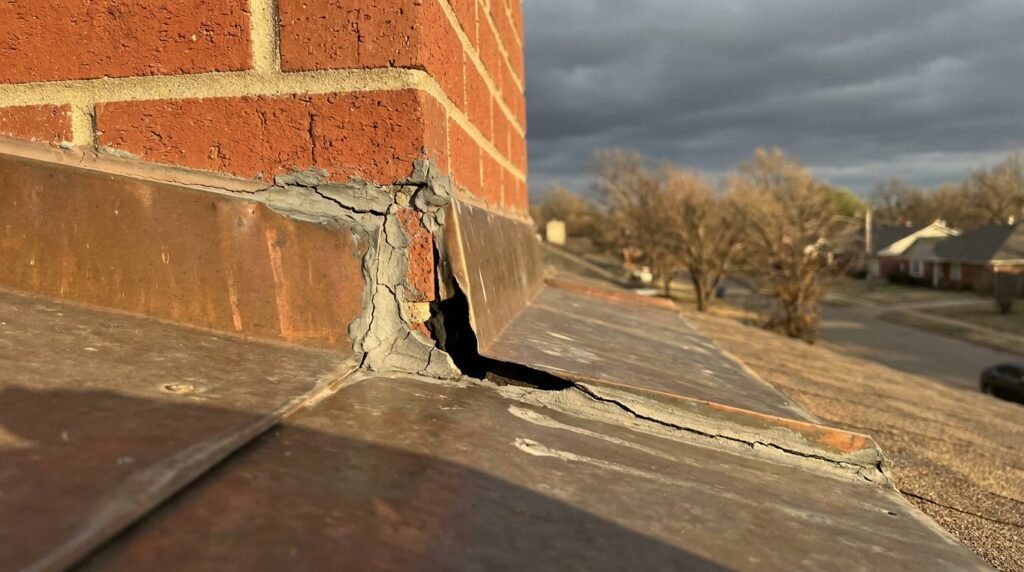
- Chimney bases and chimney sides (step flashing and counter flashing)
- Vent pipes and plumbing penetrations (pipe boot and vent collar flashing)
- Skylights (perimeter flashing)
- Roof-to-wall transitions, including where a lower roof section meets a vertical wall (step flashing and kickout flashing)
- Valleys where two roof slopes meet (valley flashing)
- Eave edges and rake edges (drip edge flashing)
Why Flashing Is More Complex on Metal Roofs Specifically
On an asphalt shingle roof, flashing sits under overlapping shingles. The shingles themselves provide a secondary layer of coverage. On a metal roof, the panel system is engineered differently. The panels are longer, they move more with temperature changes, and there are fewer built-in redundancies at transition points.
This is why flashing on metal roofing systems cannot be an afterthought. It must be designed specifically for the panel type whether that is a standing seam system, an exposed-fastener system, or a metal shake profile. The flashing details that work on one system often fail on another.
The Number One Reason Roof Flashing Fails Poor Installation
In our experience, the majority of metal roof flashing failures we see in the Oklahoma City area trace back to installation problems. Not storms. Not age. Installation. And that matters because it means the leak was preventable from day one.
Common Installation Errors That Cause Early Failure
Poor flashing installation on metal roofs takes several forms. Some are obvious on inspection. Others hide for years until a particularly heavy rain event exposes them.
- Flashing sized for the wrong panel profile leaving gaps where the flashing should be tight against the panel rib
- Sealant used as the primary waterproofing method instead of a proper mechanical overlap caulk is not a flashing system
- Overlaps installed against the direction of water flow water runs under the lap instead of over it
- Missing kickout flashing at wall-to-roof transitions one of the most frequently omitted details in residential roofing, and one of the costliest when it is left out
- Face-fastened flashing with screws placed in the water flow path
- Flashing details that do not match the manufacturer’s specifications for the specific metal panel being installed
| Contractor Insight
Between you and me, the kickout flashing omission is the most common problem we find during metal roof inspections on older OKC homes. It is a small piece of formed metal at the bottom of a wall-to-roof transition. Without it, water runs straight behind the siding. Homeowners sometimes see this damage for years without connecting it to the roof. |
How to Verify Flashing Details Before Your Roof Goes On
If you are having a metal roof installed, ask these questions before work begins:
- Can you show me the manufacturer’s flashing detail drawings for this panel system?
- Is sealant being used to support the flashing detail, or is sealant doing the actual waterproofing work?
- Will kickout flashing be installed at every wall-to-roof transition?
- How will counter flashing be attached at the chimney mechanically set into a reglet, or surface-applied with caulk?
If a contractor cannot answer those questions clearly, that is information you need before writing a check.
How Oklahoma City’s Weather Accelerates Flashing Failure
Oklahoma City sits at a weather crossroads warm, moisture-loaded Gulf air pushing north against cold air moving down from the Rockies. The result is a storm environment that is genuinely one of the most demanding in the country. For metal roof flashing, that translates to stress that homeowners in more moderate climates simply do not deal with.
Wind-Driven Hail Why the Angle of Impact Matters
Most people assume hail falls straight down. In central Oklahoma, it often does not. OKC hailstorms frequently produce hail that falls at steep diagonal angles, driven by 50 to 80 mph winds. That difference matters more than it might seem.
Straight-down hail hits the panel surface. Diagonal, wind-driven hail hits flashing edges, seam joints, and vertical transitions directly. This puts stress on exactly the parts of a metal roof where waterproofing depends on precise fit and sealant adhesion. After a significant OKC hail event, flashing separation at chimneys and skylights is one of the most common damage types we find on post-storm inspections and it is rarely visible from the ground.
Straight-Line Winds and Uplift Pressure
Thunderstorm straight-line winds across the OKC metro regularly hit the 60 to 80 mph range. At those speeds, uplift pressure builds at eave edges and panel terminations. A piece of flashing that was properly sealed can be lifted just enough to break the sealant bond and then settle back down looking completely undisturbed.
That is the dangerous scenario. The flashing looks fine. The leak develops weeks or months later. By the time water appears on a ceiling, the damage path is already established. This is why we strongly recommend a professional inspection after any significant storm event in the OKC area, even when the roof appears intact from the driveway.
Summer Heat, Winter Cold, and Thermal Fatigue
Oklahoma City summers push past 100 degrees. Winters bring below-freezing temperatures and occasional ice storms. That temperature swing sometimes more than 100 degrees of difference between seasonal extremes causes metal roofing panels and flashing components to expand and contract repeatedly through every seasonal cycle.
Each expansion and contraction cycle works at the sealant bond. Over several OKC storm seasons, even correctly installed sealant begins to fatigue. This is normal and expected but it is why flashing inspection and sealant maintenance are necessary on a metal roof, not optional.
What Hail Does to Pipe Boots and Vent Collars
Most pipe boot flashing uses a rubber or EPDM collar to seal around the vent pipe. Direct hail impact degrades these rubber components faster than anything else. A boot that appears intact after a storm may have internal microfractures that allow water infiltration during the next heavy rain. This is a specific vulnerability in OKC’s storm environment that gets overlooked when homeowners inspect from the ground.
Galvanic Corrosion The Flashing Failure Nobody Talks About
Most roofing content mentions rust. Fewer explain galvanic corrosion and on metal roofs, it is a separate and more serious problem.
Galvanic corrosion occurs when two dissimilar metals come into direct contact in the presence of moisture. When this happens, an electrochemical reaction causes the less noble metal to degrade at an accelerated rate. The visible evidence rust streaking, pitting, or flaking at the flashing surface often does not appear until significant degradation has already occurred inside the joint.
On metal roofs, the most common scenario involves aluminum flashing in contact with copper components, or the wrong flashing material used on Galvalume-coated steel panels without a proper separation barrier. These are details that most homeowners have no way to verify after installation which is another reason that choosing the right contractor matters before the job starts.
| Why This Matters in Oklahoma
Oklahoma’s humid spring and summer weather creates the moisture conditions that accelerate galvanic reaction. A flashing incompatibility that might take many years to produce visible damage in a dry climate can progress significantly faster in central Oklahoma’s seasonal humidity. |
Sealant and Butyl Tape Failure The Slow Leak You Will Not See Coming
How Long Should Flashing Sealant Last on a Metal Roof?
Quality sealants rated for metal roofing applications typically carry ratings in the range of 10 to 20 years under controlled conditions. In OKC’s UV environment, summer heat, and storm exposure, real-world performance at the shorter end of that range is realistic for sealant joints that are not periodically inspected and maintained.
Butyl tape used at seams and panel overlaps in many metal roofing systems generally performs well but is not immune to displacement from thermal movement or hail impact. Once butyl tape loses contact with the panel surface, it cannot reseal on its own.
Signs of Sealant Failure to Watch For
You often cannot see sealant failure from the ground. But these are the indicators worth looking for on your own property:
- Cracking or chalky appearance at chimney base flashing, visible through binoculars
- Water stains on interior ceilings or walls that appear or worsen after rain particularly near penetrations
- A musty smell in the attic following rain, even without visible dripping
- Staining or streaking on fascia boards below eave flashing
- Rust-colored streaks running down from flashing locations on the panel surface
Thermal Expansion and Why It Matters More on Metal Roofs
Metal expands when heated and contracts when cooled. Every material does this, but metal roofing panels have a higher coefficient of thermal expansion than most other roofing materials. Across a long standing seam panel, the movement across a full temperature cycle can be significant.
Flashing at panel terminations must accommodate that movement. If a contractor installs flashing using techniques designed for asphalt shingle roofs where panels are short and movement is minimal the rigid attachment points on a metal roof will work against the flashing over time. The flashing pulls. The sealant stretches. Eventually, the seal breaks.
This is precisely why manufacturer-specific flashing details exist. Standing seam metal roofing manufacturers engineer their flashing components to allow for panel movement while maintaining waterproof integrity. A contractor who does not follow those details whether from unfamiliarity or to save time creates a failure mode that may not show up for a year or two, but will show up.
Warning Signs That Your Metal Roof Flashing Is Already Failing
Catching a flashing problem early is the difference between a modest repair and a significant remediation job. Here are the most reliable indicators that something is wrong.
- Water stains on ceilings or walls, particularly near chimney, skylight, or vent locations
- A musty smell in the attic that was not there before mold can begin establishing within 24 to 48 hours of sustained moisture exposure
- Rust streaking visible on the roof panel surface below a flashing location
- Flashing edges that appear lifted, bent, or no longer flush against the panel when viewed through binoculars
- Daylight visible at flashing joints when viewed from inside the attic during daylight hours
- Sealant that appears cracked, dried, or pulled away from the metal surface
- Staining on fascia boards or siding below the roofline
Ground-Level vs. Attic Inspection What You Can Actually See
From the ground with binoculars, you can identify obvious issues: lifted flashing edges, rust streaks, visible gaps, flashing that has separated from a chimney or wall. What you cannot see from the ground is sealant condition, butyl tape displacement, or early-stage separation at seam points.
An attic inspection after heavy rain is often more revealing. Wet insulation, stained roof decking, or rust at nail or screw points gives you direct evidence of active infiltration. Most homeowners do not think to check the attic after a storm, but it is one of the most useful things you can do. If you see anything that looks like moisture damage in the attic staining, wet insulation, rusty fastener heads call for a professional inspection promptly.
Flashing Repair vs. Full Replacement Making the Right Call in Oklahoma City
Not every flashing problem requires a complete overhaul. But it depends on several factors, and getting that assessment wrong in either direction costs money.
When a Spot Repair Makes Sense
Targeted repair is appropriate when the flashing itself is structurally intact but the sealant or mechanical attachment has failed at a specific location. A single pipe boot collar replacement, sealant refresh around an isolated vent, or re-securing a piece of step flashing that was displaced by wind these are contained problems with contained solutions.
The key condition for repair to hold: the underlying flashing material must be in sound condition and correctly installed to begin with. Resealing a piece of flashing that was installed wrong from the start does not fix the installation problem. It extends the timeline before the next failure.
When Full Flashing Replacement Is the Right Move
Full flashing replacement makes sense in several situations:
- Galvanic corrosion has compromised the flashing material itself at that point, new sealant over degraded metal is a temporary fix at best
- The original installation used incorrect details or wrong materials from the start, and spot repairs are only addressing symptoms
- Multiple flashing failure points exist across the roof, indicating a systemic problem rather than isolated wear
- Age plus storm exposure has degraded butyl tape and sealant throughout the system, and the roof is approaching a maintenance threshold
Cost Considerations for Oklahoma City Homeowners
Minor flashing repairs a single pipe boot replacement or sealant refresh at one location sit at the lower end of the repair cost range and are generally affordable to address promptly.
Chimney or skylight re-flashing is a mid-range investment that varies with chimney size, accessibility, and how much of the surrounding panel area needs to be disturbed.
Full perimeter and penetration re-flashing on an older metal roof is a larger investment, but compare it to the cost of addressing water damage in the attic, ceiling, or wall structure below. In our experience, deferred flashing repair consistently costs more in the end than addressing it when it is first identified.
One more thing worth knowing: Oklahoma homeowner’s insurance typically covers flashing failure that results from a covered storm event. If hail or high winds contributed to your flashing problem, document the damage with photos and contact your insurer. Have a qualified metal roofing contractor present during or before the adjuster’s visit if possible.
How to Prevent Flashing Failure on Your Metal Roof Practical Guidance
Prevention is not complicated. It requires attention at the right moments.
- Start at installation. If you are having a metal roof installed, confirm that manufacturer-approved flashing details are being used. Ask specifically about kickout flashing at wall-to-roof transitions it is frequently omitted and rarely noticed until water damage appears behind the siding.
- Confirm material compatibility. Aluminum flashing on certain metal panel types requires a separation barrier. Ask your contractor what flashing material is being used and whether it is compatible with your specific panels.
- Schedule inspections before storm season. The OKC spring storm season typically runs March through June. A brief professional inspection before it begins can identify sealant fatigue or minor displacement before the first significant storm of the season aggravates it.
- Inspect after significant storms. You do not need to climb on the roof. Binoculars from the ground plus an attic check will identify most active issues. If a storm was significant enough to dent your gutters or HVAC cap, it was significant enough to warrant a closer look at your flashing.
- Keep debris off the roof. Leaves and debris trapped against flashing at chimney bases or valley areas create sustained moisture contact that accelerates corrosion. Clearing the roof after fall and after major storms reduces that risk.
- Do not rely on caulk as a long-term waterproofing solution. Caulk applied to a flashing problem is a temporary measure. It is not a flashing system. If a contractor offers a caulk-only repair for a structural flashing problem, that is a flag worth paying attention to.
- Ask about Class 4 impact resistance. If you are in the market for a metal roof, Class 4 impact-resistant metal roofing may qualify for a homeowner’s insurance premium discount in Oklahoma. Confirm this with your insurer before installation the savings over time can be meaningful.
Frequently Asked Questions
Why does roof flashing fail more often than the metal panels themselves?
Metal panels are a single engineered surface. Flashing bridges transitions chimneys, vents, valleys, walls where movement, material incompatibility, and sealant dependency all create compounded failure risk. The panel sheds water. The flashing is responsible for the places water wants to go around.
How long does flashing last on a metal roof?
Quality flashing on a properly installed metal roof can last 20 to 30 years or more. Sealant and rubber components typically need attention within a 5 to 15 year window depending on weather exposure. In Oklahoma City’s storm environment, plan for periodic inspections rather than assuming a set-it-and-forget-it lifespan.
Does homeowners insurance in Oklahoma cover metal roof flashing failure?
Oklahoma homeowner’s policies generally cover flashing failure caused by a covered storm event hail, wind, or similar sudden damage. Gradual wear from deferred maintenance is typically excluded. Document post-storm damage with photos and have a qualified roofing contractor review the damage before and during the adjuster’s visit.
What is the most common flashing failure point on a standing seam metal roof?
Chimney counter flashing, pipe boot vent collars, and wall-to-roof transitions where kickout flashing was omitted are the most frequent failure points. Valley flashing is also a common source of leaks after significant hail events, as the valley concentrates both impact and water volume.
What is galvanic corrosion and why does it matter for metal roof flashing?
Galvanic corrosion occurs when two dissimilar metals contact each other in the presence of moisture, causing the weaker metal to degrade rapidly. On metal roofs, using aluminum flashing with certain panel types without a separation barrier can trigger this reaction. It is invisible in the early stages and often only discovered during a professional inspection.
How does Oklahoma City’s weather specifically affect flashing?
OKC produces wind-driven hail that falls at steep angles, putting direct stress on flashing edges and seam joints. Straight-line winds of 60 to 80 mph create uplift pressure that breaks sealant bonds. Summer heat above 100 degrees and below-freezing winters produce thermal cycling that fatigues sealant over time. The combination is more demanding than most climates.
Can I repair metal roof flashing myself?
Minor sealant maintenance at a single, accessible vent can be manageable for a careful homeowner. Anything involving step flashing, counter flashing, valley flashing, or kickout flashing should be handled by a professional. Flashing repair requires precise overlap direction and material compatibility getting it wrong creates new leak paths rather than solving the existing one.
Related Resources
For more information, explore our guides and services: