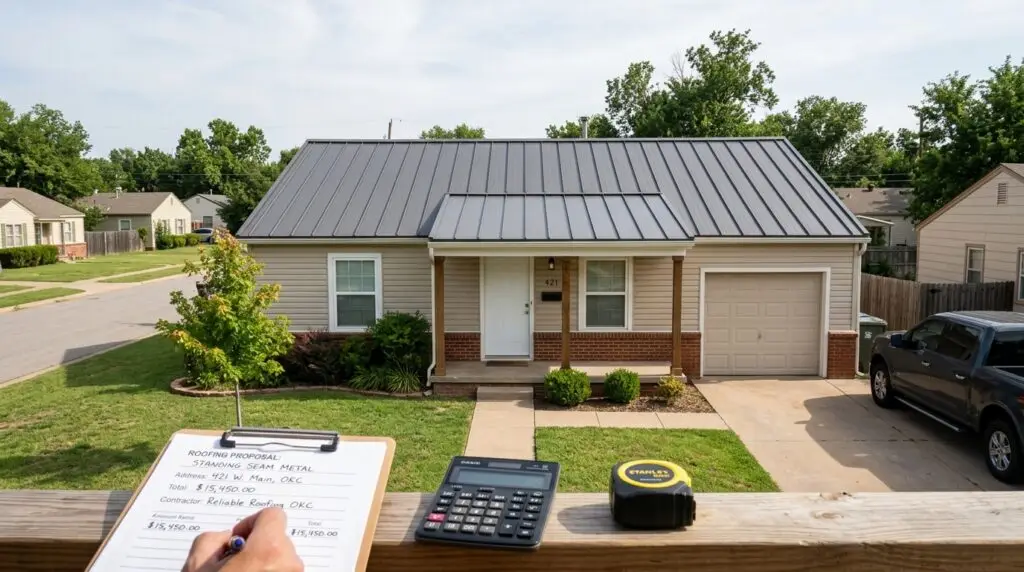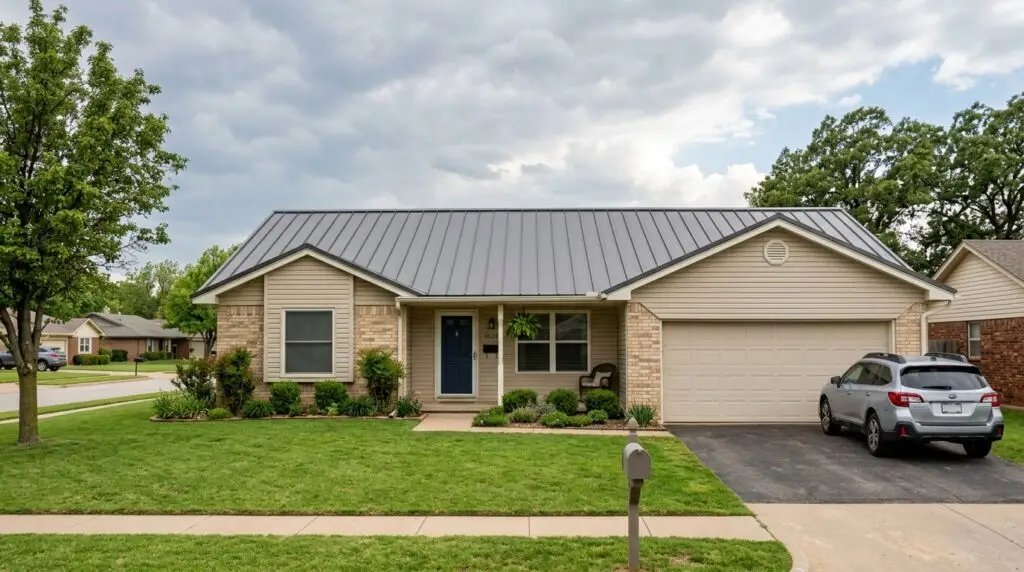
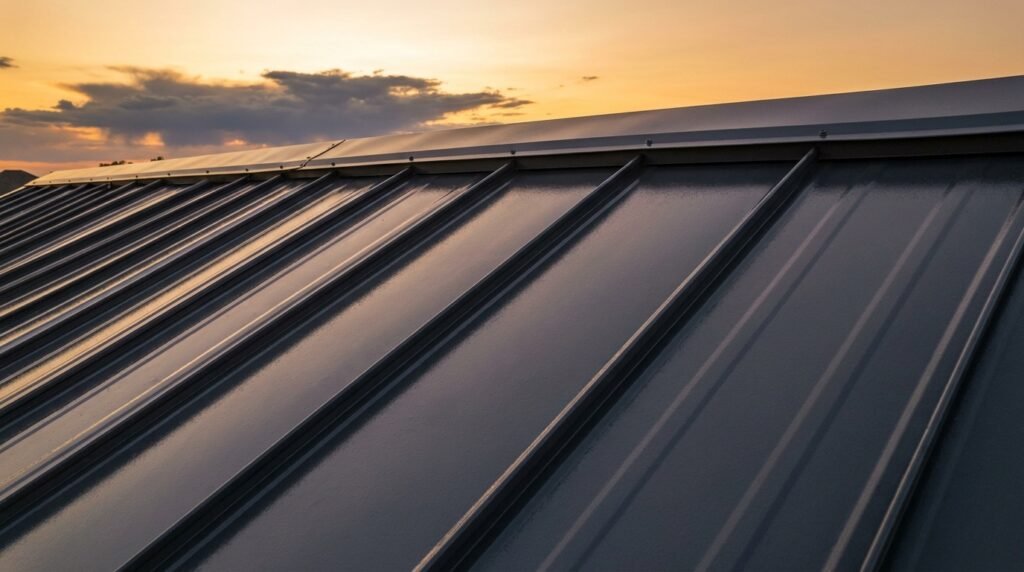
If you’re asking how long metal roof coatings last, you already know there’s a difference between a manufacturer telling you “40 to 70 years” and what actually happens on a roof in Central Oklahoma. Between the hail, the summer heat cresting past 100°F, and the kind of thermal swings that push panels through expansion and contraction cycles every single year Oklahoma is not an average roofing climate.
Most homeowners don’t realize there are actually two distinct categories of metal roof coatings: the factory-applied finish that comes on your panels from the manufacturer, and the field-applied restoration coatings that a contractor applies after installation. They behave differently, last different lengths of time, and fail for different reasons. Mixing these categories up leads to bad decisions and contractors who don’t clarify the difference aren’t doing you any favors.
This guide gives you a straight answer, a realistic breakdown by coating type, and the OKC-specific context that most national articles completely ignore.
The Direct Answer: Metal Roof Coating Lifespan in Oklahoma City
Voice search answer: Metal roof coatings in Oklahoma City typically last 10 to 20 years for field-applied restoration coatings, and 20 to 40 years for factory-applied finishes but Oklahoma’s hail, UV intensity, and thermal cycling consistently shorten those ranges compared to national averages.
Here’s the thing coating lifespan depends heavily on which type of coating you’re talking about:
- Factory-applied coatings (PVDF/Kynar 500, Galvalume substrate finishes): 20–40 years under Oklahoma conditions
- Field-applied acrylic coatings: 7–12 years in OKC’s climate
- Field-applied elastomeric coatings: 10–18 years depending on thickness and application quality
- Field-applied silicone coatings: 12–18 years
- Field-applied polyurethane coatings: 10–14 years
Every one of those ranges runs shorter than what you’ll read on a national roofing blog. That’s not pessimism it’s Oklahoma. The UV radiation in Central Oklahoma, the active hail corridor that puts us among the most storm-exposed metros in the country, and the daily thermal cycling all accelerate coating degradation in ways that manufacturer lab tests don’t fully capture.
Factory-Applied Coatings vs. Field-Applied Coatings: Why the Distinction Matters
This is the detail most articles skip, and it’s the one that matters most when you’re trying to evaluate what your roof actually needs.
What Comes on Your Metal Roof From the Manufacturer
When a metal panel is manufactured, it leaves the factory with a protective system already applied. On steel panels, that typically means a Galvalume substrate an aluminum-zinc alloy coating that provides corrosion resistance at the base level. Over that, most quality panels receive a paint finish. Premium systems use PVDF (polyvinylidene fluoride) coatings marketed under names like Kynar 500 which offer superior UV resistance and color stability. Lower-tier panels use standard polyester paint systems, which cost less upfront and show it over time.
Factory finish warranties typically run 30–40 years for PVDF systems, shorter for polyester. What the warranty covers matters most cover chalking and fading to a defined threshold, not full cosmetic perfection. In Oklahoma, a PVDF finish on a quality standing seam panel is genuinely one of the better long-term coating investments you can make, because it handles UV and thermal movement well.
What a Roofing Contractor Applies in the Field
Field-applied coatings are a different product category entirely. These are liquid-applied systems acrylic, silicone, elastomeric, or polyurethane that a contractor sprays or rolls onto an existing metal roof. They serve as a restoration layer: refreshing a degraded surface, adding reflectivity, improving waterproofing, or extending the serviceable life of panels that are still structurally sound but showing coating wear.
In our experience, homeowners call asking about “recoating” when they’ve noticed chalking, fading, or streaking on their panels. That’s the right instinct catching coating degradation before it becomes a substrate problem is always the smarter move. But knowing which product is right for your specific roof, substrate, and local conditions is where it gets complicated.
How Oklahoma City’s Climate Specifically Shortens Coating Life
Oklahoma City sits at an intersection of three climate stressors that most roofing markets don’t have to deal with simultaneously. Understanding them explains why national lifespan estimates almost always need to be adjusted downward for this market.
UV Radiation and Heat Above 100°F
Central Oklahoma receives intense UV radiation throughout the summer, and sustained temperatures above 100°F aren’t unusual from June through August. This combination attacks coating chemistry directly. Polyester finishes chalk and fade noticeably faster here than in milder climates. Even acrylic field coatings lose reflectivity faster when they’re baking under this level of UV exposure day after day.
PVDF coatings hold up significantly better their fluoropolymer chemistry resists UV degradation at a molecular level, which is exactly why they command a higher price point. If your metal roof has a standard polyester factory finish and it’s approaching 10–15 years old, the Oklahoma sun has almost certainly taken a toll worth evaluating.
Hail Impact on Coating Integrity
Oklahoma City sits within one of the most active hail corridors in the United States. This isn’t just a wind-and-rain problem it’s a coating-specific problem that most articles don’t address clearly.
Here’s what actually happens: hail that dents a metal panel but doesn’t breach it structurally can still chip, crack, or delaminate the coating at the impact point. Once that coating is compromised even in a pinhole-sized area UV radiation now has direct access to the substrate. On Galvalume steel, that’s manageable for a period. On lower-quality galvanized panels or bare steel, rust development can begin within a single Oklahoma storm season.
Class 4 impact-rated panels resist this better than lower-rated systems, but no panel is completely immune to coating impact damage in a large hail event. A post-storm coating inspection after any significant hail event in the OKC metro Moore, Edmond, Yukon, Midwest City, Norman isn’t optional if you want to stay ahead of corrosion.
Thermal Cycling: The Slow Killer
Oklahoma’s temperature swings are dramatic. A roof panel that’s 160°F on a July afternoon might be below freezing in January. That expansion-and-contraction cycle happens every single day across every season, and it puts stress on coating adhesion at every fastener point, seam, and penetration.
Elastomeric coatings are specifically engineered to handle this they flex with the metal rather than fighting it. This is one reason elastomeric systems tend to outperform rigid acrylic coatings in Oklahoma’s environment. A coating that can’t move with the metal will eventually develop adhesion failures at the points of greatest movement.
Metal Roof Coating Lifespan by Type: Oklahoma City Estimates
The table below compares national average coating lifespans with realistic estimates for Oklahoma City’s climate. Use these as planning benchmarks, not guarantees actual performance depends on application quality, maintenance, and storm exposure history.
| Coating Type | National Avg. | OKC Estimate | Best For |
| PVDF / Kynar 500 (factory) | 25–40 years | 20–35 years | UV resistance, color retention |
| Galvalume substrate (factory) | 25–40 years | 20–35 years | Corrosion resistance on steel |
| Elastomeric (field-applied) | 12–20 years | 10–18 years | Thermal cycling, hail exposure |
| Silicone (field-applied) | 15–20 years | 12–18 years | Ponding water, flat roofs |
| Acrylic (field-applied) | 10–15 years | 7–12 years | Reflectivity, budget projects |
| Polyurethane (field-applied) | 10–15 years | 10–14 years | Impact/hail zones, commercial |
Important: These OKC estimates assume professional application, correct substrate preparation, and at least biannual inspections. DIY application or skipped maintenance will compress these ranges significantly.
What Actually Shortens a Metal Roof Coating’s Life: A Contractor’s Honest Take
Between you and me, the most common reason a coating fails early has nothing to do with the product itself. It’s what happened or didn’t happen before the coating was applied.
Poor Surface Preparation
This is the number one coating failure cause we see. Applying a restoration coating over chalky residue, loose rust, or inadequately cleaned panels doesn’t give the product anything to bond to. A coating that should last 15 years under proper conditions might fail adhesion in 3–5 years when applied over inadequate prep. Professional contractors use commercial-grade cleaners and perform full surface assessment before any coating product touches the roof. If a contractor skips this step or doesn’t mention it in their process that’s your first red flag.
Wrong Coating for the Substrate
Galvanized steel, Galvalume, and aluminum all interact differently with coating chemistries. A product that performs well on one substrate can have adhesion problems on another. This isn’t theoretical it’s a documented failure mode that shows up 18–24 months after installation when coating begins peeling at the edges of panels.
Insufficient Mil Thickness
Every coating product has a specified application rate measured in mils (thousandths of an inch) when dry. Thin-applying a coating to cover more square footage per bucket saves money upfront and costs the homeowner years of lifespan. In Oklahoma’s thermal cycling environment, a coating applied at 75% of recommended thickness will fail noticeably sooner at seams and fastener points.
Ignoring Maintenance After Application
Coatings are not set-and-forget systems. Most manufacturers recommend biannual inspections spring after hail season, fall before the freeze cycle. Minor coating breaches caught at inspection can be spot-repaired for minimal cost. The same breach ignored through a full Oklahoma storm season can allow moisture under the coating, accelerating delamination across a much larger area.
Signs Your Metal Roof Coating Is Failing
Catching coating degradation early is the difference between a targeted repair and a full recoat project. Here’s what to look for especially after an Oklahoma storm season:
- Chalking: A chalky white residue when you run your hand across the panel surface indicates UV breakdown in the coating binder. This is a normal aging process but signals that coating protection is declining.
- Visible fading or bleaching: Particularly pronounced on south-facing slopes that absorb the most Oklahoma sun. If your roof color looks significantly different from the shaded north slope, the coating is degrading unevenly.
- Peeling or bubbling at seams or fastener points: Adhesion failure typically starts at the points of greatest thermal movement seams, fastener locations, and penetrations.
- Rust staining or streaking on panel surfaces: Rust-colored streaking means a coating breach has allowed moisture to reach the steel substrate. This requires prompt attention corrosion spreads.
- Interior water staining after a storm: Metal roof leaks almost never come through intact panels. If you’re seeing water inside, the source is almost always a coating or sealant failure at a penetration, flashing transition, or fastener point.
- Rising energy bills: A degraded reflective coating loses its heat-rejection value. If your cooling costs have crept up without an obvious explanation, the roof’s thermal performance may have declined.
Recoat or Replace? Making the Right Call for Your OKC Home
This is the question we get most often once a homeowner realizes their coating is degrading. It depends on several factors, and the honest answer isn’t always the same.
When Recoating Makes Financial Sense
Recoating is the right move when your metal panels are structurally sound no active rust penetration through panel thickness, no panel deformation from structural hail impact, and no more than one or two existing coating layers already applied. If your roof is under half its expected lifespan and the substrate is clean and intact, a quality restoration coating can extend serviceable life by 10–20 years at a fraction of full replacement cost.
For OKC homeowners, this often makes sense on commercial metal buildings and on residential roofs where the panels themselves have held up but the original factory polyester finish has run its course after 12–18 years of Oklahoma weather.
When You Need Replacement, Not a Recoat
Recoating over active rust penetration is money spent on a problem you’re not solving. Once corrosion has worked through panel thickness or structural hail damage has deformed panels coating over it delays the inevitable while adding cost. Multiple existing coating layers also create adhesion problems; there are limits to how many times a field coating can be reapplied before the cumulative layer system loses its integrity.
If your metal roof is approaching 30–40 years in Oklahoma conditions and showing multiple failure signs, a replacement conversation is worth having. The cost comparison between a quality recoat and a full replacement isn’t always as wide as homeowners expect, particularly when you factor in the lifespan extension a new system delivers.
What Recoating Costs in the Oklahoma City Area
Recoating project costs in OKC vary based on roof pitch and accessibility, existing coating condition and required prep work, coating product selected (acrylic vs. silicone vs. elastomeric), total square footage, and number of penetrations requiring detail work.
Getting multiple bids from established metal roofing contractors in the OKC metro not general roofing companies who occasionally do metal work will give you the most accurate picture. Be skeptical of quotes that don’t include a detailed prep scope. Surface preparation is where corners get cut, and it’s the single biggest factor in whether your recoat performs for 15 years or 5.
How to Extend the Life of Your Metal Roof Coating in Oklahoma
In our experience, homeowners who follow a consistent maintenance routine get noticeably more life out of their coating than the baseline estimates. Here’s what actually works:
- Schedule biannual inspections: Spring inspections after hail season catch storm-related coating breaches before Oklahoma’s summer heat accelerates them. Fall inspections identify any sealant or fastener issues before the freeze cycle.
- Use low-pressure washing only: Pressure washing strips coatings and drives water under panel seams. A low-pressure rinse or commercial-grade soft wash is what professional contractors use for metal panel cleaning.
- Refresh sealants every 3–5 years: At fastener points, penetrations, ridge caps, and flashing transitions these are your highest-movement areas and where sealants degrade fastest in Oklahoma’s thermal cycling.
- Keep gutters and valleys clear: Metal roofs shed water efficiently and in volume. Clogged gutters force that water back under eave flashing, where it contacts and degrades coating at the edge one of the less obvious but common failure points.
- Document your roof’s condition before storm season: Photograph all slopes from multiple angles in early spring. This pre-storm documentation is valuable if a hail event triggers an insurance claim it establishes pre-existing condition clearly.
- Never walk on panels in street shoes: Concentrated foot traffic dents lighter-gauge panels and can crack coatings at the contact points. If roof access is needed, use proper footwear and technique, or let your contractor handle it.
Metal Roof Coating Warranties: What They Actually Cover
Factory Finish Warranties
PVDF paint system warranties typically run 30–40 years and cover chalking and fading to specific thresholds not cosmetic perfection. What most homeowners miss: applying an incompatible field coating over a factory PVDF finish can void the factory warranty entirely. Before any recoating project on a relatively new metal roof, verify compatibility with the original manufacturer’s documentation.
Standard polyester factory finishes carry shorter warranties, often 10–15 years, which reflects their more limited UV performance. If your contractor is quoting a premium metal roof with a polyester finish rather than PVDF, that’s worth questioning directly.
Contractor-Applied Coating Warranties
Field-applied coating warranties typically range from 5–15 years and cover two distinct things: the material performance (product warranty from the manufacturer) and the workmanship (contractor warranty). In Oklahoma’s contractor market, the workmanship warranty is only as good as the company standing behind it a five-year warranty from a contractor who may not be in business in three years provides limited practical protection.
Ask any contractor for their workmanship warranty terms in writing, and ask directly how long they’ve operated in the OKC metro. Established local contractors have a reputation at stake in ways that out-of-state storm chasers do not.
How Oklahoma Storm Damage Affects Warranty Claims
Most coating warranties explicitly exclude storm impact damage. This creates an important distinction: hail damage to a coating is typically an insurance matter, not a warranty matter. Keeping those two claims processes separate and maintaining documentation to support each protects Oklahoma homeowners from getting bounced between an insurer and a manufacturer without resolution.
Oklahoma City Insurance Considerations for Metal Roof Coatings
Most homeowners don’t think about coating condition in the context of insurance until after a storm which is often too late to establish the baseline you need.
Many Oklahoma carriers offer premium discounts for Class 4 impact-rated metal roofing systems. If your metal roof carries that rating and you haven’t discussed it with your insurer, that’s a conversation worth having before your next renewal.
Coating condition also affects how claim disputes get resolved. If your roof has visible pre-existing coating degradation when an adjuster arrives after a storm, they may attribute some damage to deferred maintenance rather than the storm event itself limiting your covered claim. Annual documentation of coating condition gives you a clear pre-storm baseline that protects your position.
After any significant hail event in the OKC metro whether it hit Moore, Edmond, Yukon, or your specific neighborhood schedule a professional metal roof inspection before filing a claim. A documented assessment of what the hail actually caused, versus what was pre-existing, makes the claims process significantly cleaner.
Note: Always consult your specific insurance carrier and policy for coverage details. Policy terms vary, and this is general guidance, not insurance advice.
Frequently Asked Questions About Metal Roof Coating Lifespan
Q: How long does a metal roof coating last in Oklahoma City?
Factory-applied PVDF coatings typically last 20–35 years in Oklahoma City’s climate. Field-applied restoration coatings acrylic, silicone, or elastomeric generally last 7–18 years depending on the product, application quality, and storm exposure. Oklahoma’s UV intensity and hail activity shorten these ranges compared to national averages.
Q: How often should you recoat a metal roof in Oklahoma?
Most metal roofs in Oklahoma benefit from a recoating evaluation every 10–15 years, with biannual professional inspections to catch early coating failures. Roofs that have experienced multiple significant hail events should be evaluated sooner.
Q: Does hail in Oklahoma damage metal roof coatings?
Yes. Even hail that doesn’t structurally damage a panel can chip or crack the coating at impact points. Those breach sites allow UV and moisture direct access to the substrate, accelerating corrosion especially on steel panels. A post-storm inspection after any significant hail event is important.
Q: What is the best coating for a metal roof in Oklahoma?
For factory finishes, PVDF (Kynar 500) significantly outperforms standard polyester under Oklahoma’s UV conditions. For field-applied restoration coatings, elastomeric and silicone products perform well due to their flexibility in thermal cycling and moisture resistance. Polyurethane offers the best impact resistance for hail-prone commercial roofs.
Q: Can you recoat a metal roof instead of replacing it?
Yes when the metal panels are structurally intact with no rust penetration and the substrate is properly prepared. Recoating is a cost-effective restoration option when performed at the right time. If panels are structurally compromised or corrosion has penetrated through the metal, replacement is the correct call.
Q: What are the signs that a metal roof coating is failing?
Key signs include chalking or powdery residue on panel surfaces, visible fading especially on south-facing slopes peeling or bubbling at seams and fastener points, rust staining or streaking, interior water staining after storms, and unexplained increases in cooling costs.
Q: Does a metal roof coating improve energy efficiency in Oklahoma?
Yes. High-quality reflective coatings particularly white or light-colored elastomeric and acrylic systems reflect solar radiation and can reduce rooftop surface temperatures noticeably. In Oklahoma City’s intense summer heat, this translates to lower cooling loads and reduced energy costs over the coating’s lifespan.
Get a Professional Coating Assessment for Your Oklahoma City Metal Roof
If your metal roof is showing signs of coating wear or you simply haven’t had it professionally evaluated in the last few years a professional inspection is the most useful next step. Oklahoma’s storm environment makes proactive coating maintenance significantly more valuable than reactive repair.
A qualified metal roofing contractor can assess your current coating condition, identify any hail or UV damage that’s accelerating degradation, and give you honest guidance on whether recoating or replacement makes more financial sense for your specific situation. That assessment costs far less than discovering a substrate corrosion problem that proper coating maintenance would have prevented.