Metal roofs have a well-earned reputation for durability. They handle Oklahoma’s brutal storm seasons, shrug off UV exposure, and outlast asphalt shingles by decades. But here’s the thing most homeowners don’t realize until there’s a water stain on the ceiling: the panels themselves rarely fail first. The fasteners do.
Metal roof fasteners loosen over time and when they do, the consequences can quietly escalate from a small maintenance issue into a significant leak, structural damage to your roof decking, and a costly repair bill that could have been avoided. Understanding why this happens, what accelerates it in Oklahoma City’s climate, and what to do about it is the difference between a roof that performs for 30+ years and one that becomes a problem long before its time.
What Metal Roof Fasteners Actually Do And Why Their Hold Matters
Every metal roof is anchored to the structure beneath it through a system of fasteners. On most residential and commercial metal roofs, those fasteners are heavy-duty screws that pass through the metal panel and thread into the wood decking below. Without them, a 60 mph Oklahoma thunderstorm wind would have a very short conversation with your panels.
The Two Types of Metal Roof Fastener Systems: Exposed vs. Concealed
There are two primary fastener approaches, and they behave very differently over time.
Exposed fastener systems drive screws directly through the face of the metal panel. The screw head sits on the panel surface, sealed by a washer underneath it. These systems are common, affordable, and widely used but every screw is an exposed penetration point on your roof.
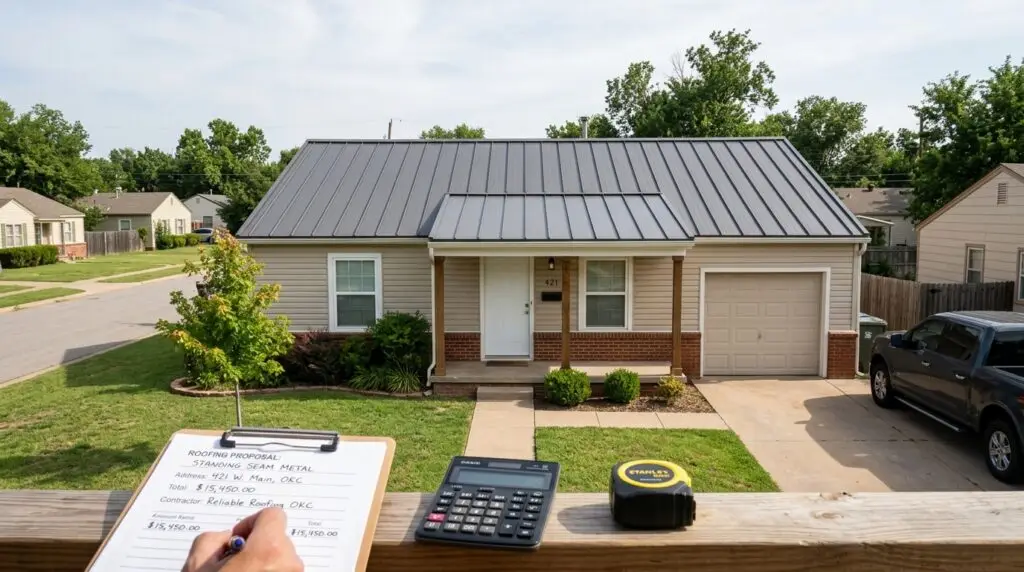
Concealed fastener systems (commonly called standing seam) attach the metal panels using clips that sit hidden beneath the raised seams. The screw never penetrates the panel surface that faces the weather. This design fundamentally changes the long-term maintenance picture.
What the Neoprene Washer Does And Why It’s the First Thing to Fail
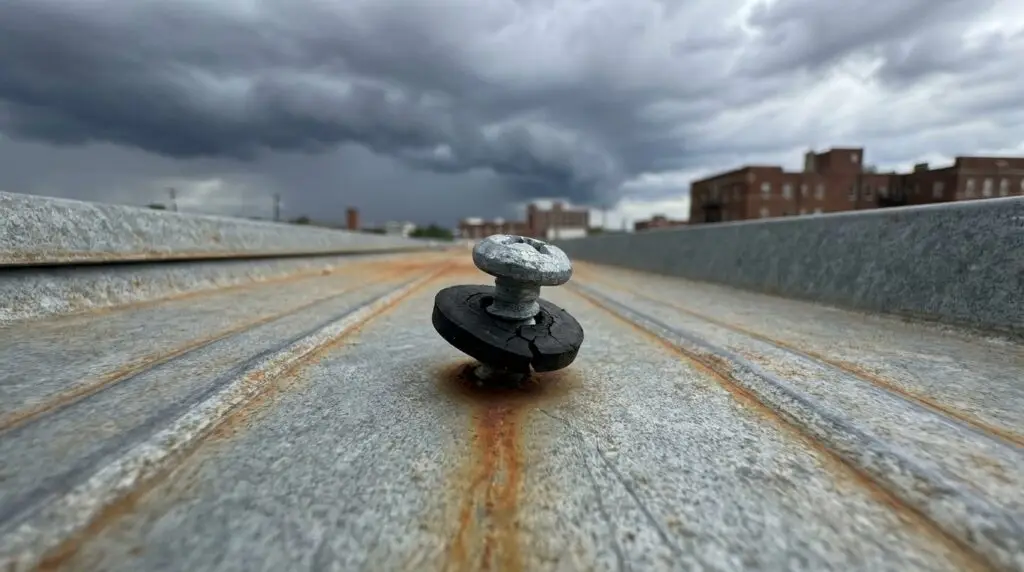
On an exposed fastener system, the neoprene rubber washer under each screw head is doing a critical job: it compresses against the panel surface to create a waterproof seal at the penetration point. When that washer is healthy, water sheds off. When it fails cracks, hardens, or loses compression water finds its way through.
The washer is almost always the first component to show wear. UV radiation and repeated temperature swings degrade rubber faster than metal. In Oklahoma’s climate, that degradation happens on an accelerated schedule compared to milder parts of the country.
The #1 Cause Thermal Expansion and Contraction in Oklahoma’s Climate
If you want to understand why metal roof fasteners loosen over time, start here. This is the root cause behind the majority of fastener issues on exposed fastener roofs, and it’s a physics problem that never stops.
How Temperature Swings Force Metal Panels to Move Repeatedly
Metal expands when it heats up and contracts when it cools down. Every metal roof panel does this every single day. In summer heat, panels grow slightly longer. When temperatures drop overnight, they shrink back. This sounds minor until you consider the cumulative math: thousands of these cycles over years, each one pulling and pushing against the fastener anchor points.
Think of it like bending a piece of wire back and forth. The wire doesn’t break on the first bend. Or the hundredth. But eventually, the repeated stress causes failure. Fasteners experience the same principle not bending, but gradual backing out of the substrate as the panel moves and the wood beneath compresses and releases over time.
Why Oklahoma City’s Climate Accelerates This Faster Than Most U.S. Regions
In our experience working with roofs across central Oklahoma, the thermal cycling problem here is more severe than most homeowners expect. Oklahoma City doesn’t just have cold winters and hot summers. It has rapid, dramatic temperature swings a 70°F day in February followed by a hard freeze the next morning, a 100°F July afternoon that cools 40 degrees after a late thunderstorm.
Spring and fall in OKC are particularly brutal for fasteners. The temperature can swing 40 to 50 degrees within a single 24-hour period. Each of those swings is another cycle of expansion and contraction stressing every exposed fastener on the roof. Standing seam systems handle this significantly better because the concealed clip design allows panels to “float” expanding and contracting without placing stress on a fixed penetration point.
Installation Errors That Make Loosening Happen Faster
Not all fastener problems are born from time and weather. Some begin the day the roof goes on and they just take a few years to show themselves.
Overdriven Screws The Most Common Installer Mistake
An overdriven screw is one where the installer applied too much torque, compressing the neoprene washer past its optimal compression point. On day one, an overdriven fastener looks fine. But that washer has already been deformed beyond its design limits. UV exposure finishes the job within a few years rather than a decade or more.
A properly installed fastener should compress the washer just until it slightly mushrooms at the edges enough to seal, not enough to deform. It’s a specific feel that experienced metal roofing contractors develop. Speed-driven crews with screw guns cranked to maximum torque skip that nuance, and the roof pays for it over time.
Underdriven Screws, Wrong Angle, and Wrong Fastener Type
Underdriven screws never achieve full grip to begin with. Thermal cycling then finishes the job, working the fastener progressively looser over the first few years until it backs out completely.
Screws driven at even a slight angle pull unevenly against the panel and the decking. That uneven load stress accelerates loosening on one side while leaving the other side seemingly intact creating a partial seal that’s actually worse than a fully failed one, because water infiltrates while the screw still appears functional.
Wrong fastener material is another issue. Using screws without proper corrosion-resistant coatings, or pairing incompatible metals, creates galvanic corrosion at the fastener point. The screw deteriorates from the outside in, losing its structural integrity while still appearing to be in place.
Too Few Fasteners Per Panel A Wind-Uplift Risk in Oklahoma
Oklahoma City thunderstorms regularly produce straight-line winds in the 60 to 80 mph range. When a roof has fewer fasteners per panel than the design calls for, each fastener carries more of the uplift load during those events. That repeated uplift stress panels flexing up and releasing works fasteners loose faster than thermal cycling alone.
This is one reason why metal roofing installation in Oklahoma requires contractors who understand the local wind environment, not just generic installation specs from a product manual.
How Oklahoma City Storms Accelerate Fastener Failure
This is where OKC’s environment creates a problem that most out-of-state roofing content never addresses: storm exposure doesn’t just damage roofs in obvious ways. It degrades fastener integrity gradually, invisibly, and cumulatively.
Wind-Driven Hail and Angular Impact Stress on Fastener Points
Oklahoma’s supercell thunderstorms are a different animal from the typical storm in most of the country. The rotational dynamics and high winds associated with these systems frequently produce hail moving at steep angles sometimes nearly horizontal. That matters for fasteners because wind-driven hail doesn’t just hit the flat surface of a panel. It hits screw heads, seam edges, and attachment points at angles that put direct mechanical stress on the fastener itself.
On an exposed fastener system, a hailstone striking a screw head at velocity applies a force the fastener wasn’t designed for. Repeated across dozens of storms over a roof’s life, that cumulative impact stress weakens the washer seal and can begin working screws out of the decking.
How Straight-Line Winds Create Uplift That Works Fasteners Loose
High winds create uplift pressure a lifting force at the panel edges and field that tries to pull the panel away from the roof deck. Properly installed fasteners at appropriate spacing resist this. But every high-wind event flexes the panels against the fastener hold. After enough events, screws that were tight begin to show slight backing-out. Washers that were sealed begin to separate from the panel surface.
Communities in Moore, Midwest City, and Del City sit in documented high-frequency storm corridors and see this cumulative effect more than other parts of the metro.
Cumulative Storm Damage When No Single Event Is Dramatic Enough to Notice
Here’s the fastener problem that gets homeowners into real trouble: most significant fastener loosening in Oklahoma doesn’t come from one catastrophic storm. It comes from three moderate storms over two years, none of which seemed dramatic enough to warrant a roof inspection.
After the first storm, a few fasteners have shifted slightly. After the second, those fasteners have backed out enough that the washer is no longer sealing properly. After the third, water is infiltrating at those points but the leak won’t show up inside the house for another few months, after rain has worked its way through the underlayment. By the time you see a water stain on your ceiling, the process has been underway for a long time.
The Role of the Wood Decking Beneath Your Metal Roof
Most people focus on the screw and the washer when they think about fastener failure. Most competitors’ articles stop there too. But there’s a third component in the system that deserves attention: the wood decking the screw threads into.
How Moisture in the Decking Weakens Fastener Grip Over Time
A fastener holds because its threads grip wood fibers in the decking. That grip depends on those wood fibers staying dense and dry. When the decking gets wet either from a failed fastener seal above it or from ambient moisture over time those wood fibers soften. The screw hole can enlarge slightly as the wood swells and contracts through moisture cycles. After enough of those cycles, a screw that still looks perfectly normal from the outside may have lost a significant portion of its holding power.
Oklahoma Humidity and What It Does to Roof Substrate Wood
Oklahoma’s climate creates a particular challenge here. The wet, humid springs followed by dry summers followed by wet falls put roof decking through repeated moisture cycles. This is why a surface-only inspection of exposed fasteners just looking at whether the screw is backed out tells only part of the story.
In our experience, an attic inspection looking up at the decking from inside can reveal moisture staining patterns that identify weakened fastener zones before the screw has visibly moved. If you’re seeing dark staining or soft spots on the decking boards from inside the attic, the fasteners in that zone deserve close attention on the next inspection.
Warning Signs Your Metal Roof Fasteners Are Backing Out
Catching fastener problems early is the difference between a targeted repair and a water damage remediation project. Here’s what to look for and how to look for it safely.
Signs Visible From the Ground
Most homeowners won’t catch every fastener issue from ground level, but certain signs are worth watching for:
- Screw heads that sit visibly higher than the panel surface if a screw head appears to be lifting away from the panel, it has backed out of the decking
- Rust streaking running down the panel face below a fastener point the screw or washer has failed and water is reacting with bare metal at the penetration
- Panels that look rippled, slightly lifted, or out of alignment panel movement is often the visible symptom of fastener loss beneath
- Flashing at chimneys, vents, or edges that no longer sits flat loose fasteners affect how flashing sits and seals
Signs You Can Only Find on Inspection
A visual ground inspection is a starting point, not a conclusion. A proper inspection identifies:
- Screws that turn without resistance when torque-tested the grip is gone, even if the screw looks intact
- Neoprene washers that are cracked, hardened, or no longer compress against the panel when pressed
- Attic moisture staining directly below fastener rows
- New interior water stains that don’t correspond to any obvious roof damage visible from outside
Most homeowners won’t spot developing fastener problems until damage is already occurring. A professional metal roof inspection annually in a normal year, and after any significant OKC storm event is the reliable early warning system.
Exposed Fastener vs. Standing Seam Which Holds Up Better in Oklahoma?
If you’re in the process of evaluating metal roofing options, fastener longevity should be a factor in that decision. It’s a real performance difference, not just a marketing distinction.
Why Exposed Fastener Systems Require More Maintenance Attention in OKC
Every screw on an exposed fastener roof is a potential failure point. With Oklahoma’s thermal extremes and storm exposure, those points are under more stress than they would be in a milder climate. Exposed fastener roofs perform well when properly installed and maintained on a consistent schedule but “consistent maintenance schedule” is the operative phrase.
How Standing Seam Concealed Clips Reduce Thermal Loosening Risk
Standing seam systems use concealed clips that allow the metal panel to expand and contract freely. The panel slides within the clip rather than being rigidly attached at a fixed penetration point. That fundamental design difference means thermal cycling doesn’t work the fasteners loose over time because the thermal movement is accommodated by the clip system rather than resisted by a screw.
This is why standing seam is generally the better long-term choice for Oklahoma City’s climate. The higher upfront cost is partially offset by lower maintenance costs over a 20 to 30-year roof life, and by meaningful reduction in storm-related fastener vulnerability.
Between you and me: if you’re replacing a roof in OKC and plan to stay in the home for the long term, the standing seam option is worth running the full cost comparison. The gap often looks smaller once you factor in the reduced maintenance.
What It Costs to Address Loose Metal Roof Fasteners And What Happens If You Don’t
Retightening vs. Full Fastener Replacement
When a contractor finds backed-out fasteners, the right response depends on the condition of the decking grip and the washer.
Retightening is appropriate when the screw still has adequate grip and the washer is in good condition. A targeted check and torque test across the affected zone, with washer replacement where needed, can restore performance at a relatively modest cost.
Fastener replacement is required when the original screw no longer holds in the decking typically because the wood fiber grip has been compromised. In that situation, a larger-diameter screw threads into the same hole and achieves a fresh grip. The old hole is effectively recaptured.
Full fastener field replacement replacing all screws across the entire roof is commonly recommended for exposed fastener roofs in the range of 15 to 20 years old, or when widespread washer failure is documented across multiple zones. This is a planned maintenance investment, not an emergency repair.
The Real Cost of Ignoring Loose Fasteners in Oklahoma’s Storm Environment
Deferred maintenance on metal roof fasteners in Oklahoma is a compounding problem. A loose fastener that costs a modest amount to address today can lead to water infiltration that softens roof decking over months. Once the decking is compromised, you’re looking at a more involved repair. Add one significant storm to a roof with failed fastener seals and you can accelerate years of water damage in a single afternoon.
There’s also an insurance dimension. Oklahoma homeowner’s policies generally cover sudden storm-caused fastener damage. They typically don’t cover gradual deterioration attributable to maintenance neglect. A documented maintenance history and a prompt post-storm inspection protects your claim position in ways that matter when you need them.
How to Maintain Metal Roof Fasteners in Oklahoma A Practical Schedule
Annual Inspection Checklist for OKC Homeowners
The right cadence for Oklahoma is two inspections per year:
- Before storm season (March): Check exposed fastener heads for visible backing, inspect washer condition at a sample of fasteners, and look for rust initiation at screw points
- After storm season (October–November): Assess cumulative storm-season stress before winter freeze cycles add additional pressure to any compromised points
Ground-level visual checks and attic moisture inspections are homeowner-accessible. On-roof fastener torque testing, washer assessment, and seam condition evaluation require a trained metal roofing contractor.
Post-Storm Inspection What to Check and When to Call a Professional
After any significant hail or high-wind event in the OKC metro including events that seem moderate exposed fastener systems should get a targeted check within 30 days. The longer wind-driven hail impact and moisture infiltration work on a compromised fastener, the more secondary damage can develop.
A word of caution: after major OKC storm events, out-of-state contractors arrive in volume. Most specialize in asphalt shingles. Metal roofing fastener assessment requires specific knowledge seam mechanics, washer condition evaluation, panel profile compatibility that doesn’t transfer from shingle work. Work with a local OKC metal roofing contractor with documented metal roofing experience.
Common Mistakes Oklahoma Homeowners Make With Metal Roof Fasteners
These show up repeatedly in practice, and they’re worth being direct about.
Waiting for a visible leak to investigate. By the time water stains appear on your ceiling, fastener-related infiltration has likely been underway for months. The decking damage is already happening. Earlier intervention is almost always less expensive.
Assuming metal roof equals no maintenance. The panels themselves are low maintenance. The fasteners on an exposed system are not. This distinction matters for planning and budgeting.
DIY retightening without checking washer condition. Tightening a screw on a cracked or hardened washer doesn’t restore the seal. It just makes the non-sealing fastener feel more secure. The water still gets through.
Skipping post-storm inspection because the roof looks fine from the ground. Most significant storm-related fastener stress is not visible from the ground. The confirmation or all-clear needs to come from an on-roof inspection.
Ignoring the attic as part of fastener health monitoring. The underside of your roof deck tells a story the exterior can’t. Moisture staining inside the attic directly below fastener rows is an early warning you shouldn’t miss.
When Loose Fasteners Mean It’s Time to Consider a New Metal Roof
Not every fastener issue points toward replacement but some do. The distinction matters because the right answer saves you money and prevents unnecessary decisions in both directions.
Targeted repair is appropriate when fastener loosening is isolated to specific zones, the roof decking is otherwise in good condition, and the overall roof age and system condition support another decade or more of service life.
Replacement becomes the honest recommendation when fastener problems are widespread across the entire roof, when the decking has sustained repeated moisture damage from long-term fastener failure, or when the roof is approaching or past the expected service life of an exposed fastener system. In those cases, re-roofing with a standing seam system eliminates the recurring maintenance cycle that produced the problem in the first place.
A qualified local OKC metal roofing contractor can distinguish between these scenarios after a thorough inspection. If you’re seeing any of the warning signs described in this article or if your metal roof hasn’t been professionally inspected in the past two years that inspection is the right starting point.
Frequently Asked Questions
Why do metal roof screws back out over time?
The primary cause is thermal expansion and contraction metal panels expand in heat and contract in cold, and each cycle applies stress to the fastener’s hold in the wood decking. Installation errors, wind uplift, storm impact, and decking moisture also contribute. In Oklahoma City’s climate, the combination of temperature extremes and storm exposure accelerates the process.
How often should metal roof fasteners be inspected?
At minimum once per year ideally twice, before and after OKC’s spring storm season. An inspection should also follow any significant hail or high-wind event in the metro, even if the roof appears undamaged from the ground.
Can I retighten metal roof screws myself?
You can check from the ground for visible screw backing or rust streaking. On-roof retightening should be done by a professional who can also assess washer condition, verify decking grip, and determine whether a larger-diameter replacement screw is needed.
Do loose fasteners always cause leaks immediately?
No and that’s part of what makes them dangerous. A backed-out screw with a failed washer creates a water infiltration point that worsens gradually. Leaks often appear months after a fastener begins to fail, by which time secondary damage to the decking is already in progress.
Does homeowner’s insurance cover loose metal roof fasteners in Oklahoma?
Sudden storm-caused fastener damage is generally covered under Oklahoma homeowner’s policies. Gradual deterioration from deferred maintenance typically is not. Post-storm documentation and a professional inspection report are critical to establishing that the damage is storm-related rather than maintenance-related.
Are standing seam metal roofs better for Oklahoma City weather?
For OKC’s combination of temperature extremes and severe storm exposure, standing seam systems reduce long-term fastener maintenance significantly. The concealed clip design allows panels to expand and contract without stressing a fixed penetration point which eliminates the primary mechanism by which exposed fasteners loosen over time.
What is the neoprene washer on a metal roof screw, and when does it need replacement?
It’s the compressible rubber gasket under the screw head that seals the penetration point against water infiltration. UV exposure and thermal cycling cause it to harden and crack over time. On exposed fastener systems in Oklahoma’s climate, washer condition should be evaluated as part of regular maintenance, with replacement as needed typically every 10 to 20 years depending on system age and storm exposure history.