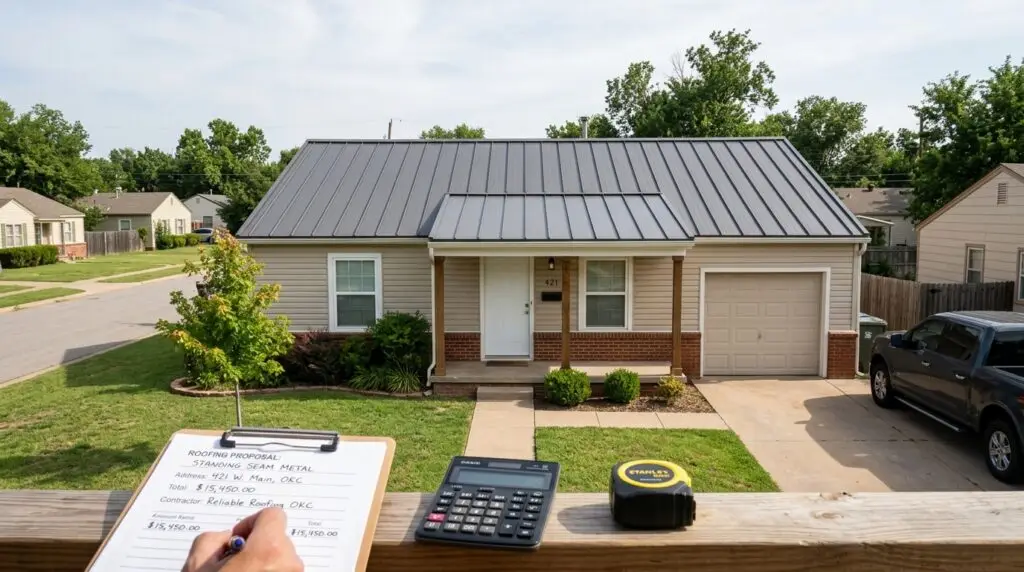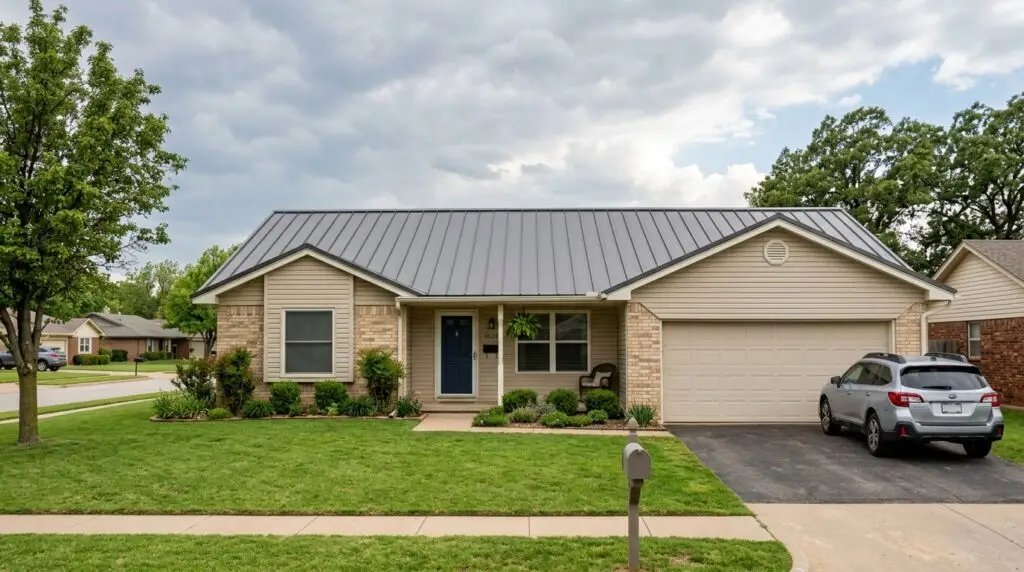
If you own a metal roof in the Oklahoma City area, you already know you made a smart investment. Metal roofs hold up against brutal summer heat, high winds, and the kind of hailstorms that send other homeowners straight to the phone with their insurance company. But here’s the thing even the toughest metal roof needs to be cleaned regularly, and cleaning it the wrong way can do more damage than leaving it alone.
In our experience working with Oklahoma City homeowners from Edmond to Moore to Yukon, most people either skip cleaning entirely or grab whatever cleaner is under the sink and go at it with a pressure washer. Both approaches create problems. This guide walks you through how to clean a metal roof safely, the right way, with the right tools and keeps you from voiding your manufacturer warranty in the process.
Why Cleaning Your Metal Roof Matters More Than Most Oklahoma City Homeowners Realize
Most homeowners don’t realize that a dirty roof is actively working against them. It’s not just a cosmetic issue.
When debris, algae, and organic growth sit on your metal panels, they trap moisture against the surface. That moisture breaks down your roof’s protective coating over time, creating conditions for rust spots and surface corrosion. Once your protective coating is compromised, your roof’s lifespan drops and repair costs go up.
Here in central Oklahoma, the problem runs a little deeper than it does in other parts of the country. OKC sits in a zone with intense UV exposure, dramatic temperature swings between seasons, and red clay dust that coats everything during dry stretches. That same clay dust, mixed with spring pollen and organic debris from thunderstorms, creates a grimy film that sticks to metal panels and holds moisture.
After a major storm and Oklahoma City gets plenty of them wind can deposit grit, hail fragments, tree debris, and abrasive material directly onto your roof surface. If that debris sits through summer heat, it bakes against the panel coating and becomes significantly harder to remove. Clean it up early, and the job takes an afternoon. Ignore it through a full season, and you may be dealing with staining and coating degradation that requires professional restoration.
The bottom line: regular cleaning protects the protective coating, prevents premature fading, and keeps your roof performing at the level you paid for.
Before You Climb Anything Safety First
Let’s get something out of the way early. Metal roofs get dangerously slippery when wet. That’s not an exaggeration. A wet standing seam panel has almost no grip, and falls from residential rooftops cause serious injuries every year.
Before you get on your roof, here’s what you need:
Non-negotiable safety equipment:
- Rubber-soled shoes with genuine traction not sneakers, not work boots with flat soles
- A fall protection harness for any pitched roof
- Safety glasses to protect against chemical splatter and debris
- Chemical-resistant gloves if you’re using any cleaning solution
- A second person on the ground always
Never work alone. Having someone on the ground is both a safety net and a practical help for handing tools and monitoring the work from a different angle.
Before you climb, inspect from the ground. Walk the perimeter and look for visible hail dents on panels, any lifted edges or displaced fasteners, and staining patterns that might indicate algae, mold, or rust. If you spot dents after an OKC storm, photograph them before you clean anything more on that in a later section.
Pick the right day. In Oklahoma’s climate, this matters more than most guides acknowledge. Avoid cleaning on hot, sunny summer afternoons cleaning solution dries onto hot metal panels before you can rinse it, leaving streaks and residue that are tougher to remove than the original dirt. Choose an overcast, mild day. Also avoid cleaning when wind advisories are in effect. Oklahoma City consistently ranks among the windiest metro areas in the country, and working on a roof during a wind advisory is genuinely dangerous.
Tools and Cleaning Solutions That Won’t Damage Your Roof
Here’s where a lot of DIY jobs go sideways. People reach for whatever is strong and available, assuming that tougher cleaners do a better job. On a metal roof with a protective coating, that logic works backwards.
The Right Tools
- Soft-bristle brush, long-handled for reach
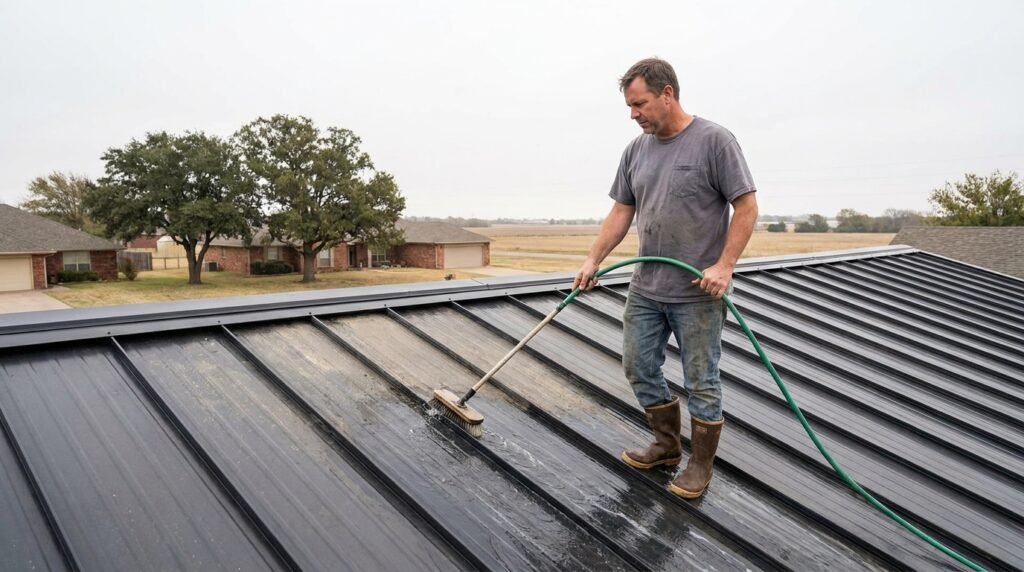
- Garden hose with an adjustable spray nozzle
- Microfiber cloth or soft plastic sponge
- Leaf blower on a low setting for dry debris before any water is applied
- Ladder stabilizers that won’t dent your gutters or panels
Cleaning Solutions Start Weak and Work Up
Start with the weakest option and only escalate if needed.
Plain water handles more than you’d expect. Light dust, pollen, and OKC’s red clay dirt often wash off a metal roof with nothing more than a hose on a gentle setting.
Mild dish soap or car wash soap dissolved in water roughly a quarter cup per gallon is safe for most coated metal panels and handles general grime and light organic buildup without touching the protective coating.
A 50/50 vinegar and water mix works well against algae and mildew, which tend to grow in shaded sections of OKC roofs during humid stretches between storms.
Diluted oxygen bleach not chlorine bleach handles more stubborn organic staining while remaining safer for the surrounding landscape and your roof’s finish.
Manufacturer-approved specialty cleaners are the right call for PVDF-coated and SMP-coated panels. Check your warranty documentation for the approved products list before using anything else.
What Will Damage Your Roof (or Void Your Warranty)
- High-pressure power washing this is the most common mistake and one of the most damaging. It strips protective coatings, forces water under panel seams, and can physically dent lighter gauge panels
- Chlorine bleach or ammonia-based cleaners
- Abrasive scrubbing pads, steel wool, or hard-bristle brushes
- Undiluted solvents on painted surfaces
- Any product not on your manufacturer’s approved cleaning list
Between you and me, the warranty issue is one that most homeowners find out about the hard way. A manufacturer can legitimately deny a warranty claim if they determine an unapproved cleaner degraded the coating that failed. It’s not worth the risk.
Step-by-Step: How to Clean a Metal Roof Safely
Once you have your gear, a good helper, and the right conditions, the actual cleaning process is straightforward.
Step 1 Clear Loose Debris First
Before water or cleaner touches the roof, remove dry debris with a leaf blower on a low setting or a soft broom. Pay close attention to valley areas and around pipe boots and penetrations that’s where OKC storm debris concentrates. Removing loose material first prevents it from scratching the panel surface when it gets wet and dragged around.
Step 2 Do a Spot Test
Apply your chosen cleaning solution to a small, inconspicuous area the back slope facing away from the street works well. Let it sit for five to ten minutes and watch for any discoloration, dullness, or coating reaction. If the test area looks fine, proceed. If anything changes, stop and verify compatibility with your roof manufacturer before continuing.
Step 3 Rinse With Low Pressure First
Start at the ridge and work downward in manageable sections. Use a garden hose with a standard spray nozzle not a pressure washer. The goal is to wet the surface and loosen surface-level grime before applying cleaner. Always spray downward with the panel direction, never upward into seams.
Step 4 Apply Cleaner and Scrub Gently
Work in sections roughly three to four feet wide. In Oklahoma’s summer heat, even on overcast days, soap can begin to dry before you rinse it working in small sections prevents that. Apply your cleaning solution and use a soft-bristle brush in gentle circular motions. For algae or mildew spots, let the solution dwell for five minutes before scrubbing.
Step 5 Rinse Thoroughly
Rinse each section until the water runs completely clear with no soap residue. Leftover cleaning solution on metal panels attracts fresh grime and can contribute to surface dullness over time. Direct your rinse water away from foundation plantings cover them with a tarp if you’re using anything stronger than mild soap.
Step 6 Inspect While You’re Up There
This step matters more in Oklahoma than most places. While you’re on the roof, check fasteners, look at sealants around vents and pipe boots, and scan panel surfaces for anything that wasn’t there before your last inspection. If you spot hail dents, lifted panels, or compromised flashing, document it with photos before you come down. That documentation supports insurance claims and helps any roofing contractor assess what needs attention.
Cleaning Your Metal Roof After an Oklahoma City Hailstorm
Post-storm cleaning is a different job than routine maintenance, and treating it the same way is a mistake.
After a significant hail event and OKC sits squarely in what storm researchers call “hail alley,” with communities like Moore, Midwest City, and Norman routinely taking direct hits the debris on your roof may include abrasive grit, hail fragments, and tree material deposited at high wind speeds. That material needs to come off carefully.
Before you clean anything after a storm, photograph everything. Hail dents on panels, dents on drip edges and ridge caps, any displaced fasteners or cracked sealant document it all. If you clean first and inspect later, you may wash away evidence that an insurance adjuster needs to see.
When you do begin cleaning, remove dry debris first, more carefully than usual. Hail can leave small fragments embedded in panel seams and low points that will scratch the coating if dragged with a brush. Rinse these areas out before scrubbing.
Know when to stop. If you find dents that have broken through the protective coating layer, rust appearing in areas that were previously clean, or panels that have shifted or buckled, stop the DIY cleaning and call a professional metal roofing company. At that point you’re dealing with damage, not maintenance.
How Often Should You Clean a Metal Roof in the OKC Area?
It depends on several factors your roof’s exposure to trees, the pitch, and how severe the storm season was. That said, for most OKC homeowners, a reliable schedule looks like this:
Late spring (May to early June): After Oklahoma’s peak storm season wraps up, clean off the accumulated debris, pollen, hail grit, and organic growth from the spring months.
Fall (October to November): Clear leaves and organic debris before winter. Debris left through winter traps moisture during freeze-thaw cycles and accelerates panel wear.
After any significant storm: If hail, high winds, or a tornado-adjacent weather event hit your neighborhood, clean and inspect as soon as it’s safe to do so.
Monthly at minimum: Clear gutters and downspouts. Clogged gutters overflow and stain metal panels along the fascia line, and that staining is harder to remove the longer it sits.
Common Mistakes Oklahoma City Homeowners Make
These come up repeatedly, and they’re worth naming directly:
Using a pressure washer on high. The most common mistake by a wide margin. It strips coatings, can dent lightweight panels, and forces water under seams.
Cleaning on a hot, sunny afternoon. Cleaning solution dries on hot metal before the rinse catches up. You end up with streaks that are worse than what you started with.
Walking on standing seam ribs. Step only on the flat faces of panels. Walking on raised seams can pop the seam seal, dent the rib, and damage the interlocking connection that makes standing seam metal roofs so wind-resistant.
Skipping the spot test. Especially important on newer PVDF-coated panels some specialty cleaners react with specific paint formulations.
Cleaning alone. A spotter on the ground is not optional. It’s a safety baseline.
Not protecting landscaping. Even mild soap runoff will stress plants if they get a concentrated dose. Tarp your beds or rinse them down before and after cleaning.
DIY vs. Hiring a Professional Metal Roof Cleaning Service in OKC
Be honest with yourself about what you’re comfortable doing. Some situations clearly call for a professional.
DIY makes sense when:
- You have a single-story home with a low-slope metal roof
- The buildup is light dust, pollen, seasonal grime
- You’re comfortable on a ladder, have proper safety gear, and have a helper
Call a professional when:
- Your roof has a steep pitch or the home is multi-story
- You need a post-storm inspection alongside the cleaning
- There’s visible rust, heavy algae, or staining you can’t identify
- Your roof is still under manufacturer warranty and you want cleaning that won’t risk voiding it
Professional metal roof cleaning services use soft-wash systems low-pressure, high-volume application which are the industry standard for coated metal panels. They bring their own commercial-grade equipment, they’re insured, and they know how to identify damage during the cleaning process.
Cost varies based on roof size, pitch, access, and the extent of staining. For most residential metal roofs in the OKC metro Edmond, Yukon, Norman, Moore, The Village expect pricing to reflect the scope of the job. Bundling cleaning with an annual inspection often stretches the value significantly, since you get two services in a single visit.
If someone is offering rock-bottom pricing on roof cleaning after a storm, ask questions. Post-storm periods attract out-of-area contractors who may not be familiar with Oklahoma licensing requirements or your specific roof system.
Maintaining Your Metal Roof Between Cleanings
A little consistent attention goes a long way toward avoiding major problems.
Keep gutters clear. OKC’s combination of tree pollen, red clay, and organic storm debris clogs gutters faster than most climates. Overflow stains panels and can cause moisture backup under drip edges.
Trim overhanging branches. Branches that scrape across panels scratch the coating gradually, and large limbs become a serious risk during Oklahoma’s ice storms and high-wind events.
Check sealants annually. Pipe boots, flashing transitions, and ridge cap sealants are the most common failure points on metal roofs. A quick visual check once a year catches early cracking before it becomes a leak.
Schedule a professional inspection every one to two years, regardless of how the roof looks from the ground. Many hail dents and fastener issues are genuinely invisible from street level and only reveal themselves on close inspection.
How a Clean Roof Protects Your Investment Long-Term
Here’s the argument that tends to make this click for homeowners who are on the fence about whether cleaning is worth the effort.
Metal roofing reflects sunlight. A clean surface reflects more effectively than a dirty one covered with algae or grime. In Oklahoma City summers where temperatures regularly push past the mid-90s and urban surfaces absorb intense heat a cleaner roof means lower attic temperatures and reduced cooling costs. That’s a real, practical benefit of a maintenance habit.
Beyond energy efficiency, documented maintenance history matters when it comes time to sell a home. Buyers in OKC’s competitive market have become more educated about roofing, particularly after the hail events that have affected neighborhoods from Nichols Hills to Moore. A roof with a maintenance record is a selling point. A roof with no history raises questions.
And practically speaking, small cleaning sessions done regularly prevent the kind of buildup that requires aggressive chemical treatments or professional restoration work. Prevention is always cheaper than repair.
Frequently Asked Questions
Can I use a pressure washer to clean my metal roof?
Pressure washers are not recommended for metal roofs. High-pressure settings strip protective coatings, force water under panel seams, and can dent lighter gauge panels. A standard garden hose with a spray nozzle is the right tool for rinsing.
What is the safest homemade cleaner for a metal roof?
A mild dish soap dissolved in water about a quarter cup per gallon is safe for most coated metal panels. For algae or mildew, a 50/50 water and white vinegar solution works well. Always run a spot test in a small area first.
How do I clean my metal roof without getting on it?
Hose-end sprayers with extended nozzles allow some cleaning from the ground on lower-slope roofs. Telescoping soft-bristle brushes can reach accessible areas from a ladder without fully accessing the roof. For thorough cleaning, professional roof cleaners with soft-wash systems are the safest option.
How often should I clean my metal roof in Oklahoma City?
Twice per year is the general recommendation once in late spring after storm season, and once in fall before winter. Add an additional cleaning after any significant hailstorm or severe wind event.
Will cleaning my metal roof void the warranty?
Using unapproved cleaners or abrasive tools can void your manufacturer’s paint or panel warranty. Always verify that your cleaning products and methods align with your warranty documentation before starting. When uncertain, hire a professional familiar with your roof system.
How do I know if my metal roof was damaged by hail before I clean it?
Inspect from the ground first. Look for dents on drip edges, gutters, and visible panel faces. Before climbing up, photograph any suspected damage. On the roof surface, look for dents with compromised coating or areas where the paint finish has cracked or flaked. Document everything before cleaning removes evidence.
What happens if I skip cleaning my metal roof for several years?
Over time, debris and organic growth trap moisture against the panel surface and degrade the protective coating. This accelerates surface corrosion, can cause fastener staining to spread, and ultimately shortens the lifespan of the roof system. In OKC’s climate, storm debris left through multiple seasons compounds this damage significantly.