If you’re an Oklahoma City homeowner looking at a worn-out shingle roof and wondering whether you can just put metal roofing on top of it you’re asking exactly the right question. And the answer is: sometimes yes, but it depends on several factors that most homeowners don’t fully understand until they’re already in the middle of a project.
Here’s the thing. This isn’t a simple yes-or-no decision. It’s a roofing decision that carries real consequences especially in a place like Oklahoma City, where hailstorms roll through with alarming regularity and where your roof is one of the most financially important parts of your home. Get this choice right, and you save time and money. Get it wrong, and you’re dealing with hidden deck rot, voided warranties, denied insurance claims, and a costly tear-off a few years down the road.
Let’s walk through everything you need to know before making this call.
What “Installing Metal Over an Existing Roof” Actually Means
Before we get into specifics, let’s make sure we’re speaking the same language.
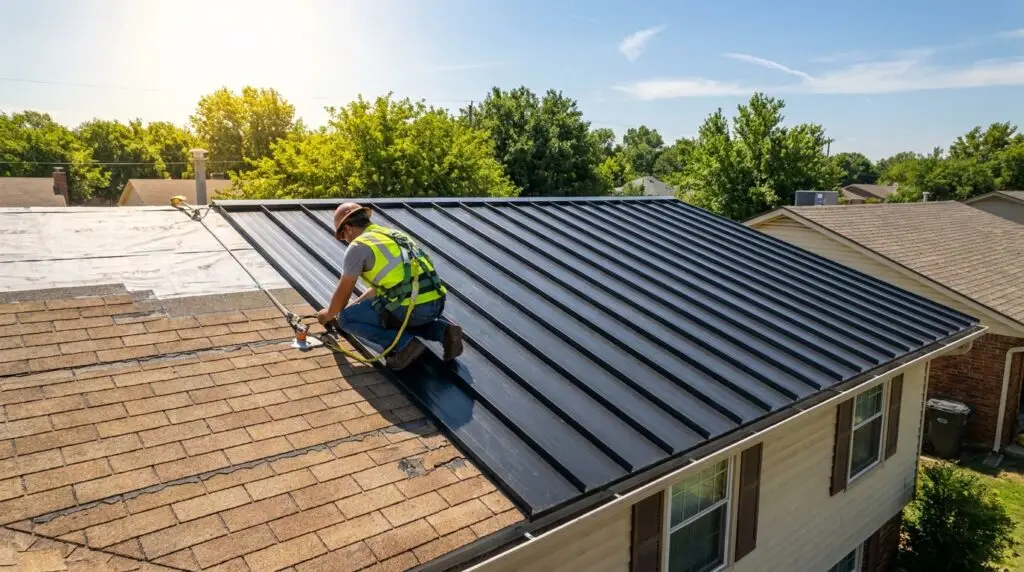
A roof overlay also called a “recover” or “roof-over” means installing new metal panels directly on top of your existing shingles without tearing anything off first. You skip the demolition step entirely.
A full replacement means removing everything down to the deck, inspecting the structure, making repairs, and then installing the new metal system from scratch.
These are not the same thing. And in Oklahoma, your specific situation may determine which one is even legally permitted.
The Three Installation Methods for Metal Over Shingles
When contractors do install metal roofing over existing shingles, they generally use one of three approaches:
Direct attachment Metal panels are fastened over an underlayment barrier placed on top of the existing shingles. This is the simplest method, but it requires that the existing surface is flat and in solid condition.
Furring strip framework Wood purlins or furring strips are screwed through the shingles into the structural framing below, creating a ventilation gap between the old shingles and the new metal panels. This is particularly important in OKC’s climate, where attic heat buildup is a serious problem during summer.
Specialty recover systems Some manufacturers offer clip-based systems that create an above-sheathing ventilation airspace without the labor cost of a full furring strip installation. These systems can be a smart middle ground for the right home.
Each method has its place. A good contractor will recommend the right approach based on your specific roof not the one that’s easiest for them to install.
The Four Factors That Determine If Your OKC Home Qualifies
1. How Many Shingle Layers Are Already Up There?
This is the first question any honest roofing contractor will ask. Oklahoma’s building code, based on the IRC 2018 with state-specific amendments, generally limits installations to one existing layer of roofing before requiring a full tear-off. Oklahoma’s code also explicitly prohibits adding additional layers of asphalt shingles over existing asphalt you can’t simply keep piling on.
Most homeowners don’t realize how common it is for OKC homes to already have two shingle layers. Houses built in the 1980s and 1990s in neighborhoods across Edmond, Yukon, Midwest City, Moore, and Del City often had a second shingle layer added sometime in the 2000s or 2010s rather than a full replacement. If that’s your situation, a tear-off isn’t optional it’s required before any new roofing goes down, metal or otherwise.
2. What Is the Condition of Your Existing Roof Deck?
Oklahoma’s code is specific here. A “solidly sheathed” deck means sawn lumber or structural panels with no significant rot, warping, cracking, or gaps. If your deck doesn’t meet that standard, the new installation won’t either and no amount of metal roofing on top will fix what’s deteriorating underneath.
Here’s what makes this particularly relevant in OKC: the freeze-thaw cycles we experience in January and February, combined with heavy spring rains, accelerate wood deck deterioration under older shingles. Water finds its way in gradually not through dramatic leaks, but through slow infiltration around flashing, in valleys, and near penetrations. By the time a homeowner notices a problem, the damage underneath can be substantial.
An overlay installs over that damage without solving it. A full replacement exposes it, addresses it, and gives the new roof a solid foundation.
3. Can Your Home’s Structure Handle the Combined Weight?
Metal roofing is lighter than most people expect typically around one to three pounds per square foot, compared to two to five pounds for asphalt shingles. The combined weight of both layers is usually manageable for most homes.
That said, older ranch-style homes common throughout South OKC, Choctaw, and Blanchard deserve a closer look. If the framing is original and hasn’t been updated, a structural assessment before adding any roof system is money well spent. This is a conversation to have with your contractor during the inspection phase before any work begins.
4. Does Your Home Meet Oklahoma’s Ventilation Requirements?
This one gets overlooked more than it should. Oklahoma follows IRC R806.2, which requires one square foot of ventilation for every 150 to 300 square feet of attic space. When you install metal roofing directly over existing shingles without creating a ventilation gap, you can trap heat between the layers and in an OKC summer, attic temperatures regularly reach extreme levels that accelerate material degradation.
Furring strips or a specialty clip system solve this by creating airflow between the shingle surface and the metal panels. If a contractor proposes a direct overlay without addressing ventilation, that’s a conversation worth having before you sign anything.
The Real Benefits of Going Over Existing Shingles And Who They Apply To
Let’s be fair. A properly executed metal overlay on a qualifying roof is a legitimate roofing solution not a shortcut. When conditions are right, the benefits are genuine.
Faster installation. Skipping tear-off can reduce project duration by one to seven days depending on roof size and complexity. For families with kids at home or homeowners working remotely, that matters.
Lower upfront cost. Avoiding tear-off labor and disposal fees reduces the initial project expense. In a city where quality roofing labor is in high demand after storm season, that savings can be meaningful.
Less disruption. Fewer days of crew activity means less noise, less debris around the yard, and less general upheaval for the household.
Environmental benefit. Keeping existing shingles out of landfills is a genuine positive, and it’s one of the reasons some environmentally conscious homeowners specifically request this approach.
Added insulation. The existing shingle layer provides a modest additional insulation value beneath the metal.
The honest caveat: every one of these benefits applies only when the underlying roof qualifies. On a compromised substrate, you’re not saving money you’re deferring a more expensive problem.
The Risks Oklahoma City Homeowners Must Understand Before Saying Yes
In our experience, the risk side of this equation gets glossed over far too often in the rush to close a sale. Here’s what deserves your full attention.
Hidden Moisture and Deck Rot Gets Sealed In
When you overlay, you cover whatever is underneath good and bad. OKC’s storm history means many roofs have experienced minor water infiltration that hasn’t yet caused visible leaks. Sealing that under a 40- to 70-year metal roof means you’ll discover the problem later, after significant damage has accumulated.
Future Leak Diagnosis Gets Dramatically Harder
With two roofing layers, identifying the source of a leak becomes significantly more complex. Is water entering through the metal system? Through the old shingles beneath? Through a compromised valley that was sealed over rather than addressed? Diagnosing and repairing each of these scenarios costs more time and money when there are two layers to work through.
Warranty Complications Are a Real Risk
Some metal roofing manufacturers limit or void their warranties for overlay installations. In Oklahoma City’s hail environment, this is a serious problem. A Class 4 impact-rated metal system is one of the best investments an OKC homeowner can make but if the overlay voids the manufacturer warranty, you lose one of the primary reasons to choose metal in the first place. Always verify warranty terms in writing before proceeding.
Insurance Claims Can Become More Complicated
Between you and me, this is the risk that catches the most homeowners off guard. Oklahoma insurers assess storm damage claims carefully, and they will look at how your roof was installed. If an overlay was done without a permit, using non-compliant methods, or in a way that conflicts with your policy terms, a denial becomes possible. OKC homeowners with overlaid roofs should have a direct conversation with their insurer about coverage before the storm season hits not after.
Oklahoma City Building Code What the Rules Actually Say in 2025
Most roofing content you’ll find online references national building codes in generic terms. Here’s what actually applies in Oklahoma City right now.
Oklahoma has adopted the IRC 2018 with state-specific amendments. Oklahoma Administrative Code § 748:20-6-14 explicitly states that where an existing roof has one or more applications of asphalt shingles, additional applications of asphalt shingles are not permitted. Metal roofing over asphalt follows a separate evaluation path but the deck integrity and ventilation requirements remain non-negotiable.
Metal roof panels in Oklahoma must be applied to solid or spaced sheathing meeting the state’s “solidly sheathed” definition: sawn lumber or structural panels with no significant defects, gaps, rot, or warping.
As of January 2025, Oklahoma City requires a building permit for all roof replacements over 500 square feet. This applies regardless of installation method. A permitted installation triggers city inspections that verify proper decking, underlayment, and ventilation and that documentation protects your insurance claim and your home’s resale value.
If you’re in Edmond, Norman, Moore, Yukon, or Midwest City rather than within OKC proper, local requirements can vary. Contact your local development services office or work with a CIB-registered contractor who knows the specific rules for your jurisdiction before work begins.
Hail Alley Reality Why This Decision Hits Different in Oklahoma City
Oklahoma City isn’t like most places when it comes to roofing. This city sits at the center of one of the most storm-active corridors in the country. OKC has historically ranked as the number one metro area in the United States for hail activity, with hundreds of hail events recorded in the surrounding region in recent years alone.
That context changes everything about the overlay-versus-tear-off calculation. In a calmer climate, a properly installed overlay might be a perfectly reasonable long-term solution. In Oklahoma City, where the next hailstorm is genuinely always a possibility, a roof installation decision that creates warranty complications, coverage gaps, or hidden structural vulnerabilities carries much higher stakes.
Class 4 impact-rated metal roofing is the gold standard for OKC homes. Many Oklahoma insurers recognize Class 4 impact ratings and offer premium reductions for qualifying installations. But those benefits only apply when the installation is fully code-compliant, properly permitted, and covered under a complete manufacturer warranty. An overlay that undermines any of those conditions costs more than it saves.
The Strengthen Oklahoma Homes Program A Financial Angle Most Homeowners Miss
The Oklahoma Insurance Department’s Strengthen Oklahoma Homes (SOH) program provides grants to qualifying Oklahoma residents for residential wind and hail mitigation. The program uses the FORTIFIED Home™ Roof standard developed by the Insurance Institute for Business and Home Safety.
If your home qualifies and if the metal roofing system meets FORTIFIED™ installation requirements a grant may help make a full replacement financially accessible. This is worth investigating before you choose an overlay simply to reduce upfront cost. The grant changes the math, and it’s a program most roofing content completely ignores. Start at the Oklahoma Insurance Department’s website for current eligibility details.
Overlay vs. Full Tear-Off An Honest Decision Guide for OKC Homeowners
Here’s a practical breakdown to help you make the right call for your specific situation.
An overlay may make sense when:
- You have a single layer of asphalt shingles confirmed in good condition
- A licensed contractor’s inspection confirms the roof deck is solid no soft spots, no moisture, no compromised areas
- The metal roofing manufacturer explicitly covers overlay installations under their warranty
- Your insurer has confirmed storm damage coverage applies to this installation method
- The proper OKC building permit will be pulled and the installation will be inspected
- Ventilation requirements are addressed through furring strips or a qualifying recover system
A full tear-off is the right call when:
- Two or more shingle layers already exist
- Any deck rot, soft spots, or evidence of water infiltration is present
- Significant shingle damage, curling, or buckling exists across the surface
- You plan to add solar panels (deck access is required)
- You want maximum manufacturer warranty coverage
- You’re pursuing a FORTIFIED Home™ designation under the SOH grant program
- You want the cleanest possible position for future storm damage insurance claims
Most experienced Oklahoma City roofing contractors will recommend a full tear-off in the majority of cases. Not because it’s a bigger job but because OKC’s storm exposure makes the long-term risk of sealed-in deck damage too significant to ignore. A good contractor gives you the honest assessment, not the easy answer.
Questions to Ask Before Hiring a Metal Roofing Contractor in Oklahoma City
After major hail events in the OKC metro, out-of-state storm chasers flood the area. Some do quality work. Many disappear before warranty issues surface. Protect yourself by asking the right questions upfront.
Are you registered with the Oklahoma Construction Industries Board (CIB)? This is non-negotiable. You can verify registration through the CIB’s online database. Any contractor unable or unwilling to provide their CIB number should not be on your shortlist.
Will you pull the required building permit? If the answer is anything other than yes, walk away.
Does the manufacturer’s warranty cover an overlay installation for this specific product? Get the answer in writing, not verbally.
What did you find during your inspection of my deck? A legitimate contractor will provide specific findings not a general assurance that everything looks fine.
Do you carry liability insurance and workers’ compensation coverage? Ask for certificates, not just confirmation.
What is your process if you discover deck damage after tear-off begins? How they answer this question tells you a lot about their transparency and professionalism.
Red flag: any contractor who discourages you from pulling a permit, offers to complete an overlay without a thorough inspection, quotes a price before getting on your roof, or cannot provide a verifiable local CIB registration number.
What Metal Roofing Over Existing Shingles Costs in Oklahoma City
Cost is always part of this conversation, and it’s worth being direct about how the numbers actually work.
An overlay installation generally costs less upfront than a full replacement because you eliminate tear-off labor and disposal fees. That’s real savings. But it’s only genuine savings if the underlying roof qualifies and the installation is done correctly.
A full replacement costs more initially but it eliminates the risk of future repair costs tied to hidden damage, and it typically provides stronger warranty coverage and a cleaner insurance claim position.
If your roof was damaged in a storm and you’re filing a claim, understand that Oklahoma insurers generally cover like-for-like replacement meaning asphalt equivalent cost if you had asphalt shingles. Upgrading to metal means covering the cost difference out of pocket. In OKC’s hail corridor, many homeowners find the long-term value of metal roofing justifies that additional investment.
Cost ranges vary significantly based on roof pitch, square footage, system type, and market conditions especially after major storm events, when contractor availability tightens and material costs can shift. Get at least three quotes from CIB-registered Oklahoma City contractors, and make sure each quote covers the same scope of work before comparing numbers.
Factor in permit fees, potential deck repair costs if issues are discovered, and whether a FORTIFIED™ grant may offset part of your investment.
Frequently Asked Questions
Can you put metal roofing directly over asphalt shingles in Oklahoma City?
Yes, in many cases but only over a single existing layer of shingles in good condition. Oklahoma building code and OKC’s 2025 permit requirements must be followed, and the deck must be confirmed solid. A licensed contractor inspection is required before any overlay proceeds.
Is a full tear-off better than an overlay for Oklahoma City homes?
For most OKC homeowners, yes. Oklahoma’s intense storm exposure means hidden deck damage is common. A full tear-off exposes and addresses those issues, provides stronger warranty coverage, and creates a cleaner path for future insurance claims.
Will my Oklahoma homeowners insurance cover a metal roof installed over existing shingles?
It depends on your policy and whether the installation was permitted and code-compliant. Confirm coverage details with your insurer before choosing an overlay, and ensure all work is pulled with a proper OKC building permit.
How many roofing layers are allowed in Oklahoma City?
Oklahoma’s adopted building code generally limits roofing to one existing layer before a tear-off is required. Oklahoma explicitly prohibits adding additional asphalt layers over existing asphalt shingles. Metal over a single asphalt layer follows a separate evaluation based on deck condition and code compliance.
Does a metal roof overlay void the manufacturer’s warranty?
It can. Some manufacturers limit or void warranties for overlay installations. In OKC’s hail environment, this matters significantly verify warranty terms in writing before proceeding with any overlay installation.
Do I need a permit to install metal roofing in Oklahoma City?
Yes. As of January 2025, Oklahoma City requires a building permit for all roof replacements over 500 square feet, regardless of installation method. Working without a permit can result in a denied insurance claim and complications when selling your home.
What metal roofing is best for Oklahoma City hailstorms?
Class 4 impact-rated metal roofing systems are the strongest choice for OKC’s hail environment. Many Oklahoma insurers offer premium discounts for qualifying Class 4 installations. Standing seam and stone-coated metal shingle systems with Class 4 ratings are both well-suited to OKC conditions.