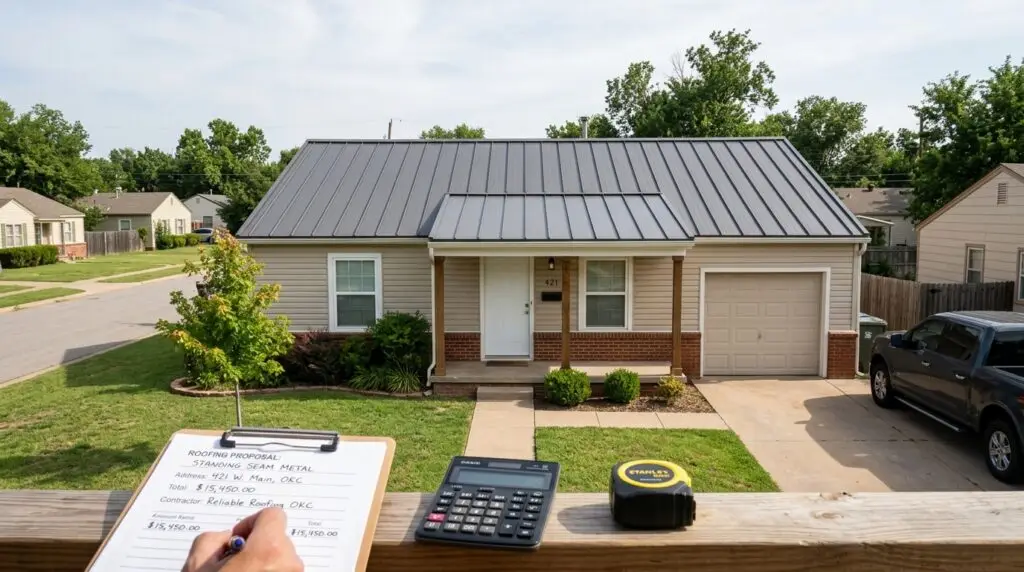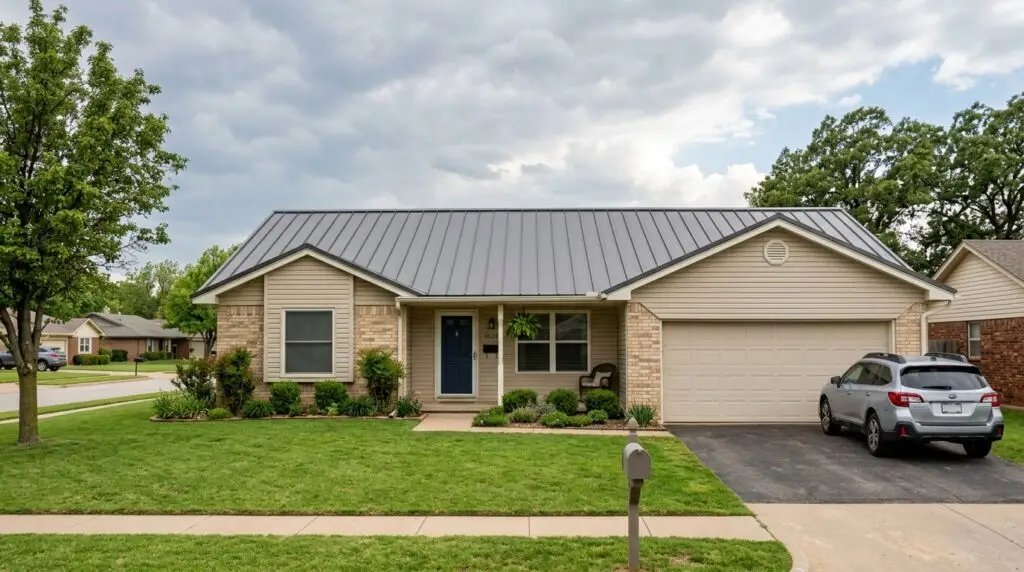
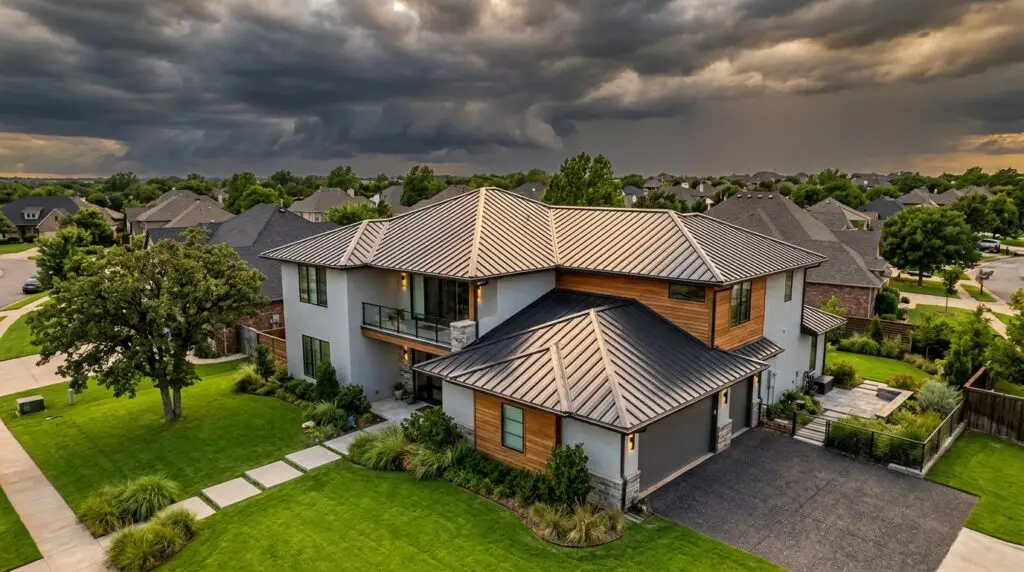
If you’ve lived in Oklahoma City for any stretch of time, you already know what the weather can do to a house. One week it’s a dry 100-degree July afternoon. The next, you’re watching golf ball-sized hail hammer your roof during a spring storm while tornado sirens sound in the distance. That kind of weather cycle destroys average roofing materials, fast. And that’s exactly why metal roofing in Oklahoma City has become the choice that makes the most long-term sense for homeowners across the metro.
This guide breaks down the real reasons metal roofing performs so well here, not the generic talking points you’ll find on most contractor sites, but the practical, locally grounded explanations that actually help you make a smart decision.
Oklahoma City’s Climate Is Not Average — And Your Roof Shouldn’t Be Either
Here’s the thing most people don’t fully appreciate until they’ve replaced a roof once or twice: OKC isn’t just “hot in summer, cold in winter.” The city sits in the heart of Tornado Alley, one of the most storm-active corridors anywhere in the country. From April through June, severe thunderstorms roll through the metro with regularity, bringing combinations of large hail, high winds, and sometimes straight-line microbursts that can exceed 80 mph.
Then come the summers. Oklahoma’s UV exposure and prolonged heat cycles put serious stress on roofing materials. And the winters bring freeze-thaw cycles that expand and contract whatever’s on your roof, weakening seams, cracking granules, and loosening fasteners over time.
Why Standard Asphalt Shingles Struggle Here
Asphalt shingles aren’t a bad roofing material. They’re just a material that was never designed for what Oklahoma City routinely throws at a roof. In more moderate climates, a shingle roof might reach close to its manufacturer warranty. In OKC, that same roof often degrades significantly faster, through storm-driven granule loss, UV breakdown, and wind uplift, and many homeowners find themselves dealing with their second or even third roof within a normal ownership period.
That’s not a knock on shingles. It’s just the honest reality of what this climate does to them.
The Real Reason Metal Roofing Performs Well in OKC Specifically
When you understand the specific weather stressors in Oklahoma City, metal roofing’s advantages stop being abstract and start making practical sense.
Wind Resistance That Matches Oklahoma’s Storm Reality
Metal roofing systems, particularly standing seam panels, are designed for exactly the kind of sustained high-wind events that OKC sees every storm season. Standing seam panels lock together with raised, concealed seams. There are no exposed screws to loosen over time from thermal movement or wind vibration. The panels hold firm because they’re mechanically fastened in a way that accounts for both uplift force and expansion.
In our experience, homes in wind-exposed neighborhoods like Yukon, Moore, and Midwest City, where open terrain means gusts hit roofs with full force, benefit most noticeably from this design. Compare that to exposed-fastener asphalt systems where loosened nails and lifted shingle edges become the failure points during the same storms.
Heat Reflection in Oklahoma’s Brutal Summers
Oklahoma summers are no joke. When a dark asphalt roof absorbs July heat all day, attic temperatures can climb into ranges that force your HVAC system to work significantly harder. Metal roofing with reflective coatings handles this differently. The surface reflects solar radiant heat rather than absorbing it, which keeps attic temperatures meaningfully lower.
For OKC homeowners on OG&E, that translates directly to cooling bills during the months when usage is highest. It’s not a theoretical benefit, it’s something you see in the numbers when you compare summer utility costs between a reflective metal roof and a standard dark shingle system on similar homes.
Freeze-Thaw Resistance Through OKC Winters
Metal expands and contracts with temperature changes, and it’s engineered to do exactly that without failing. The panel systems are designed with thermal movement in mind. That’s a meaningful advantage over tile, which can crack, or asphalt, which becomes brittle through repeated freeze-thaw cycles and eventually loses its structural integrity at the granule layer.
The key here is proper underlayment selection. In Oklahoma’s heat, lower-quality underlayment materials can break down prematurely beneath a metal roof, which is why installation quality matters as much as the panel itself.
Hail Resistance — The Most Important Factor for OKC Homeowners
Most homeowners in Oklahoma City have seen hail damage firsthand. If you haven’t, you’ve heard the stories. And when people ask about metal roofing here, hail resistance is almost always the first real question under the surface. Let’s talk about it honestly.
How Metal Handles Hail Differently Than Other Materials
When a hailstone strikes a metal panel, the metal flexes and absorbs the impact. It dents. It doesn’t crack, shatter, or lose a protective layer the way asphalt does. That distinction matters enormously when it comes to long-term performance.
Most homeowners don’t realize there are two very different categories of hail damage: cosmetic and functional. Cosmetic damage means your roof looks dented but continues to perform exactly as designed, water sheds correctly, the system is intact. Functional damage means the storm actually compromised the roof’s ability to keep water out, seam separation, displaced flashing, loosened fasteners.
In most OKC hail events, a properly installed metal roof sustains cosmetic damage only. The roof keeps working. Compare that to asphalt, where the same storm strips granules, exposes the mat layer, and starts a clock on accelerated deterioration, even if the damage isn’t visible from the ground.
Understanding UL 2218 Class 4 Impact Rating
This is the number you want to know before you buy any metal roofing system. UL 2218 is the standard impact-resistance test for roofing materials. Class 4 is the highest rating available, indicating the panels have been tested to withstand significant simulated hail impact without functional damage.
Here’s the important nuance: not every metal roof automatically qualifies for Class 4 rating. The gauge (thickness) of the panel, the panel profile, and the quality of installation all factor into whether the system performs to that standard. A thinner-gauge panel installed incorrectly can underperform compared to a properly installed 24-gauge standing seam system.
Always ask any contractor you’re evaluating to provide the manufacturer’s UL 2218 certification documentation before you sign anything. A reputable metal roofing contractor in OKC will provide it without hesitation.
The Insurance Angle OKC Homeowners Need to Understand Before They Buy
This is the part most competitor articles completely skip over, and it’s genuinely important for Oklahoma homeowners.
Many Oklahoma insurance carriers offer premium discounts for homes with Class 4 impact-rated roofing. The discount range varies by carrier and policy, but it can be meaningful enough to factor into your material selection. Talk to your insurance agent directly before and after installation to understand what’s available on your specific policy.
There’s also the cosmetic damage waiver issue. Some insurers ask Oklahoma homeowners to sign a waiver as a condition of their policy, a waiver that surrenders their right to claim cosmetic hail damage. Given that cosmetic denting is the most common type of metal roof hail damage in this market, signing that waiver without understanding it can have real financial consequences. Between you and me, this is a conversation worth having with your agent before you finalize any roofing decision.
Metal Roofing Cost in Oklahoma City — What to Actually Expect
Cost is always the conversation that comes up, and it deserves an honest answer rather than a vague brush-off.
Upfront Cost vs. Lifetime Cost — Why the Math Favors Metal in OKC
Metal roofing carries a higher upfront installed cost than asphalt shingles. That’s true. But in Oklahoma City, where the weather creates a cycle of repeated shingle damage and replacement, the total cost of ownership calculation changes significantly over a typical homeownership period.
Think about it this way: how many roofs do you want to buy in the time you own your home? A well-installed metal roof is typically a one-time installation for most homeowners. Asphalt, in Oklahoma’s conditions, often means going through that process again, and potentially again, before you ever sell. When you factor in the cost of multiple replacements, the insurance claim hassle, the temporary repairs, and the ongoing maintenance, metal’s higher entry price looks different.
Variables That Move the Price in Either Direction
Installed costs vary based on several factors that your contractor should explain clearly:
Panel type is the biggest driver. Standing seam systems cost more than exposed fastener or corrugated panels. Stone-coated steel falls in between. Each has its own performance characteristics and best-fit applications.
Gauge matters for both performance and price. 24-gauge panels are thicker, more impact-resistant, and more expensive than 26-gauge. For an OKC home in a hail-exposed location, the gauge upgrade is often worth the cost difference.
Roof complexity, valleys, penetrations, pitch, dormers, adds labor time and material waste, which moves the price up.
Tear-off requirements add cost if existing layers need to be removed before installation.
Get itemized, written quotes from any contractor that specify gauge, manufacturer, coating warranty, and panel profile. If a contractor gives you a number without those specifics, that’s a red flag.
Energy Savings and Rebate Programs Worth Knowing
OG&E offers energy efficiency rebates that some metal roof upgrades may qualify for, depending on the system’s reflective properties. The Oklahoma Energy Rebate Program (OERP) is another avenue worth exploring. Federal residential clean energy credits may also apply depending on your installation specifics.
Verify current eligibility directly with OG&E, your tax advisor, and your contractor. These programs change, and you want confirmed information rather than assumptions.
Types of Metal Roofing That Work Best for OKC Homes
Not all metal roofing is the same. The type you choose affects performance, aesthetics, cost, and how well it fits your specific home and neighborhood.
Standing Seam — The Top Performer for Storm-Prone Areas
Standing seam is the system most metal roofing professionals recommend for Oklahoma City homes where storm performance is the priority. The hidden fastener design eliminates the most common failure point of metal roofing, exposed screws that loosen over time through thermal cycling and wind vibration.
It’s the cleaner-looking system, it handles wind-driven rain exceptionally well, and it’s the type that most readily qualifies for UL 2218 Class 4 rating at appropriate gauges. For homes in Edmond, Yukon, Moore, and Midwest City, neighborhoods that see some of the most severe storm exposure in the metro, standing seam is consistently the right answer.
Exposed Fastener / Corrugated Panels — Budget-Friendly With Trade-Offs
Corrugated metal is the more affordable option, and it has its place. It works well on outbuildings, agricultural structures, and some residential applications where budget is the primary constraint. The performance difference from standing seam is real, though: exposed fasteners require periodic inspection and re-tightening as thermal expansion cycles loosen them over time.
If you go this route, build that inspection step into your annual maintenance routine, especially after OKC storm seasons.
Stone-Coated Steel — The Middle-Ground Option
Stone-coated steel panels mimic the look of traditional shingles, tile, or wood shake while delivering metal’s performance advantages. They’re heavier than smooth-panel systems and the textured surface is less prone to visible denting from hail, which can actually work in your favor from an insurance standpoint.
For homes in HOA-restricted neighborhoods, Heritage Hills, Nichols Hills, parts of Edmond, where standing seam’s modern profile might not receive approval, stone-coated steel often threads the needle between curb appeal requirements and performance needs. Work with a contractor who knows local ordinances and can help you get HOA sign-off before installation begins.
What OKC Homeowners Often Get Wrong When Choosing Metal Roofing
In our experience, the mistakes that lead to regret aren’t usually about choosing metal over shingles. They’re about how people choose within the metal roofing category, especially in the chaotic period after a major OKC storm.
Choosing by Price Alone After a Storm
Every significant hail event in Oklahoma City brings a wave of contractors, many from out of state, offering fast work at low prices. The pressure to sign quickly is real. The problem is that post-storm speed and low price almost always come with corners cut: thinner gauge panels, mismatched profiles if replacing a damaged section, cheaper underlayment, or installation crews who don’t have experience with your specific panel system.
Before signing anything with any contractor, ask these specific questions: What gauge panel are you specifying? Is it UL 2218 Class 4 rated? What’s the coating warranty, and who manufactures the panels? Will you provide a written scope of work with those specs before the project begins? A qualified contractor answers all of these comfortably. An unqualified one deflects.
Overlooking Local Code and HOA Requirements
Oklahoma Building Code requires permits for most full roof replacements, particularly when structural elements are involved. Your contractor should pull those permits, if they’re suggesting you skip that step, walk away.
In historically significant or deed-restricted areas, additional rules apply. Some require pre-approval for roof color, profile type, or visible equipment. Metal roofing offers enough variety in finish options, matte, stone-coated, painted to match traditional aesthetics, that compliance is usually achievable. But you need a contractor familiar enough with local requirements to guide that process correctly.
Metal Roofing Maintenance in Oklahoma City — What’s Actually Required
One of the most persistent misconceptions about metal roofing is that it requires no attention at all. That’s not quite right. The honest answer: it requires significantly less maintenance than asphalt, and the maintenance it does need is straightforward.
The Twice-a-Year Inspection Routine
A spring inspection, after storm season, and a fall inspection are the baseline. In spring, you’re checking that storm season hasn’t displaced any flashing, loosened any fasteners on exposed-fastener systems, or created any debris accumulation in valleys. In fall, you’re clearing elm leaves (a particular feature of suburban OKC living), checking gutters, and trimming any overhanging branches before winter.
Most of this is a ground-level visual check with binoculars. You don’t need to be on the roof twice a year, you need eyes on it.
After Major OKC Storms
Schedule a professional inspection after any significant hail or wind event, even if the roof looks fine from the ground. A trained metal roofing inspector looks for things that aren’t visible at street level: seam displacement, fastener tension, flashing movement at penetration points. Documenting that inspection creates a record that protects your insurance position if damage is found, and confirms your roof’s integrity if it isn’t.
What Metal Roofing Does NOT Require
No granule monitoring. No algae or moss treatments. No periodic re-nailing. No worrying about shingles lifting in wind. Once a quality metal system is properly installed, the maintenance burden drops substantially compared to what most OKC homeowners are used to dealing with.
Is Metal Roofing Right for Your OKC Home? An Honest Decision Framework
It depends on several factors, and the honest answer isn’t “metal is right for everyone.”
Metal roofing makes the most sense if:
- You plan to stay in your home long-term and want to eliminate the repeated replacement cycle
- Your home is in a high storm-exposure area, Yukon, Edmond, Moore, Midwest City, or neighborhoods with open terrain
- You have a ranch-style home with a low-slope roof (common from Warr Acres to Forest Park) where water management and wind uplift resistance matter most
- You want the insurance and energy efficiency benefits that come with a Class 4-rated reflective system
Asphalt may still make sense if:
- Your ownership horizon is short (under 5–7 years) and cost recovery timing matters
- Your budget is genuinely constrained and a quality shingle installation is the better immediate decision
- Your HOA has restrictions that make metal roofing impractical without significant design compromises
The question that cuts through most of the deliberation: how many more roofs do you want to buy in this house? For most long-term Oklahoma City homeowners, the honest answer points toward metal.
How to Choose a Metal Roofing Contractor in Oklahoma City
The contractor you choose matters at least as much as the panel system you select. A great panel installed poorly underperforms. A qualified contractor on a mid-range panel outperforms the reverse every time.
Ask every contractor these questions before signing:
- What gauge panel are you specifying, and is it UL 2218 Class 4 rated?
- What is the manufacturer’s warranty on materials, and what is your labor warranty?
- Are you licensed, insured, and pulling the required Oklahoma building permits?
- Will you provide a written, itemized scope of work specifying gauge, panel profile, manufacturer, and coating before the project begins?
Watch for these red flags specific to the OKC market:
- Out-of-state “storm chaser” contractors who appear after major hail events and pressure you to sign immediately
- Vague material specs (“high-quality metal panels”) without gauge or manufacturer disclosure
- Reluctance to pull permits or suggestions that permits aren’t necessary
- Offers to “handle your insurance” without a clear, written explanation of their process and role
Local experience matters here. Contractors who have worked extensively in OKC understand the specific neighborhoods, the local building code requirements, HOA dynamics in Nichols Hills versus open subdivisions in Edmond, and the insurance documentation practices that protect your claim. That knowledge has real value, and it’s part of what you’re paying for when you choose a qualified local metal roofing contractor.
Frequently Asked Questions About Metal Roofing in Oklahoma City
Does metal roofing hold up against Oklahoma hail?
Yes. Metal panels flex and absorb hail impact rather than cracking or losing a protective layer. In most OKC hail events, metal roofs sustain cosmetic denting only, the roof continues to perform correctly. Class 4-rated panels provide the highest available impact resistance.
How long does a metal roof last in Oklahoma City?
A properly installed metal roof in OKC typically lasts significantly longer than asphalt shingles, often through multiple storm cycles over decades. Lifespan depends on material gauge, coating quality, installation quality, and ongoing maintenance. Annual inspections and post-storm checkups extend service life.
Is a metal roof louder than shingles during rain or hail?
With proper underlayment and insulation, standard in any quality installation, metal roofs are not noticeably louder than asphalt shingles. The “loud roof” experience is associated with older open-framing barn-style installations, not modern residential systems with solid decking and full underlayment.
Will a metal roof lower my homeowner’s insurance in Oklahoma?
Many Oklahoma carriers offer premium discounts for Class 4 impact-rated roofing. The amount varies by carrier and policy. Confirm with your insurance agent before and after installation, and understand the cosmetic damage waiver issue before you sign any policy modification.
What does metal roofing cost in Oklahoma City?
Installed costs vary based on panel type (standing seam vs. exposed fastener vs. stone-coated), gauge, roof complexity, and contractor. Always get itemized written quotes that specify gauge, manufacturer, and coating warranty, not just a per-square-foot number without those details.
Can I get a metal roof if I live in a neighborhood with an HOA in Edmond or Nichols Hills?
Possibly, but HOA approval is required in most deed-restricted neighborhoods. Stone-coated steel and matte-finish standing seam options often satisfy HOA aesthetic requirements. Get written HOA approval before installation begins, and work with a contractor who knows how to navigate local ordinance requirements.
How soon after a hailstorm should I get my metal roof inspected?
As soon as safely possible after the storm. Most Oklahoma insurers have time limits for filing storm damage claims. A prompt professional inspection documents damage while corroborating evidence, dents on HVAC units, gutters, and vehicles, is still fresh and photographable.
Looking for a metal roofing inspection, installation estimate, or storm damage assessment in Oklahoma City or the surrounding metro? Contact our local team → We serve homeowners across OKC, Edmond, Yukon, Moore, Midwest City, Nichols Hills, Warr Acres, and surrounding areas.