If you live in the Oklahoma City metro, you already know your roof takes more punishment in a single spring storm season than most roofs in the country face in a decade. We’re talking golf ball-sized hail, straight-line winds that peel shingles off like paper, summer heat that pushes past 100°F for weeks at a time, and winter freeze-thaw cycles that crack anything that wasn’t built to flex.
Choosing the best roofing materials for Oklahoma weather isn’t a decorating decision. It’s a structural survival decision. The wrong material doesn’t just look bad after a few years, it fails you when you need it most, drives up insurance headaches, and costs you far more in the long run.
This guide cuts through the noise. We’ll tell you exactly which materials hold up, which ones struggle, why not all metal roofs are the same, and how to make a smart decision for your specific home and situation.
Why Oklahoma Weather Destroys Average Roofs Faster Than Anywhere Else
Most homeowners don’t realize just how extreme Oklahoma’s roofing environment is, until they’re filing their third insurance claim in five years.
Oklahoma City sits squarely in Tornado Alley. The spring storm season runs primarily from April through June, but severe weather events roll through from late winter well into fall. The OKC metro recorded over 170 hail reports within a 10-mile radius of the city center in a recent nine-year stretch. That’s not a rare event. That’s a predictable annual pattern.
The Four Forces Oklahoma Roofs Face Every Year
Hail is the most financially destructive force on Oklahoma rooftops. Hailstones in the OKC area regularly reach quarter-size and golf ball-size, and recent seasons have documented stones in the 3″ to 4″+ range. Here’s the critical problem: impact-resistant roofing products are tested using a 2-inch steel ball. When hail exceeds that threshold, which it frequently does in Oklahoma, even “impact-resistant” materials face stress they weren’t designed to absorb.
Straight-line winds and tornado events create a different category of damage. High-speed winds don’t just tear shingles off; they create uplift pressure at the eaves and ridge that stresses the entire roofing system. Materials with low wind ratings simply don’t survive Oklahoma storm seasons intact.
Extreme summer heat is something people outside Oklahoma underestimate. When temperatures push past 100°F for extended stretches, roofing materials expand significantly. Materials that can’t flex or that have compromised sealants develop gaps, curled edges, and adhesive failures that accelerate deterioration. UV radiation compounds the problem, degrading material surfaces and granule bonds from the outside.
Winter freeze-thaw cycles round out the damage picture. Oklahoma winters aren’t as severe as northern states, but the temperature swings are dramatic, warm enough for ice to melt and refreeze repeatedly. That cycling works moisture into any existing crack or compromised seal and expands it progressively over time.
If your roof isn’t specifically designed to handle all four of these forces together, it’s already at a disadvantage.
How to Actually Compare Roofing Materials for Oklahoma’s Climate
Here’s where most homeowners, and honestly, a lot of online articles, go wrong. They compare materials on price alone, or on aesthetics, or on some abstract “average lifespan” number that was calculated in mild Pacific Northwest weather.
That’s not how roofing decisions should work in Oklahoma. You need a framework built around local performance.
The Five Performance Criteria That Actually Matter Here
1. Impact resistance rating. The UL 2218 standard classifies roofing materials from Class 1 through Class 4, with Class 4 being the highest. Class 4 means the material survived a 2-inch steel ball dropped from 20 feet. In Oklahoma, Class 4 is the minimum you should consider, not a premium upgrade.
2. Wind uplift rating. Look for materials tested and rated for sustained high winds. Oklahoma doesn’t need a product that “meets code” it needs a product that survives real storm conditions.
3. Thermal performance. Two components matter: heat reflectivity (how much radiant heat the material deflects in summer) and thermal expansion tolerance (how well the material and its fastening system handles daily and seasonal temperature swings without loosening or cracking).
4. True longevity. Not manufacturer marketing claims, real-world lifespan in a high-stress storm environment. A material rated for 30 years in Phoenix may perform significantly differently in Moore, Oklahoma.
5. Insurance eligibility and discount potential. Oklahoma carriers vary, but many offer meaningful premium discounts for Class 4-rated roofing systems. The Strengthen Oklahoma Homes program has provided incentives for homeowners who upgrade to impact-resistant materials. This is money left on the table if you don’t ask about it.
The Oklahoma Cost-of-Ownership Test
Upfront installation cost is the wrong number to compare. It’s the number contractors lean on because it’s the easiest to compete on. Here’s the right question: What does this roof cost me over the next 30 years?
A lower-cost material replaced twice in 30 years, plus two rounds of tear-off labor, two rounds of decking inspection, and two windows of storm vulnerability during installation, frequently costs more than a single premium installation that lasts the full period without major intervention.
Ask every contractor you meet with for a 20-year cost-of-ownership estimate, not just a day-one installation price. The ones who can give you that number are usually the ones who know what they’re doing.
Metal Roofing: The Highest-Performing Option for Oklahoma Weather
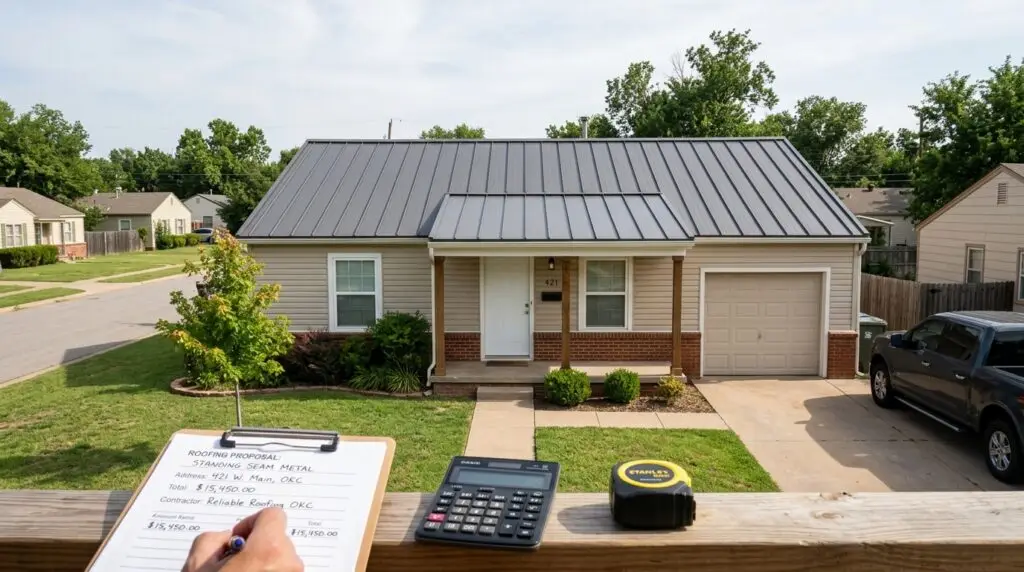
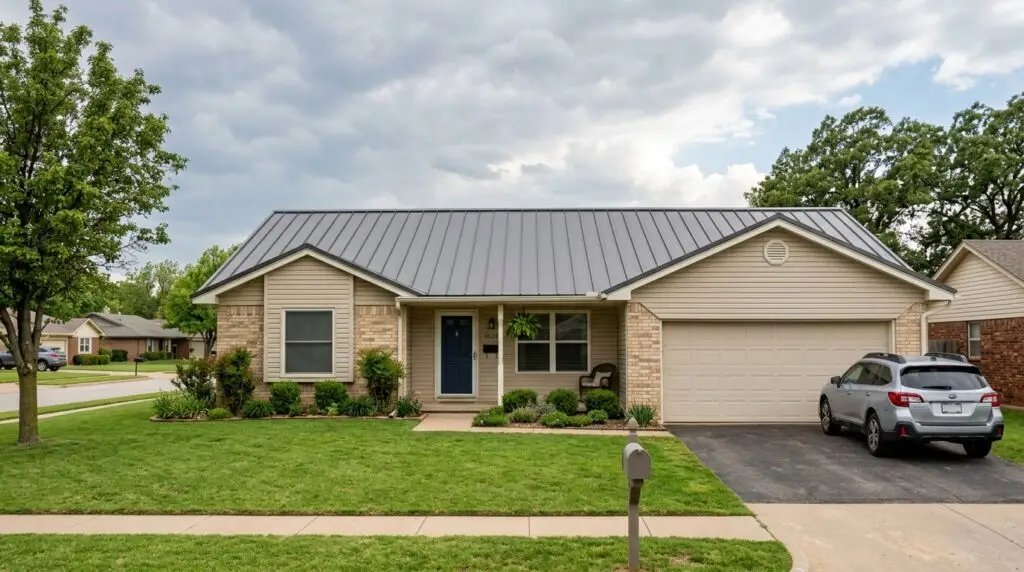
When you look at the best roofing materials for Oklahoma weather through a performance-first lens, metal roofing, specifically standing seam steel, consistently comes out on top. This isn’t a marketing position. It’s a material science reality.
Why Metal Outperforms Everything Else in Oklahoma
Wind resistance. Standing seam metal roofing systems, when properly installed, are engineered to handle the kind of sustained high wind events that routinely hit the OKC metro. Unlike shingles that can lift and peel at the edges, a standing seam system locks panels together in a way that dramatically reduces wind uplift vulnerability.
Hail resistance. Steel deflects and absorbs hail impact energy rather than cracking or fracturing under it. Where asphalt shingles lose granules and develop micro-fractures that aren’t visible from the ground, properly gauged steel panels maintain their structural integrity through repeated impacts. Note: very large hailstones can cause cosmetic denting on metal, but cosmetic dents don’t compromise function. A dented metal roof still protects your home. A shingle roof with hidden micro-fractures silently fails over the next year.
Thermal expansion design. This is where metal roofing engineering really shines in Oklahoma’s climate. Standing seam systems use floating clip fasteners, the panels aren’t rigidly bolted to the deck. They ride on clips that allow the metal to expand and contract with temperature changes without pulling fasteners loose or buckling panels. Oklahoma’s temperature swings are severe. This design feature matters enormously for long-term performance.
Longevity. A properly installed metal roof in Oklahoma typically lasts 40 to 70 years, depending on metal type and coating quality. That’s the equivalent of two to three full asphalt roof cycles, with the compounding value of avoiding repeated replacement costs.
Energy efficiency. Metal roofing with reflective coatings significantly reduces radiant heat absorption during Oklahoma’s brutal summer months. Cooler attic temperatures mean lower cooling loads, which translates to real reductions in monthly energy costs. Some homeowners notice this immediately in the first summer after installation.
The Three Types of Metal Roofing — Not All Metal Is Equal
Most articles about metal roofing treat it as a single category. It’s not. The type of metal roofing you choose matters as much as choosing metal over asphalt.
Standing Seam Metal Roofing is the premium option and the one we recommend most often for long-term residential performance in Oklahoma. Concealed fasteners, interlocking raised seams, floating clip attachment, this system is purpose-built for environments with high wind, dramatic temperature swings, and repeated hail exposure. It’s particularly well-suited architecturally for newer construction in Edmond, Deer Creek, and Nichols Hills, where cleaner roof lines are the norm.
Metal Shingles offer the durability of metal in a profile that closely resembles traditional asphalt or slate shingles. For homeowners in Moore, Yukon, Midwest City, and Bethany who want storm protection without dramatically changing the look of their home, metal shingles hit a strong balance of performance and aesthetics. Installation is generally faster than standing seam, which can reduce labor costs modestly.
Exposed Fastener Panels (R-Panel / Corrugated) are more commonly seen on commercial buildings, agricultural structures, and rural Oklahoma properties than on residential homes. The lower material cost is real, but the exposed fastener points are a maintenance consideration over time. In a high-UV, high-thermal-cycling environment like Oklahoma, fastener sealants degrade and periodically need attention. For residential applications, we typically guide homeowners toward standing seam or metal shingles instead.
Metal Roofing and Oklahoma Insurance: What Most Homeowners Don’t Know
Between you and me, a lot of homeowners skip this conversation entirely, then find out after installation that they qualified for a significant discount they never claimed. That’s a frustrating and avoidable situation.
Many Oklahoma homeowners insurance carriers offer premium discounts for Class 4-rated roofing systems, and qualifying metal roofs frequently meet or exceed that threshold. The Strengthen Oklahoma Homes program has historically offered additional incentives for homeowners who install impact-resistant materials. Specific discount amounts vary by carrier and policy terms.
The practical rule: before you sign any roofing contract, call your insurance agent and ask specifically whether the material being installed qualifies for a discount, and get that answer in writing. Don’t rely on what the contractor tells you, verify it directly with your carrier.
Class 4 Impact-Resistant Shingles: The Honest Middle-Ground Assessment
We want to be straight with you on this one, because a lot of roofing articles are either all-in on shingles (usually because they’re cheaper to install) or dismiss them entirely.
The honest answer: Class 4 impact-resistant architectural shingles are a legitimate option for some Oklahoma homeowners. They’re not the best option long-term, but they’re not a bad decision in every situation.
What Class 4 Actually Means — and What It Doesn’t
The UL 2218 Class 4 rating means a shingle survived a 2-inch steel ball dropped from 20 feet without cracking or fracturing. For moderate hail events, dime to quarter-size, this protection is meaningful. For the larger hail events that the OKC metro regularly experiences, it’s worth understanding that “Class 4” is a minimum performance threshold, not a guarantee of no damage.
There’s also a significant quality range within the Class 4 category. The best Class 4 architectural shingles from premium manufacturers perform very differently than bargain-tier Class 4 products. And in all cases, installation quality is the variable that determines whether a Class 4 shingle actually performs to its rating, poor nailing patterns, improper starter strips, and inadequate underlayment can compromise a premium product down to entry-level performance.
When Asphalt Shingles Make Practical Sense in Oklahoma
If you’re planning to sell your home within the next seven to ten years, the cost-of-ownership equation shifts. The premium for metal roofing becomes harder to recoup in a shorter ownership window, and a properly installed Class 4 shingle roof provides solid protection for that timeframe.
Budget constraints are real. If metal roofing simply isn’t financially accessible right now, Class 4 architectural shingles are a meaningful upgrade over standard shingles and are a reasonable defensive choice. Just make sure you’re comparing real Class 4 products, not standard shingles being upsold with vague language.
Historic districts and architecturally restricted neighborhoods in older OKC-area communities sometimes limit material choices. If your neighborhood has those restrictions, work with a contractor who knows how to navigate them.
Roofing Materials That Struggle in Oklahoma (Contractors Don’t Always Volunteer This)
Most contractors will sell you whatever material you walk in asking about. Here’s what the honest ones tell you before you ask.
Standard 3-tab asphalt shingles have wind resistance ratings that are simply too low for Oklahoma’s storm environment. They’re inexpensive upfront and common, but in our experience, they’re the most frequently replaced roofing material in the metro following spring storm seasons. If you’re quoted 3-tab shingles, ask why.
Wood shakes look beautiful. They also absorb moisture, support mold growth in Oklahoma’s humidity, carry fire risk, and require more maintenance than most homeowners expect or follow through on. They struggle in the heat-moisture cycling of Oklahoma’s climate in a way that degrades them faster than advertised lifespans suggest.
Clay and concrete tile can perform well in high heat, but they come with structural weight requirements most older Oklahoma homes weren’t built to accommodate. They also have vulnerability to the freeze-thaw cycling that affects northern and central Oklahoma, repeated freezing can cause tile cracking over time. Installation expertise for tile is more limited in the OKC market than for metal or asphalt, which matters for long-term maintenance and repair availability.
Thin-gauge imported metal panels look like metal roofing on a quote sheet but perform like a different product. Gauge, the thickness of the metal, determines how well a panel handles hail impacts and thermal cycling. Thin-gauge panels can dent more easily under large hail and may not have the coating quality to resist Oklahoma’s UV load effectively. Always ask for the specific gauge and coating specifications before accepting any metal roofing proposal.
Oklahoma City Neighborhoods and the Roofing Decisions That Match Them
Roofing decisions aren’t one-size-fits-all across the OKC metro, and the best contractors know this. Your neighborhood’s home age, construction style, storm exposure pattern, and architectural context all affect which material makes the most sense.
Edmond and Deer Creek feature a high concentration of newer, larger-footprint homes with architectural profiles that suit standing seam metal roofing very well. Homeowners in these areas making long-term investments in their properties consistently benefit from the premium metal option.
Moore and Midwest City sit directly in the historical path of the most destructive tornado and severe weather events in the OKC metro. Storm performance is non-negotiable here. Both standing seam and metal shingles are appropriate choices; the deciding factor is usually architectural preference and budget.
Yukon and Mustang are growing suburban communities where cost-value balance matters to most homeowners. Class 4 architectural shingles or metal shingles both perform well here. Standing seam is worth the investment for long-term owners.
The Village and Bethany have older housing stock that often requires a structural assessment before adding heavy roofing materials. Metal shingles are frequently the better fit than standing seam for older deck conditions, lighter load, good performance, minimal modification to the existing structure.
Norman and Cleveland County present a mixed market, university housing and rental properties often have shorter decision horizons than owner-occupied homes in established neighborhoods. Material choice should honestly reflect how long you plan to hold the property.
Hidden Roof Damage: What Oklahoma Homeowners Miss After Every Storm
This is the section most roofing articles skip entirely, which is a genuine disservice to Oklahoma homeowners.
Why Storm Damage Isn’t Always Visible from the Ground
You can walk out after a hail storm, look up at your roof, and see nothing obviously wrong. Then, 9 or 12 months later, you have a leak. This isn’t bad luck. It’s physics.
Hail impacts on asphalt shingles cause granule loss, the protective coating is knocked away from the impact point. From the ground, this can look like nothing. But that exposed asphalt now faces direct UV radiation every day, accelerating deterioration at exactly those points. The resulting micro-fractures in the shingle substrate don’t leak immediately. They develop progressively and often don’t present as interior water intrusion until well after the storm event, sometimes after your insurance claim window has closed.
Wind events cause their own hidden damage. Ridge cap displacement, flashing separation at chimneys and valleys, and fastener backing on exposed fastener panels can all be loosened by sustained wind vibration without creating obvious visible damage from the driveway.
What to Do After a Major OKC Storm Event
Get a professional inspection scheduled within 30 days of any significant hail or wind event. Most Oklahoma homeowners insurance policies have defined filing windows, and damage documented within that window is far easier to process than damage identified later.
From the ground, look for: dented or displaced gutters and downspouts (a reliable indicator of hail size and distribution), missing or displaced ridge caps, obvious shingle displacement, and debris accumulation in valleys. These warrant an immediate call to a licensed inspector.
What you can’t see from the ground, granule loss patterns, micro-fractures, flashing integrity, fastener condition, requires trained eyes on the roof.
One firm contractor red flag: anyone who shows up at your door unsolicited after a storm and pressures you toward a same-day decision. Legitimate local roofing contractors don’t need to operate that way. Storm chasers from out of state are a well-documented problem in the OKC market after major weather events.
Metal Roofing Installation in Oklahoma: What Separates a 50-Year Roof from a 15-Year Problem
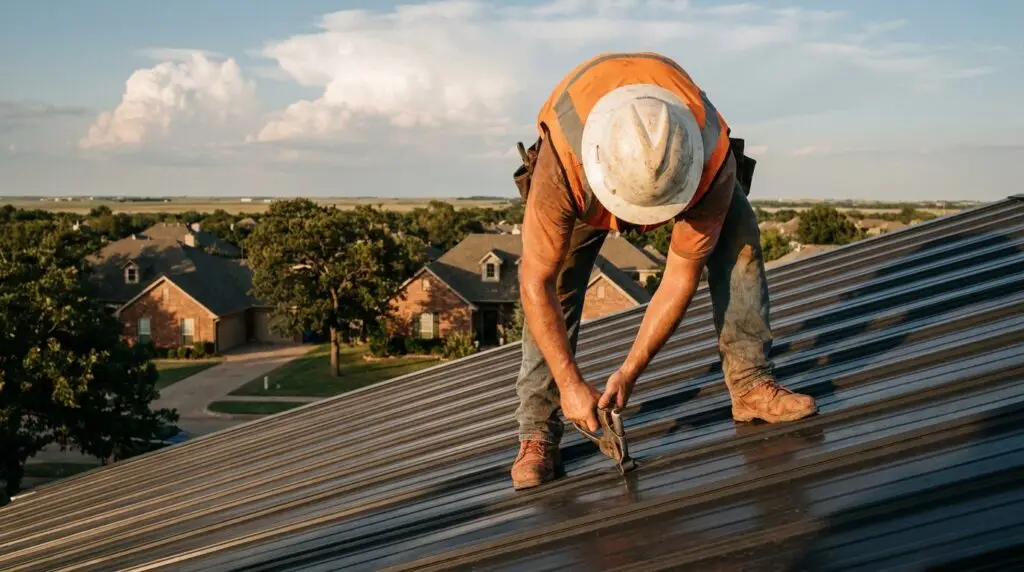
Here’s the thing that doesn’t get said enough: the material is only half the equation. A premium standing seam metal roof installed incorrectly will fail faster than a properly installed Class 4 shingle roof. Installation quality is where the actual long-term performance is determined.
Oklahoma-Specific Installation Considerations
Deck preparation matters more in Oklahoma’s humidity range than many installers acknowledge. Deteriorated or moisture-compromised decking under new metal roofing creates a long-term failure point that doesn’t show up immediately but shortens the lifespan of even the best material.
Thermal expansion gap requirements are engineering specifications, not suggestions. Oklahoma experiences dramatic temperature differentials between winter lows and summer highs. Standing seam systems need to be installed with the proper floating clip system and the correct expansion allowances for this specific climate range. An installer cutting corners on clip type or spacing creates a roof that starts working against itself within a few years.
Flashing at valleys, penetrations, and chimneys is the number-one failure point in OKC metal roof installations. This is where water infiltration almost always begins when a metal roof develops a leak. It requires precision, the right sealant materials rated for Oklahoma’s temperature range, and experienced hands. Ask specifically about flashing methods before signing any contract.
Attic ventilation is an often-overlooked factor. Metal roofing installed over an inadequately ventilated attic traps heat between the deck and the roof panel in a way that accelerates degradation and can affect the interior comfort of the home. A qualified contractor will assess your ventilation situation as part of the installation scope.
Questions to Ask Before Signing with Any Oklahoma Roofing Contractor
- Are you licensed and insured in Oklahoma? (Verify directly with the Oklahoma Construction Industries Board, don’t take their word for it.)
- Do you have local references from completed projects in OKC or the surrounding metro?
- What’s the labor warranty you provide, separate from the manufacturer’s material warranty?
- How specifically do you handle thermal expansion in your standing seam installations? What clip system do you use?
- Are you a locally based company, or are you operating temporarily in our market following a storm event?
Real Cost of Metal Roofing in Oklahoma: What to Budget and Why the Investment Makes Sense
The cost question is the one that stops most homeowners from making the best long-term decision, so let’s address it directly.
Metal roofing costs more upfront than asphalt shingles. That’s simply true. What’s also true is that the factors driving the best roofing materials for Oklahoma weather cost analysis over time frequently reverse that initial gap.
What Drives Metal Roofing Cost in Oklahoma
Several factors determine your final project cost: the size and pitch of your roof (steeper pitches require more safety setup and take more labor time), the complexity of your roofline (valleys, dormers, skylights, and chimneys all add cost), the metal system you select (standing seam costs more than metal shingles; higher-gauge steel costs more than thinner panels), how many existing roofing layers need to be torn off, the condition of your decking, and the specific coating and finish you choose.
Get multiple detailed written quotes, not ballpark estimates over the phone. Any legitimate contractor will do a proper measurement and provide itemized pricing.
Framing the Investment Decision Correctly
Over a 30 to 50-year ownership period, consider all the real cost variables: the number of full metal roof replacements you avoid, the insurance premium savings if your carrier discounts Class 4-rated metal roofing, the energy cost reduction from reduced cooling loads in Oklahoma’s heat, and the avoided repair costs during OKC’s regular storm seasons.
Financing options for metal roofing are widely available. If the upfront cost is the primary obstacle, ask specifically about financing terms, many Oklahoma metal roofing contractors offer programs that spread costs over terms that make the lifetime value equation work immediately.
Frequently Asked Questions: Best Roofing Materials for Oklahoma Weather
What is the best roofing material for Oklahoma weather?
Metal roofing, specifically standing seam steel, offers the strongest combination of wind resistance, hail resistance, thermal performance, and long-term durability for Oklahoma’s climate. For homeowners with tighter budgets, Class 4 impact-resistant architectural shingles are the next best option.
How long does a metal roof last in Oklahoma?
A properly installed metal roof in Oklahoma typically lasts between 40 and 70 years, depending on the metal type, coating quality, and installation quality. This significantly outlasts asphalt shingles in Oklahoma’s storm environment, which typically need replacement every 15 to 25 years in this climate.
Does metal roofing hold up to Oklahoma hail?
Yes. Metal roofing is among the most hail-resistant options available. Steel panels and standing seam systems resist the cracking and micro-fracturing that affects asphalt shingles during large hail events. Very large hailstones can cause cosmetic denting on softer metals, but denting does not compromise the roof’s function. Steel gauge selection matters, heavier gauges perform better under repeated large hail impacts.
Will a metal roof lower my homeowners insurance in Oklahoma?
Many Oklahoma homeowners insurance carriers offer premium discounts for Class 4 impact-rated roofing, and qualifying metal roofs frequently meet that threshold. The Strengthen Oklahoma Homes program has offered additional incentives for homeowners upgrading to impact-resistant materials. Confirm eligibility with your specific carrier before installation, and get the discount confirmation in writing.
Is metal roofing loud during rain and hail in Oklahoma?
When properly installed over solid decking with adequate underlayment and insulation, metal roofing is not significantly louder than asphalt shingles inside the home. Noise issues are primarily associated with metal roofing installed over open framing without underlayment, which is not standard practice in residential installation.
How soon after an Oklahoma hail storm should I get my roof inspected?
Within 30 days of a significant storm event is the practical window. Many insurance policies have defined claim filing deadlines, and damage documented promptly is far easier to process. Hail damage that appears minor initially can develop into active leaks 6 to 12 months later, getting inspected early protects both your home and your insurance options.
What is the worst roofing material for Oklahoma weather?
Standard 3-tab asphalt shingles are the least appropriate choice for Oklahoma’s storm environment. Their wind resistance ratings are too low for the conditions OKC homeowners regularly face, and they lack the impact resistance of Class 4-rated products. Wood shakes are similarly problematic due to moisture cycling, fire risk, and maintenance demands in Oklahoma’s climate.