If you’ve lived in the Oklahoma City metro for any length of time, you already know what spring feels like. One afternoon it’s calm and sunny. By dinnertime, there are tornado sirens going off in Moore, quarter-sized hail hammering Edmond, and straight-line winds pushing 70 miles per hour through Midwest City. Your car takes a beating. Your windows rattle. And your roof, the one thing standing between your family and all of it, absorbs every single impact.
Here’s the thing most homeowners don’t realize: a single storm rarely destroys a roof outright. What actually happens is more dangerous. Each storm weakens the system a little more, and the next one finds the path of least resistance. Understanding exactly how Oklahoma storms affect roofing systems, and why certain materials hold up while others fail, is the first step toward making a smarter decision about your home.
Oklahoma Is One of the Most Demanding Roofing Environments in the Country
This isn’t a dramatic claim, it’s geography. Oklahoma sits directly in the path where warm, moisture-laden air from the Gulf of Mexico collides with cold fronts pushing down from the Rockies. That collision produces powerful updrafts, rotating storms, and some of the most intense hail events recorded anywhere in the United States.
The Oklahoma City metro, including the suburbs of Edmond, Norman, Yukon, Midwest City, and Moore, occupies a particularly active zone within what meteorologists call Tornado Alley. The flat terrain offers no natural wind breaks. There are no mountain ranges, no dense forest corridors, nothing to slow a storm system down before it reaches your neighborhood.
What Makes OKC Storm Damage Worse Than Most People Expect
Wind shear at altitude causes hailstones to travel at steep, angled trajectories rather than falling straight down. That means even a modest-sized stone hits a roof with more force than gravity alone would produce. Combined with the thermal cycling Oklahoma roofs endure, hot summers regularly pushing past 100°F, followed by rapid temperature drops when storm fronts arrive, roofing materials here face stress that simply isn’t present in most other parts of the country.
Oklahoma consistently ranks among the top states in the nation for wind and hail insurance claims per capita. The state averages more than 50 tornadoes annually, with spring storm season running from March through June. The OKC metro sits at the center of that risk window.
The Four Types of Storm Damage Oklahoma Roofs Face Every Year
Not all storm damage looks the same, and not all roofing materials respond to it the same way. In our experience inspecting roofs across the OKC metro after major weather events, we see four distinct damage types, each with its own signature, and each with different implications depending on what your roof is made of.
Hail Damage: The Silent Destroyer
Hail is the number one roofing threat in central Oklahoma, and the most deceptive. Most homeowners look at their roof after a storm, see no missing shingles, and conclude everything is fine. That’s often the wrong conclusion.
Here’s what hail actually does. Small stones, pea-sized, roughly half an inch, cause mostly cosmetic impact on newer materials. Once you get to quarter-sized hail (about an inch in diameter), asphalt shingles begin losing protective granules. Those granules aren’t decorative. They shield the asphalt layer beneath from UV degradation. Once they’re gone, the clock starts ticking.
Golf ball-sized hail, 1.75 inches, causes cracking, bruising, and sometimes punctures through standard shingles. In a single event, a hailstorm that size can compromise the waterproofing integrity of an entire roof field without leaving a single visible hole. The damage is real. The leaks just haven’t started yet.
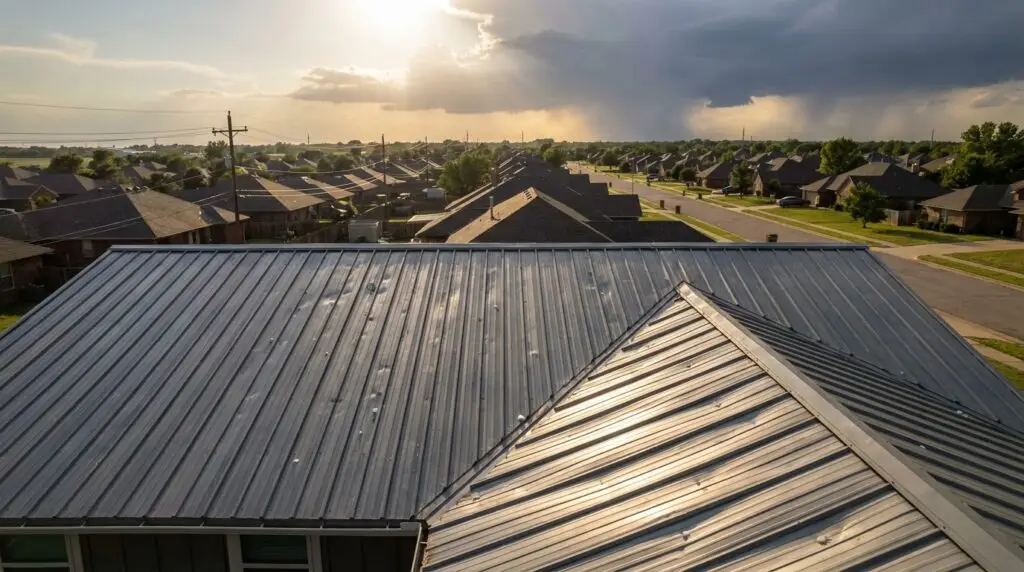
Metal roofing responds differently. A Class 4 impact-rated metal panel, tested under the UL 2218 standard by dropping a 2-inch steel ball from prescribed heights, absorbs the impact without granule loss, because there are no granules. The panel may show a cosmetic dent from extreme hail, but the waterproofing function remains intact.
Wind Damage: The Most Misunderstood Type
Straight-line winds during OKC storm events routinely reach 60 to 80 miles per hour. Oklahoma has recorded straight-line wind events exceeding 70 mph that removed entire roof sections from residential homes. And that’s not tornado wind, that’s a run-of-the-mill severe thunderstorm.
Wind damage is directional. It concentrates on the wind-facing slope of your roof and tends to attack ridge caps and eave edges first. Most homeowners who do a ground-level walkthrough after a storm check the visible slopes and miss the damage entirely. The compromised side is the one the storm hit head-on.
For asphalt shingles, the failure mode is clear: wind catches the leading edge of a shingle, breaks the adhesive strip that holds it down, and either lifts it or removes it entirely. Once that adhesive seal is broken, re-sealing requires replacing the shingle. A shingle that lays back flat after being lifted is no longer properly bonded.
Standing seam metal roofing eliminates the exposed fastener problem entirely. The panels interlock and are secured through concealed clips, leaving no nail heads or screw heads at the surface for wind to exploit. Wind uplift ratings on quality metal panels start at 130 mph and go higher, ratings verified through FM 4473 testing protocols.
Heavy Rain and Water Intrusion
Rain by itself rarely destroys a healthy roof. What it does is find every weakness that hail and wind already created. A micro-fracture in a shingle, a lifted flashing seal, a section of compromised sealant around a vent, rain exploits all of it.
Oklahoma City can receive heavy rainfall quickly when severe storms move through. The drainage system, gutters, downspouts, valley channels, has to handle that volume efficiently. If debris is holding water against the roof surface, or if flashing has pulled away from a chimney or skylight, water intrusion begins at exactly those spots.
Metal roofing’s interlocking panel system and smooth surface shed water faster and more completely than overlapping asphalt shingles. There’s less surface area for water to pool, and fewer seams for it to penetrate.
Tornado and Debris Impact
Oklahoma averages more tornadoes per year than virtually any other state, and the OKC metro sits in the most active part of that corridor. Moore, Midwest City, and south Oklahoma City have experienced multiple direct tornado impacts over the past few decades.
Tornado damage mechanisms are different from wind damage. Tornado-force winds create negative pressure, uplift, that works from beneath the roof deck, not just across the surface. That’s why tornadoes can remove an entire roof section while leaving the walls standing. The roof peels up rather than blows in.
Flying debris, branches, sections of fence, roofing material from neighboring homes, creates puncture and impact damage that neither asphalt nor metal is immune to at extreme velocities. But metal roofing’s structural rigidity provides better resistance to debris impact than the softer asphalt composite.
The Compounding Damage Problem Most Oklahoma Homeowners Miss
This is the part that most roofing content doesn’t explain clearly enough, so let’s be direct about it.
Every storm that hits your roof leaves it slightly weaker than before. Granules gone from a hail event last May mean the asphalt layer is now exposed and aging faster. The adhesive strip that wind broke last September means a shingle is holding on with less than full bond strength. The micro-fractures from the hailstorm three years ago have been slowly absorbing moisture and cycling through freeze-thaw each winter.
Storm 1 loosens the system. Storm 2 finds those loose points and exploits them. Storm 3 sends water into the decking through the gaps Storm 2 created. By the time you see a water stain on your ceiling, you’re not dealing with a new problem, you’re dealing with the culmination of three or four events that each chipped away at the same roof.
This is why asphalt roofs in Oklahoma frequently fail well short of their rated lifespan. A 25-year shingle installed in OKC may realistically need replacement in 10 to 15 years. Not because the product is defective, but because it wasn’t designed for the compounding stress this climate delivers.
| Metal roofing resists the compounding cycle because its failure modes are fundamentally different. No granules to lose progressively. No adhesive strips that weaken with each thermal cycle. A properly installed standing seam metal roof can absorb multiple severe storm seasons without the same accumulating vulnerability. |
Oklahoma’s Storm Season Calendar and What It Means for Your Roof
Understanding when your roof is most at risk, and why, helps you make smarter maintenance and replacement decisions.
Spring (March Through June): Peak Hail and Tornado Season
This is the highest-risk window for OKC homeowners. The atmospheric conditions that produce large hail, supercell thunderstorms, and tornadoes are most active during these months. Neighborhoods throughout the metro, but particularly Moore, Midwest City, Norman, and south OKC, have historically seen the most severe spring storm events.
After any significant spring storm, schedule a professional inspection within the first week. Insurance documentation is time-sensitive. Claims supported by early inspection findings are considerably stronger than claims filed weeks after the damage occurred.
Summer (July Through September): Heat-Accelerated Deterioration
Oklahoma summers are brutal. Temperatures routinely push past 100°F, and rooftop surface temperatures can reach 150°F or higher on dark-colored asphalt shingles. That heat accelerates the deterioration of granules, dries out the asphalt binder, and causes thermal expansion and contraction that loosens fasteners over time.
Metal roofing reflects a significant portion of solar radiation rather than absorbing it. That difference in thermal load doesn’t just extend the life of the roof, it reduces cooling costs and protects the structural elements beneath.
From a practical standpoint, summer is actually the best time to schedule a metal roof installation. Contractors have more scheduling availability between spring storm events and fall wind season, and installation conditions are stable.
Fall (October Through November): High Winds and Debris
Fall in Oklahoma brings a different threat profile. The large hail events typically wind down, but high straight-line winds, mesocyclones, and rapid cold fronts deliver sustained wind loads and significant debris. Falling tree limbs, especially in neighborhoods with mature tree canopies like parts of Edmond and Yukon, create impact and puncture damage. Debris driven into roof valleys and around vent penetrations can compromise flashing seals.
Fall is the right time for a pre-winter inspection. Any entry points created by fall wind events will get worse through the freeze-thaw cycles ahead.
Winter (December Through February): Freeze-Thaw and Ice
Oklahoma winters are generally milder than northern states, but the state does experience ice storms and hard freeze events. More relevant than outright ice storms is the repeated freeze-thaw cycle, water works into micro-fractures from fall and spring events, freezes, expands, and enlarges those cracks incrementally.
Metal roofing’s smooth surface naturally sheds ice and snow. There’s no granule texture to grip moisture, and the thermal conductivity of metal means ice releases more readily than on asphalt or composite materials.
Why Metal Roofing Outperforms Asphalt in Oklahoma’s Storm Environment
Class 4 Impact Resistance: What the Rating Actually Means
The UL 2218 Class 4 rating is the highest impact classification available for roofing products. Testing involves dropping a 2-inch diameter steel ball from specified heights onto the material and evaluating whether it fractures or cracks. Class 4-rated materials withstand the test without functional failure.
Most metal roofing panels designed for residential applications in high-hail states like Oklahoma carry Class 4 ratings. Many Oklahoma homeowners insurance carriers offer premium discounts for Class 4-rated roofing installations, it’s worth a direct conversation with your insurer before you choose materials, because in some cases the annual premium savings meaningfully offset the higher upfront installation cost.
Wind Uplift: Why the Fastener System Matters More Than Most Contractors Explain
Wind uplift resistance starts with how the roof is attached. Standing seam metal panels use concealed clips that slide along the panel seam, allowing for thermal expansion while maintaining a mechanically secure connection. There are no exposed screw heads at the surface, which means there are no projections for wind pressure to catch.
For OKC conditions, look for panels rated to at least 130 mph wind uplift. For areas of the metro with higher historical tornado exposure, Moore, Midwest City, south OKC, panels rated to 150 mph provide an additional margin. FM 4473 certification is the relevant third-party testing standard to ask your contractor about.
Longevity Across Multiple Storm Seasons
A properly installed metal roof in Oklahoma has a realistic service life of 40 to 70 years. That’s not marketing language, it reflects the durability of steel and aluminum in environments where they don’t face the UV degradation and granule loss that limits asphalt.
Consider the comparison over a 40-year ownership window. An asphalt roof in OKC may require full replacement once or twice in that period due to cumulative storm damage, in addition to whatever repair costs accumulate between replacements. A metal roof installed once, properly, typically only requires periodic maintenance and minor repairs over that same span.
The Honest Trade-Offs Worth Knowing
Between you and me, not every roofing contractor is upfront about this, so we will be. Metal roofing can show cosmetic dents from very large hail, hailstones in the 2.5-inch-and-above range that hit Class 4 panels may leave visible impressions without causing structural damage or water intrusion. The roof still functions. It may not look perfect.
Noise is another real consideration. A metal roof without proper attic insulation is louder during rain and hail than asphalt. This is a solved problem, a qualified installer accounts for it, but it’s worth discussing with your contractor before the job begins.
Installation requires more skill and experience than asphalt replacement. Improper panel overlap, incorrect fastener placement, or flashing shortcuts create leak points that can be difficult and expensive to diagnose. The quality of the installer matters as much as the quality of the material.
What to Do Immediately After an Oklahoma Storm: A Practical Sequence
Most homeowners don’t realize the first 72 hours after a storm are the most important window for documentation and claim protection. Here’s the sequence that actually matters.
First 24 Hours
- Do a safe ground-level walkthrough. Look for obvious missing shingles or panels, visible debris on the roof, and any damage to gutters, vents, or HVAC units. Do not climb on the roof yourself.
- Check gutters and downspout outlets for granule accumulation, a heavy deposit after a storm is a reliable indicator of significant hail impact on asphalt shingles.
- Check interior ceilings for new water stains or damp spots. Attic access points are worth a quick look too.
- Document everything with photos. Note the date, time, and storm event in your records.
- If you have asphalt shingles, check for dents on gutters, vents, and any HVAC sheet metal, if those metal components are dented, your shingles were likely hit hard enough to cause granule damage.
Within the First Week
Contact a local, licensed roofing contractor for a professional inspection before you file your insurance claim. An independent contractor assessment documents the damage on your terms. Insurance adjusters work for the insurance company, that’s not cynicism, it’s just the structure of the relationship. Having your own documentation strengthens your claim.
Oklahoma law requires insurers to acknowledge claims within 10 days and complete their investigation within 45 days. Your policy likely requires you to report damage promptly, typically within 30 to 60 days. Acting quickly also prevents secondary damage from worsening and potentially complicating your claim.
Understanding Your Insurance Deductible Before You File
Most Oklahoma homeowners don’t discover this until they’re sitting across from an adjuster. Many Oklahoma insurance policies include a separate wind and hail deductible calculated as a percentage of the home’s insured value, typically 1 to 2%, rather than a flat dollar amount. On a home insured for $300,000, a 1% deductible means $3,000 out of pocket before coverage kicks in.
Know your deductible before you file. A contractor inspection will give you a repair estimate. If the repair cost is close to your deductible, it may not make financial sense to file a claim, especially if you’d prefer to keep your claims history clean ahead of a renewal.
Common Mistakes Oklahoma Homeowners Make After Storm Damage
In our experience, these are the decisions that end up costing homeowners the most.
- Waiting too long to inspect. Hidden damage worsens quickly, and insurance documentation windows close. A roof that looked fine in June may be actively leaking by September.
- Hiring a storm chaser. After major OKC storm events, out-of-state roofing crews flood the metro. They often deliver substandard work and disappear when warranty issues arise. Use a licensed, locally established contractor.
- Patching over cumulative damage. Replacing a few shingles on a roof that’s already had multiple storm seasons of compounding damage doesn’t restore its protective function, it delays the inevitable and may delay your insurance eligibility for a full replacement.
- Not understanding your deductible before filing. See the section above. This surprises homeowners at exactly the wrong moment.
- Choosing a replacement material based only on upfront cost. Calculate the likely replacement frequency over a 20 to 40-year window. A metal roof that costs significantly more upfront may cost less over the ownership period than two or three asphalt replacements plus repair cycles.
Choosing the Right Metal Roofing System for Oklahoma’s Storm Profile
Panel Types and Their Performance in OKC Conditions
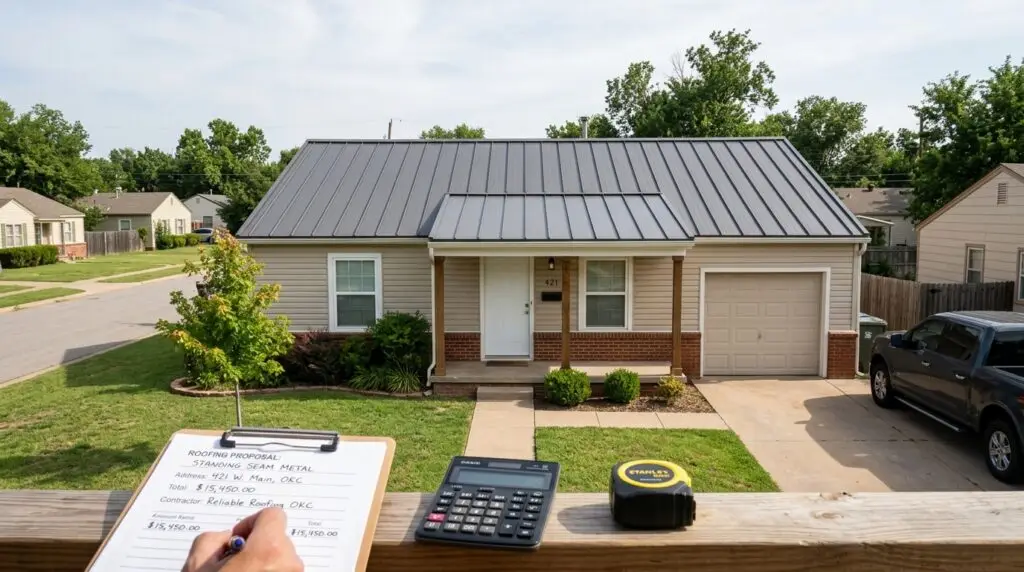
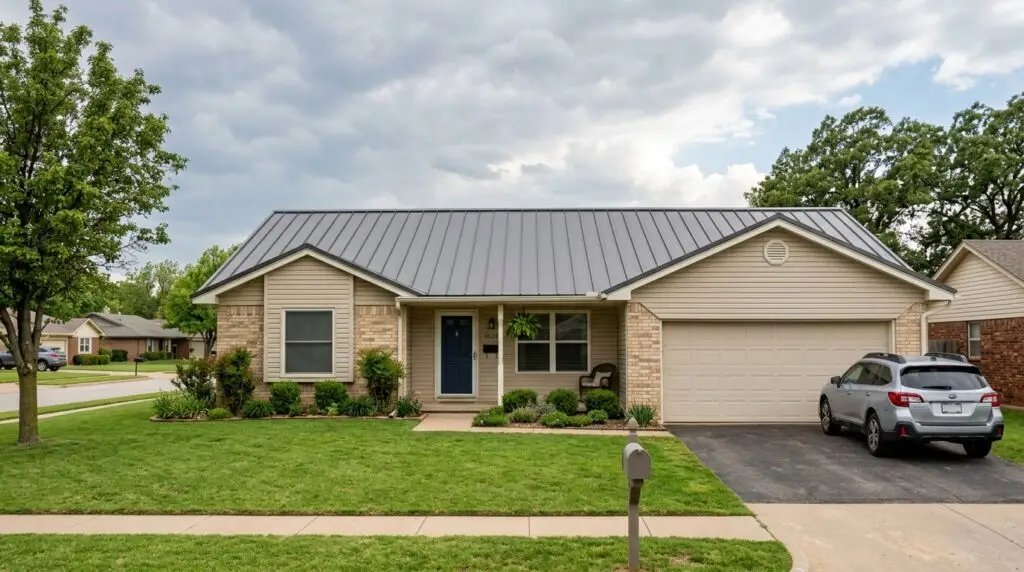
Standing seam metal roofing is the strongest choice for Oklahoma’s storm environment. Concealed fasteners, mechanically interlocked panels, and high wind uplift ratings make it the right solution for homes in high-exposure areas. It’s also the most architecturally clean option for homes where appearance matters.
Exposed fastener panels, sometimes called corrugated or R-panel metal roofing, are a lower-cost option appropriate for outbuildings and agricultural structures. The exposed screws require periodic maintenance as washers age, and they carry somewhat lower wind resistance ratings. In a residential storm-prone context like OKC, standing seam is the better investment.
Stone-coated steel panels offer the appearance of traditional asphalt or tile with metal performance underneath. They’re a solid option for neighborhoods with aesthetic standards or HOA requirements, common in parts of Edmond and Nichols Hills, while still providing Class 4 impact resistance and strong wind ratings.
Questions to Ask Your Metal Roofing Contractor Before Signing
- What is the wind uplift rating on these specific panels, and is it certified under FM 4473?
- Is this product Class 4 impact-rated under UL 2218?
- What underlayment are you installing, and how does it perform in Oklahoma heat?
- What does the manufacturer’s warranty cover for storm-related damage?
- Are you licensed and insured in the state of Oklahoma?
- How do you handle flashing at chimneys, vents, and skylights?
Cost Ranges and What Drives Them
It depends on several factors, panel type, roof pitch, the condition of the existing deck, removal and disposal of the current material, and the complexity of the roof geometry. Metal roofing installation in the OKC market generally costs significantly more upfront than asphalt shingle replacement.
The calculation shifts when you factor in longevity. Metal roofing’s 40 to 70-year service life, combined with potentially lower insurance premiums for Class 4-rated materials and reduced repair frequency, narrows the long-term cost gap considerably. When a major storm event triggers a full replacement anyway, as happens regularly in OKC, insurance coverage at replacement time may close the upfront cost gap further.
Maintaining Your Metal Roof Through Oklahoma’s Storm Seasons
Metal roofing is low-maintenance, not no-maintenance. A few consistent habits extend its service life and protect your insurance standing.
- Inspect after every significant storm event, even when no damage is obvious. Document the inspection date. A consistent inspection history strengthens future insurance claims considerably.
- Clear debris from roof valleys, gutters, and around penetrations after fall wind events. Debris holds moisture against metal surfaces and accelerates corrosion at seams.
- Check flashing annually around chimneys, skylights, and pipe penetrations. This is the most common point of failure on any roofing system, metal included.
- Trim tree limbs that overhang your roof before spring storm season. This matters especially in established neighborhoods with mature trees, parts of Edmond, Yukon, and northwest OKC. Branches that contact the roof surface abrade the coating; branches that fall in a storm cause impact damage.
- Keep documentation of all repairs, inspection reports, and warranty paperwork. Your insurer may request this history as part of a major storm claim evaluation.
Frequently Asked Questions
The following questions are answered concisely for homeowners doing quick research and for voice search and AI-assisted lookups.
How do Oklahoma storms damage roofing systems?
Oklahoma storms damage roofing systems through four primary mechanisms: hail impact strips protective granules from asphalt shingles or dents metal panels; high winds, routinely 60 to 80 mph, lift and loosen shingles or pry at exposed fasteners; heavy rain then penetrates any gaps wind or hail created; and debris from tornado or severe thunderstorm events causes direct puncture and flashing damage. Repeated storm seasons compound this damage progressively.
Is metal roofing worth it for Oklahoma weather?
For most OKC homeowners planning to stay in their home long-term, yes. Metal roofing carries Class 4 impact resistance, wind uplift ratings of 130 mph or higher, and a realistic service life of 40 to 70 years. Asphalt roofs in Oklahoma often need full replacement in 10 to 15 years due to cumulative storm damage. The upfront cost of metal is higher, but when you calculate replacement frequency and potential insurance premium reductions, the long-term numbers often favor metal.
How long does a metal roof last in Oklahoma?
A properly installed metal roof in Oklahoma can last 40 to 70 years. By comparison, standard asphalt shingles rated for 25 to 30 years frequently require replacement in 10 to 15 years in Oklahoma’s climate, because repeated hail and wind events cause cumulative damage that shortens the functional lifespan well below the labeled rating.
What size hail damages a roof?
Hailstones reaching 1 inch in diameter, roughly quarter size, begin stripping granules from asphalt shingles. Stones of 1.5 inches or larger (golf ball size) cause functional damage to most standard roofing materials. Class 4-rated metal panels resist impact at these sizes without structural compromise, though very large hail may cause cosmetic denting.
What should I do immediately after a storm damages my roof in Oklahoma City?
Complete a safe ground-level walkthrough within 24 hours. Look for dented gutters, granule buildup at downspouts, debris on the roof, and interior ceiling stains. Document everything with photos and note the storm date. Contact a local licensed roofing contractor for an inspection before filing your insurance claim, independent documentation consistently strengthens claim outcomes.
Does metal roofing reduce homeowners insurance costs in Oklahoma?
Many Oklahoma insurance carriers offer discounts for Class 4 impact-rated roofing, which includes most residential metal roofing systems. Discounts vary by insurer and policy. Before scheduling a roof replacement, call your insurer to confirm what rating qualifies and what the discount looks like, in some cases it meaningfully offsets the higher upfront cost of metal over time.
When is hail season in Oklahoma City?
Oklahoma City’s peak hail season runs from March through June, coinciding with spring severe weather season. This is when atmospheric conditions, warm Gulf moisture meeting cold fronts, most frequently produce the large hail and supercell thunderstorms that cause the most roofing damage across the OKC metro.