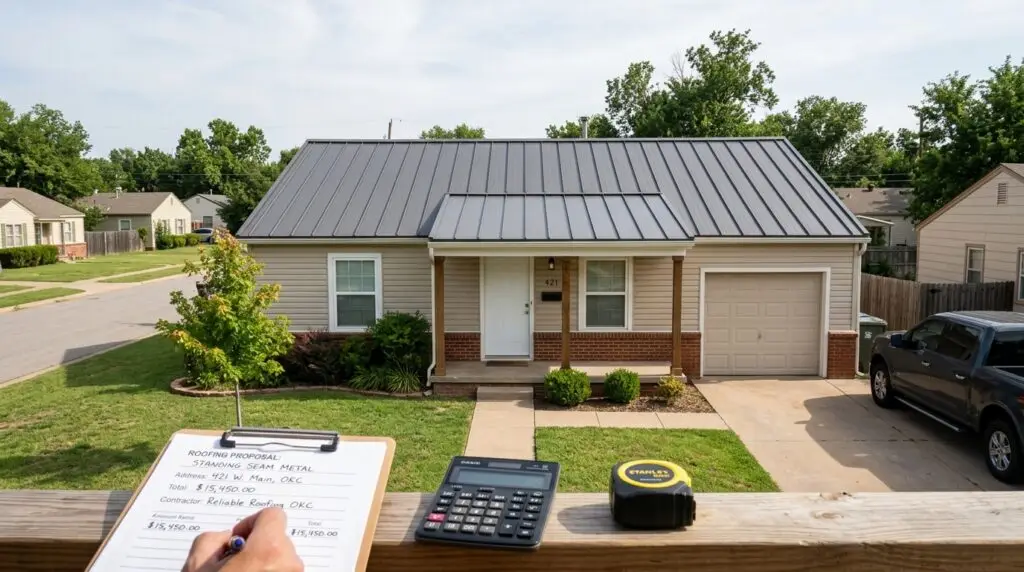

Every spring, the first big hail event rolls across the metro and our phones light up by 7 a.m. the next morning. Some of those calls are about real damage. A lot of them are about damage that could have been cut in half by two hours of work back in February.
That is the honest case for preparing your roof for Oklahoma storms. A storm almost never creates a roof failure out of thin air. It finds the weak spot that was already sitting there quietly, and it exploits it.
Central Oklahoma sits where hail, straight-line wind, and tornado risk all overlap. The National Weather Service office in Norman tracks a severe weather ramp-up that generally runs from March through June, with a smaller second window in the fall. If you own a home in Oklahoma City, Edmond, Moore, Norman, Yukon, or Mustang, that is your calendar whether you like it or not.
One more thing before we get into the list. Most homeowners with metal assume they are covered. The panels are the tough part, sure. The screws, washers, sealant, closures, boots, and edge trim are on a much shorter clock in this climate, and those are the parts storms go after first.
How to Prepare Your Roof for a Storm: The Short Answer
To prepare your roof for a storm, clear the gutters, downspouts, and valleys, trim limbs back off the roof, secure the ridge cap and rake and eave trim, check fasteners, sealant, and pipe boots, put away anything in the yard that can fly, and take dated photos of every slope. On a metal roof, fasteners and edge trim come first.
The five priorities, in the order that matters
- Attachment. Fasteners, clips, seams, ridge cap, rake and eave trim. Anything wind can get a grip under.
- Seals. Pipe boots, sealant at end laps and penetrations, closure strips.
- Water paths. Gutters, downspouts, valleys, drip edge, and grading that carries water away from the foundation.
- Surroundings. Overhanging limbs, loose yard furniture, satellite mounts, trampolines.
- Documentation. Dated photos of all four elevations and every slope, filed with your policy.
How much time each piece takes
A professional storm readiness inspection on a typical single family metal roof usually runs one to two hours, depending on size, pitch, and how many penetrations you have. The night before a storm, you are looking at twenty or thirty minutes of ground level work. After a storm, a walkaround takes about fifteen minutes, plus an attic check the next time it rains.
Oklahoma’s Storm Calendar: When to Prep, When to Watch
Timing is most of the game here, and almost nobody talks about it.
Late winter, roughly February into early March
This is the high value window. Book the inspection, capture your baseline photo set, and get repairs done while schedules are open and sealants cure in mild weather. That photo set is the single most useful thing in this article, and it costs you nothing but ten minutes.
Spring, March through June
Monitoring mode. After every significant hail or wind event, do a ground level walkaround, check the gutters, look in the attic after the next rain, take dated photos, and write the storm date down somewhere you will find it later.
Here is the thing about spring in this metro. Once the first serious hail hits, good local crews book out for weeks and out of state storm chasers show up the same afternoon. Prep work is dramatically easier to schedule in February than in May. That is not a sales line, it is just how our season runs.
Summer, July and August
Heat is a storm issue, even though it does not feel like one. Triple digit afternoons and the thermal cycling that comes with them are what back screws out and age sealant. The damage shows up later as a leak during a storm, not during the heat wave itself.
Fall, September through November
Second pass. Check sealant and fasteners after a hard summer of UV, clear the leaves out of the gutters, and get ready for Oklahoma’s smaller autumn severe weather window before freeze and thaw cycles start working on everything.
If you want the deep version of the seasonal task list, we cover it in our guide to roof maintenance before storm season.
The Seasonal Storm Prep Checklist for Oklahoma Homeowners
From the ground, all the way around the house
Walk the full perimeter with binoculars or your phone camera zoomed in. You are looking for lifted panel edges, ridge cap that has shifted, loose rake or gable trim, pipe boots missing their collars, and rust streaking below fastener heads.
Clear the gutters and downspouts completely, then confirm water actually discharges away from the foundation. A packed gutter during a three inch per hour Oklahoma downpour backs water up under the eave and into the fascia, and you will not see it happen.
Trim limbs back off the roof plane. On metal, wind driven abrasion wears through the coating slowly and quietly, and it is entirely preventable.
Put away or tie down patio furniture, grills, trampolines, and yard decor. In our experience, flying debris punctures more panels around here than hail does.
Inside the house and up in the attic
Look for ceiling and wall stains, bubbling paint, and a musty smell in upstairs rooms and closets. Then get in the attic on a bright day with the lights off. Daylight pinholes, damp or clumped insulation, dark streaks running down rafters, rusted fastener tips poking through: those are your early warnings. Our field guide on the warning signs of a roof leak goes deeper if you find something that worries you.
While you are up there, make sure soffit and ridge vents are not blocked by insulation or bird nests. Blocked ventilation speeds up the heat cycling that loosens everything else.
The step almost everyone skips
Photograph every slope, all four elevations, the gutters, and the attic, with the date visible. Save those photos with your inspection report, your maintenance receipts, and your policy declarations page in one folder.
And think about it this way, because it makes the point stick: you are not photographing damage. You are photographing the absence of damage. That is the whole reason it works later.
What to hand off to a professional
Anything that puts you on the roof. Anything involving fasteners or sealant. Anything above one story. And this one matters more than people expect: do not walk a metal roof. It is slick long before it looks slick, and a boot in the wrong spot creates exactly the damage you were trying to avoid. Send photos to a roofer instead.
Metal Specific Storm Prep That Never Shows Up on a Checklist
Almost every storm prep article you will find was written for asphalt shingles, then had the word metal sprinkled on top. Metal roofing is sheet metal work. Different failure points, different prep.
Fasteners and washers on exposed fastener panels
This is item number one, full stop. Screws back out with thermal cycling, and neoprene washers harden and crack under Oklahoma sun. Plan on a fastener review somewhere in the ten to twenty year window, sooner on south and west facing slopes that take the worst of the afternoon heat.
One honest note: over torquing crushes the washer and makes the leak worse. Failed screws usually need replacement with an oversize fastener, not another quarter turn.
Seams, end laps, and where sealant belongs
Sealant goes in front of the fastener line, not behind it. Get that backwards and the lap holds water instead of shedding it. Dried or cracked butyl at end laps is a leak waiting on the first sideways rain.
Standing seam is built to move, so clips and expansion allowance on long panel runs deserve a look before spring temperature swings start.
Closures, ridge caps, and rake trim
Those foam and rubber closures at eaves, ridges, and valleys are what stop wind driven rain, blowing debris, and animals. Missing closures are common on budget installs, and they go missing after wind events too.
The edges, which is where storms actually start peeling roofs
Uplift concentrates at eaves, rakes, ridges, and especially that lower corner where the rake meets the eave. Once wind gets under a panel edge, it inflates the system and peels it back. Edge metal and trim securement is the highest leverage wind item on any metal roof, and perimeter and corner zones need tighter fastener spacing than the middle of a slope. Most wind failures we see started at an edge, not in the field.
Penetrations and add-ons
Pipe boots, vents, skylights, chimneys, satellite mounts, solar racking. Old satellite dish mounts drilled straight through panels turn up constantly on OKC roofs, and they leak long before the panel ever will. If panels are in your future, our notes on whether metal roofs are good for solar panels cover mounting done right.
Coating, rust, and dissimilar metals
Touch up scratches down to bare metal before spring rain. Clear debris that traps moisture against panels. Keep copper or lead flashing away from steel. On older Galvalume, cut ends and edge rust are worth a close look. Most of this falls under straightforward metal roof repair if you catch it early.
What prep genuinely cannot do
Between you and me, you cannot hail-proof a roof, and any roofer who tells you otherwise is selling something. Most hail marking on metal is cosmetic. Prep does not stop dents. What it does is stop the leaks that follow a storm, and make real damage easy to prove to an adjuster. Those two things are worth plenty.
Severe Weather Is Forecast Tonight: The 24 Hour List
Say the Storm Prediction Center has central Oklahoma outlined and the local mets are already talking about hail size. What can you actually do today?
Still worth doing
Clear the gutter and downspout outlets you can reach from the ground. Move vehicles into the garage or under solid cover. Bring in or tie down anything that can become a projectile. Close and latch shutters and windows. Move valuables out from under any ceiling that has given you trouble before.
Charge phones and battery banks, and have a weather radio or two reliable alert sources running. If you never took your baseline photos, take them right now. A same week photo of your roof beats a perfect one from last year.
Not worth doing
Do not climb a ladder in rising wind. Do not tarp a roof that is not currently leaking. Do not rush fastener or sealant work in fading light, because bad sealant placement in a hurry creates the exact leak you were trying to head off.
During the storm
Shelter in an interior room on the lowest floor, away from windows and skylights. Nothing on your roof is worth a trip outside while hail is falling. If water starts coming in, contain it with buckets and towels, and poke a small hole in a bulging ceiling to relieve trapped water. Then photograph it. Roof work waits for daylight and a dry surface.
The First 48 Hours After an Oklahoma Storm
The first hour or two
Safety first, and we mean the boring kind. Downed power lines, gas smells, sagging ceilings. Stay off the roof and off ladders. Contain interior water and move belongings out of the way.
The rest of day one
Document before you touch anything. Dated photos and video from the ground of every elevation, plus gutters, downspouts, window screens, the fence, the deck, and your AC condenser fins. Collateral damage on soft metal is often the clearest evidence that hail was big enough to matter.
Write down the storm date and time and save a radar or forecast reference. Keep receipts for anything you buy to prevent further damage, since most policies expect reasonable mitigation and will reimburse it.
Day one into day two
Schedule a professional metal roof inspection with a contractor who works on metal regularly. Ask for photos and written findings, and ask them to separate storm damage from normal wear in plain language.
Emergency tarping is a legitimate short term step, but it belongs to somebody with fall protection, not a homeowner on a wet metal slope. Our storm damage roof repair crews handle that part.
What storm damage looks like on metal
Dents and dimples on panels and gutters. Seams pulling apart. Ridge cap or trim knocked out of position. Fasteners backed out or sheared. Torn pipe boots. Punctures from debris. Coating fractured at impact points.
And here is the part that catches people: the leak often shows up on the third or fourth rain after the storm, not the day of it. If something looks urgent, our list of signs you need roof repair immediately will help you sort it out.
The door knocker rule
Storm chase crews follow OKC hail within hours. Do not sign anything, including an authorization to inspect, before you have a local inspection and a written scope in hand. We wrote a full breakdown on how to choose the right roofing contractor for exactly this reason.
How Storm Prep Protects Your Insurance Claim
The denial you are heading off
Carriers regularly attribute storm damage to wear, neglect, or improper maintenance. A dated set of pre-storm photos plus a maintenance record is the cleanest answer a homeowner can hand an adjuster, and it costs nothing to build.
Policy terms to read in March, not June
Replacement cost value versus actual cash value, which decides whether you are paid for a new roof or a depreciated one. Separate wind and hail deductibles, which are often a percentage of insured value instead of a flat dollar figure. Cosmetic damage exclusions, which matter a great deal on metal, since dents are frequently cosmetic. Read the roof surfacing endorsement specifically, because plenty of Oklahoma policies treat the roof differently from the rest of the house.
Claim timing in Oklahoma
Oklahoma law addresses policies that put a time limit on wind and hail roof claims. Those policies have to allow filing past the first anniversary and out to twenty-four months from the date of loss when the damage is not evident without an inspection. Check the Oklahoma Insurance Department and your own policy language rather than taking any roofer’s word for it, ours included.
The folder that pays for itself
Inspection report, dated photos, maintenance receipts, storm dates, declarations page. All in one place. Ten minutes of filing in March saves weeks of arguing in June.
What Storm Prep and Repairs Cost in Oklahoma City
| Service | What you get | What to watch for |
|---|---|---|
| Free storm readiness inspection | Condition assessment, photos, a repair quote | It is a sales visit by design. Insist on written findings and photos, and never sign a contingency agreement on the spot. |
| Paid pre-storm service visit | Actual work: sealant, fasteners, boots, trim, valley clearing | Get the scope in writing and ask what is excluded. |
| Annual readiness agreement | Scheduled visits, a documentation trail, priority scheduling after storms | Confirm it covers metal specific items instead of a shingle template. |
Plenty of Oklahoma City roofing companies offer free storm and pre-season inspections. Paid standalone inspections generally land in the low hundreds, roughly the $100 to $400 range depending on height, pitch, size, and complexity. A hands-on service visit that reseals penetrations, swaps failed fasteners and boots, resecures trim, and clears valleys typically runs a few hundred dollars on a straightforward residential metal roof, and more on complicated rooflines or when fastener replacement is extensive. Emergency tarping usually falls in the same few hundred dollar neighborhood and is often reimbursable as mitigation, so keep the receipt.
What moves the number: roof size, pitch, number of stories, penetration count, exposed fastener versus standing seam, how long maintenance has been deferred, whether drone or infrared imaging is involved, and whether you need the report formatted for an insurance file.
The cheapest storm prep is the kind you do in February. A boot and sealant refresh costs a fraction of one drywall and insulation repair, and it happens on your schedule instead of at eleven at night during a thunderstorm.
The Check Found Something: Fix It, Watch It, or Replace It?
| What the check found | What it usually means | Reasonable next step |
|---|---|---|
| Clogged gutters, debris in valleys, limbs on the roof | Housekeeping | Handle it now. Cheapest item on the list by a wide margin. |
| A handful of backed-out screws, cracked boot sealant | Normal wear in this climate | Maintenance level repair before April. |
| Loose ridge cap, lifted rake or eave trim | Wind vulnerability | Fix this first. It is the item most likely to turn one storm into a torn open roof. |
| Cosmetic denting, oil canning, light chalking | Appearance, not performance | Photograph it, document it, monitor it. Nobody should sell you a roof on looks alone. |
| Widespread fastener failure or separating seams | Systemic, usually age or install driven | Full fastener and seam program, or price it against replacement. |
| Perforating rust, wet decking, several active leaks | The system is at the end | Replacement conversation, and check claim eligibility from prior storms first. |
Is it worth replacing before storm season instead of after? It depends on several factors, mainly remaining service life and whether you have claimable damage sitting on the roof right now. Replacing a roof that already has legitimate storm damage may leave money on the table. Replacing a genuinely failing roof in February means you are not competing with half the metro for crews in May. Our guides on how to tell if your roof is failing and when roof repair is better than replacement walk through both sides.
Upgrades Worth Pricing Before Spring
UL 2218 Class 4 is the top impact resistance classification, and a lot of metal systems carry it. Some carriers offer premium credits for impact rated roofs, so ask your agent rather than assuming. On the wind side, heavier gauge and concealed fastener standing seam generally handle uplift and thermal movement better than thin exposed fastener panels. Look for UL 580 or ASTM E1592 uplift testing on the specific system instead of a mph number printed in a brochure.
The unglamorous details decide storm performance more than the panel profile does: properly secured drip edge and rake trim, quality synthetic underlayment, sound decking, correct fastener pattern in perimeter and corner zones, and closures installed where they belong. A storm is what exposes install shortcuts. If you are already planning a metal roof installation, that is the conversation to have up front.
One local program most OKC homeowners have never heard of: the Oklahoma Insurance Department runs Strengthen Oklahoma Homes, sometimes called OKReady, to help homeowners upgrade to the IBHS FORTIFIED roof standard. It requires an independent FORTIFIED evaluator rather than your roofer, the evaluation fee is on the homeowner, and grants do not cover costs above the award amount. Worth a look before you commit to a replacement.
While you are pricing upgrades, do not skip ventilation. Balanced intake and exhaust slows the heat cycling that ages sealant and fasteners in the first place. It is maintenance wearing an upgrade costume.
Storm Prep Mistakes We See Every Spring
- Assuming a metal roof needs no prep. Panels last decades. Screws, washers, boots, closures, and sealant do not.
- Waiting until the watch is issued. By then your options are gutters and lawn furniture.
- Climbing up in rising wind to check something real quick. This is the injury we hear about every year.
- Tightening every screw on the roof. Over torquing crushes washers and creates leaks.
- Caulking over a mystery spot. It traps water, hides the real entry point, and raises the eventual repair bill.
- Pressure washing coated panels. It drives water under laps and damages the finish. Soft wash or leave it alone.
- Skipping the before photos, then trying to prove storm damage in June.
- Signing with the first door knocker because no local relationship existed before the storm.
- Hiring a shingle crew for metal work. Ask what they do all week, not what they can do.
What Matters Most, By Where You Live in the Metro
Older ranch homes in Del City, Midwest City, Bethany, and south Oklahoma City. Simple gable roofs, thinner original decking, metal often laid over older layers, aged plumbing boots, limited attic ventilation. Focus on boots, decking condition, and ventilation.
Mature tree neighborhoods around Nichols Hills and central OKC. Debris packed valleys, limb abrasion on coating, moisture held behind chimneys. Focus on trimming and valley clearing before spring.
Newer builds in Edmond, Yukon, Mustang, and Norman. Complex rooflines with more valleys, dormers, and sidewall transitions, which means more flashing and more failure points, plus wide open western exposure to straight-line wind. Focus on flashing, kick-out flashing, and edge securement.
Moore and the south metro storm corridor. Repeat hail exposure means storm history matters as much as roof age. Focus on documentation discipline and an honest look at cumulative wear.
Acreage properties out toward Piedmont and El Reno. Long unobstructed wind fetch, metal outbuildings, low slope additions. Focus on edge trim, closures, and lap sealant.
Patio covers, carports, and low slope additions anywhere. These are the number one source of the it only leaks in one room call. Focus on laps, closures, and the transition where the addition meets the main roof.
Book a Storm Readiness Inspection Before the Next System Moves In
The whole system fits in one sentence: baseline inspection in late winter, repairs in early spring, a short list the night a watch goes up, documentation after every event, and a second pass in the fall.
Before you hire anyone, ask these. Do you work on metal specifically, not just shingles? Will I get dated photos and written findings? Will you replace failed fasteners instead of just retightening them? Will you separate storm damage from normal wear in writing? Are you licensed and insured, and do you pull City of Oklahoma City permits when the work requires one? And will you tell me plainly if nothing needs doing yet?
A good roofer answers all six without flinching. If you want help preparing your roof for Oklahoma storms this season, schedule a storm readiness metal roof inspection in Oklahoma City, Edmond, Moore, Norman, Yukon, and Mustang. February is a much better phone call than May.
Frequently Asked Questions
How do I prepare my roof for a storm?
Clear gutters, downspouts, and valleys, trim limbs off the roof, secure ridge cap and edge trim, check fasteners, sealant, and pipe boots, put loose yard items away, and take dated photos of every slope. On metal, fasteners and edge trim matter most.
When is storm season in Oklahoma?
Severe weather generally ramps up from March through June, with peak hail and wind activity in spring and a smaller second window in fall. Prep in February. Monitor and document through spring.
Can you hail-proof a roof?
No. You can improve impact resistance with a Class 4 rated system, but no roof is hail-proof. Good prep prevents the leaks that follow a storm and makes real damage much easier to prove on a claim.
Are metal roofs better than shingles in hail and high wind?
Generally yes on both counts, especially heavier gauge standing seam. Metal resists puncture and uplift well, though it can still dent. Denting is usually cosmetic, while a shingle strike often removes protection outright.
What should I do in the first 24 hours after a hailstorm?
Check for safety hazards, contain any interior water, then photograph every elevation plus gutters, screens, fence, and AC fins from the ground. Note the storm date. Schedule a professional inspection. Stay off the roof.
How long do I have to file a hail or wind roof claim in Oklahoma?
Oklahoma law requires policies with wind and hail time limits to allow filing beyond the first anniversary and out to twenty-four months from the date of loss when damage is not evident without an inspection. Confirm your specific policy terms.
Is it safe to walk on a metal roof to check it myself?
No. Metal gets slick well before it looks slick, and foot traffic in the wrong place dents panels and loosens fasteners. Inspect from the ground with binoculars or a zoomed phone camera, and let a roofer handle the rest.