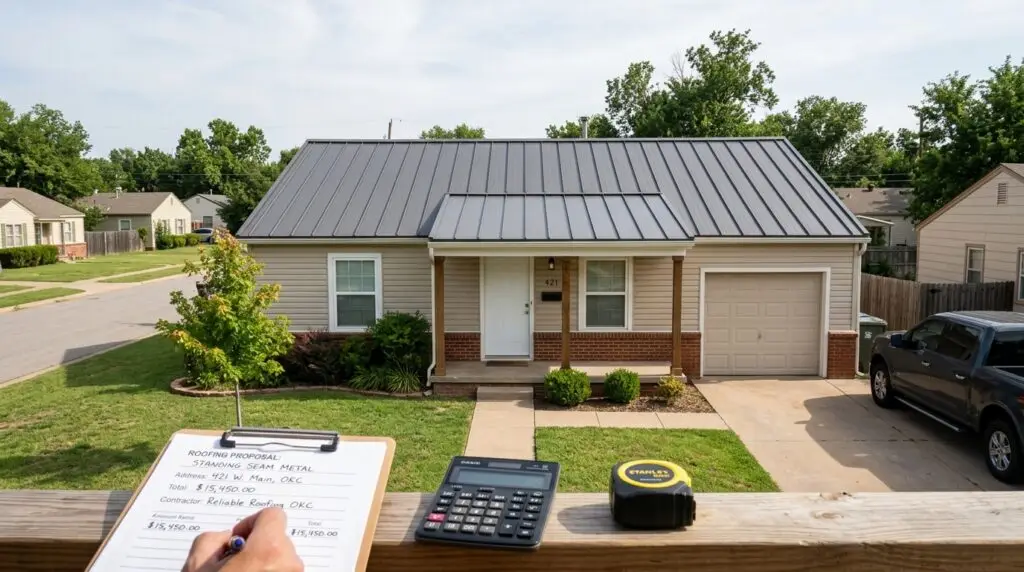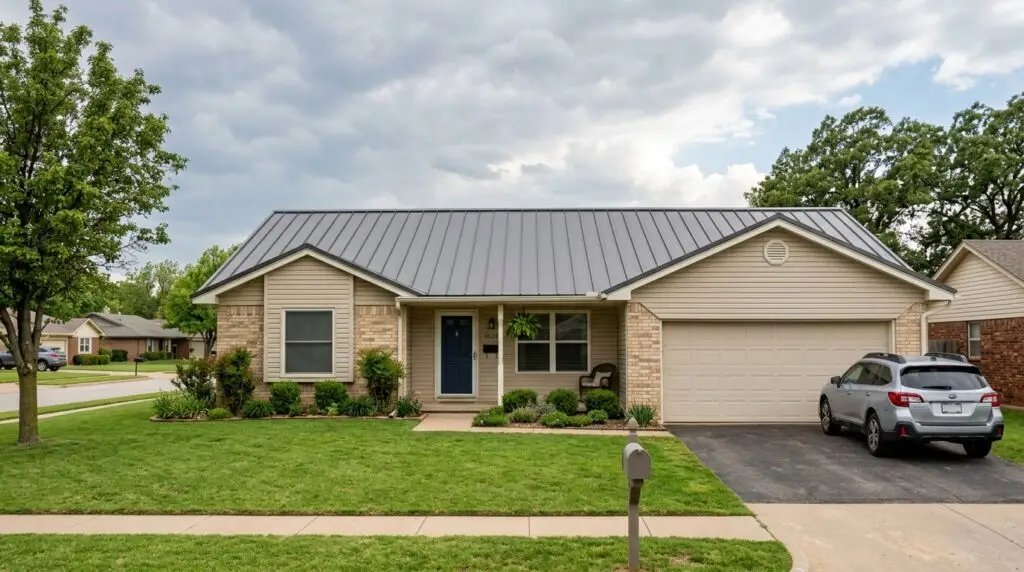
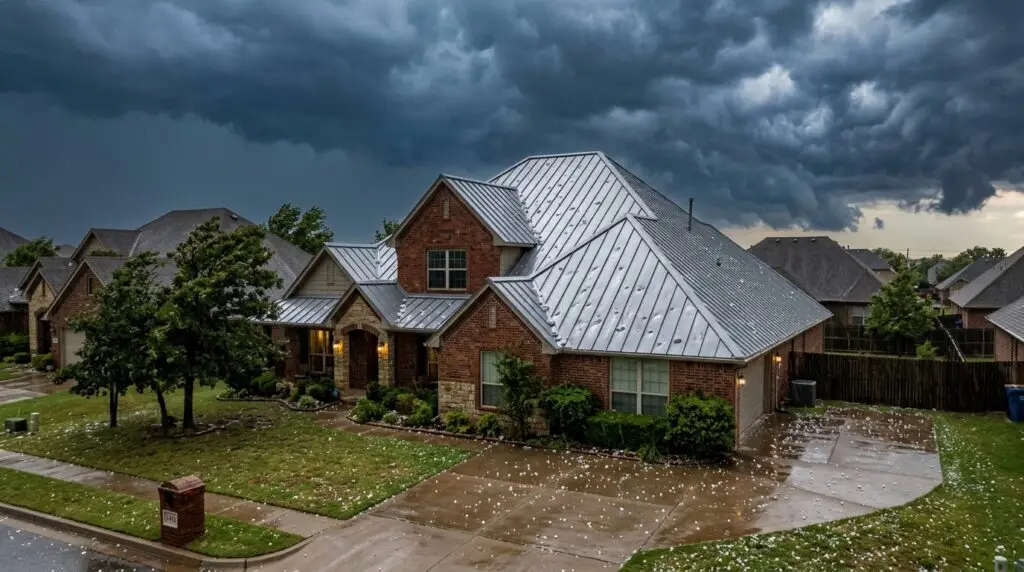
Short answer: yes, hail can damage a metal roof. But here’s what most articles won’t tell you “damage” covers a wide spectrum, and where your metal roof lands on that spectrum depends on several factors that every Oklahoma City homeowner should understand before, during, and after storm season.
In Oklahoma City, hail isn’t a rare event. It’s a seasonal reality. Central Oklahoma sits in the heart of Tornado Alley, and from April through June, severe thunderstorms roll through the metro through Edmond, Yukon, Moore, Midwest City, and Norman bringing hailstones that range from pea-sized to the size of a baseball. So the question isn’t just “can hail damage metal roofing?” The better question is: how much, under what conditions, and what should you do about it?
Let’s break it down properly.
The Direct Answer: Yes But “Damage” Isn’t Always What You Think
Most homeowners picture a hole in their roof when they hear “hail damage.” The reality with metal roofing is much more nuanced, and understanding the difference could save you from a bad insurance decision or an unnecessary replacement.
Cosmetic Damage vs. Structural Damage A Critical Distinction
Cosmetic damage means dents, dings, or scuffed coatings things that affect the appearance of your roof but not its ability to keep water out. Structural damage means the roof’s protective function has been compromised: punctures, separated seams, or cracked panels that allow moisture intrusion.
Here’s the thing in the vast majority of OKC hail events, metal roofs suffer cosmetic damage, not structural damage. That dime-sized dent in a steel panel? Your roof is still doing its job perfectly. This distinction matters enormously when it comes time to file an insurance claim or decide whether to hire a contractor.
What Hail Actually Does to Metal on Impact
Metal is malleable by nature. When a hailstone strikes a metal panel, the metal flexes and absorbs the impact rather than cracking or shattering the way asphalt, tile, or wood shingles might. Think of it like a car hood during a storm you’ll see dents, but the vehicle still runs fine.
This flex-and-absorb behavior is exactly why metal consistently outperforms other roofing materials in severe weather regions like Central Oklahoma. Asphalt shingles lose their protective granules on impact, becoming brittle and more vulnerable over time. Metal doesn’t degrade the same way.
Why Oklahoma City Is One of the Harshest Hail Environments in the Country
If you’re reading this as an OKC homeowner, you already know what storm season feels like. But let’s put some context around it, because the roofing decisions you make here should be calibrated to this specific environment not generic national advice.
OKC’s Hail Season: What the Data Tells Us
Central Oklahoma’s peak hail season runs mid-April through mid-May, with April carrying the highest probability. OKC and surrounding metro communities including Edmond, Moore, Yukon, Midwest City, and Norman all sit in the same high-frequency storm corridor.
Hailstones of 1 inch or larger are common in severe OKC storm events. Golf ball–sized hail (roughly 1.75 inches) occurs regularly enough that local roofing contractors plan for it. And on the high end, baseball-sized or larger stones have struck the metro area during particularly severe supercell outbreaks.
Wind-Driven Hail Oklahoma’s Compound Threat
Most people think about hail falling straight down. In Oklahoma, that’s rarely what happens. Central Oklahoma sits at the convergence of warm, humid Gulf air and cold upper-level atmospheric systems, creating powerful updrafts that launch hailstones at steep, damaging angles.
Wind-driven hail hits metal roofing at an angle, concentrating impact force differently than vertical hail. For homeowners with flatter-pitched roofs common in ranch-style homes throughout Midwest City and south OKC this means greater exposure. It’s one reason why the gauge of your metal panel and the type of panel profile you choose matters more here than in many other markets.
The UL 2218 Impact Resistance Rating What It Means for Your Roof
When shopping for a metal roof or evaluating one you already have, you’ll encounter the UL 2218 rating system. Understanding it is non-negotiable if you live in an OKC zip code.
How the Class 1–4 Rating System Works
The UL 2218 standard tests impact resistance by dropping a 2-inch steel ball from approximately two stories onto the roofing material. Results are rated Class 1 through Class 4, with Class 4 being the highest level of impact resistance. Class 4 materials are designed to resist cracking or puncturing when struck by a 2-inch steel ball dropped from 20 feet.
For OKC homeowners, Class 4 is the target. Many insurance carriers in Oklahoma offer premium discounts sometimes meaningful ones for homes with Class 4 rated roofing. Talk to your insurance agent directly about what’s available on your specific policy.
Do All Metal Roofs Achieve Class 4?
Not automatically. Metal gauge, panel profile, underlayment quality, and installation technique all influence the final rating. Even a high-quality 24-gauge panel can underperform if it’s installed incorrectly improper fastener tension or misaligned panels reduce its ability to flex and shed impact energy the way it was designed to.
Always ask the manufacturer for their UL 2218 certification sheet before purchasing. A reputable OKC metal roofing contractor should provide this without hesitation.
5 Factors That Determine How Much Hail Damages a Metal Roof
It depends on several factors and being honest, no two storms are identical. Here are the five that matter most in the Oklahoma City market.
1. Metal Gauge (Thickness)
Gauge is one of the most misunderstood specs in metal roofing. Counter-intuitively, a lower gauge number means thicker metal. A 22-gauge panel is thicker and more resistant than a 29-gauge panel.
For Oklahoma City’s storm exposure, 24-gauge steel is the recommended minimum for residential installations. Anything thinner and you’re accepting more cosmetic damage risk with every major storm event. In our experience, homeowners who chose 29-gauge panels to save money upfront often regret it after their first golf ball–hail event.
2. Panel Profile and Surface Texture
Ribbed, striated, or textured panel surfaces distribute impact force more effectively than smooth flat panels. The raised geometry deflects a portion of the hailstone’s energy rather than absorbing it all at a single flat point.
Standing seam panels which have concealed fasteners and raised seams also outperform exposed-fastener systems in high-wind hail conditions because there are fewer vulnerable penetration points on the roof surface.
3. Roof Pitch and Slope
Steeper pitched roofs are generally less susceptible to hail damage. Hailstones are more likely to glance off a steep surface than to land with full perpendicular force.
This has direct implications for OKC homeowners in neighborhoods where ranch-style and low-slope homes are common. If your home has a low pitch, it’s another reason to prioritize heavier gauge and textured panel profiles.
4. Metal Type Steel, Aluminum, Copper, or Zinc
Steel is the dominant choice in the OKC metro, and for good reason. It combines strength, cost efficiency, and hail resistance in a way that aluminum, copper, or zinc can’t fully match.
Aluminum is lighter and corrosion-resistant, but thinner gauges dent more easily under hail impact. Copper is beautiful and long-lasting, but its softness makes it susceptible to visible denting. For most OKC residential roofing, Galvalume or galvanized steel at 24-gauge is the practical sweet spot.
5. Hailstone Size and Wind Speed
Hailstones below 1 inch rarely cause noticeable damage to a properly installed metal roof. Denting risk increases meaningfully at 1 to 1.5 inches. At golf ball size (1.75 inches) and above, even quality metal panels will show cosmetic damage and when hail reaches that size with strong winds behind it, structural inspection becomes warranted.
How to Inspect Your Metal Roof After an OKC Hail Storm
Most homeowners don’t realize they don’t need to climb on their roof to get a solid initial assessment. Here’s how to do a smart post-storm check.
What to Check Around the Property First (Safer and More Informative)
Before you even think about getting on the roof, walk your property and inspect:
- Gutters and downspouts: Dents here confirm hail size and force accurately. Golf ball–sized dents in aluminum gutters mean your roof absorbed significant impact.
- HVAC units and vents: Metal condenser fins and vent covers take hail the same way your roof does. If those are dented, your roof is dented.
- Window wraps and fascia: Dented aluminum trim around windows and soffits confirms the storm was hitting horizontal surfaces with real force.
- Vehicle surfaces: If your cars were outside, compare any denting to the confirmed hail size from local weather reports.
Between you and me: if your gutters look like a golf range target, don’t wait. Get a professional metal roofing inspection scheduled.
What to Look for on the Roof Surface
If you can safely access your roof or work with a contractor who can:
- Dents on flat panel areas, particularly around ridge caps and valley areas which tend to be most vulnerable
- Scratched, chipped, or cracked paint/coating that exposes bare metal beneath
- Seam stress or fastener loosening on older exposed-fastener systems
- Any areas of visible water staining on the underside (check from the attic as well)
When to Monitor vs. When to Call a Professional
- Minor surface dents, no coating damage monitor through next rain cycle
- Chipped coating or scratched bare metal inspect and treat within 30–60 days before Oklahoma humidity starts the corrosion process
- Seam separation, fastener stress, or any interior water signs call a contractor immediately
Metal Roof Hail Damage vs. Asphalt Shingles The OKC Cost Reality
This comparison matters a lot more in Oklahoma City than it does in, say, Portland or Seattle. Here’s why:
When asphalt shingles take hail impact, they lose the protective granules embedded in their surface. Those granules shield the asphalt layer from UV degradation. Once they’re gone, the clock starts ticking faster on that roof’s useful life. After a significant hail event, an asphalt roof that still looks passable from the street might be 30–40% through its remaining lifespan.
Metal doesn’t work this way. A dented 24-gauge steel panel performs identically to an undented one the protection isn’t stored in a surface layer that can be knocked off. It’s in the material itself.
Over a 40-to-50-year ownership horizon in OKC’s hail environment, a homeowner with asphalt shingles can expect multiple full replacements driven by storm damage. A homeowner with a properly installed metal roof is looking at one installation and ongoing maintenance a fundamentally different financial equation.
Insurance Claims for Metal Roof Hail Damage in Oklahoma What You Need to Know
This is where things get complicated for OKC homeowners and where most generic roofing articles completely fail you.
Cosmetic Damage Waivers Should You Sign?
Some insurance companies will ask Oklahoma homeowners to sign a cosmetic damage waiver as a condition of their policy or renewal. By not signing, your policy covers both structural and cosmetic storm damage. By signing, you may get a slight premium reduction but you surrender your right to claim for the denting and surface damage that makes up the vast majority of metal roof hail claims.
Given the frequency and intensity of OKC hail events, most homeowners in this market are better served by keeping full cosmetic coverage. A good local insurance agent who understands Oklahoma’s weather environment can help you weigh this against your specific premium.
Actual Cash Value vs. Replacement Cost Coverage
These two coverage types produce dramatically different claim outcomes. With actual cash value (ACV) coverage, your insurer depreciates your roof’s value based on its age meaning a 10-year-old roof might only net you half the cost of replacement. With replacement cost value (RCV) coverage, you’re paid the actual cost to repair or replace the damaged material.
In Oklahoma’s hail environment, RCV coverage on your roofing matters more than it does in low-risk markets. Review your current policy and ask your agent specifically how metal roof hail damage is treated under your coverage structure.
OKC Claim Filing Tips
- Document damage the same day with detailed photos roof surface, gutters, vents, and any soft metal trim around the property
- Note the storm date and confirm local weather service records this supports your claim timeline
- Contact a local metal roofing contractor before the insurance adjuster visits when possible an experienced local contractor knows how to document damage that adjusters sometimes overlook
- Be cautious of out-of-state storm chasers who appear in OKC after major events work with established local contractors who know Oklahoma building codes and insurance practices
How to Choose the Right Metal Roof for Oklahoma City’s Hail Environment
If you’re in the market for a new metal roof or replacing a damaged one, here’s what to specify for OKC conditions.
Standing Seam vs. Exposed Fastener for Hail Zones
Standing seam systems conceal all fasteners beneath the panel profile, eliminating the penetration points that become vulnerable in severe weather. This design also allows for thermal expansion and contraction critical in Oklahoma’s dramatic temperature swings from winter to summer.
Exposed fastener systems can perform well when properly installed with quality screws and neoprene washers, but they require more maintenance attention over time especially after hail events that can stress fastener seals. In our experience, standing seam is the long-term winner for OKC storm exposure.
Coatings and Finishes That Matter After Hail
Kynar 500 (PVDF) coatings are the gold standard for metal roof finishes. They resist chalking, fading, and the kind of surface damage that hail impact can initiate. A scratched Kynar coating holds up better against Oklahoma’s humidity-driven corrosion than a standard polyester finish.
Stone-coated steel is another option worth considering for OKC homeowners who want hail resistance without visible denting concerns the textured stone surface effectively disguises cosmetic impact damage.
Common Mistakes Oklahoma Homeowners Make After a Hail Storm
- Waiting weeks to inspect. Oklahoma insurance policies have claim filing timelines. Don’t miss them.
- Signing cosmetic damage waivers without fully understanding what coverage they’re surrendering.
- Assuming no interior damage means the roof is completely fine. Small coating breaches can allow corrosion over time even without immediate leaks.
- Hiring out-of-state storm-chaser crews who lack familiarity with Oklahoma building codes, HOA requirements, or local insurance practices.
- Skipping touch-up on scratched coatings. Bare steel in Oklahoma’s humidity will begin surface oxidation within months if left untreated.
Related Services for Oklahoma City Homeowners
- Metal Roof Installation in Oklahoma City New installation for residential and commercial properties across the OKC metro
- Metal Roof Repair Services Post-hail repair, coating restoration, and seam re-sealing
- Storm Damage Roof Inspection Professional assessments after severe weather events throughout Edmond, Moore, Yukon, Midwest City, and Norman
- Metal Roof Cost Guide for OKC Homeowners What to budget for installation, gauge options, and long-term ROI in Oklahoma’s storm corridor
Frequently Asked Questions: Metal Roofs and Hail Damage
Can hail put a hole in a metal roof?
Punctures are extremely rare and typically only occur when oversized hail baseball-sized or larger strikes a thin-gauge panel at high velocity. Quality 24-gauge steel installed correctly has an extremely low puncture risk even in severe OKC storm events. Denting, not puncturing, is the realistic concern.
How big does hail have to be to damage a metal roof?
Hailstones under 1 inch rarely cause noticeable damage to properly installed metal roofing. Visible denting becomes more likely at 1 to 1.5 inches. At golf ball size (1.75 inches) and above which does occur in OKC storm events cosmetic denting is expected and structural inspection is warranted.
Will hail damage void my metal roof warranty?
Most manufacturer warranties cover material defects, not storm damage that falls under your homeowner’s insurance policy. However, some manufacturers require documented post-storm inspections to maintain warranty validity. Review your specific warranty document and check in with your contractor after major storms.
Does a metal roof make hail noise louder inside the house?
With proper underlayment and attic insulation, modern metal roofs are not significantly louder than asphalt shingles during hail events. The noise concern is mostly associated with older metal roofing installed over open framing without an insulated deck system.
Does my OKC homeowner’s insurance cover metal roof hail damage?
Most standard Oklahoma homeowner’s policies cover hail damage. However, your coverage type (actual cash value vs. replacement cost) and whether you’ve signed a cosmetic damage waiver significantly affect what you actually receive in a claim. Review your policy before storm season, not after.
Is a metal roof worth it in Oklahoma City specifically because of hail?
For most OKC homeowners planning to stay in their home for 7 or more years, the answer is yes. The combination of reduced insurance premiums, elimination of repeated asphalt shingle replacement cycles driven by hail events, and a 40-to-70-year lifespan makes metal roofing a strong financial decision in Oklahoma’s severe weather environment.
How soon after a hail storm should I inspect my metal roof?
Within 24 to 72 hours when it’s safe to do so. Prompt documentation protects your insurance claim and allows you to identify any coating damage before Oklahoma’s humidity begins working on any exposed bare metal.
Serving Oklahoma City, Edmond, Moore, Yukon, Midwest City, Norman, and surrounding communities. Licensed Oklahoma metal roofing contractor. Contact us for a post-storm inspection or free installation estimate.