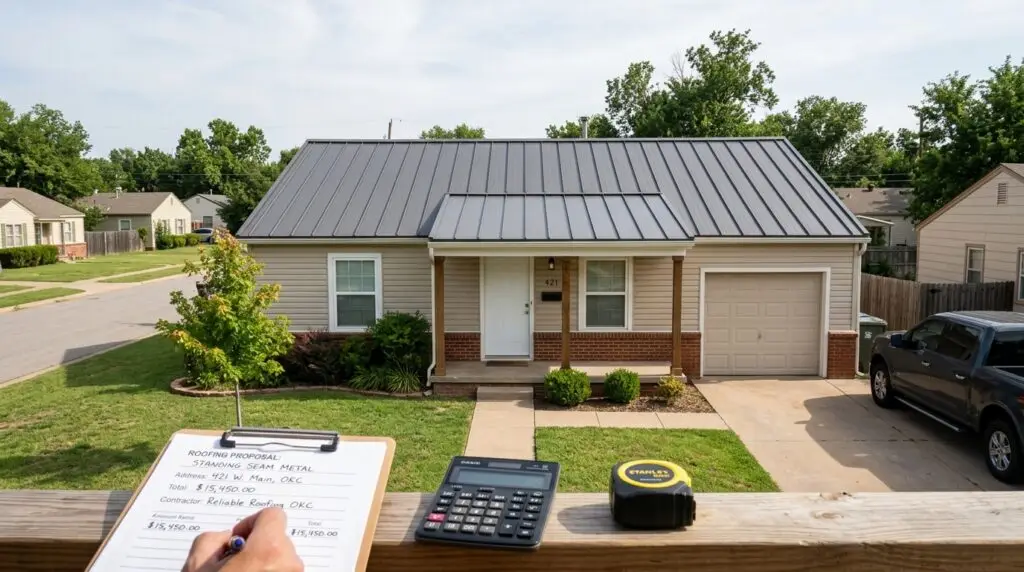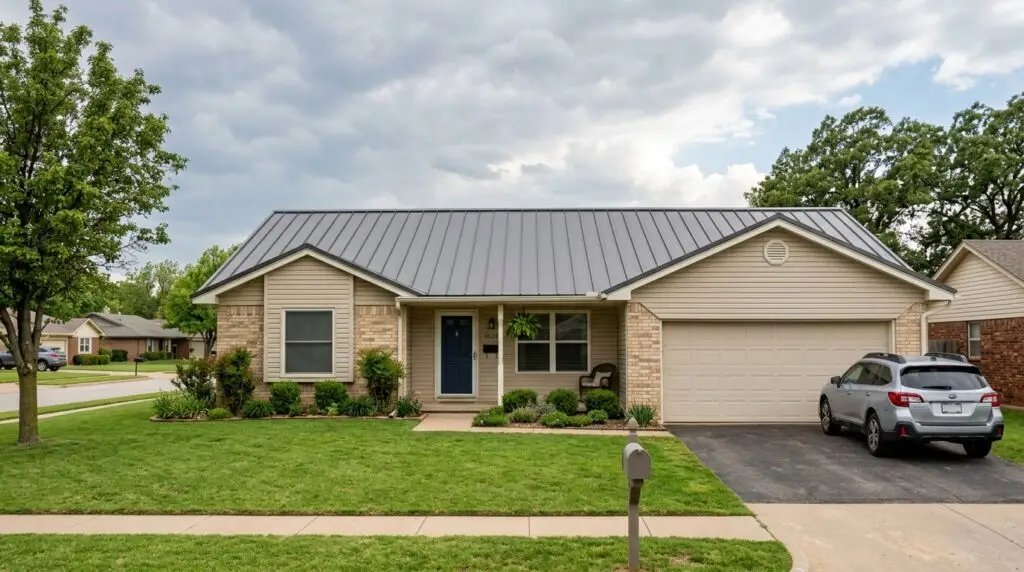
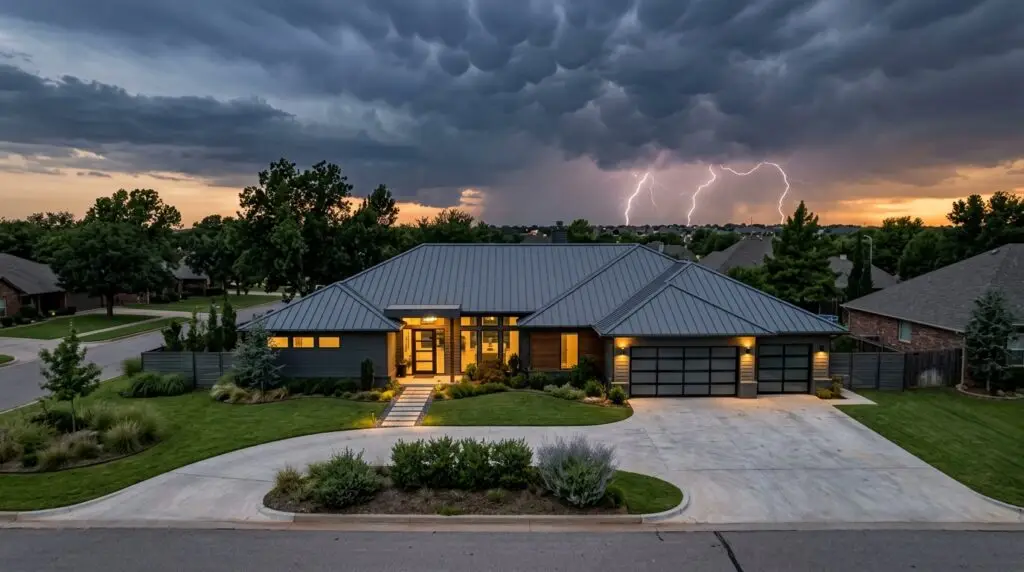
No, metal roofs do not attract lightning. Height, isolation, and topography, not roofing material, determine where lightning strikes, according to the National Weather Service and the Metal Construction Association. If anything, a metal roof can make a lightning strike safer for your Oklahoma City home. Let’s break down why, because this is one of the most persistent myths in roofing, and it deserves a real answer.
The Short Answer — No, Metal Roofs Don’t Attract Lightning
Here’s the thing: lightning doesn’t care what your roof is made of. It’s looking for the shortest, easiest path from the clouds to the ground. That path depends on how tall your house is, what’s around it, and how exposed it sits, not whether you installed standing seam panels or asphalt shingles.
Most homeowners don’t realize this myth started with something completely unrelated: lightning rods. Because lightning rods are metal and sit on top of buildings, people assumed metal itself pulls lightning toward it. That’s backwards. A lightning rod doesn’t attract the strike, it manages it once it happens, giving the electrical charge a safe, controlled path to the ground instead of letting it rip through your attic or walls.
What Actually Determines Where Lightning Strikes
Lightning targets the tallest, most exposed object in an area. That’s usually a tree, a utility pole, an antenna, or the tallest building on the block. Topography matters too, a house on a hill is at higher risk than one tucked into a valley, regardless of roofing material.
Why This Myth Persists
Weathervanes have sat on top of barns and homes for over a century, made almost entirely of metal, positioned at the highest point of the structure. If metal truly attracted lightning, weathervanes would be getting hit constantly. They’re not. That alone should put the myth to rest, but it keeps circulating because “metal conducts electricity” gets misheard as “metal attracts electricity.” Those are two very different things.
The Science Behind Lightning and Roofing Materials
It depends on several factors, but material choice isn’t really one of them. Let’s separate two concepts that get mixed up constantly: attraction and conduction.
Path of Least Resistance, Explained Simply
Lightning is a massive discharge of static electricity searching for the fastest route to the ground. Air is a poor conductor, so lightning naturally seeks out taller objects that shorten that path. Nothing about a metal roof panel makes your house taller or more exposed than it already is. Swap the shingles for standing seam panels, and your home’s height and location stay exactly the same, which means your lightning risk stays exactly the same too.
Conductivity vs. Attraction — The Key Difference Homeowners Miss
Conductivity only matters after a strike happens, not before. A conductive material moves electrical current efficiently once it’s already flowing through it. It doesn’t reach up and pull a charge down from the sky. Think of it this way: a copper wire doesn’t attract electricity sitting in a drawer, but plug it into a circuit and it’ll conduct current instantly. Your metal roof works the same way.
Why a Metal Roof Can Actually Be Safer If Lightning Strikes
This is the part most articles skip over, and it’s honestly the more important half of the conversation. If lightning does strike your home, the roofing material absolutely affects what happens next.
The Faraday Cage Effect on Your Home
A metal roof, especially when bonded and grounded properly, can act somewhat like a Faraday cage, dispersing an electrical charge across the surface of the structure rather than concentrating it in one spot. Instead of the energy punching through a single point, it spreads out and finds its way to the ground more evenly.
Non-Combustibility and Class A Fire Rating
Most metal roofing systems carry a Class A fire rating, the highest available. That matters enormously in a lightning event, because the real danger from a strike usually isn’t the electrical current itself, it’s the fire that follows. Wood shakes, older asphalt shingles, and other combustible materials can ignite when lightning’s intense heat jumps from the strike point to the nearest flammable surface. Metal simply doesn’t burn the same way.
What Happens to the Electrical Charge After a Strike
When lightning strikes a properly grounded metal roof, the current travels across the conductive surface and down through a grounding path, dissipating into the earth rather than concentrating heat in one localized area. That reduces the odds of a fire starting and limits damage to the structure itself. Compare that to a strike on a wood-framed, shingle-covered roof, where the energy has fewer safe paths to travel and more flammable material sitting right where it lands.
Do You Need a Lightning Protection System (LPS) With a Metal Roof in Oklahoma?
For most residential homes, no, a standard metal roof installation doesn’t require an added lightning protection system. But “most” isn’t “all,” and this is where a real conversation with a local contractor pays off.
When an LPS Actually Makes Sense
An LPS becomes worth considering when your property sits well above its surroundings, a home on open acreage outside the city, a house that’s noticeably taller than everything around it, or an isolated structure like a barn or workshop out on rural land. If you’re the tallest thing for a good distance in any direction, especially out toward the edges of Oklahoma County or further into rural stretches near Piedmont or Guthrie, it’s a reasonable upgrade to discuss.
What an LPS Costs and What’s Involved
A full lightning protection system includes air terminals (the rods themselves), conductor cables that run down the structure, and grounding rods driven into the earth, all installed to meet NFPA 780 standards. Costs vary widely depending on the size of the roof, the complexity of the structure, and how many grounding points are needed, expect it to range from a modest add-on to a more significant investment for larger or more complex properties. Any reputable roofing contractor should be able to walk you through a specific quote once they’ve seen your roof.
Proper Grounding and Bonding During Installation
Here’s something a lot of homeowners never think to ask about: proper grounding and bonding during the initial metal roof installation. Even without a full LPS, ensuring your metal roofing system is correctly bonded to your home’s electrical grounding system is a smart, low-cost step. In our experience, this is the kind of detail that separates a rushed installation from one done by a contractor who actually understands how the system performs under real-world conditions, not just how it looks going on.
Metal Roofs and Oklahoma’s Severe Weather Season
Between you and me, lightning is rarely the thing that keeps OKC roofing contractors up at night. It’s everything that comes with it.
OKC’s Storm Alley Reality: Spring Thunderstorms, Hail, and Straight-Line Winds
Oklahoma City sits squarely in an active severe weather corridor. Spring and early summer bring supercell thunderstorms that combine lightning with large hail and damaging straight-line winds, sometimes all in the same system. Homeowners searching “do metal roofs attract lightning” are often really asking a bigger question: is my roof going to hold up when severe weather hits?
How Metal Roofing Performs in Combined Threats
This is where metal roofing earns its reputation. Many metal roofing products carry a Class 4 impact rating, the highest hail-resistance classification available, and they’re built to withstand high wind speeds that would tear lesser materials apart. When a storm rolls through with lightning, hail, and wind together, which happens more often than most people expect in central Oklahoma, a properly installed metal roof is dealing with all three threats at once, not just one.
Local Property Types and What They Mean for Risk
Suburban two-story homes in Edmond, Norman, and Yukon face different exposure than single-story ranch homes in older OKC neighborhoods, and rural properties out toward Mustang or Piedmont face different risk altogether due to open exposure and fewer surrounding structures. It depends on several factors, tree cover, nearby structures, and how your home sits relative to its surroundings all play a role in your actual lightning exposure, separate from whatever’s covering your roof.
Metal Roofs vs. Other Roofing Materials During a Lightning Event
| Material | Lightning Attraction Risk | Fire Risk if Struck | Notes |
|---|---|---|---|
| Metal | No higher than any other material | Low, non-combustible, Class A rated | Can help disperse charge if grounded |
| Asphalt Shingles | No higher than any other material | Higher, petroleum-based, combustible | Common but more vulnerable to fire spread |
| Wood Shake | No higher than any other material | Highest, organic material, ignites easily | Not ideal for lightning-prone regions |
| Clay/Concrete Tile | No higher than any other material | Low, naturally fire-resistant | Vulnerable to cracking from hail impact |
Asphalt Shingles and Fire Risk Comparison
Asphalt shingles don’t attract lightning any more than metal does, but they’re a petroleum-based product, which means they’re inherently more flammable if a strike ignites nearby materials. That’s a meaningful difference for homeowners weighing long-term risk, especially in a region where severe thunderstorms are a near-annual event.
Wood Shake, Clay Tile, and Combustibility Factors
Wood shake carries the highest fire risk of common roofing materials. Clay and concrete tile fare better on fire resistance but can crack or shatter under hail impact, a real concern given how frequently central Oklahoma sees hail-producing storms.
Common Mistakes Homeowners Make When Evaluating Lightning Risk
- Assuming any metal on the roof increases danger. Gutters, flashing, and vents are metal on nearly every roof, regardless of the main roofing material. None of it changes lightning risk.
- Skipping proper grounding on a new install. A contractor who doesn’t bond the roofing system correctly is leaving performance on the table, even if the roof looks great.
- Confusing insurance myths with fire-safety facts. Some homeowners assume a metal roof automatically raises premiums due to “lightning risk.” That’s not how insurers actually evaluate the material.
- Ignoring the real risk factors. Tall trees, isolated positioning, and open topography matter far more than roofing material. Homeowners who fixate on the roof sometimes overlook the oak tree standing thirty feet from their house.
Does a Metal Roof Affect Your Homeowners Insurance in Oklahoma?
Why Insurers Often Favor Metal Roofing in Storm-Prone Areas
Insurers generally view metal roofing favorably in hail- and wind-prone regions like central Oklahoma, largely because of its impact resistance and wind performance, not because of anything related to lightning. Some insurance carriers offer premium discounts for Class 4 impact-rated roofing, though specific discounts vary by carrier and policy.
What to Ask Your Insurance Agent Before or After Installing
Ask your agent directly whether your policy offers any discount for impact-resistant roofing, and get it in writing. Don’t assume the discount applies automatically just because you installed metal, insurers handle this differently, and it’s worth a five-minute phone call to confirm.
How to Decide If a Metal Roof Is Right for Your OKC Home
Questions to Ask a Local Metal Roofing Contractor
Ask about the specific product’s impact rating, its wind rating, and whether the installer plans to properly ground and bond the system to your home’s existing electrical grounding. Ask how they handle flashing and penetrations, since that’s where most roof failures actually originate, lightning or not.
Signs Your Current Roof Isn’t Holding Up to Oklahoma Storms
Granule loss, cracked or missing shingles after a hailstorm, soft spots on the decking, or visible wind damage around the roofline are all signs it’s time for a closer look. If your current roof has been through a few Oklahoma spring storm seasons without an inspection, that’s reason enough to have someone take a look before the next one rolls through.
What an OKC Roofing Contractor Wants You to Know
In our experience, the calls that come in after a big storm are almost never about lightning. They’re about hail dents, torn-off shingles, and wind-damaged flashing. Lightning-specific roof damage is uncommon enough that it rarely tops the list of concerns worth losing sleep over, but hail and wind absolutely should be top of mind if you’re anywhere in central Oklahoma.
Honestly, a lot of the lightning protection systems we get asked about are oversold by people who don’t fully understand when they’re actually necessary. For a typical suburban home surrounded by trees and similarly-sized neighboring houses, an LPS is rarely worth the added cost. For an isolated home on open acreage, sitting taller than everything around it, that conversation changes. A good contractor will tell you the difference honestly instead of upselling a system you don’t need.
Frequently Asked Questions
Do metal roofs attract lightning more than shingle roofs?
No. Lightning strikes based on height, isolation, and topography, not roofing material. Metal and shingle roofs carry the same lightning risk.
Is it dangerous to be in a house with a metal roof during a thunderstorm?
No more dangerous than any other roofing material. In fact, a properly grounded metal roof can help disperse an electrical charge more safely than combustible materials.
Do I need a lightning rod if I have a metal roof?
Most homes don’t. A lightning protection system is generally only worth considering for tall, isolated, or rural structures with limited surrounding cover.
Can lightning cause a fire on a metal roof?
It’s far less likely than on combustible materials like wood shake or asphalt shingles, since most metal roofing carries a Class A fire rating.
Does a metal roof increase my homeowners insurance in Oklahoma?
Not due to lightning risk. Many insurers actually favor metal roofing in storm-prone regions because of its hail and wind resistance.
What’s more likely to damage a metal roof in OKC, lightning or hail?
Hail and wind cause far more roofing damage claims in central Oklahoma than lightning does.
How do I know if my metal roof is properly grounded?
Ask your installer directly during the project, or have a roofing professional inspect the bonding and grounding connections if you’re unsure about an existing roof.