If you own a home in Oklahoma City, you already know the deal with hail. It shows up without much warning, it hits hard, and it leaves you standing in the driveway the next morning wondering what exactly happened to your roof. If that roof is metal, the first question is almost always the same: did it actually get damaged, or does it just look that way?
Here is the short answer: hail can damage a metal roof, but the type of damage and whether it matters depends on factors most homeowners have never been told about. The hail size, the angle it hit, the gauge of your panels, the system type, and how many storms that roof has already absorbed all play into the real answer.
This guide walks through exactly how hail affects metal roofs in Oklahoma, what to look for after a storm, and how to make smart decisions about inspection, insurance, repair, and replacement without guessing.
Oklahoma Is Hail Alley and Your Metal Roof Knows It
Oklahoma sits squarely in one of the most active severe weather corridors in the United States. The Oklahoma City metro area, along with communities like Moore, Edmond, Yukon, and Midwest City, sees concentrated hail activity during the spring and early summer months roughly April through June when warm Gulf moisture collides with cold air masses pushing down from the north.
Most homeowners think of hail as an occasional nuisance. In reality, the OKC area can absorb multiple significant hail events in a single season. That accumulation matters more than most people realize, and we will get to that in a moment.
The important thing to understand upfront is this: hail in Oklahoma is not always the golf ball-sized monster that makes the news. The smaller, more frequent storms the ones that drop marble- to quarter-sized hail for twenty minutes are responsible for a significant amount of the cumulative damage metal roofs in this region quietly absorb year after year.
What Hail Actually Does to a Metal Roof and What It Doesn’t
Cosmetic damage dents, dings, and surface marks that don’t compromise your roof’s job
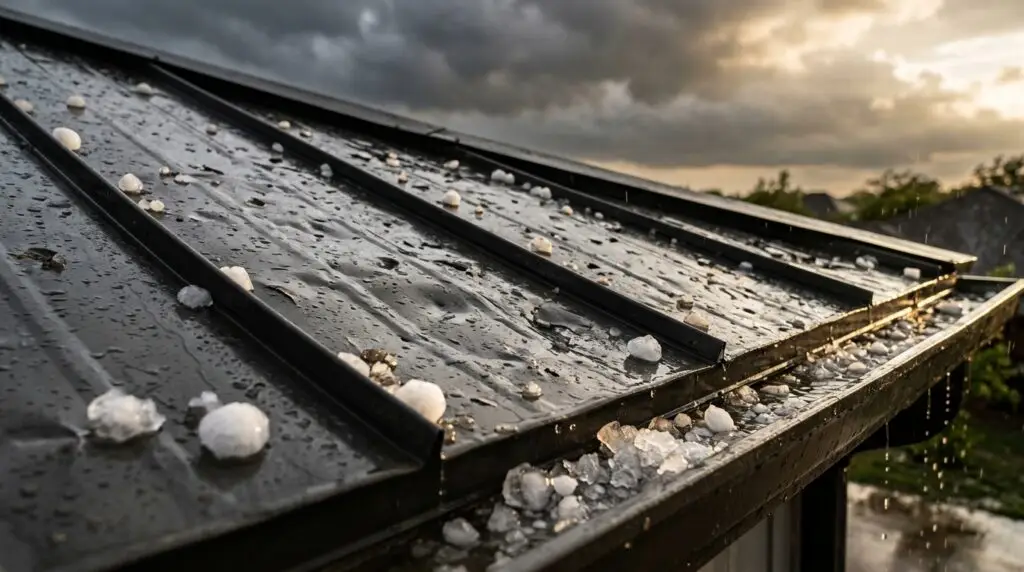
Most hail damage on metal roofs is cosmetic. That means the panel surface shows visible denting or marking, but the roof continues to perform its primary function: keeping water out of your home. A dented metal roof can still be watertight. It can still drain properly. It can still last decades.
Cosmetic damage does not mean insignificant especially if you plan to sell your home, or if your insurance policy covers it. But it is a fundamentally different category than damage that puts your home at risk.
Functional damage what actually puts your home at risk
Functional damage is where things get serious. This category includes loosened or backed-out fasteners, compromised seams that allow water infiltration, distorted panel profiles that affect drainage, cracked or chipped coatings that expose bare metal to the elements, and damaged flashing at penetrations or edges.
The good news is that metal roofs especially heavier-gauge systems resist functional hail damage far better than asphalt shingles do. Puncture through a metal panel from hail alone is extremely rare. The more common functional failures involve fasteners, seams, and coatings, not holes in the metal itself.
Why ‘it just has a few dents’ is not a safe conclusion after an Oklahoma storm
Here is the thing most homeowners miss: functional damage does not always look dramatic from the ground or even on close inspection. Fasteners can work loose. Seams can shift slightly. Protective coatings can develop micro-fractures from the impact force alone, even when the surface dent looks minor. These conditions invite rust, moisture migration, and long-term panel failure but they rarely announce themselves visually in the days right after a storm.
This is exactly why a professional inspection after significant hail is not optional. It is how you find out what the storm actually did.
Why Oklahoma Hail Hits Metal Roofs Differently Than Most States
Wind-driven hail vs. straight-down hail OKC’s storm systems and angular impact
Most people picture hail falling straight down. In a typical thunderstorm, that is roughly what happens. But Oklahoma’s supercell thunderstorms are a different animal. The rotational dynamics and high winds associated with these storms frequently produce hail moving at a significant horizontal angle sometimes nearly parallel to the ground.
That angular impact changes everything about where your metal roof is vulnerable. While a straight-down hail impact is distributed across the flat face of a panel, wind-driven hail hits seams, panel edges, flashing, and fastener locations with disproportionate force. These are already the highest-stress points on any metal roofing system. Add a 60 mph gust driving hail sideways, and the physics shift considerably.
Standing seam systems handle this better than exposed fastener systems, because the mechanical attachment points are hidden inside the seam rather than exposed on the panel surface. But no system is completely immune when the wind is doing what Oklahoma wind does.
OKC storm corridors why some neighborhoods see repeat exposure
Communities south of Oklahoma City particularly Moore have experienced some of the most concentrated severe weather activity in the region’s documented history. Midwest City and Del City sit in corridors that see consistent hail tracks moving northeast. Edmond and Yukon, to the north and west respectively, face their own exposure patterns driven by storm formation dynamics on the western plains.
If your home is in any of these areas, your metal roof has likely been tested more than once. The question is not whether storms will come it is whether your roof’s previous exposures have left it more vulnerable to the next one.
Cumulative hail damage how repeated smaller storms do more damage than one big one
In our experience, this is the most misunderstood aspect of metal roof hail damage in Oklahoma. Homeowners tend to track the big storms and ignore the rest. But cumulative damage is real and it is significant.
Each hail impact even minor ones places stress on fasteners, panel seams, and protective coatings. Over several seasons, that stress accumulates. Fasteners begin to back out incrementally. Coatings develop microscopic damage that eventually allows moisture to reach the base metal. Seams that moved slightly in one storm and slightly in another develop chronic leak points.
When the eventual ‘big storm’ causes visible failure, the root cause often traces back to years of smaller impacts that were never assessed or addressed. This is why annual inspections matter not just post-storm ones.
Metal Roof Type and Gauge: How Your Roof’s Specs Determine Hail Vulnerability
Steel gauge explained why thicker panels perform better in Oklahoma hailstorms
Steel gauge is counterintuitive: a lower gauge number means thicker steel. A 24-gauge panel is significantly thicker and more hail-resistant than a 29-gauge panel. For Oklahoma conditions, 24 to 26 gauge is the appropriate range for residential metal roofing. Thinner panels dent more visibly, absorb more fastener stress per impact, and generally show their age faster in high-hail environments.
If you are replacing a hail-damaged roof with a metal system, or upgrading from asphalt, gauge selection matters enormously. It also matters for insurance which we will cover shortly.
Standing seam vs. exposed fastener systems
Standing seam metal roofing hides its attachment points inside a raised seam that snaps or locks together. This design eliminates the exposed fastener as a hail vulnerability. No washers to compress, no fastener holes to widen from repeated impact stress.
Exposed fastener systems common in agricultural and commercial applications, and sometimes used in residential installations have screws driven through the panel face. Each fastener is a potential point of failure after hail impact. The washer under the screw head can be compressed or cracked, and the hole it covers can work loose over time. This does not mean exposed fastener systems are wrong for every application, but it is an honest difference worth understanding.
Stone-coated steel, aluminum, and other metal options
Stone-coated steel panels absorb impact energy differently than smooth-surface metal. The aggregate coating adds a layer of impact distribution and reduces the appearance of cosmetic denting. Aluminum dents more visibly than steel at equivalent thicknesses, which matters if you have a cosmetic damage exclusion on your policy. Ribbed and corrugated panel profiles distribute impact force across the panel geometry rather than concentrating it at the point of contact, which can reduce dent severity.
Class 4 impact resistance (UL 2218) what the rating means for OKC homeowners
The UL 2218 Class 4 rating is the highest impact resistance designation for roofing materials. The test involves dropping a two-inch steel ball from 20 feet and checking for cracking or functional damage. Many steel metal roofing products meet this standard.
Why does this matter practically? Many Oklahoma insurance carriers offer meaningful premium discounts often in the range of 10 to 35 percent, though this varies by carrier and policy for homes with Class 4 rated roofing. If you are already replacing a storm-damaged roof, choosing a Class 4 rated metal system can offset a portion of the upgrade cost through long-term insurance savings. Always confirm specifics with your own carrier.
After a Hailstorm in OKC: What to Do in the First 48 Hours
Step 1: Do a safe ground-level assessment
Before anything else, walk around your property and look at every soft-metal surface you can find: gutters, downspouts, HVAC units, window trim, and any metal fascia. These surfaces dent far more easily than your roof panels, so they serve as a reliable field indicator of hail size and impact energy. If your gutters are heavily marked, your roof saw real impact. If nothing on the soft metals shows denting, the storm was likely lighter than it felt.
Stay on the ground. Do not get on the roof yourself wet or damaged metal roofing is a fall hazard, and post-storm conditions on an already-stressed system are unpredictable.
Step 2: Document everything before anyone else does
Date-stamped photographs are your most important asset for an insurance claim. Take photos of every soft-metal surface showing impact marks. Photograph any visible damage on the roof from a safe ground-level angle. If there is interior water damage, photograph that too. Do this before a contractor or adjuster visits the documentation establishes the pre-contact condition of your property.
Step 3: Schedule a professional metal roof inspection
Metal roofing inspection requires different expertise than asphalt shingle inspection. Evaluating seam integrity, fastener condition, coating damage, and flashing performance requires someone who works on metal systems regularly not a general storm damage inspector who mostly handles shingles.
Most reputable metal roofing contractors offer post-storm inspections. This is not the same as a sales visit. A proper inspection gives you documented findings you can take to your insurance carrier, not just a quote for replacement.
Signs of hidden damage that appear days or weeks after a storm
Watch for these indicators in the weeks following a significant hail event: new water stains on interior ceilings or walls, visible separation at flashings around chimneys or vents, fasteners that appear to have backed out from their original position, and any section of roofing where panels have shifted visibly from their original alignment. These signs often appear gradually as the damage settles and weather conditions cycle.
Oklahoma Insurance and Metal Roof Hail Claims: What Your Policy May and May Not Cover
Cosmetic damage exclusions why many Oklahoma policies won’t pay for dents alone
This is one of the most financially consequential things an Oklahoma homeowner with a metal roof needs to understand. Many insurance policies issued in this state include a cosmetic damage exclusion clause specifically for metal roofing. Under this exclusion, the carrier will not pay for hail damage that is purely cosmetic meaning your roof still functions but looks dented.
This is not a hidden clause. Carriers disclose it. But many homeowners sign it without fully understanding what it means in a state where metal roofs absorb hail on a regular basis.
Should you sign the cosmetic damage waiver? The honest trade-off
Between you and me, this is a question without a universal answer and anyone who tells you otherwise is oversimplifying.
The waiver typically comes with a premium reduction. If your metal roof is a heavily textured or stone-coated system that shows denting minimally, and if you plan to own the home long-term with no near-term resale plans, the trade-off may work in your favor. If your roof is a smooth-surface panel system (where denting is more visible), if you have a lower-gauge installation, or if home resale is on your horizon, the cosmetic exclusion creates real financial exposure.
The right answer depends on your specific panel profile, your roof’s gauge, your personal timeline, and your risk tolerance. Ask your metal roofing contractor to weigh in before you sign.
Why both an adjuster and a metal roofing contractor should inspect your roof
Insurance adjusters are trained to evaluate claims against policy language. Metal roofing contractors are trained to evaluate metal system performance. These are different skills, and they answer different questions.
The adjuster determines what your policy covers. The contractor determines what your roof actually needs. If the adjuster recommends replacement, the contractor can verify that the replacement spec matches your original system same gauge, same panel profile, same coating standard. This matters because mismatched replacement is one of the most common and costly post-claim mistakes Oklahoma homeowners make.
Class 4 rating and insurance premium discounts in Oklahoma
If your existing metal roof carries a UL 2218 Class 4 rating, confirm this with your carrier. Many Oklahoma insurers recognize this rating and provide ongoing premium discounts. If you are replacing a damaged roof and upgrading to a Class 4 rated system, ask your carrier how this affects your future premiums. The discount range varies by carrier but can be meaningful enough to factor into your material selection decision.
Repair or Replace? How to Make the Right Call After Hail Hits Your OKC Metal Roof
When targeted repair is the right move
Not every hail-damaged metal roof needs to be replaced. If the damage is isolated a section of compromised flashing, a cluster of backed-out fasteners in one area, a handful of panels with coating damage targeted repair is often the right and more economical answer.
Repair also makes sense when the overall system is sound and relatively recent. A roof that has been well-maintained, is within its expected service life, and shows localized rather than widespread damage is a strong repair candidate.
When full replacement makes more sense
Replacement becomes the right conversation when: the damage is widespread across multiple roof sections, the system is approaching the end of its practical service life, the coating has failed broadly (not just at impact points), or cumulative damage from multiple storm seasons has compromised the system’s overall integrity. In these cases, continued repair becomes a cycle of diminishing returns.
The honest version of this conversation also includes the insurance angle if your carrier is already paying for replacement, the incremental cost to upgrade gauge or system type is often modest relative to the total project.
Cost ranges for hail-related metal roof repairs vs. replacement in the OKC market
Costs vary considerably based on system type, panel profile, roof complexity, and material specifications. Minor targeted repairs addressing specific flashing, fastener, or panel issues typically run in the hundreds to low thousands of dollars. Partial panel section replacements fall in a mid-range depending on accessibility and material match. Full system replacement for a typical residential metal roof in the OKC area ranges more broadly based on system type and gauge selection.
Use these as directional guidance only. Actual quotes depend on your specific system. Get more than one opinion from contractors who specialize in metal roofing not storm-damage generalists who primarily work in shingles.
5 Mistakes Oklahoma Homeowners Make After Hail Hits a Metal Roof
Most homeowners don’t realize how many costly mistakes happen in the first two weeks after a storm. Here are the ones we see most often.
- Judging the roof from the ground and assuming no visible damage means no problem. Fastener stress, seam movement, and coating micro-damage are invisible from thirty feet below. A ground-level look tells you almost nothing about the functional condition of the system.
- Waiting until next storm season to get an inspection. The window for a clean insurance claim is not indefinite. Documentation becomes harder, adjusters become skeptical of timing, and meanwhile the roof continues to degrade.
- Letting a non-metal-specialist inspect a metal system. An inspector whose daily work is asphalt shingles is evaluating granule loss, bruising, and tab cracking none of which apply to metal. They may miss fastener backing, seam stress, and coating failure entirely.
- Signing the cosmetic damage waiver without understanding your roof’s gauge or panel profile. Some panel systems show denting far more prominently than others. Sign this without understanding your system and you may be forfeiting a legitimate claim.
- Accepting an insurance replacement that swaps a heavier-gauge system for lighter-gauge panels. This happens. A 24-gauge roof gets replaced with a 29-gauge system because the adjuster spec did not specify gauge, and the lowest-bid contractor used whatever was available. Your roof is technically replaced but materially downgraded. Specify gauge in writing before the work begins.
Metal Roofs vs. Asphalt Shingles After Hail: The Real Performance Difference in Oklahoma
What hail does to asphalt shingles vs. what it does to metal
Asphalt shingles fail after hail in a specific and well-documented pattern: the impact knocks granules loose from the shingle surface. Those granules are what protect the underlying asphalt from UV degradation. Once they are gone, the shingle begins breaking down not immediately, but steadily. A hail-impacted asphalt shingle roof can look functional for another year or two while silently deteriorating. Metal roofing has no granules to lose. A dented metal panel retains its structural properties. The failure mode is simply different.
The practical result: an asphalt shingle roof hit by significant Oklahoma hail typically needs replacement within a few years regardless of whether the shingles look intact. A well-specified metal roof hit by the same storm may need nothing beyond an inspection, or targeted repair at most.
Long-term cost perspective
Metal roofing costs more upfront than asphalt. That is straightforward. But in Oklahoma’s hail climate, the calculus is different than in a lower-storm-exposure state. When you factor in repeat hail repair and replacement cycles on asphalt, the potential insurance premium discounts from a Class 4 rated metal system, and a service life that typically runs several times longer than asphalt, metal’s higher initial cost often produces a lower total cost of ownership over a 30-plus year period.
That said, metal roofing is not the right answer for every homeowner in every situation. It depends on your timeline, your budget, your home’s value, and your appetite for ongoing storm-related maintenance decisions. The point is simply that the cost comparison deserves a full-picture view, not just a first-cost comparison.
Protecting Your Metal Roof Between Oklahoma Hailstorms: Maintenance That Actually Matters
Annual inspection timing in Oklahoma
The OKC storm season peaks in spring. An inspection each March before primary storm season lets you identify and address any vulnerabilities before the worst weather arrives. A second inspection in September, after the season winds down, captures cumulative damage from the summer’s events before winter weather adds additional stress. This two-inspection cadence is particularly important for homes in Moore, Edmond, and other communities that sit in active storm corridors.
Coating and finish care
When hail impacts damage a metal panel’s protective coating whether Galvalume finish, Kynar 500 paint system, or stone-coated aggregate bare metal becomes exposed to moisture. That exposure point is where rust or corrosion begins, and it is entirely preventable with timely touch-up. After any significant storm, a contractor inspection should specifically evaluate coating integrity at impact points. Touch-up coating is inexpensive. Replacing a panel section that has rusted through is not.
Flashing and fastener checks the two highest-risk hail failure points
If there are two areas to focus on after any Oklahoma hailstorm, it is flashings and fasteners. Flashing the metal transitions around chimneys, vents, skylights, and roof edges takes disproportionate stress from wind-driven angular hail. Even a small flashing separation becomes a chronic leak point through seasonal expansion and contraction. Fasteners, on exposed fastener systems in particular, should be checked for backing and washer integrity after significant hail events. These are the most common, and most preventable, causes of post-hail water intrusion.
Choosing the Right Metal Roofing Contractor After Hail Damage in OKC
Metal roofing specialist vs. general storm damage contractor
After a major OKC hailstorm, contractors appear from out of state some from hundreds of miles away. Most of them work in asphalt. They know how to replace shingles efficiently, and they move on to the next storm market as quickly as they came. This is not what you want evaluating or replacing a metal roofing system.
Metal roofing requires specialized knowledge: seam mechanics, panel profile compatibility, gauge specification, coating systems, and fastener engineering that simply does not apply to asphalt work. A metal roofing specialist evaluates your system against metal-specific performance standards, not shingle standards. The difference in outcome matters enormously.
Red flags to watch for after an Oklahoma storm
Be cautious of any contractor who knocks on your door within 48 hours of a major storm, pressures you to sign anything before an inspection, or guarantees your insurance will cover the work before they have even seen your roof. Reputable contractors do not operate this way. The post-storm contractor rush in OKC is real, and homeowners who make fast decisions under pressure frequently end up with inadequate replacements, mismatched materials, or workmanship issues that appear months later.
What to ask your contractor before agreeing to any work
Before signing anything, ask these questions: What gauge panel are you specifying for the replacement? Does it match my existing system? What coating system will you use, and what is the warranty? Do you have experience with my specific panel profile? Are you familiar with Oklahoma insurance claim documentation requirements? Will you provide a written scope of work that specifies gauge, profile, and coating before the project begins?
A qualified metal roofing contractor will answer all of these without hesitation.
Had Hail in OKC? Here’s the Next Step for Your Metal Roof
If a hailstorm has hit your OKC area home recently, here is where things stand. Most metal roofs survive Oklahoma hailstorms without functional compromise but many carry hidden damage that only a proper inspection reveals. The decisions you make in the first few weeks after a significant storm shape your insurance outcome, your roof’s long-term performance, and your wallet.
Three things matter most right now: getting a professional metal-specific inspection, documenting what you find before anything is touched, and understanding your policy’s cosmetic damage provisions before your adjuster visit.
We serve homeowners across Oklahoma City, Moore, Edmond, Yukon, Midwest City, and surrounding communities. If your metal roof has been through a recent hailstorm, contact our team for a professional post-storm inspection no pressure, no obligation, just a clear and honest assessment of where your roof stands.
Frequently Asked Questions About Hail and Metal Roofs in Oklahoma
Does hail damage metal roofs in Oklahoma?
Yes, but the extent depends on hail size, wind angle, panel gauge, and system type. Most hail damage on metal roofs in Oklahoma is cosmetic visible denting without functional water intrusion. Functional damage involving fasteners, seams, or coatings is less common but does occur, particularly after wind-driven hailstorms or repeated storm events over multiple seasons.
What size hail will dent a metal roof?
Most smooth-surface metal panels begin showing visible denting at around one inch of hail diameter, though heavier-gauge (24-gauge) panels are more resistant. Textured or stone-coated panels tend to conceal denting better. Wind-driven hail at smaller sizes can also cause denting due to the added velocity and angular impact force common in Oklahoma’s supercell storms.
Is hail damage to a metal roof covered by insurance in Oklahoma?
It depends on your specific policy. Functional hail damage damage that affects your roof’s ability to keep water out is generally covered. Cosmetic-only damage may be excluded if you have signed a cosmetic damage exclusion waiver, which is common on metal roofing policies in Oklahoma. Review your policy carefully and consult with a metal roofing contractor before your adjuster visit.
How do I know if my metal roof has hail damage?
The most reliable way is a professional inspection. From the ground, you can check gutters, HVAC units, and soft-metal fascia for denting as an impact indicator. On the roof itself, look for dented panels, backed-out fasteners, flashing separation, and any coating damage at impact points. Interior water stains appearing after a storm are a sign of functional damage requiring immediate attention.
What is the difference between cosmetic and functional hail damage on a metal roof?
Cosmetic damage is visible denting or surface marking that does not affect the roof’s waterproofing performance. Functional damage compromises the roof’s ability to keep water out through loosened fasteners, compromised seams, cracked coatings exposing bare metal, or damaged flashing. This distinction matters significantly for insurance claims in Oklahoma, where many policies exclude cosmetic-only damage on metal roofing systems.
Should I repair or replace my metal roof after a hailstorm in OKC?
It depends on several factors: the scope and distribution of damage, the age and overall condition of the system, whether the damage is isolated or widespread, and your insurance coverage. Targeted repair is often appropriate for localized damage on a sound system. Replacement makes more sense when damage is widespread, the system has significant cumulative wear, or when an insurance claim makes the economics of replacement favorable.
Are metal roofs worth it in Oklahoma’s hail climate?
For most Oklahoma homeowners in high-hail-exposure areas, the answer is yes but the full cost picture matters. Metal roofing’s higher upfront cost is offset by a significantly longer service life, substantially better hail performance than asphalt, potential insurance premium discounts for Class 4 rated systems, and lower long-term maintenance and replacement costs in a climate that stresses asphalt shingles heavily.