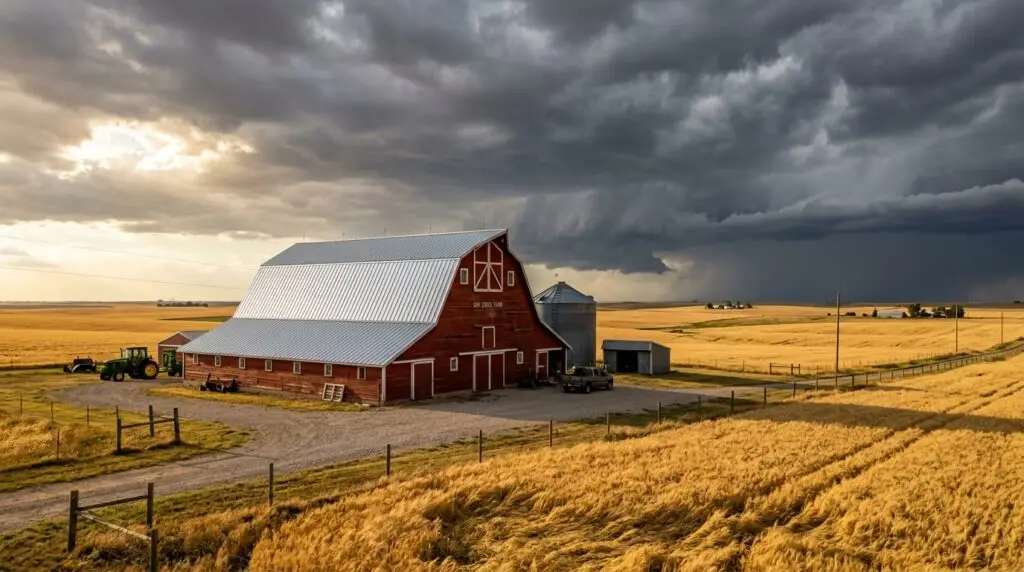
If you own a farm, ranch, or rural property anywhere in or around Oklahoma City, you already know that a roof isn’t just a roof out here. It’s the difference between a dry barn and a ruined hay crop. Between healthy livestock and a flooded stall. Between functioning equipment and a six-figure repair bill.
Oklahoma’s weather is not forgiving. Supercell thunderstorms, baseball-sized hail, sustained winds, ice storms, and brutal summers bake and batter roofing materials in ways that most of the country simply doesn’t experience. Agricultural buildings take the full force of all of it, with no wind breaks, no neighboring structures, and no margin for error on large, open spans.
Metal roofing for Oklahoma farms and barns has become the standard answer to that challenge. But picking the wrong panel type, the wrong gauge, or the wrong contractor turns a smart investment into an expensive mistake. This guide breaks down everything you need to know before making a decision.
Why Oklahoma Farm and Ranch Properties Demand More from a Roof
Open Land Means Amplified Wind Exposure
Here’s the thing most roofing companies won’t tell you upfront: a metal panel system that performs fine on a suburban home in Edmond can fail faster on a working farm in the Yukon-to-El Reno corridor. Why? Because there’s nothing stopping the wind.
Suburban roofs benefit from neighboring homes, trees, and natural wind breaks. On 40 or 80 open acres, your barn roof takes the full, uninterrupted force of every storm that rolls in from the western plains. Wind uplift pressures on large agricultural structures can be dramatically higher than on comparably-sized residential buildings, and that changes the engineering requirements considerably.
Oklahoma’s Supercell Storms Hit Agricultural Structures Differently
Central Oklahoma sits at the convergence of warm, humid Gulf air and cold upper-level atmospheric systems, the exact conditions that spawn violent supercell thunderstorms. These storms produce hail that doesn’t fall straight down. The rotational dynamics launch hailstones at steep horizontal angles, sometimes nearly parallel to the ground. That angular impact hits seams, panel edges, and fastener points with concentrated force.
For large, low-pitch barn roofs, which are the most common agricultural profile in this region, that means the hail-facing slope receives substantially more punishment than the slope you’d see on a steeper residential pitch. It’s one reason why panel gauge matters more on farm buildings than it does anywhere else in the metro.
What’s Actually at Risk: Livestock, Equipment, and Feed
A leaking residential metal roof is an inconvenience. A leaking barn roof is a financial event. Hay that gets wet is often a total loss. Stored equipment develops rust. Livestock health deteriorates in wet, drafty conditions. The stakes of a failed agricultural roof are direct, measurable, and expensive, which is exactly why metal roofing on Oklahoma farms and barns is worth serious consideration, not just a quick price comparison.
The Three Metal Roofing Systems Used on Oklahoma Agricultural Buildings
Corrugated and Exposed-Fastener Panels, The Most Common Choice
Walk past any working farm between Chickasha and Stillwater and you’ll see it: corrugated or ribbed steel panels with exposed fasteners running in neat rows across the roof surface. This is the workhorse of Oklahoma agricultural roofing, and for good reason.
Corrugated and exposed-fastener panels (R-panel and PBR panel systems fall into this category) are efficient to install, readily available from Oklahoma suppliers, and cost significantly less per square foot than standing seam. For most working farm applications, hay storage, equipment sheds, and secondary outbuildings, they’re the practical choice.
The trade-off is maintenance. Every exposed fastener is a potential leak point over time. The rubber washers under those fasteners compress and degrade with Oklahoma’s heat cycles. In our experience, exposed-fastener systems on agricultural buildings need fastener inspections every several years, particularly on large spans where thermal expansion creates the most movement. That step gets skipped constantly, and that’s where leaks start.
Structural Standing Seam Panels, When Large Span Performance Matters
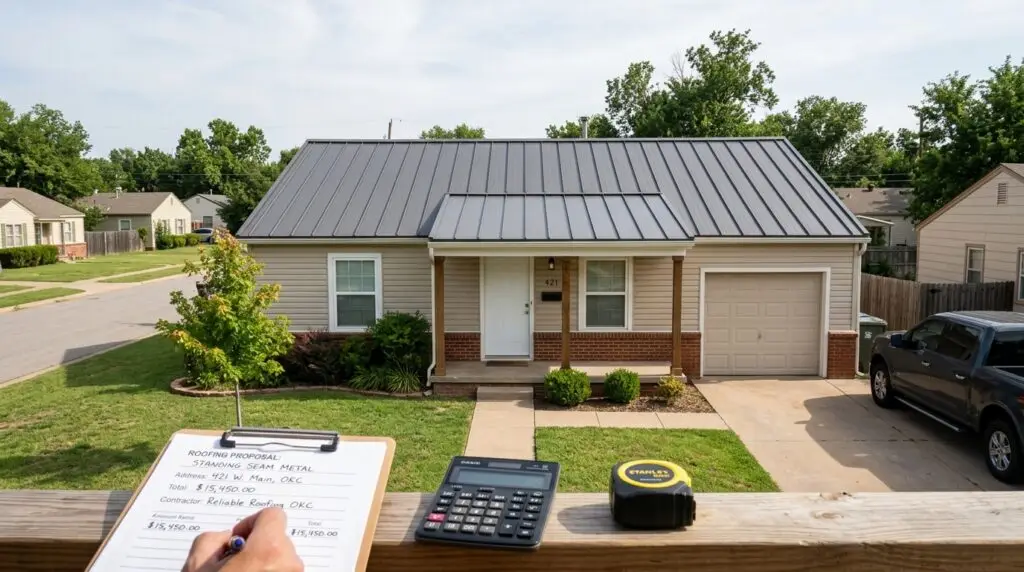
Standing seam metal roofing uses concealed fasteners hidden inside the raised seams, with the panels mechanically locking together. There are no exposed screws on the roof surface, which eliminates the most common failure point on exposed-fastener systems.
For larger agricultural buildings, 60-foot-wide spans, commercial livestock operations, high-value equipment storage, standing seam delivers better long-term performance. It also handles Oklahoma’s wind-driven hail better, because the mechanical attachment points are protected inside the seam rather than exposed on the panel face. The upfront cost is higher, but on a structure you’re planning to use for decades, the math often works in its favor.
Retrofit Metal Roofing, Going Over an Existing Deteriorated Roof
Many Oklahoma farm buildings carry original metal roofing that’s 30 to 50 years old. In some cases, a retrofit system, installing new panels over the existing roof without a full tear-off, is viable. It depends entirely on the condition of the underlying framing, the current roof’s integrity, and whether additional weight is structurally acceptable.
A contractor worth hiring will assess the framing honestly before recommending a retrofit. Some older Oklahoma barns have framing that simply won’t support another layer. That’s not a sales pitch, it’s a structural reality. Get that assessment in writing before work begins.
| Quick Reference: Panel Types for Oklahoma Agricultural Roofs Corrugated / Exposed Fastener → Best for: Hay barns, secondary sheds, budget-conscious projects, straightforward spans R-Panel / PBR Panel → Best for: Equipment storage, multi-use farm buildings, mid-range budgets Standing Seam → Best for: Large livestock operations, high-value equipment storage, long-term investment properties Retrofit Systems → Best for: Sound existing framing, avoiding full tear-off, incremental upgrades |
How Oklahoma’s Weather Directly Affects Your Barn Roof
Hail Impact and the UL 2218 Rating, What It Actually Means for Farmers
You’ll hear contractors throw around the UL 2218 rating. Here’s what it means in plain terms: the UL 2218 standard tests impact resistance by dropping a steel ball from approximately two stories onto the roofing material. Class 4 is the highest rating and represents the strongest resistance.
For Oklahoma agricultural properties, 26-gauge steel is the recommended minimum. Thinner 29-gauge panels save money on paper but tend to dent, deform, and develop fastener pull-through faster under the kind of hail events Central Oklahoma produces regularly. Between you and me, homeowners and farmers who chose 29-gauge to cut upfront costs often call us after their first golf ball hail event. The savings don’t last.
Wind Uplift on Agricultural Buildings: Why Open Land Changes Everything
Wind uplift, the force that tries to peel a roof panel up and away from the structure, is a function of wind speed and the aerodynamic profile of the building. Low-pitch, wide-span agricultural buildings are particularly vulnerable because they present a large horizontal surface for wind to get underneath.
Farms in the Mustang, El Reno, and Yukon areas west and northwest of Oklahoma City sit in one of the most active storm formation zones in the state. If your property is in that corridor, the wind exposure argument for heavier gauge panels and concealed-fastener systems becomes significantly stronger.
Condensation and Humidity: The Silent Problem Inside Livestock Barns
This is the gap most competitors completely ignore. Livestock, cattle, horses, hogs, produce enormous amounts of moisture through breathing and body heat. In a cold Oklahoma winter, that warm, humid air hits the cold underside of a metal roof panel and condenses. Without proper ventilation, ridge vents, eave vents, and airflow planning, that condensation drips down onto animals, feed, equipment, and structural framing.
Condensation is a slow-building problem that’s invisible until it isn’t. By the time you’re seeing water stains on the framing or rust on equipment, significant moisture damage has already accumulated. Ventilation planning should happen before installation, not as an afterthought. Any contractor who doesn’t ask about your building’s use and occupancy before specifying a panel system isn’t doing their job.
Metal Roofing vs. Other Barn Roof Materials in Oklahoma
Metal vs. Asphalt Shingles on Oklahoma Farm Structures
Asphalt shingles have one significant advantage: low upfront cost. Everything else favors metal on an Oklahoma agricultural building. Shingles on open farmland regularly fail within 10 to 15 years, sometimes less, due to UV degradation, hail damage, and wind uplift. The seal strips and granular coating that shingles depend on deteriorate faster under Oklahoma’s combination of intense summer heat and violent storm cycles.
On a large agricultural building, re-roofing with asphalt every 12 to 15 years becomes a recurring operational expense that adds up quickly. Metal roofing eliminates that cycle entirely.
Galvanized Steel vs. Galvalume Steel, What Performs Better in Oklahoma
Most metal roofing in Oklahoma‘s agricultural market is either galvanized or Galvalume steel. Standard galvanized steel carries a zinc coating that protects against corrosion. Galvalume uses an aluminum-zinc alloy that outperforms standard galvanized in environments with higher humidity and moisture exposure, which matters for livestock barns and properties in eastern Oklahoma near rivers and lakes.
For most Central Oklahoma farm applications, Galvalume steel with a quality PVDF or siliconized polyester paint system is the practical sweet spot. It offers strong corrosion resistance without the premium cost of copper or zinc.
What Metal Roofing on Oklahoma Farms and Barns Actually Costs
Cost Ranges by Panel Type
Agricultural metal roofing costs less per square foot than residential metal roofing because the geometry is typically simpler, large, relatively flat planes without dormers, valleys, or complex flashing details. Here are honest ranges for the Oklahoma market:
- Corrugated / Exposed Fastener (26-gauge): roughly $3–$7 per square foot installed on straightforward agricultural structures
- R-Panel / PBR systems: approximately $4–$8 per square foot installed depending on span and framing conditions
- Standing Seam (agricultural grade): $8–$14 per square foot installed on most farm building profiles
These are installed totals, materials, labor, fasteners, underlayment, and ridge cap. Material-only pricing you find online is not what you should be budgeting against.
What Drives Cost Up on Agricultural Metal Roofing Projects
Several factors push a farm roofing project toward the higher end of those ranges. Span width matters, buildings wider than 40 to 50 feet require more structural consideration in panel selection. Existing framing condition matters, especially on older Oklahoma barns where rot, settlement, or previous storm damage has compromised the structure. Distance from OKC-area suppliers affects material availability and lead times for specialty profiles.
One cost factor most homeowners and farmers don’t anticipate: post-storm pricing. In the weeks following a major tornado or hail event in the OKC metro, contractor demand spikes sharply. That’s the worst time to make a major roofing decision under pressure. Planning ahead, getting assessments and quotes before you urgently need a new roof, almost always produces better outcomes and better pricing.
Why Farm Roof Quotes Differ So Much Between Contractors
If you get three quotes and one is dramatically lower than the others, dig into why. Common reasons include thinner gauge panels, a lower-quality paint system, skipped underlayment, or a crew that’s optimized for speed over installation quality. Ask specifically: What gauge panel are you quoting? What’s the coating system? How are the fasteners specified? Is underlayment included? Get that in writing before you sign anything.
Choosing the Right Metal Roofing for Your Specific Oklahoma Farm Structure
Horse Barns and Livestock Shelters, Ventilation Comes First
For any structure housing animals, ventilation is the non-negotiable design element. Continuous ridge vents and eave vents create the airflow that prevents condensation, removes ammonia from manure gas, and keeps interior temperatures manageable in Oklahoma summers. Metal roofing amplifies heat without proper ventilation design, the interior of a poorly ventilated metal barn can reach temperatures that stress or harm livestock.
Panel color matters here too. Lighter-colored metal panels reflect more solar radiation. On a livestock barn in Central Oklahoma, a light gray, tan, or white Galvalume panel can meaningfully reduce interior heat compared to darker colors.
Equipment Storage and Machine Shops, Span Strength and Clearance
For equipment storage, combines, tractors, large implements, the priority is clearance height and wide-span structural integrity. A panel system that performs fine on a 30-foot barn may not be the right spec on a 60-foot implement shed. Structural standing seam or heavier gauge R-panel systems are worth the cost differential when the building houses six-figure equipment.
Hay Storage and Feed Barns, Moisture Control Is Non-Negotiable
Even minor roof leak on a hay barn can represent thousands of dollars in spoiled feed. Watertight panel profiles, properly sealed ridge caps, and closed closure strips at the eaves and gables aren’t optional on hay storage structures, they’re essential. In our experience, hay barn roofs that fail early almost always have one of two problems: undersized panel overlap on low-pitch applications, or ridge caps that were never properly sealed.
Metal Roofing Installation on Oklahoma Farms: What to Expect
Common Installation Mistakes That Shorten Metal Barn Roof Life
Most premature metal roof failures on Oklahoma agricultural buildings trace back to installation errors, not material failures. The most common mistakes we see:
- Over-torqued fasteners: Tightening screws too aggressively compresses the rubber washers flat, eliminating their sealing function. Within a few years, those over-torqued fasteners become leak points.
- Insufficient panel overlap on low-pitch roofs: Agricultural barns often run at 1:12 or 2:12 pitch, much shallower than residential roofs. Lower pitch requires greater panel overlap to prevent water infiltration. Installers who spec residential overlap on a 1:12 barn roof create problems.
- Missing closure strips: Open corrugated profiles at the eaves and ridges allow water, insects, and birds into the building. Closed-cell foam closure strips aren’t a luxury, they’re a waterproofing requirement.
- Skipped thermal expansion planning: Metal panels expand and contract with temperature changes. On long Oklahoma summer days, steel panels can move significantly. Systems that don’t account for this movement develop fastener fatigue and panel distortion over time.
What to Ask a Contractor Before Work Starts on Your Farm
Before signing with any roofing contractor for an agricultural project, get answers to these questions in writing:
- Are you licensed in Oklahoma and do you carry liability insurance for agricultural properties?
- What specific panel brand, gauge, and coating system are you quoting?
- How do you handle fastener specification on wide-span structures?
- Do you provide a manufacturer’s warranty in addition to your labor warranty?
- Can you provide references from other Oklahoma farm or ranch projects?
That last question matters more than most people realize. Post-storm periods attract out-of-state roofing crews who work Oklahoma markets briefly and disappear. A contractor without a verifiable local address, local license, and established local references is a risk on a project this size.
Maintaining a Metal Roof on an Oklahoma Farm or Ranch
Annual Inspection Checklist
Metal roofs require minimal maintenance compared to asphalt shingles, but minimal doesn’t mean zero. An annual walkthrough before storm season (late winter or early spring, before Oklahoma’s severe weather window) should cover:
- Fastener inspection: Check for backed-out or visibly loose screws on exposed-fastener systems; re-torque as needed
- Ridge cap condition: Look for lifted sections, compromised sealant, or displaced closure strips
- Panel overlap integrity: Any separation or lifting at panel laps
- Gutter and downspout condition: Blockages create standing water at the eave, which accelerates corrosion at panel edges
- Penetrations: Any pipe boots, vents, or skylights should have intact sealant
After a Major Oklahoma Storm: What to Look For
After a significant hail or wind event, do a visual inspection from the ground before getting on the roof. Look for: lifted panel corners (the starting point of wind uplift failure), displaced ridge caps, and visible denting on hail-facing slopes. Document everything with photographs before making any temporary repairs, that documentation matters for insurance purposes.
How Long Should a Metal Barn Roof Last in Oklahoma Conditions?
With proper installation and basic maintenance, corrugated or exposed-fastener steel on an Oklahoma agricultural building typically delivers 20 to 40 years of service life. Standing seam systems routinely reach 40 to 60 years. Oklahoma’s hail frequency and UV intensity can compress those ranges if maintenance is deferred, but they’re still dramatically longer lifespans than asphalt shingles in the same conditions.
Insurance Considerations for Metal Roofing on Oklahoma Farm Properties
This is the section most competitors skip entirely, and it may be the most financially important one on this page.
Farm and ranch insurance policies operate differently from standard homeowner policies. Outbuilding coverage limits vary widely between carriers, and many Oklahoma agricultural property owners discover after a storm that their barns are either underinsured or covered under a replacement cost formula that doesn’t reflect current material and labor prices.
Metal roofing with a UL 2218 Class 4 impact-resistance rating may qualify for insurance premium discounts with certain Oklahoma carriers. The discount availability varies by insurer, confirm directly with your agent, and get any premium adjustment in writing. It’s also worth reviewing your outbuilding replacement cost coverage before storm season, not after. The time to find a coverage gap is during renewal, not while filing a claim.
When damage does occur: photograph everything before any temporary repairs, get a written estimate from a local licensed contractor, and be cautious of storm chasers who approach you unsolicited. Out-of-state crews who specialize in post-storm markets sometimes file insurance claims without owner oversight, accept partial payment, and move on, leaving warranty issues with no one to call.
Common Mistakes Oklahoma Farm Owners Make When Buying a Barn Roof
Choosing the Cheapest Gauge to Save Money Upfront
Most homeowners don’t realize the gauge decision has long-term consequences that dwarf the upfront savings. A 29-gauge panel on a large open barn in Tornado Alley isn’t a budget choice, it’s a deferred expense. Thinner steel dents more readily, develops fastener pull-through faster, and requires earlier replacement. On a large agricultural structure, the labor cost alone to re-roof makes that ‘savings’ look very different in year 15.
Skipping Ventilation Planning on Livestock Buildings
We’ve seen this play out repeatedly. A beautifully installed metal roof on a livestock barn, with no ridge venting and inadequate eave airflow. Within two to three years: condensation stains on the interior framing, dripping onto animals in winter, accelerated corrosion on equipment. Ventilation is a system, it has to be designed into the project, not bolted on as an afterthought after the fact.
Hiring an Out-of-State Crew After a Storm
It happens after every major OKC storm event. Crews with out-of-state plates canvass rural properties, offering fast turnarounds and easy insurance navigation. Some are legitimate. Many are not. The risk is real: if installation quality problems emerge in year two or three, a contractor without a local address and established local operations may not be reachable. Verify licensing through the Oklahoma Construction Industries Board before work begins.
Is Metal Roofing Worth It for Oklahoma Farms? An Honest Assessment
For most Oklahoma agricultural applications, the answer is yes, with nuance.
For any structure housing livestock, feed, or high-value equipment, metal roofing’s combination of storm resistance, longevity, and low maintenance frequency makes it the clear practical choice. The upfront cost is real, but the lifetime cost math, factoring in Oklahoma’s storm replacement cycles for asphalt, the maintenance demands of aging corrugated tin, and the actual risk of a failed roof on a working farm, consistently favors metal.
For small, seasonal structures or buildings at the end of their useful life, the calculation changes. A weathered 30-year-old chicken coop with failing framing might not be worth a premium metal re-roof, it might be worth a replacement structure. That’s an honest assessment, and it’s the kind of conversation a contractor who has your interests in mind will have with you upfront.
It depends on several factors: the structure’s size, its use, its current condition, and how long you plan to rely on it. What we can tell you with confidence is that on a working Oklahoma farm, a properly specified and installed metal roof system, the right gauge, the right panel profile, the right ventilation design, is one of the highest-return property investments a rural property owner can make.
Frequently Asked Questions
Is metal roofing good for barns in Oklahoma?
Yes. Metal roofing is one of the most practical choices for Oklahoma agricultural buildings. It handles wind uplift, hail impact, and wide-span coverage better than asphalt shingles or wood, and it significantly outlasts alternatives in Oklahoma’s demanding storm climate.
What gauge metal roofing is best for an Oklahoma barn?
For most Oklahoma farm and barn applications, 26-gauge steel is the recommended minimum. Oklahoma’s frequent hail and high-wind events make thinner 29-gauge panels a risk for cosmetic and structural damage over time. Heavier gauge panels cost more upfront but reduce repair frequency on open, exposed agricultural properties.
How much does it cost to put a metal roof on a barn in Oklahoma?
Agricultural metal roofing in Oklahoma generally ranges from $3–$7 per square foot installed for corrugated and exposed-fastener panels, and $8–$14 per square foot for standing seam systems. Total project cost depends on structure size, framing condition, panel type, and current labor rates in the OKC area.
How long does a metal barn roof last in Oklahoma?
A properly installed corrugated steel barn roof in Oklahoma typically lasts 20–40 years with regular maintenance. Standing seam systems can last 40–60 or more years. Oklahoma’s hail frequency, UV exposure, and freeze-thaw cycles can compress those lifespans if the roof is neglected or if an undersized gauge was installed.
Can Oklahoma hail damage a metal barn roof?
Yes, though metal handles hail far better than asphalt shingles. Large hailstones common in Central Oklahoma’s supercell storms can dent thinner gauge panels without causing immediate leaks. Heavier gauge metal and ribbed or textured panel profiles distribute impact force more effectively, reducing both cosmetic and structural damage.
Do metal barn roofs make noise during Oklahoma rain and hail?
Metal roofs on open barn structures without insulation can be noisy during heavy rain and hail. Adding rigid insulation or a spray foam layer significantly reduces sound transmission. For livestock barns, this is worth budgeting for, prolonged noise from severe storms can cause animal stress.
Should I repair or replace my Oklahoma barn’s existing metal roof?
If the existing metal panels show widespread rust, significant fastener pull-through, or recurring leaks across multiple locations, replacement is usually more cost-effective than ongoing repairs. Localized damage, a few panels or a ridge cap section, is generally worth repairing. A local Oklahoma contractor can assess whether the underlying framing supports reroofing versus a full tear-off.