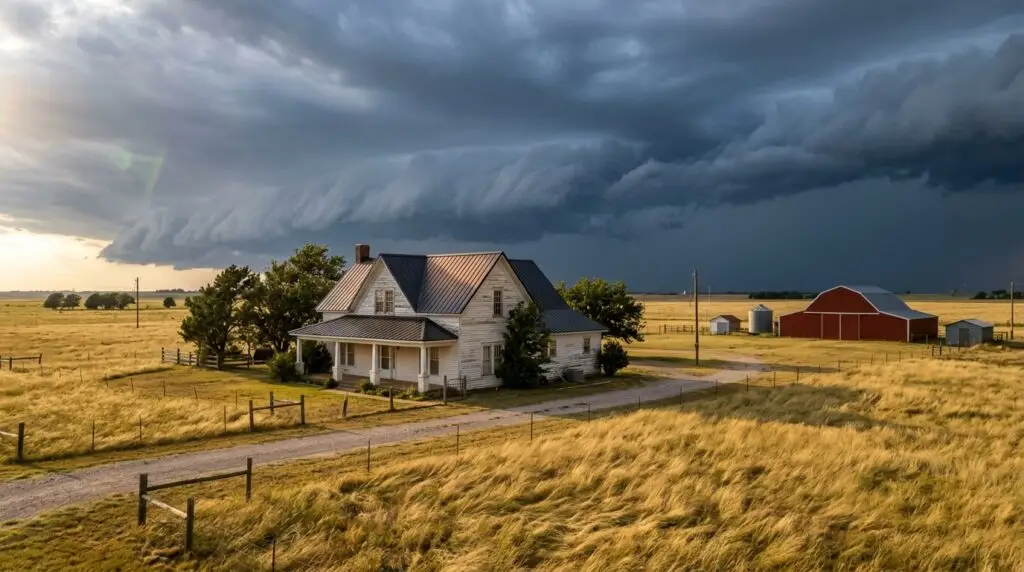
If you own acreage in central or western Oklahoma, your roofing situation is fundamentally different from a homeowner in an OKC suburb. You’re not just protecting one house, you’re often managing a main residence, a barn, outbuildings, and maybe a workshop, all sitting on open ground with nothing to break the wind for miles. And when a supercell rolls through Canadian County or a hail event sweeps across Grady County, every one of those structures takes the full hit.
Most homeowners don’t realize how much that exposure gap matters. The same storm that dents a few shingles on a house in Edmond can strip an unprotected rural roof down to the decking. That’s not an exaggeration, it’s what happens when you remove the wind buffers that suburban neighborhoods take for granted.
Metal roofing for rural Oklahoma properties isn’t just a trend. For many landowners, it’s becoming the only choice that actually makes financial and practical sense.
What Makes Rural Oklahoma Properties Different When It Comes to Roofing
Let’s be direct about something: rural properties present roofing challenges that most general contractors and even some roofing companies aren’t fully equipped for.
Large Roof Spans, Multiple Structures, and Fewer Nearby Contractors
The average rural Oklahoma property might include 3,000 to 5,000 square feet of roofable surface across multiple structures, and that’s a conservative estimate. A main house, a two-bay equipment shed, a hay barn, and a smaller storage building adds up fast. Each structure has its own pitch, age, and exposure profile. Managing that across a single project takes coordination and experience.
Access is another real factor. Contractors servicing areas around Tuttle, Blanchard, Luther, or Harrah often charge mobilization costs that urban jobs don’t carry. Material deliveries take longer. Scheduling gets more complicated. These aren’t dealbreakers, but they’re costs that should be in your budget from day one.
Open-Land Wind Exposure — The Risk Most People Underestimate
Here’s the thing about rural Oklahoma: trees, buildings, and terrain features that naturally slow wind down simply don’t exist on flat, open acreage. Properties along the Canadian River corridor, in Logan County’s open plains, or across the Grady County farmland face sustained wind loads that urban roofs rarely experience.
Wind doesn’t just blow roofs off. It works at seams, corners, ridge lines, and fastener points, slowly, storm after storm, until a failure point opens. A roof that performs fine in a suburb can develop chronic leak points on exposed acreage within a few years. This is why the material and installation system you choose matters more on rural land than almost anywhere else.
Why Metal Roofing for Rural Oklahoma Properties Outperforms Every Alternative
This isn’t a blanket endorsement of metal roofing for every situation. But when you look honestly at what rural Oklahoma throws at a roof, hail, sustained wind, UV heat, temperature cycling from 10°F winters to 110°F summers, the comparison stops being close.
Lifespan That Outlasts the Mortgage
Standard asphalt shingles in Oklahoma regularly fail in 7 to 15 years. Not because asphalt is a bad product in general, but Oklahoma’s combination of UV intensity, temperature swings, and repeated hail impact degrades granule adhesion faster than nearly anywhere in the country. A roof that’s supposed to last 25 years in the Northeast may need full replacement in under 15 years here.
A properly installed metal roof typically lasts 40 to 70 years. That’s one installation decision versus two or three full replacements over the same period, with all the labor, material, and disruption that comes with each.
Wind and Hail Resistance Rated for Oklahoma Conditions
Oklahoma’s 2018 International Residential Code requires roofing products rated for wind speeds exceeding 110 mph. For rural properties in open terrain, that’s a floor, not a ceiling. Standing seam metal panels are engineered with hidden fasteners, which eliminates the most common wind failure point in exposed-fastener corrugated systems.
Class 4 impact-rated metal roofing, the highest classification available, handles the kind of hail events that central Oklahoma sees regularly. Hailstones at 1.5 inches or larger, which occur in supercell storms across the Canadian Valley corridor, can dent thinner panels cosmetically, but heavy-gauge standing seam systems maintain structural integrity where asphalt shingles simply fail.
Fire Classification — An Underrated Advantage for Rural Homeowners
Between you and me, this is the benefit that most rural Oklahoma property owners don’t think about until they’ve talked to their insurance agent. Metal roofing carries a Class A fire rating, the highest classification available. On properties adjacent to dry grassland, cedar stands, or brushy creek bottoms, wildfire exposure is a real risk that asphalt shingles handle poorly.
Insurers increasingly factor fire risk into rural policy pricing. A Class A-rated roof doesn’t just protect the structure, it changes how your insurer categorizes your risk profile.
Types of Metal Roofing That Work Best on Rural Oklahoma Properties
Not all metal roofing is the same. The product type, gauge, and installation method have a bigger impact on performance than the fact that it’s metal at all.
Standing Seam — The Premium Choice for Exposed Rural Locations
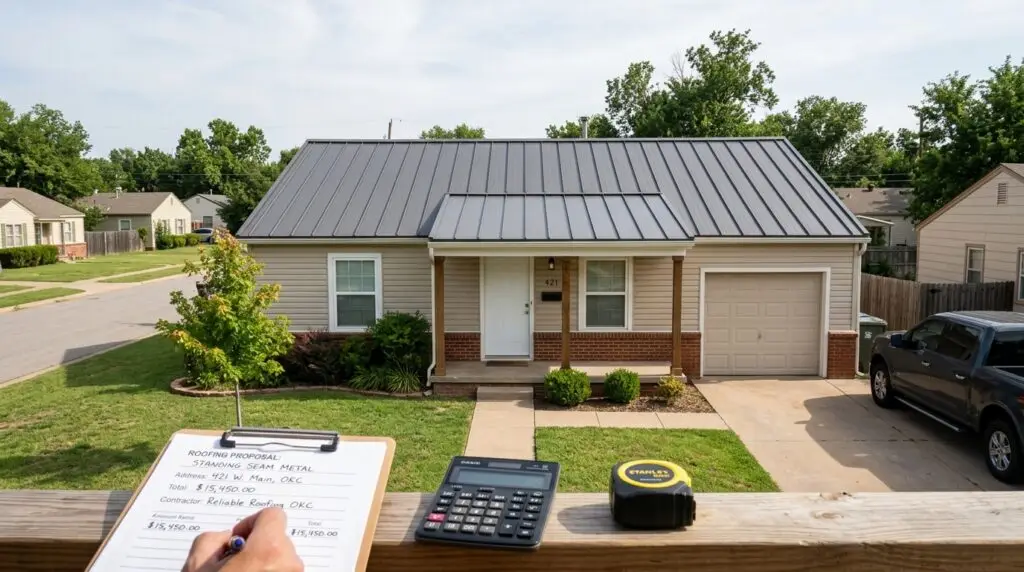
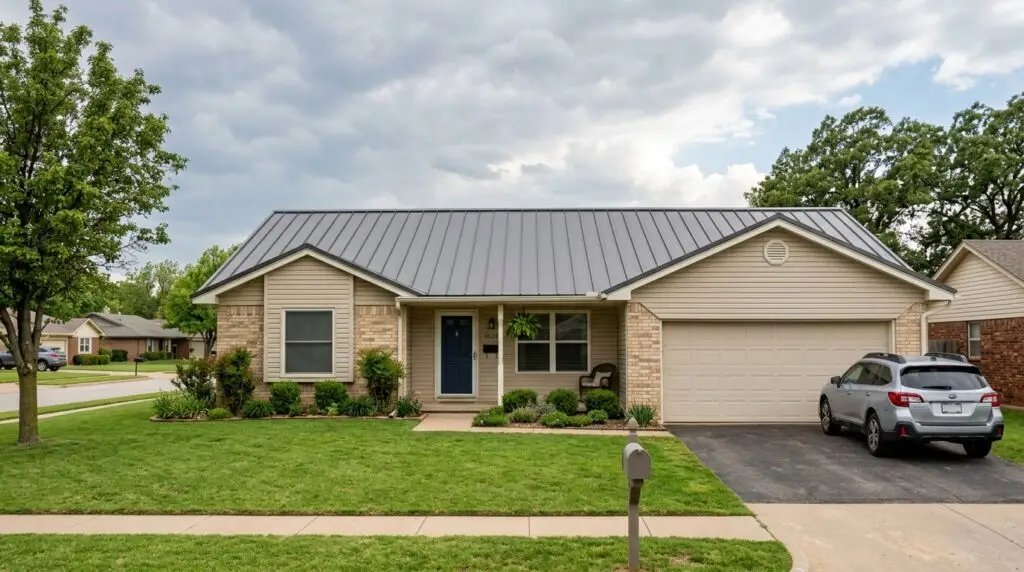
Standing seam panels interlock at raised seams above the surface. No exposed screws. No exposed fasteners to back out, corrode, or create entry points for wind-driven rain. This is the system we recommend most strongly for main residences on rural properties, particularly those with full storm exposure.
The aesthetic is clean and modern, which pairs well with the farmhouse and ranch-style architecture common around the rural edges of Yukon, Piedmont, and Mustang. Higher upfront cost, but fewer callbacks, fewer repairs, and better long-term performance.
Corrugated Metal Panels — Practical for Outbuildings and Large Spans
Corrugated panels have earned their place on Oklahoma barns and equipment sheds for good reason: they cover large roof spans efficiently, cost less per square foot, and handle the structural demands of agricultural buildings well.
The tradeoff is the exposed fasteners. In Oklahoma’s freeze-thaw cycling, those fasteners can back out over time, and the rubber washers beneath them can degrade. This isn’t a fatal flaw, it’s a maintenance reality. If you budget for periodic inspections and resealing, corrugated systems on outbuildings perform reliably for decades.
Just don’t make the mistake of putting corrugated exposed-fastener metal on your main house to save money on the front end. We see this more often than we’d like, and it creates problems 8 to 12 years down the road.
Stone-Coated Steel — A Middle Ground Worth Considering
Stone-coated steel panels look like asphalt shingles or wood shakes but carry the impact resistance and wind rating of steel underneath. If you’re dealing with a rural subdivision or property covenant with aesthetic standards, or if you simply want a more traditional-looking roof without sacrificing performance, stone-coated steel bridges that gap effectively.
Real Cost Factors for Metal Roofing on Rural Oklahoma Properties
In our experience, the biggest source of sticker shock in rural metal roofing projects isn’t the material itself, it’s the factors that drive total project cost that most homeowners don’t anticipate.
What Drives the Price Up on Rural Installations
Roof area: Rural properties simply have more of it. Covering a main house plus two outbuildings can put you at 8,000 to 12,000 square feet of total roofable surface. Material and labor scale accordingly.
Mobilization and logistics: Contractors working outside the OKC metro, servicing Chickasha, Guthrie, Shawnee, or El Reno, factor travel, setup, and material delivery into their pricing. This is reasonable and legitimate. Get it itemized in writing.
Gauge and panel system: Thicker steel costs more. Standing seam costs more than corrugated. But these aren’t places to cut corners, the performance difference is real, and so is the insurance documentation value.
Underlayment and insulation: Proper underlayment on a rural metal roof isn’t optional, it’s what separates a quality installation from one that leaks, sweats, and amplifies noise. Budget for it. More on that in a moment.
Where Metal Roofing Saves Money Over Time
Energy savings add up meaningfully in Oklahoma summers. Metal roofs with reflective coatings reduce heat transfer into the attic, which takes real pressure off air conditioning in a climate that regularly pushes past 100°F for weeks at a time.
Maintenance costs over a 40-year period are dramatically lower than cycling through two or three asphalt replacements. And if your metal roofing system qualifies for a Class 4 impact rating or FORTIFIED certification, you may see measurable reductions in annual insurance premiums.
Oklahoma Storm Reality — How Hail and Wind Actually Affect Rural Metal Roofs
Let’s get specific about something that vague articles always gloss over.
What Hail Does (and Doesn’t Do) to Metal Roofing
Large hail on a heavy-gauge standing seam metal roof typically causes cosmetic denting. The panel surface may show impact marks, but the roof continues to function, no leaks, no structural compromise, no immediate need for replacement.
The same storm on a thin-gauge corrugated system from a budget installation? That’s a different story. Thin panels can deform more severely, fastener points can shift, and what looks like cosmetic damage may actually be allowing moisture infiltration at seam lines.
This distinction matters enormously when you’re comparing contractor quotes. “Metal roofing” can mean a 26-gauge standing seam system built for 60 years of performance, or it can mean a thin corrugated panel that’s going to need attention in a decade. Always ask for the gauge specification in writing before signing anything.
Wind Uplift and the Rural Exposure Problem
Wind failure on rural roofs rarely looks like a roof flying off in one piece. It starts at edges, a drip edge that wasn’t properly secured, a ridge cap with inadequate fastening, a valley seam that wasn’t sealed. Wind finds those points and works them, storm after storm.
Proper installation of drip edge, underlayment, ridge cap, and fastener pattern is non-negotiable on open rural land. Ask your contractor specifically: “What wind uplift rating does this system carry, and how are the edge and ridge details installed?” A contractor who can’t answer that question clearly is a contractor to walk away from.
The FORTIFIED Home Standard — What Rural Oklahoma Homeowners Should Know
This is one of the most underutilized programs in rural Oklahoma, and it deserves more attention. The Oklahoma Insurance Department’s Strengthen Oklahoma Homes program offers qualifying homeowners up to $10,000 in grant funding for wind-resistant roofing upgrades that meet the FORTIFIED Home™ standard developed by the Insurance Institute for Business & Home Safety (IBHS).
FORTIFIED certification is also increasingly recognized by Oklahoma carriers for ongoing premium reductions. For rural property owners who are already paying elevated insurance rates due to storm exposure and remote location, this combination of upfront grant funding and long-term premium savings makes a compelling financial case for investing in a qualifying metal roofing system.
Metal Roofing and Homeowners Insurance in Rural Oklahoma
Oklahoma consistently ranks among the most expensive states in the country for homeowners insurance. Rural policyholders often face even higher rates than their suburban counterparts, driven by storm exposure, longer emergency response times, and the value of multiple insured structures.
Material choice directly influences what your insurer charges, and what they’ll pay when something goes wrong.
How Metal Roofing Can Lower Your Rural Property Insurance Premium
Class 4 impact-rated metal systems are recognized by many Oklahoma carriers for premium reductions. FORTIFIED-certified installations strengthen your negotiating position further. And here’s something most homeowners don’t know: documenting your roof’s gauge, wind rating, and installation method gives you documentation that matters when an adjuster shows up after a storm.
Understand whether your policy pays Replacement Cost Value (RCV) or Actual Cash Value (ACV). ACV policies apply depreciation, on a 15-year-old asphalt roof, you may receive only a fraction of actual replacement cost. A metal roof that’s still within its rated lifespan after a storm event holds its RCV position far better.
Installation Considerations Specific to Rural Oklahoma Properties
Underlayment and Insulation — Don’t Skip This
Metal roofs without proper underlayment and insulation are noisy during hailstorms and can develop condensation problems when Oklahoma’s temperature swings create moisture differentials between the roof surface and the attic space below. Quality underlayment is not a luxury line item, it’s what makes a metal roof livable. Budget for it from the start.
Multi-Structure Coordination
Coordinating metal roofing across multiple structures at once, main house, barn, equipment shed, typically produces better pricing than separate projects and ensures consistent material quality across your property. Contractors can order materials in larger quantities, mobilize once, and move through structures efficiently.
Common Mistakes Rural Oklahoma Property Owners Make With Metal Roofing
These are the ones we see repeatedly, and they’re all avoidable:
Choosing corrugated exposed-fastener panels for the main residence to save money. The savings are real upfront. The maintenance and early replacement costs that follow aren’t.
Hiring a contractor unfamiliar with rural property logistics. Remote access, multi-structure sequencing, and material delivery coordination require experience. Ask specifically whether they’ve completed rural acreage projects.
Skipping proper underlayment. This is where the noise complaints and condensation problems come from. It also compromises your installation documentation for insurance purposes.
Not verifying wind uplift ratings in writing before signing. After a storm event, this documentation is exactly what an adjuster will ask for.
Failing to coordinate all structures in one project. Multiple mobilizations mean multiple setup costs and the risk of mismatched materials that become obvious over time.
How to Choose the Right Metal Roofing Contractor for Your Rural Oklahoma Property
Questions to Ask Before Signing Anything
- Are you licensed and insured in Oklahoma?
- Have you completed metal roofing projects on rural properties with multiple structures in this area?
- What gauge steel or aluminum are you proposing, and from which manufacturer?
- What wind uplift rating does this system carry?
- How are the edge, ridge, and valley details installed and secured?
- Will you provide written documentation of installation specs for my insurance carrier?
Red Flags That Should Stop You Cold
- Vague material specs, “quality metal panels” without gauge or manufacturer details
- No discussion of underlayment or ventilation
- Same-day pressure after a storm event (storm-chasing contractors are a real and persistent problem in rural Oklahoma)
- No written warranty on both materials and installation labor
Metal Roofing Maintenance for Rural Oklahoma Properties — What Actually Requires Attention
The low-maintenance reputation of metal roofing is well-earned, but “low maintenance” doesn’t mean “no maintenance.” Here’s what actually needs attention on rural Oklahoma properties:
Annual inspection checklist:
- Check exposed fasteners (if corrugated systems) for backing out or corrosion, particularly after winter freeze-thaw cycles
- Inspect ridge caps, valleys, and all penetrations (vent pipes, skylights, HVAC curbs) after storm season
- Clear debris buildup in valleys and at drip edges, rural properties with tree cover see more organic accumulation than urban roofs
After significant hail events: Get a contractor on the roof before you file an insurance claim. Having documentation of the damage condition, with photos and written notes, gives you a much stronger position when the adjuster arrives. Don’t let the adjuster’s report be the only documentation on file.
Frequently Asked Questions
Is metal roofing worth it for rural Oklahoma properties?
Yes, especially for properties with storm exposure, multiple structures, and high insurance costs. Metal roofing’s longer lifespan, wind and hail resistance, and fire rating make it particularly well-suited to open rural land where weather exposure is higher and maintenance access is less convenient.
How long does a metal roof last in Oklahoma?
A properly installed metal roof in Oklahoma typically lasts 40 to 70 years. Standard asphalt shingles in Oklahoma’s climate often need replacement in 7 to 15 years due to UV degradation, temperature cycling, and storm damage.
What type of metal roofing is best for Oklahoma’s weather?
Standing seam metal roofing is the top recommendation for primary residences. It has no exposed fasteners, carries high wind uplift ratings, and performs well under repeated hail impact. Corrugated panels remain a practical option for outbuildings and agricultural structures.
Will metal roofing lower my homeowners insurance in Oklahoma?
It may. Class 4 impact-rated systems and FORTIFIED Home-certified installations are recognized by some Oklahoma carriers for premium reductions. Rural property owners already facing elevated base rates stand to benefit most.
Can I get a grant for a metal roof in Oklahoma?
Oklahoma’s Strengthen Oklahoma Homes program, through the Oklahoma Insurance Department, offers qualifying homeowners up to $10,000 toward wind-resistant roofing upgrades meeting the FORTIFIED Home™ standard. Eligible ZIP codes expand periodically, check the Oklahoma Insurance Department website for current availability.
Is metal roofing loud during Oklahoma hailstorms?
Without proper insulation and underlayment, yes. Quality underlayment layers substantially reduce noise. This is a budget line item that should be included in every rural metal roofing quote from the start.
What wind speed rating should I look for on a rural Oklahoma metal roof?
Oklahoma’s IRC 2018 code requires wind ratings exceeding 110 mph. For rural properties on open, unprotected terrain, prioritize systems rated beyond this minimum and confirm edge, ridge, and fastener details in writing before installation begins.