If you’ve been watching your neighbors in Edmond, Moore, or Yukon replace their old asphalt shingles with metal roofing lately, you’re not imagining a trend. Oklahoma homeowners are switching to metal roofing at a pace that’s hard to ignore, and the reasons go a lot deeper than aesthetics.
It’s not about keeping up with the Joneses. It’s about a combination of brutal Oklahoma weather, sky-high insurance premiums, and a growing realization that the roofing math in this state is fundamentally different from the rest of the country. If you’ve been on the fence about making the switch, this guide is going to give you the complete picture, including the things most roofing websites never bother to tell you.
Oklahoma’s Weather Has Changed the Roofing Math for Good
Let’s be straight with each other about something most roofing content skips right past: Oklahoma is one of the hardest places in the country to own a roof.
What Oklahoma Homeowners Are Actually Dealing With
Oklahoma City sits squarely in what meteorologists call Hail Alley, the stretch of the central United States where cold Arctic air collides with warm Gulf moisture, producing some of the most frequent and violent severe weather events on the planet. Communities like Norman, Moore, Midwest City, Piedmont, and Yukon experience significant hail events with a regularity that homeowners in most other states simply don’t face.
The financial impact is real and measurable. Oklahoma homeowners pay well above the national average for home insurance, in some cases more than double, largely because of the property damage risk that comes with living here. That insurance burden isn’t going away. In fact, it’s been climbing. And that single fact has changed the way a lot of OKC-area homeowners are thinking about their next roof.
Why Asphalt Shingles Fail Faster in Oklahoma Than Anywhere Else
Here’s something the packaging on a 30-year asphalt shingle doesn’t mention: in Oklahoma’s specific climate, you’re unlikely to get 30 years out of it.
Asphalt shingles are bound by bitumen, a petroleum-based material that’s genuinely vulnerable to the kind of thermal cycling Oklahoma produces. We’re talking about swings from freezing temperatures in January to 105-degree summers, sometimes within the same month in spring. That daily expansion and contraction beats asphalt up from the inside out. Add direct UV exposure, and you’ll see granule loss start showing up in your gutters years before you expect it.
Most homeowners in the OKC area are realistically looking at a 15–18 year replacement cycle on asphalt shingles, not 25 or 30. That’s not a knock on shingles; it’s just the honest reality of our climate. And once you account for that, the cost comparison with metal roofing starts to look very different.
Metal Roofing and Hail: What Class 4 Impact Resistance Actually Means
Every roofing website in Oklahoma will tell you that metal roofing is “hail resistant.” Very few of them will explain what that actually means or how to verify it before you buy.
What the UL 2218 Class 4 Rating Means in Plain English
The UL 2218 standard is the testing protocol used to measure a roofing material’s impact resistance. Here’s how it works in simple terms: a steel ball of a specific size and weight is dropped from a set height onto the roofing material. The goal is to simulate what a large hailstone does when it hits your roof at speed.
Class 4 is the highest rating available. A roofing panel that achieves Class 4 has to withstand a 2-inch steel ball drop without cracking or splitting, simulating roughly what a large hailstone does on impact.
Here’s the critical difference between metal and asphalt at that impact level: metal panels may dent, but they don’t crack. The waterproof barrier stays intact. Asphalt shingles at the same impact level crack, fracture, and lose the granule layer that protects the bitumen underneath. Once that happens, water infiltration and accelerated deterioration follow quickly.
In our experience, this is the distinction that matters most to homeowners after a major hail event. A metal roof might look cosmetically dented after a storm. An asphalt roof might look fine from the street, and be compromised in ways you won’t discover until water starts coming in.
Standing Seam vs. Exposed-Fastener Metal in an OKC Storm
Not all metal roofing performs equally, and this is where buyer education matters.
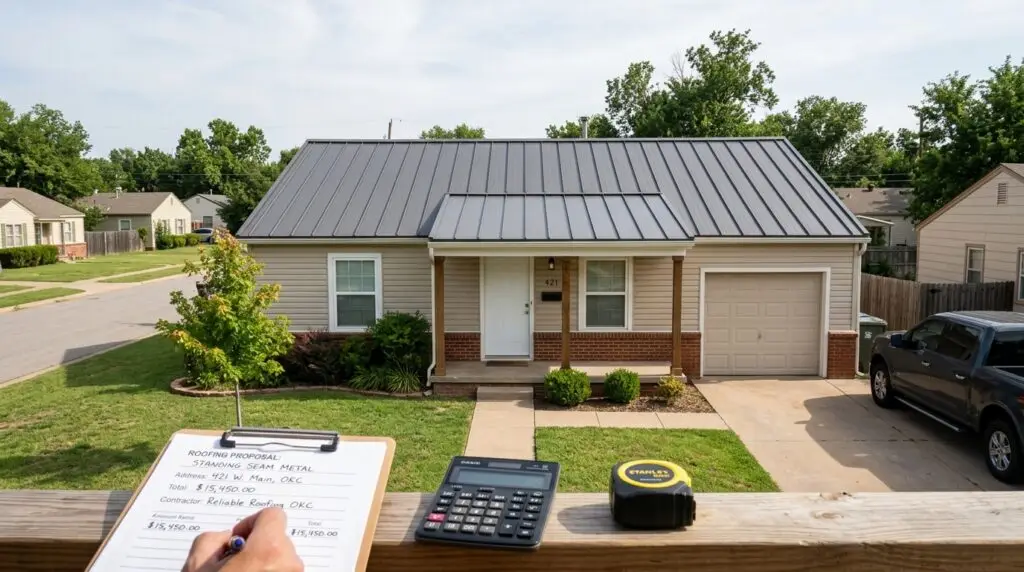
Standing seam metal roofing uses vertical panels with hidden fasteners, the screws are completely concealed beneath the panel locks. This design means there are no exposed screws to loosen in high-wind events. That’s a significant advantage in the northwest OKC corridor, Deer Creek, and Piedmont, where straight-line winds during storm season routinely test roofing systems hard.
Exposed-fastener panels (including corrugated metal) are more affordable and still represent a significant upgrade over standard asphalt. The tradeoff is that the fasteners are visible and can loosen over time, particularly in areas with frequent wind events. For homeowners in the OKC metro who want the performance benefits of metal at a lower entry price, exposed-fastener systems can still be a solid choice. The key is using the right sealant and having a contractor who understands Oklahoma-specific installation requirements.
How a Metal Roof Can Reduce Your Oklahoma Home Insurance Premiums
This is the section that most roofing websites either skip entirely or handle with a single vague sentence. Given what Oklahoma homeowners are paying for insurance right now, it deserves a lot more attention.
The Insurance Discount OKC Homeowners Often Don’t Know to Ask For
When your roof carries a UL 2218 Class 4 impact resistance rating, your insurer’s risk goes down. Fewer claims. Less severity when damage does occur. Many insurance carriers pass some of that reduced risk back to you in the form of a premium discount.
Most homeowners don’t realize that these discounts are available, or that they need to ask for them specifically. The trigger isn’t just “metal roof.” The trigger is the Class 4 impact rating. When you contact your insurer, ask specifically: “Do you offer a premium discount for UL 2218 Class 4 impact-rated roofing?” Then get the answer confirmed in writing before installation begins.
Discount amounts vary significantly by carrier. Some are modest. Some are meaningful. But even a consistent annual discount, compounded over the 40–70 year lifespan of a metal roof, adds up to a real number, and it works in your favor from day one.
ACV vs. RCV Policies: What Your Roof Claim Actually Pays Out
Between you and me, this is one of the most important things an Oklahoma homeowner can understand, and almost nobody talks about it.
When you file a hail damage claim on your roof, what your insurance pays out depends heavily on whether you have an Actual Cash Value (ACV) policy or a Replacement Cost Value (RCV) policy.
An ACV policy pays you the depreciated value of your old roof. If your asphalt shingles are 12 years into a 15-year lifespan, your payout reflects that age. You’ll receive significantly less than what it actually costs to replace the roof, and you’ll cover the gap out of pocket.
An RCV policy pays what it actually costs to replace the roof at today’s material and labor rates, regardless of the old roof’s age.
Here’s where metal roofing creates a long-term advantage: because metal depreciates so slowly, your position at claim time stays stronger for decades longer than it would with asphalt. Ask your insurer which policy type you have and whether switching makes sense. It’s a question worth a phone call.
The “Strengthen Oklahoma Homes” Program — Free Money Most Homeowners Miss
The Oklahoma Insurance Department runs a grant program called Strengthen Oklahoma Homes, designed specifically to help eligible homeowners upgrade to storm-resistant roofing materials. Qualifying homeowners have received meaningful financial assistance toward a new roof, money they didn’t have to pay back.
Most homeowners in the OKC area have never heard of it. If you’re considering a metal roof installation in Oklahoma City, it’s worth asking your contractor whether your property and zip code qualify. Contact our team to find out if your OKC home is eligible.
Metal Roof vs. Asphalt in Oklahoma: The Real Cost Over 50 Years
The upfront cost of metal roofing stops a lot of Oklahoma City homeowners before they ever get a quote. That’s understandable. But comparing sticker prices without accounting for how roofs actually perform in our climate is the most common, and most expensive, mistake homeowners make.
Why the Sticker Price Comparison Misleads You
Think about it this way. Asphalt shingles in Oklahoma need to be replaced roughly every 15–18 years given our climate conditions. Over a 50-year period, that means two or three complete re-roofing projects. Each one comes with material costs, labor costs, permit costs, and the disruption of a major home project.
A properly installed metal roof, on the other hand, is typically the last roof a homeowner ever installs. One project. One time. When you spread the total cost across those decades, the math shifts considerably.
What Metal Roofing Actually Costs in Oklahoma City
To give you a realistic picture: in the OKC metro area, standing seam metal roofing typically runs in the range of $900–$1,400 per square installed (a square equals 100 square feet of roof surface). Metal shingles and stone-coated steel generally fall in the $700–$1,000 per square range.
Your actual cost depends on several factors: roof size and pitch, the complexity of your roof design, the condition of the existing decking, and permit fees. Oklahoma City requires permits for roofing projects covering more than 500 square feet, which covers nearly every residential re-roof. Any contractor who suggests skipping the permit is a contractor to avoid. Unpermitted work creates problems at resale and can complicate future insurance claims.
Always request a line-item estimate that breaks out materials, labor, underlayment, and permits separately. A contractor who can’t provide that level of detail shouldn’t be installing your roof.
Financing Options OKC Homeowners Can Actually Use
The good news: you don’t have to write one large check. A number of financing routes are available to OKC homeowners:
- Contractor financing programs, many reputable local metal roofing contractors offer in-house financing or partnerships with third-party lenders
- Home equity loans or HELOCs, if you have equity built up, this typically offers the lowest interest rate option
- FHA Title I Property Improvement Loans, available for homeowners with limited equity
- Personal installment loans, faster approval but generally higher interest rates
Request a free metal roofing estimate and ask your contractor what financing options they can connect you with. The ROI case for metal in Oklahoma’s market is genuinely strong, and you don’t have to pay for it all upfront.
Oklahoma’s Heat Is Relentless — Here’s How a Metal Roof Fights Your Energy Bill
Oklahoma summers are no joke. When afternoon temperatures push into triple digits for weeks at a stretch, your roof is either working for you or against you. Asphalt absorbs that solar radiation and radiates it directly into your attic. Metal reflects it.
How Reflective Coatings Work in Oklahoma’s Summer Climate
Modern metal roofing panels are coated with finishes designed to reflect solar energy rather than absorb it. This keeps attic temperatures lower, which means your HVAC system doesn’t have to work as hard to maintain a comfortable interior temperature.
The impact is most significant on south-facing and west-facing roof sections, the surfaces that take the brunt of Oklahoma’s afternoon sun. Homeowners in Nichols Hills, Edmond, and the southwest OKC corridors have reported meaningful reductions in monthly energy costs after switching to metal roofing with reflective coatings.
Pairing Metal Roofing With Proper Insulation and Ventilation
Here’s the thing: metal alone isn’t a magic solution. The energy and acoustic performance of a metal roofing system depends significantly on how it’s installed. Proper underlayment, adequate attic ventilation, and appropriate insulation all work together with the metal panel to create a complete system.
This is also the answer to the noise question that comes up constantly: “Won’t a metal roof be loud when it rains?” With the right underlayment, particularly decoupled systems that create a gap between the panel and the deck, modern metal roofs are no louder than asphalt during rain events. Ask any contractor you’re evaluating specifically what underlayment system they use and why.
Standing Seam, Stone-Coated Steel, and Corrugated: Which Metal Roof Fits Your OKC Home?
Not every metal roof looks like a barn. The range of styles available today is genuinely broad, and the right choice depends on your home’s architecture, your budget, and your priorities.
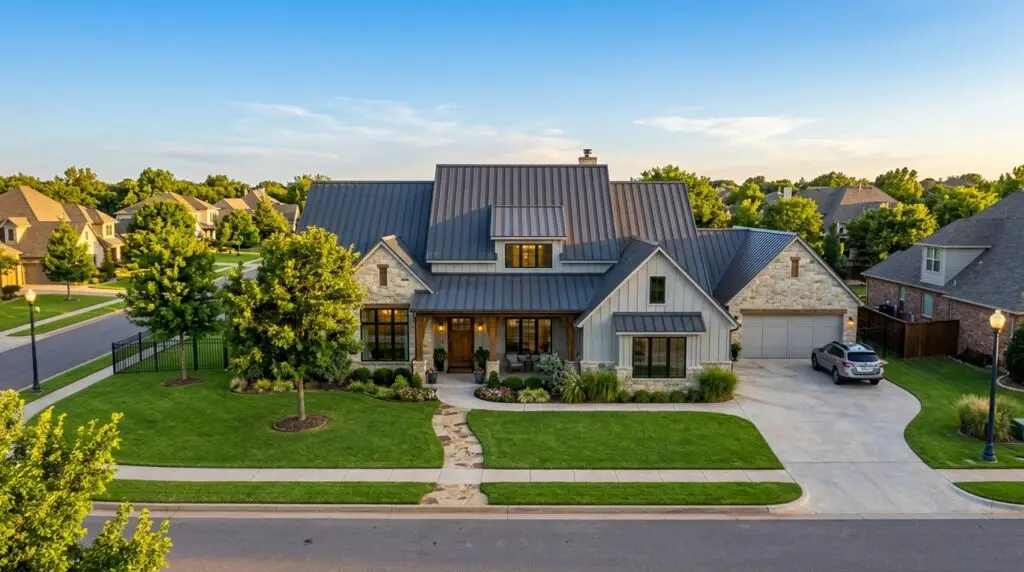
Standing seam metal roofing is the premium choice for storm performance and modern curb appeal. Clean vertical lines, hidden fasteners, and the strongest wind and hail performance available. It’s grown particularly popular in newer construction in Edmond, Deer Creek, and the higher-end neighborhoods of northwest OKC.
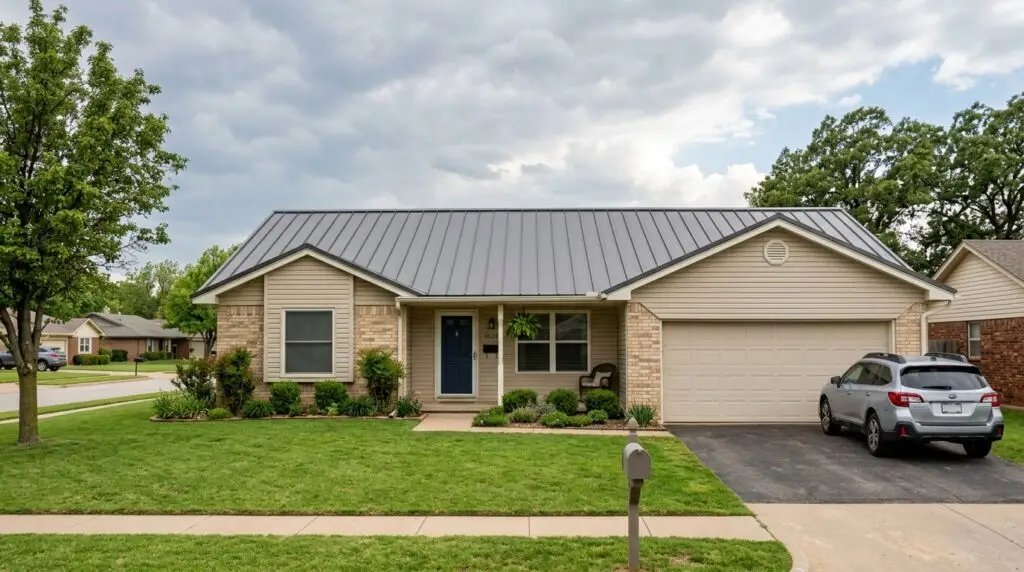
Stone-coated steel is the answer for homeowners who want the durability of metal without the industrial or modern look. Stone-coated panels are engineered to mimic the appearance of traditional tile, cedar shake, or architectural shingles. You get Class 4 impact performance wrapped in a familiar aesthetic. It’s a strong choice for homes in established neighborhoods where traditional roofing styles are the norm.
Corrugated metal panels are making a genuine comeback in residential design, particularly on homes with a farmhouse or industrial aesthetic in areas like Yukon, Mustang, and the rural OKC metro fringe. They’re the most affordable entry point into metal roofing and still represent a meaningful upgrade in longevity and storm resistance compared to asphalt.
What Oklahoma City Homeowners Should Expect During a Metal Roof Installation
Most homeowners have had asphalt shingles installed before. Metal roofing installation is a different process, and knowing what to expect helps you ask the right questions and catch problems early.
Questions to Ask Before Hiring a Metal Roofing Contractor in Oklahoma
Not every contractor who hangs a banner saying “metal roofing” has the experience to back it up. Before you sign anything, ask:
- Are you licensed with the Oklahoma Construction Industries Board?
- Will you pull the required permits for this project?
- Do you carry both liability insurance and workers’ compensation coverage?
- What’s the difference between your workmanship warranty and the manufacturer’s warranty?
- Do you have local references from projects in the OKC area I can contact?
These aren’t gotcha questions. Any reputable contractor will answer them without hesitation.
Red Flags That Signal a Problem Contractor
After a significant hail event in the OKC metro, out-of-state roofing crews descend quickly. Some are legitimate. Many are not. The warning signs are consistent:
- No physical Oklahoma address or verifiable license number
- Demanding a large cash deposit before materials are even ordered
- Quoting a price significantly below every other estimate you’ve received
- Pressure to sign immediately (“this price is only good today”)
- Suggesting you skip the permit to “save money”
A low bid often means cut-rate materials, unlicensed labor, or a contractor who won’t be around when you need warranty work done. Learn how to choose a qualified metal roofing contractor in Oklahoma City before you commit to anyone.
How to Maintain a Metal Roof in Oklahoma — It’s Simpler Than You Think
One of the most common concerns we hear from homeowners considering metal roofing is maintenance. The honest answer: it’s significantly simpler than maintaining asphalt.
Annual Metal Roof Maintenance Checklist
You don’t need a professional on your roof every year. But a basic annual check, particularly after Oklahoma’s spring storm season, goes a long way:
- Visual inspection after major hail events: look for cosmetic denting (normal) vs. lifted or separated panels (not normal)
- Keep gutters and valleys clear: debris buildup causes water to pond, which creates issues at roof penetrations over time
- Check sealant at penetrations: vents, chimneys, and pipe boots are the most common leak points on any roof, metal or asphalt
- Schedule a professional metal roof inspection every few years, and always after a storm large enough to generate widespread insurance claims in your area
What “Low Maintenance” Actually Means
Low maintenance doesn’t mean zero maintenance. It means metal roofing won’t develop the kind of progressive deterioration that asphalt does, no curling, no granule loss, no cracking from UV exposure. A quality metal roof won’t need replacement because of age-related wear. Issues that do arise are typically isolated and repairable.
Cosmetic denting from large hail is the most common thing homeowners worry about. It’s worth understanding: surface denting doesn’t compromise the waterproof integrity of the panel. Your roof can look like it took a beating and still be performing exactly as designed. That’s a fundamentally different situation than cracked or displaced asphalt shingles, where visible damage almost always means water infiltration risk.
Is a Metal Roof Right for Your Oklahoma Home? An Honest Decision Framework
We’re not going to tell every homeowner that metal is the right choice. It depends on several factors, and being honest about those factors serves you better than a sales pitch.
Metal Roofing Makes the Most Sense If…
- You plan to stay in your home for 10 or more years
- You’ve filed multiple hail damage claims on asphalt shingles and you’re tired of the cycle
- Your homeowners insurance premium has increased significantly in recent years
- You’re building new construction or doing a comprehensive renovation
- You want to maximize home value for the long term
When You Might Want to Consider Other Options
- You’re planning to sell within the next two to three years (the ROI timeline for metal requires staying in the home)
- Upfront cost is prohibitive and no financing options are accessible
- Your roof decking has structural issues that need to be addressed first, no roofing material performs well on a compromised substrate
The honest answer for most Oklahoma City homeowners who plan to stay in their homes long-term is that the financial and performance case for metal is genuinely strong in this market. Hail frequency, insurance costs, and Oklahoma’s thermal extremes all push in the same direction.
Ready to Get a Metal Roofing Estimate in Oklahoma City?
If you’ve read this far, you have a clearer picture of why so many OKC homeowners are making the switch, and whether it makes sense for your situation. The right next step is a professional on-site evaluation by a licensed Oklahoma contractor who understands local building codes, permit requirements, and the specific storm exposure your home faces.
We serve Oklahoma City and the surrounding communities including Edmond, Norman, Moore, Yukon, Mustang, Piedmont, Midwest City, Deer Creek, and Warr Acres. Our team provides free metal roofing inspections and estimates with honest, line-item quotes and no high-pressure sales tactics.
Schedule your free metal roofing inspection today and find out exactly what a metal roof would cost for your home, and what it could save you over the long run.
Frequently Asked Questions About Metal Roofing in Oklahoma
How long does a metal roof last in Oklahoma?
A properly installed metal roof in Oklahoma typically lasts 40–70 years, significantly longer than asphalt shingles, which realistically need replacement every 15–18 years in Oklahoma’s climate due to hail exposure, UV intensity, and extreme temperature cycling.
Does a metal roof lower homeowners insurance in Oklahoma?
Many insurance carriers offer premium discounts for metal roofs that carry a UL 2218 Class 4 impact resistance rating. Discounts vary by carrier, so ask your insurer specifically about Class 4 impact-rated roofing credits before installation, and get any discount confirmed in writing.
How much does a metal roof cost in Oklahoma City?
In the OKC metro, standing seam metal roofing typically runs $900–$1,400 per square installed. Metal shingles and stone-coated steel generally fall in the $700–$1,000 per square range. Your total cost depends on roof size, pitch, complexity, and decking condition. Always request a line-item estimate that includes permits and underlayment.
Is metal roofing loud when it rains or hails in Oklahoma?
With proper underlayment and insulation, modern metal roofing systems are no louder than asphalt during rain or hail. The key is correct installation, including decoupled underlayment systems, which effectively eliminates the “tin roof” noise concern most homeowners have.
What type of metal roofing holds up best to Oklahoma hail?
Standing seam metal roofing with a UL 2218 Class 4 impact rating performs best in Oklahoma’s hail-prone environment. The hidden fastener design prevents screw loosening in high-wind events, and the panel system maintains its waterproof integrity even after cosmetic denting from large hail.
How do I verify that a metal roofing contractor in OKC is legitimate?
Verify licensing through the Oklahoma Construction Industries Board, confirm they will pull required permits, request proof of liability insurance and workers’ compensation coverage, and ask for local OKC-area references. Be cautious of out-of-state storm chasers who appear after major hail events.
Can metal roofing be installed over existing asphalt shingles in Oklahoma?
In some cases, yes, but most reputable OKC contractors recommend full removal first. Complete tear-off allows inspection of the decking for hail or moisture damage and ensures proper underlayment installation, both of which are critical given Oklahoma’s weather conditions.