If you’ve lived in the Oklahoma City area for more than one spring season, you already understand what’s at stake when the sirens go off. The question isn’t whether a severe storm will hit, it’s whether your roof will still be there when it’s over.
More OKC homeowners are turning to metal roofing for tornado and wind resistance than ever before. And for good reason. But there’s a lot of noise out there, and most of what’s being written about metal roofing is generic content that could apply to any state. This article isn’t that. This is written specifically for homeowners in Oklahoma City, Moore, Edmond, Midwest City, Yukon, Del City, and the surrounding communities who face a roofing challenge that most of the country simply doesn’t.
Let’s cut through the marketing and talk about what actually matters.
Why Oklahoma City Homeowners Face a Different Roofing Risk Than Most of the Country
Oklahoma City doesn’t just sit in Tornado Alley, it sits at the intersection of Tornado Alley and what meteorologists often call Hail Alley. That’s not a tagline. It’s a geographic reality that should shape every roofing decision you make.
Living in the Tornado Alley Crosshairs — OKC’s Storm Reality
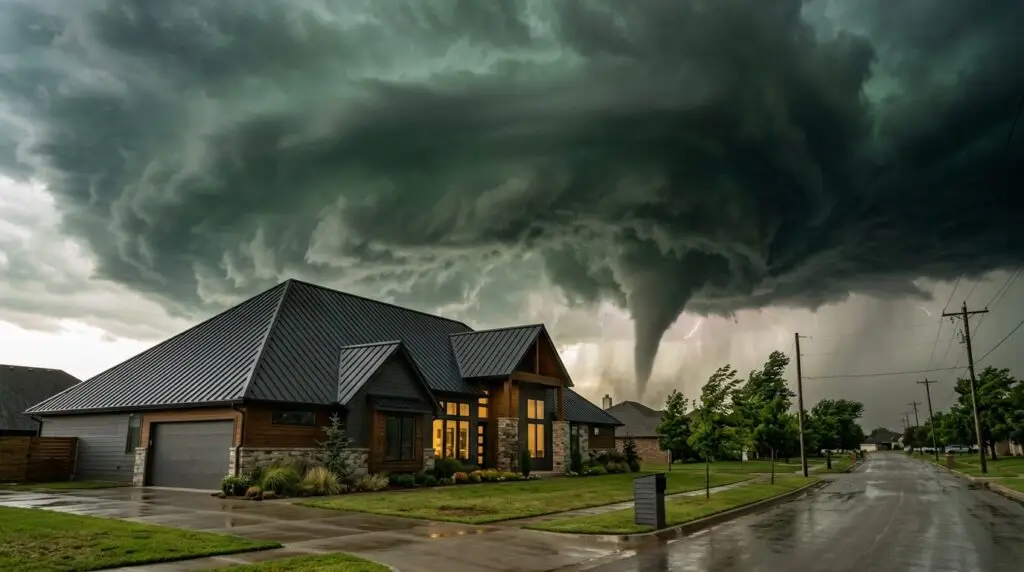
The communities south and east of OKC, Moore, Del City, Midwest City, have been hit by significant tornado events more than once in living memory. The 1999 Bridge Creek–Moore tornado is a reference point most longtime Oklahomans carry with them. It wasn’t just a historic storm. It was a reminder that this region demands a different standard of home protection.
Spring tornado season runs roughly March through June in central Oklahoma, with the peak typically falling in May. But severe straight-line wind events, the kind that peel shingles off in sheets without a tornado in sight, happen throughout the year. That combination of rotating and straight-line wind threats makes Oklahoma City’s roofing environment genuinely unique.
How Oklahoma’s Weather Destroys Ordinary Roofs Faster Than Anywhere Else
Here’s something most homeowners don’t realize: asphalt shingles that might last 25 to 30 years in a moderate climate often fail within 12 to 18 years in the OKC metro. The culprit isn’t any single storm, it’s the cumulative beating. Every spring hail event strips granules from the surface. Every summer UV cycle breaks down the mat underneath. Every freeze-thaw swing in January and February opens microscopic cracks.
By the time you see the damage from the ground, you’re often already 3 to 5 years past the point where quiet deterioration began.
And there’s a financial layer on top of the physical one. Oklahoma homeowners carry some of the highest home insurance premiums in the country, roofing material choice directly affects what you pay, and in some cases, whether you can get coverage at all.
How Metal Roofing for Tornado and Wind Resistance Actually Works
Most articles stop at “metal roofs are rated for 140 mph winds.” That’s true, but it tells you almost nothing about why, or about the conditions where it matters most. Let’s go a level deeper.
Wind Uplift — The Force That Actually Lifts Roofs Off Homes
When wind accelerates over the surface of a roof, it creates low pressure above the roof and higher pressure below it. That pressure difference doesn’t push the roof sideways, it tries to pull it upward. This is called wind uplift, and it’s the primary force responsible for roof failures during tornado and high-wind events in Oklahoma.
The tricky part: uplift is not evenly distributed. The edges, ridges, eave overhangs, and corners of your roof experience significantly higher uplift forces than the center field of the roof. Those are the zones where failures start, a lifted edge becomes a leading edge, and from there the wind does the rest.
Most homeowners assume that if a roofing material is rated for high wind, the roof is protected. But the rating only applies when the entire system, panel, fastener, underlayment, deck, and truss attachment, is installed correctly and working together. A roof can fail at 80 mph even if the panel is rated for 140, because the failure point is almost always the connection, not the material itself.
How Metal Roofing Systems Are Engineered to Resist Uplift
Metal roofing for tornado and wind resistance is engineered differently than other roofing systems, and the differences are meaningful.
Standing seam metal panels attach to the roof deck through concealed clips, not screws driven through the surface of the panel. Those clips allow the panel to expand and contract with temperature changes without loosening over time. More importantly, they create a continuous, secure attachment along the full length of every panel.
The panels themselves interlock at their seams, which means wind has nowhere to grab. There are no exposed edges flapping in the breeze, no lifted tab corners, no granule-depleted sections where the wind can find purchase. Fewer individual pieces also means fewer potential failure points, a standing seam roof has dramatically fewer seams and attachment points than a roof covered with thousands of individual shingles.
The roof deck, typically OSB or plywood, and its attachment to the truss system matters equally. A strong metal panel on a poorly secured deck is still a vulnerable roof. This is why experienced OKC contractors talk about roofing as a system, not just a material choice.
What Wind Ratings on Metal Roofing Actually Mean — and What They Don’t
This is one of the areas where homeowners get misled the most. Not by dishonest contractors, but by the way ratings are often presented without context.
Understanding Tested Wind Speed vs. Real-World Performance
Standard residential metal roofing systems are tested to withstand wind speeds in the range of 130 to 140 mph under controlled laboratory conditions. Engineered standing seam systems in high-risk zones can be specified to perform at wind speeds exceeding 160 mph. Some specialized systems are rated even higher.
Here’s the thing: those numbers come from testing a specific assembly, a specific panel, attached with specific clips, to a specific deck, at specific fastener spacings. When any of those variables change during installation, the real-world performance changes with them.
It’s also worth understanding where Oklahoma City tornadoes typically fall on the Enhanced Fujita scale. An EF2 produces winds of 111 to 135 mph. An EF3 reaches 136 to 165 mph. The majority of tornado events in the OKC metro fall in the EF0 to EF2 range, which is exactly where properly installed metal roofing delivers meaningful protection over asphalt alternatives. No material survives a direct EF5 strike intact, and anyone who tells you otherwise is selling you something.
The Label Doesn’t Tell the Whole Story — What to Ask Your Contractor
Before you sign off on a metal roofing installation, ask for the specific tested assembly, not just a product brochure claim. You want the panel, the clip system, the underlayment, and the deck attachment method to all match what was tested at the rated wind speed.
Ask about gauge. A 24-gauge steel panel and a 29-gauge panel carry very different performance profiles under both wind load and hail impact, even if both are sold as “metal roofing.” In our experience, this is one of the most common areas where homeowners get a quote that sounds reasonable on paper but doesn’t reflect what they think they’re getting.
Standing Seam vs. Exposed Fastener Metal Roofing — Which One Holds Up in a Tornado Corridor?
For OKC homeowners specifically, this is often the most important decision in the entire metal roofing selection process.
Why Standing Seam Is the Standard Recommendation for OKC Storm Zones
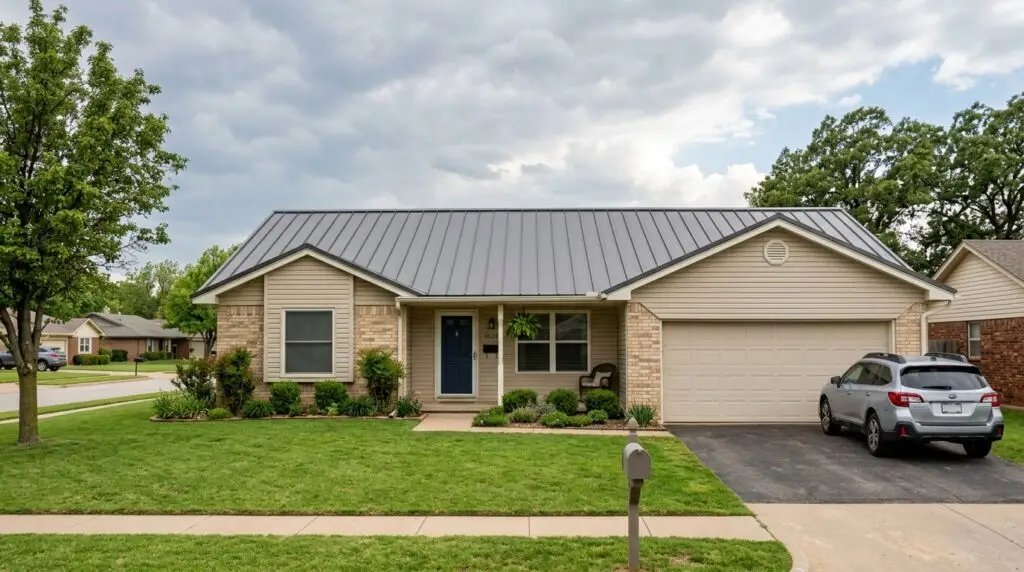
Standing seam metal roofing is the system we see perform consistently well in Oklahoma’s storm environment. The concealed clip attachment eliminates the exposed screw heads that represent the primary vulnerability of standard exposed-fastener systems. There are no rubber washers to degrade under Oklahoma’s summer UV exposure. There are no screw penetrations for hail to compromise or wind-driven rain to exploit.
Standing seam also tends to qualify for Oklahoma’s FORTIFIED Roof program, a voluntary re-roofing standard supported by the Oklahoma Insurance Department that is specifically designed to strengthen homes against hail and high winds. Qualifying roofs may be eligible for homeowners insurance premium discounts from participating carriers. That’s not a minor footnote, over the life of a metal roof, those discounts can meaningfully offset the higher upfront investment.
For homeowners in Moore, Del City, and Midwest City, the communities with the highest historic tornado frequency in the OKC metro, standing seam is the recommendation we make most consistently.
Where Corrugated and Exposed Fastener Panels Still Make Sense
Between you and me, corrugated and exposed-fastener systems have their place. They’re well-suited for outbuildings, shops, agricultural structures, and residential applications where budget is the binding constraint. They can perform reasonably well in wind if installed correctly.
The key difference is maintenance. Exposed fasteners require periodic inspection after Oklahoma’s storm seasons because thermal expansion and contraction cycles, and we get significant temperature swings here, from 105-degree July days to ice storms in February, gradually work the fasteners loose. If you go this route, build that inspection step into your annual routine. A loose fastener that goes unchecked is a future leak point.
Steel Gauge, Coatings, and Hail Impact Ratings — Choosing the Right Material for Oklahoma’s Storm Season
Material selection for Oklahoma City isn’t about finding the cheapest metal option. It’s about matching the material to the specific threats this region produces.
Gauge Selection for Oklahoma’s Hail Frequency
The OKC metro sits in one of the most hail-active corridors in North America. Golf ball-sized hail is not unusual during peak spring storm season. Baseball-sized hail, while less common, happens here. Gauge selection should reflect that reality.
Most experienced OKC metal roofing contractors recommend a minimum of 26-gauge steel for standing seam systems. For homeowners who want maximum hail resilience, 24-gauge is the stronger choice. It’s thicker, more impact-resistant, and better equipped to handle repeated severe hail events over the life of the roof.
At 29-gauge, common in lower-cost exposed-fastener systems, visible denting from large hail is a realistic outcome. That may or may not affect your insurance position depending on your policy, but it’s something to factor in before selecting a system.
UL 2218 Class 4 — The Hail Impact Rating That Matters for Oklahoma Insurance
UL 2218 Class 4 is the highest available hail impact rating. It means the roofing product has been tested by dropping a 2-inch steel ball from 20 feet without cracking or fracturing the material. In most markets, Class 4 is a premium consideration. In Oklahoma City, it’s the standard you should require, not an upgrade.
Why? Because many Oklahoma insurance carriers offer premium discounts specifically for Class 4 impact-rated roofing. The exact discount varies by carrier and policy, but it’s worth having that conversation with your insurance agent before you finalize your material selection. What you learn may influence which system makes the most financial sense for your specific situation.
One more note on coatings: Galvalume steel offers superior corrosion resistance compared to standard galvanized steel, making it the better long-term choice for Oklahoma’s climate, which delivers both extended dry periods and intense, humid storm seasons.
Installation Is Where Wind Resistance Is Won or Lost
In our experience, this is the most underappreciated aspect of the entire metal roofing decision. You can specify the right system and still end up with a vulnerable roof if installation quality doesn’t match material quality.
The Roof Deck Is Your First Line of Defense
The panel is the most visible part of a metal roofing system. But the roof deck, and its attachment to the truss system, is the foundation everything else depends on. Even the best standing seam panel fails if the deck beneath it isn’t properly secured.
On older Oklahoma City homes, neighborhoods like Capitol Hill, Bethany, and parts of Midwest City have significant housing stock from the mid-20th century, deck condition and truss connections deserve close attention before a new metal roof goes on. A quality contractor will inspect the deck before installation begins and document any repairs needed, not skip over them to keep the bid number low.
Oklahoma City requires permits for most full metal roof replacements. That’s not a bureaucratic inconvenience, it’s a layer of accountability that ensures inspections happen and installation meets code. Any contractor who suggests skipping the permit process should be disqualified immediately.
Red Flags to Watch for When Hiring a Metal Roofing Contractor in OKC
After a significant hail event hits the OKC metro, the landscape changes overnight. Contractors from out of state flood the area. Aggressive door-to-door soliciting ramps up. Promises of “free roofs through insurance” become the standard sales pitch.
Most homeowners don’t realize that accepting the first post-storm quote, especially during peak demand, often means paying inflated pricing and working with contractors who won’t be around for warranty claims. Take time to verify that any contractor you consider is licensed and insured in Oklahoma. Ask for references from local jobs. Get two to three detailed, line-item written quotes that specify gauge, manufacturer, panel system, coating, underlayment type, and warranty terms.
A quote for a 29-gauge corrugated panel is not comparable to a quote for a 24-gauge standing seam system. Without the line-item detail, you can’t make a real comparison, and some contractors count on that.
What Metal Roofing Costs in Oklahoma City — and Why the Range Is Wide
It depends on several factors, and the honest answer is that national average calculators don’t apply particularly well to the OKC market.
Realistic Cost Ranges for OKC Metal Roofing Projects
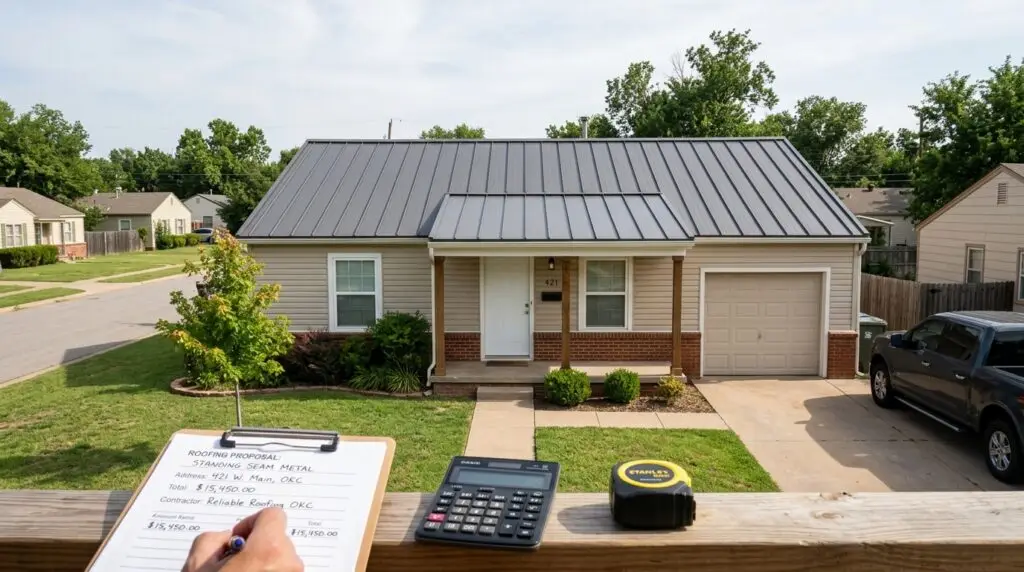
Installed metal roofing in the Oklahoma City area typically runs somewhere in the range of $8 to $18 per square foot, depending on the system type, roof complexity, pitch, and current labor availability. For a typical OKC home, that translates to a total project investment ranging from roughly $15,000 on the lower end to $45,000 or more for larger homes with premium standing seam systems.
Corrugated and exposed-fastener systems sit at the lower end of that range. Standing seam with premium coatings sits at the higher end. Stone-coated steel, which mimics the look of traditional shingles, tile, or wood shake while delivering metal performance, typically falls in the middle tier.
Factors That Drive Cost Higher in the OKC Market Specifically
Post-storm labor demand is real. After a major hail event, contractor availability tightens and pricing reflects that. If you’re not working against an insurance deadline, waiting a few weeks for the immediate post-storm rush to settle before finalizing quotes can make a meaningful difference.
Specialty standing seam panels sometimes require 3 to 6 weeks of fabrication lead time from certain manufacturers, particularly for custom colors or profiles. If your insurance claim has a deadline, that timeline needs to factor into your contractor conversations early.
And if your home has structural or decking repairs needed before installation, which is common in older OKC neighborhoods, budget for those as legitimate additions to the project, not contractor padding.
Oklahoma’s FORTIFIED Roof Program and the Insurance Discount Most Homeowners Don’t Know About
This is one of the most practical financial considerations in the entire metal roofing decision for Oklahoma homeowners, and it’s consistently underexplained.
Oklahoma’s FORTIFIED Roof program is a voluntary re-roofing standard developed specifically to strengthen homes against hail and high winds. It’s supported by the Oklahoma Insurance Department. Homes that receive FORTIFIED designation may qualify for homeowners insurance premium discounts from participating carriers.
Here’s what most homeowners don’t know: not every metal roof automatically qualifies. The installation has to meet specific FORTIFIED specifications, including requirements around sealed roof decks, drip edge installation, and fastener patterns. It’s a conversation worth having with both your contractor and your insurance carrier before the project begins. Getting the designation as part of your installation is far easier than trying to certify it retroactively.
For homeowners in neighborhoods with HOA requirements, Edmond, Piedmont, Nichols Hills, The Village, standing seam in a low-profile, matte finish typically satisfies aesthetic approval requirements. Stone-coated steel is another option that passes HOA review in most deed-restricted communities because it mimics the appearance of traditional roofing materials.
Maintenance After Oklahoma Storm Seasons — What Metal Roof Owners Should Do Every Year
Metal roofing is low-maintenance compared to asphalt. It is not zero-maintenance, and in Oklahoma, that distinction matters.
Annual Inspection Priorities for OKC Metal Roof Owners
After each spring storm season, inspect the following: on exposed-fastener systems, check that fasteners are still snug, thermal cycling loosens them over time. On any system, check sealants at all penetrations: pipe boots, vents, chimneys. These are the most common leak points on any roof, metal or otherwise.
Inspect ridge caps and panel edges for any signs of uplift or separation after high-wind events. Even a well-installed roof can experience minor issues after an extreme event. Catching them early, before water intrusion begins, is the difference between a minor service call and a significant interior repair.
Metal roofs shed debris more effectively than textured asphalt surfaces. But debris can still accumulate in valleys and around penetrations, trapping moisture. Clear it after major storm events.
What a Metal Roof Cannot Protect Against — Setting Realistic Expectations
No roofing material is tornado-proof against a direct EF4 or EF5 strike. If a tornado of that magnitude makes a direct hit on a structure, the roof is the least of the building’s problems. That’s not a knock on metal roofing, it’s the honest truth.
What metal roofing for tornado and wind resistance actually delivers is meaningful protection across the EF0 to EF2 range, the range that accounts for the vast majority of tornado events in the Oklahoma City area. It delivers superior performance against the hail, wind-driven rain, and debris impacts that accompany those events. And it delivers that protection consistently, year after year, rather than degrading with each storm season the way asphalt does.
That’s the real value proposition: not an invincible roof, but a dramatically more resilient one.
Frequently Asked Questions
Is metal roofing good for tornadoes in Oklahoma?
Yes. Standing seam metal roofing is one of the strongest options for tornado-prone areas like Oklahoma City. These systems are tested to resist wind speeds of 130 mph and above, with engineered systems exceeding 160 mph. Metal roofing significantly outperforms asphalt shingles across the EF0–EF2 wind range that represents the majority of Oklahoma tornado events.
What is the best type of metal roof for OKC wind resistance?
Standing seam metal roofing. Its concealed clip attachment eliminates exposed fasteners, the most common failure point in high-wind events, and its interlocking panels give wind nowhere to grab. For homeowners in Moore, Del City, and Midwest City, standing seam is consistently the top recommendation.
Does metal roofing qualify for insurance discounts in Oklahoma?
Many Oklahoma insurance carriers offer premium discounts for Class 4 UL 2218 impact-rated metal roofing. Oklahoma’s FORTIFIED Roof program can also make qualifying homes eligible for further discounts. Contact your carrier before selecting a system, what you learn may influence your final decision.
What gauge metal roofing should I use in Oklahoma City?
For standing seam systems in the OKC metro, 26-gauge steel is the recommended minimum. For maximum hail resilience, appropriate given OKC’s frequent large hail events, 24-gauge is the stronger choice. Avoid 29-gauge for primary residential roofing in this market.
How much does metal roofing cost in Oklahoma City?
Installed metal roofing in OKC typically ranges from about $8 to $18 per square foot depending on system type, roof complexity, and current market conditions. Total project costs for most OKC homes fall between $15,000 and $45,000 or more for premium standing seam. Avoid committing to quotes during the immediate post-storm rush when prices can spike.
Will a metal roof survive a direct tornado hit?
No roofing material survives a direct EF4 or EF5 strike intact. Metal roofing delivers meaningful protection in the EF0–EF2 range, the most common tornado intensity in central Oklahoma, and performs significantly better than asphalt in wind, hail, and debris impacts. Proper installation is as critical as material selection.
Is metal roofing noisy during hailstorms?
A properly installed metal roof with solid decking, insulation, and sound-deadening underlayment is not noticeably louder than an asphalt roof during rain or hail. The noise concern applies primarily to thin, uninsulated metal on open structures like barns, not to residential metal roofing installed to current standards.