If you own or manage a commercial property in the Oklahoma City metro, you already know what spring storm season feels like. One week it’s calm. The next, you’re watching hail the size of quarters pelt your roof from a nearly horizontal angle while 70 mph straight-line winds push through the I-35 corridor. Your roof is the only thing between your business, your inventory, and all of it.
Standing seam roofing for commercial properties has become the system of choice for building owners who are done playing defense, done patching, recoating, and watching a membrane system age out before the mortgage does. But it’s not right for every building, and it’s not a small investment. Before you sign anything, here’s what you actually need to know.
What Is Standing Seam Roofing and Why Does It Matter for Commercial Buildings?
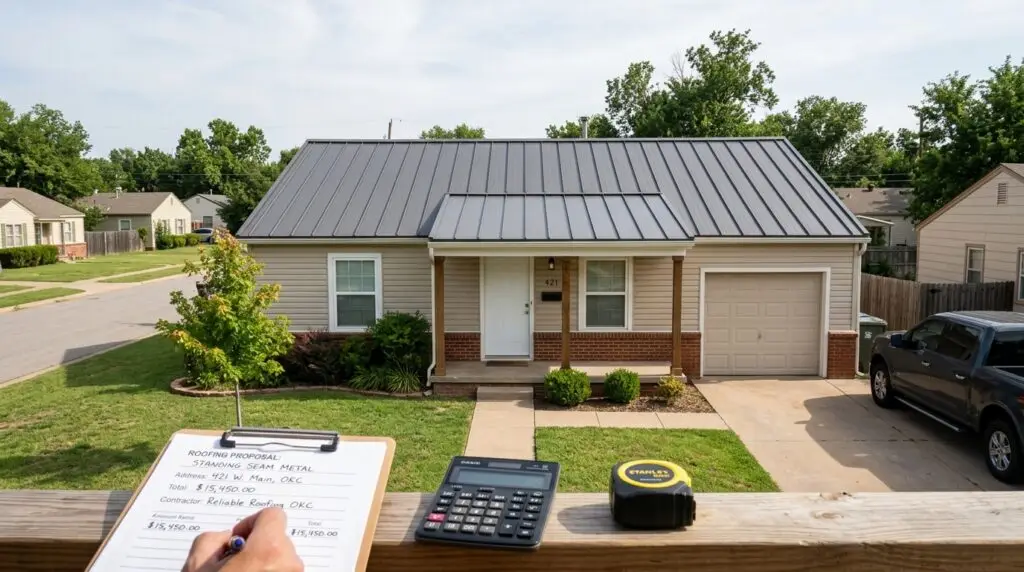
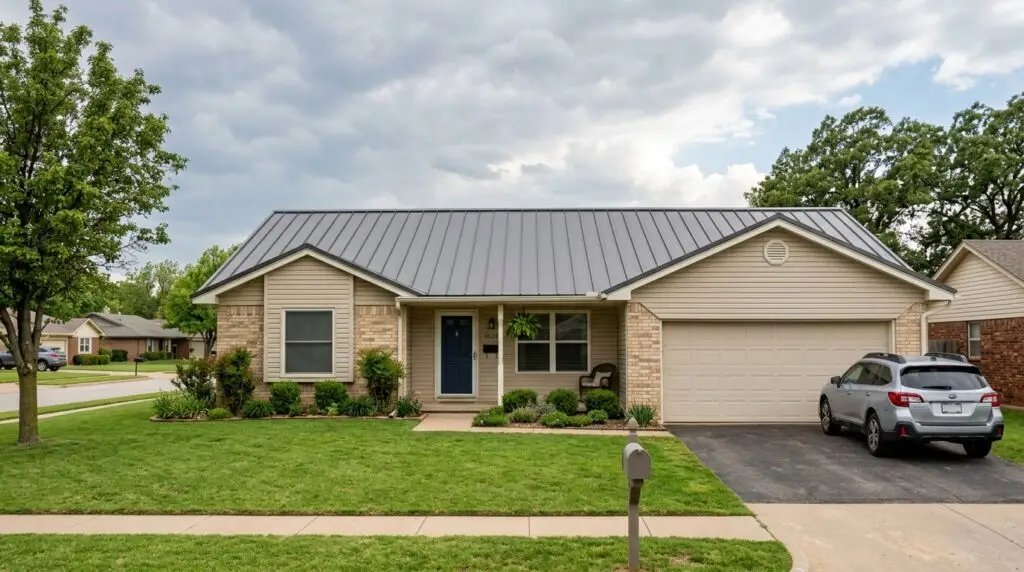
Most people have seen standing seam metal roofing without knowing the name. The panels run vertically down the roof slope, and where two panels meet, the edges fold upward and interlock to form a raised seam, that seam stands above the flat panel surface. That’s it. Simple concept, significant engineering behind it.
Here’s the thing that separates it from most other commercial roofing systems: the fasteners are completely hidden. On a standard exposed-fastener metal roof, screws punch through the top of the panel and sit exposed to weather, sealed by rubber washers. Those washers crack, dry out, and fail, especially in a climate like Oklahoma City’s, where the temperature swings between 100°F summers and single-digit winters on a yearly basis.
Standing seam uses concealed clips that slide along the inside of the seam. The panels are mechanically locked together, and there are no screw heads sitting on the roof surface for hail to dent, for UV to degrade, or for wind uplift to exploit.
Structural vs. Architectural Standing Seam — Which Applies to Your Building?
This distinction matters and almost never gets explained clearly in commercial roofing conversations.
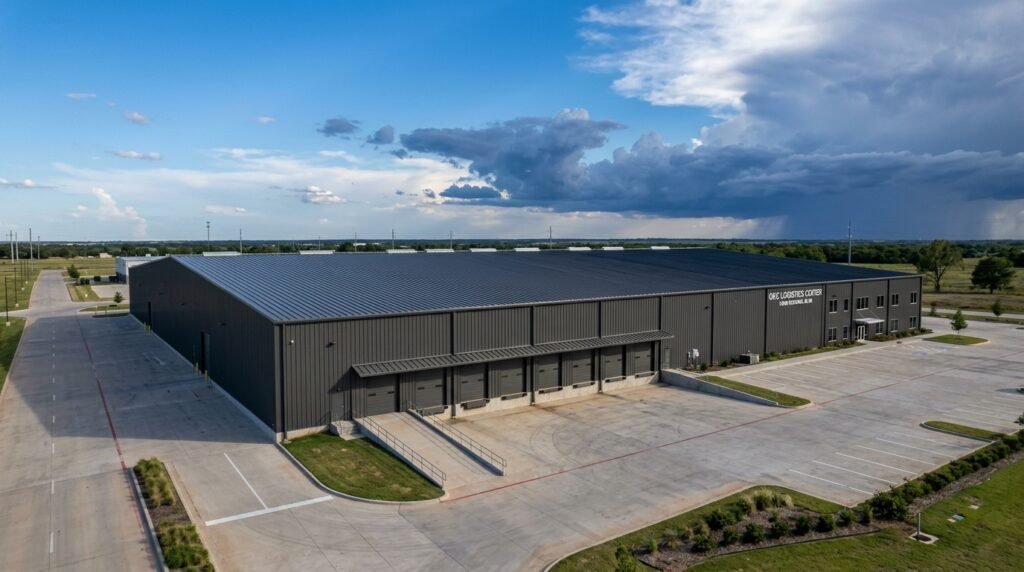
Structural standing seam can span open framing without a solid roof deck underneath. This is the system used on warehouses, metal buildings, distribution centers, and manufacturing facilities, the kind of buildings that have open bar-joist framing where installing a full roof deck would add significant cost and weight.
Architectural standing seam requires a solid substrate, typically plywood or OSB decking, underneath the panels. This is the system you’d see on retail buildings, office parks, churches, and schools.
If a commercial roofing contractor pitches you without asking which type of framing your building has, that’s a red flag worth noting.
Why Oklahoma City’s Climate Makes This System Worth Serious Consideration
We’re going to be direct about this: there are parts of the country where the argument for standing seam over a quality TPO membrane is mostly aesthetic. Oklahoma City is not one of those places.
What “Tornado Alley” Actually Means for a Commercial Roof
Oklahoma City sits near the center of one of the most storm-active corridors in North America. The supercell thunderstorms that develop here don’t just produce vertical hail. The rotational dynamics and sustained high winds drive hail at steep horizontal angles, sometimes nearly parallel to the ground. That changes everything about where your roof is vulnerable.
Vertical hail lands on the flat surface of a panel. Wind-driven hail hits seams, flashing edges, parapet walls, and fastener locations with concentrated force. These are already the highest-stress points on any roofing system. Add 60 mph winds driving ice at those exact spots, and the physics get complicated fast.
Standing seam handles this better than exposed-fastener systems because the mechanical attachment points are inside the seam, not sitting exposed on top of the panel. The seams themselves are designed to flex and absorb lateral stress rather than transfer it to a screw shank.
Areas like Moore, Midwest City, south Oklahoma City, and the I-35 corridor have historically seen some of the metro’s most severe weather events. If your commercial building sits in those areas, the wind uplift and impact performance specs of your roofing system genuinely matter.
Thermal Cycling in Oklahoma: Often Overlooked, Always Damaging
Here’s something most building owners don’t think about until it’s too late: thermal cycling is a slow killer for commercial roofing systems.
Oklahoma City regularly sees temperature swings exceeding 90°F between seasons, sometimes 50°F within a single day during spring. Metal expands in heat and contracts in cold. On a large commercial roof spanning tens of thousands of square feet, that movement adds up. An exposed-fastener system handles that movement by letting the panel flex against the screw shank, which fatigues the metal around the fastener over time and eventually creates a leak pathway.
A properly specified standing seam system handles thermal movement by design. The floating clips allow panels to slide slightly along the seam without transferring stress to the fasteners. That’s not a marketing claim, it’s mechanical engineering. In our experience, it’s one of the most underappreciated advantages of the system on large commercial applications where thermal movement is amplified.
Commercial Properties in OKC That Benefit Most From Standing Seam
Not every commercial building is a natural fit for standing seam roofing. Here’s an honest breakdown.
Good candidates:
- Warehouses and distribution centers (particularly in south OKC and the Tinker AFB logistics corridor), structural standing seam spans their open framing without a deck
- Retail strip centers and larger commercial buildings along Memorial Road and the I-240 corridor, sloped canopy roofs and main structures perform well
- Office buildings and medical facilities in Edmond, Nichols Hills, and along NW Expressway, architectural standing seam handles longer ownership cycles better than repeated membrane replacement
- Churches and educational facilities, large roof spans, institutions that want a 40+ year system rather than a 15-year replacement cycle
- Industrial and manufacturing buildings, structural standing seam is essentially purpose-built for this
Less ideal candidates:
- Flat commercial roofs with zero or near-zero slope, membrane systems (TPO, EPDM) are engineered for these and are the appropriate choice
- Buildings where budget constraints are severe and short-term performance is acceptable, standing seam has a higher upfront cost; that needs to be acknowledged honestly
Real Cost Factors for Commercial Standing Seam Roofing in Oklahoma City
The question every commercial property owner asks first is: what does it cost? The honest answer is that it depends on several factors, and any contractor who quotes a flat per-square-foot number before seeing your building isn’t being rigorous enough.
What Drives Price on a Commercial Install
Panel gauge. This one matters more in Oklahoma than in most states. 24-gauge steel is meaningfully thicker and more impact-resistant than 26-gauge. For OKC’s hail environment, 24-gauge is the appropriate commercial specification. Specifying 26-gauge to save money is a decision that tends to look bad after the first significant hail event.
Panel width. Wider panels cover more square footage per seam, which reduces labor hours. Narrower panels have a more traditional aesthetic but cost more to install. For large commercial roofs where labor is a major cost driver, this is worth discussing with your contractor.
Roof complexity. A simple gabled warehouse roof is significantly less expensive to outfit than a retail building with multiple slopes, HVAC curb penetrations, skylights, drains, and parapet walls. Every penetration requires detailed flashing work, and flashing is where most failures originate.
Tear-off vs. recover. Installing over an existing membrane system (if structurally sound and code-permissible) can save meaningful cost. Full tear-off gives you a clean deck inspection and typically better long-term performance. Your contractor should evaluate both options honestly.
Business operations coordination. An occupied commercial building requires phased installation, daily cleanup, and careful scheduling around tenants or operations. This adds planning time that gets reflected in the project cost.
How to Think About Long-Term Value
Between you and me, the commercial property owners who fixate exclusively on upfront cost often end up spending more over a 20-year period than the ones who invested in a quality system at the start.
A standing seam metal roof at 40+ years of service life versus a TPO membrane that requires significant maintenance and eventual replacement within 15–25 years is a different math problem than the initial quotes suggest. Add in reduced business disruption from fewer roof-related emergencies, potential insurance premium advantages from Class 4 impact ratings, and HVAC cost reductions from reflective cool-roof coatings, the lifecycle cost comparison often looks quite different from the upfront numbers.
Storm Damage, Hail, and Insurance Claims on Commercial Metal Roofs
This section is the one most commercial roofing articles skip entirely. It shouldn’t be skipped, because in Oklahoma City, storm damage and insurance claims are a near-certain part of owning commercial property for more than a decade.
What Actually Happens During an Oklahoma Hailstorm
Standing seam metal roofing generally survives Oklahoma hailstorms in better condition than competing systems. However, that doesn’t mean you don’t need a post-storm inspection.
24-gauge standing seam panels can show cosmetic denting from significant hail impacts, visible marks that don’t affect waterproofing. That’s different from functional damage. Functional damage on a standing seam commercial roof typically shows up at the highest-stress locations: flashing around HVAC curbs and penetrations, parapet cap metal, eave edges, and clip attachment areas. These can absorb impact and movement stress that isn’t visible from a ground-level walkthrough.
Large commercial roofs also experience cumulative storm stress differently than residential roofs. Even when panels look intact from below, repeated storm events over multiple seasons can compromise seam integrity and clip attachment. That’s why post-storm professional inspection matters, not because we expect to find obvious damage, but because the damage worth finding usually isn’t obvious.
The Insurance Claim Conversation
Oklahoma insurers increasingly distinguish between cosmetic damage and functional impairment when processing metal roof claims. Cosmetic denting alone may not trigger a covered claim under some commercial policies. Functional damage, anything affecting water management, structural attachment, or coating integrity, generally does.
The documentation you have before and after a storm matters significantly on commercial claims. A contractor who understands this process, who photographs conditions before damage occurs and documents post-storm findings thoroughly, is a genuine asset during a large commercial claim.
It’s also worth a direct conversation with your insurance carrier before final material selection. In Oklahoma, Class 4 impact-rated metal roofing may qualify for premium discounts that meaningfully offset the system’s higher upfront cost. The FORTIFIED™ Roof program, backed by the Oklahoma Insurance Department, provides a certification pathway worth understanding, particularly for commercial properties in high-exposure areas.
The Commercial Installation Process: What to Expect as a Business Owner
Installing standing seam roofing on an occupied commercial building is a different undertaking than a residential project. The scale, complexity, and business-continuity considerations require a different level of project management.
Pre-Installation Requirements
Before a panel goes on, a quality commercial contractor should complete a structural assessment of your existing roof deck or framing, particularly on older buildings. Metal adds weight, and existing decking needs to be confirmed sound before the new system goes on top of it.
Permitting is non-negotiable, and it varies across the OKC metro. Oklahoma City, Edmond, Moore, Norman, and Midwest City each maintain their own permitting processes and inspection requirements. A contractor operating without permits on a commercial building is putting your occupancy certificate at risk. Make sure this is discussed explicitly before work begins.
HVAC coordination matters more on commercial roofs than residential. Rooftop mechanical units require custom curb flashings, and this work needs to be planned in concert with your HVAC contractor, not treated as an afterthought when the metal crew encounters it mid-installation.
What Good Installation Looks Like
The quality of a standing seam installation shows up in details that most building owners won’t see until something fails. Clip spacing needs to be specified for Oklahoma’s wind uplift requirements. Flashing at penetrations, parapets, and eave edges needs to be executed precisely, these locations account for the majority of post-installation leaks on any roofing system.
Panel run direction, thermal expansion planning, and deck preparation are decisions made before the first panel goes up. They determine how the roof performs over the next 40 years. On large commercial roofs, rushing any of these steps in favor of speed creates problems that show up years later and are expensive to correct.
Maintenance Realities for Commercial Standing Seam Roofs in Oklahoma
Standing seam metal roofing does require less ongoing maintenance than membrane systems. But “less maintenance” and “no maintenance” are not the same thing, and treating them as equivalent is how preventable problems develop.
What Routine Maintenance Covers
For a commercial standing seam roof in OKC, routine maintenance typically means:
- Annual inspection covering seams, clip attachment points, flashing integrity at all penetrations, and gutter/drainage systems
- Post-storm inspection after any significant hail or wind event, ideally before any subsequent storm season (April through June in central Oklahoma is the highest-risk window)
- Sealant integrity checks at penetrations and parapet wall junctions, where thermal movement concentrates stress
- Debris management, large commercial roof spans can accumulate debris in valleys and at drains, holding moisture against flashings
What Happens When Maintenance Is Skipped
The most common commercial failure point we see is flashing separation at HVAC curbs. These flashings absorb constant thermal movement while bearing mechanical equipment load. Without periodic inspection, small separations become chronic leak paths before anyone notices.
Sealant failure at penetrations is similar, it develops quietly and goes undetected until water intrusion shows up on interior ceilings, by which point secondary damage to decking and insulation has already begun.
Standing seam handles Oklahoma’s conditions better than most systems. But “better” still means maintained, not ignored.
Common Mistakes Made on Commercial Standing Seam Projects in OKC
In our experience, these are the decisions that cause the most problems down the road:
Using a residential crew on a commercial project. Standing seam installation on a 30,000 sq ft warehouse is not the same job as a residential re-roof. Structural standing seam spanning open framing requires different knowledge, different equipment, and different quality control than any residential application.
Underspecifying panel gauge to reduce initial cost. 26-gauge and 29-gauge panels are legitimate for some applications. For a commercial roof in Oklahoma’s hail environment, 24-gauge is the appropriate baseline specification. The price difference between 24-gauge and 26-gauge is modest relative to the total project cost. The performance difference in a significant storm is not.
Skipping the structural review on older buildings. This is particularly relevant for OKC commercial buildings constructed before the 1990s, where decking condition and load capacity may not meet current requirements.
Treating HVAC penetration flashing as an afterthought. Every rooftop mechanical unit is a potential failure point. Proper curb flashing requires planning, not improvisation.
Selecting panel color without understanding cool-roof technology. Standard dark metal panels absorb heat. Modern cool-roof pigments allow darker colors to reflect infrared radiation, reducing HVAC load without sacrificing appearance. On a large commercial building in Oklahoma’s sun, this matters for operating costs. Ask your contractor specifically about Energy Star qualified panel options.
What to Look for When Hiring a Commercial Standing Seam Contractor in OKC
The commercial roofing market in Oklahoma City includes experienced local contractors and storm-chasing crews who follow severe weather events across state lines. After a major hail event in the metro, out-of-state contractors appear quickly. Most specialize in asphalt shingles. Very few have meaningful experience with commercial standing seam systems.
Questions worth asking before signing:
- How many commercial standing seam projects have you completed in the Oklahoma City metro?
- What panel manufacturer, gauge, and clip system do you specify, and why?
- How do you comply with wind uplift requirements under Oklahoma building code?
- Do you pull permits in the specific municipality where my building is located?
- What does your workmanship warranty cover, and for how long?
- How do you phase the installation to minimize disruption to our operations?
Red flags in commercial bids:
- No mention of permits or specific panel specifications
- Bids that don’t itemize manufacturer, gauge, clip type, and underlayment
- Warranty language that excludes “acts of weather” in a state where weather is the primary threat
- A crew that appeared in your area within two weeks of a major storm and has no verifiable local project history
A qualified commercial metal roofing contractor in Oklahoma City will answer these questions confidently and in specific terms. If answers are vague or the contractor seems unfamiliar with local permitting processes, that’s useful information before a contract is signed.
Energy Performance: Standing Seam on Oklahoma’s Commercial Buildings
Oklahoma City’s summers are genuinely brutal, extended periods of intense UV exposure and temperatures that routinely push past 100°F. For commercial building owners, that solar load translates directly to HVAC operating costs.
Standing seam metal roofing with cool-roof pigment technology reflects a significant portion of solar radiation rather than absorbing it. This isn’t marketing, it’s measurable through solar reflectance values that qualify systems for Energy Star certification. On a large commercial roof surface, the HVAC load reduction compared to a dark traditional roofing system can be meaningful over a full Oklahoma summer.
LEED certification is a consideration for some commercial property owners pursuing energy ratings or green building designations. Standing seam metal panels with recycled content and cool-roof ratings can contribute to multiple LEED categories. If this matters for your project, confirm specific product certifications with your material supplier before finalizing specifications.
Frequently Asked Questions About Standing Seam Roofing for Commercial Properties
Is standing seam roofing worth it for commercial buildings in Oklahoma City?
For commercial properties with sloped or semi-sloped rooflines, standing seam is one of the most durable long-term investments available in Oklahoma’s storm environment. The concealed fastener design eliminates the most common failure points on exposed-fastener systems, and the floating clip attachment handles Oklahoma’s extreme thermal cycling better than alternatives. Higher upfront cost is typically offset by a longer service life and lower ongoing maintenance compared to membrane systems.
How does standing seam hold up against Oklahoma hail?
Better than most systems. The mechanical attachment points are inside the raised seam, not exposed on the panel surface. Significant hail can cause cosmetic denting, particularly on lighter-gauge panels, but functional damage affecting waterproofing is much less common than with asphalt or exposed-fastener metal. For OKC commercial buildings, 24-gauge panels are the recommended specification.
How much does commercial standing seam roofing cost in OKC?
Commercial standing seam is priced per roofing square and varies based on roof size, panel gauge, roof complexity, number of penetrations, and whether tear-off of an existing system is required. Standing seam carries a higher labor cost than membrane systems due to installation precision requirements. Request itemized quotes that specify panel manufacturer, gauge, clip type, underlayment, and warranty terms.
What’s the difference between standing seam and TPO for a commercial roof?
TPO is a membrane system designed for low-slope or flat commercial roofs. Standing seam is suited for sloped commercial applications and provides superior wind and impact resistance. Both are legitimate systems, the right choice depends on roof slope, building type, budget, and ownership timeline. For flat commercial roofs, TPO or EPDM remain the appropriate specifications. For sloped commercial applications in Oklahoma City, standing seam is usually the stronger long-term choice.
How long does a commercial standing seam metal roof last in Oklahoma?
With proper installation and routine maintenance, 40 to 60 years is the realistic service life range. Longevity depends on panel gauge specification, installation quality (particularly flashing and clip attachment), and post-storm maintenance practices. This significantly exceeds standard TPO or modified bitumen systems, which typically require replacement or major restoration within 15 to 25 years.
Do commercial metal roofs in Oklahoma qualify for insurance discounts?
Some Oklahoma insurers offer premium discounts for Class 4 impact-rated metal roofing systems. Eligibility varies by carrier and policy. The FORTIFIED™ Roof program, supported by the Oklahoma Insurance Department, provides a certification pathway that may qualify commercial properties for additional savings. Have this conversation with your carrier before finalizing material selection, in some cases, annual premium savings meaningfully offset the higher upfront installation cost.
Can standing seam be installed on an occupied commercial building?
Yes, with proper planning. Experienced commercial contractors in OKC routinely phase installations to keep active building areas protected throughout the project. This requires detailed scheduling, daily debris and weather protection protocols, and coordination between the roofing crew and your facilities team. It adds planning complexity but is standard practice on occupied commercial properties.