If you own or manage a commercial property in the Oklahoma City metro, this question carries real weight. A roof replacement is one of the largest capital expenses your building will face, and getting the timeline wrong, either by replacing too early or waiting too long, costs serious money.
Here’s the honest answer upfront: commercial metal roofs typically last between 40 and 70 years, sometimes longer. But that range assumes ideal conditions, quality installation, and reasonable maintenance. In OKC’s climate, where spring storms, golf-ball-sized hail, straight-line winds, and 100°F summers are just part of life, the conditions are rarely ideal. What you choose, how it gets installed, and what you do after every storm season matters more here than it would in most parts of the country.
This guide breaks it all down, section by section, without the fluff.
The Honest Answer: Commercial Metal Roof Lifespan by System Type
Not all commercial metal roofs are built the same way, and the system you install has more impact on lifespan than almost any other single factor. There are two primary systems used on commercial buildings, and the difference between them is significant.
Standing Seam Metal Roofs
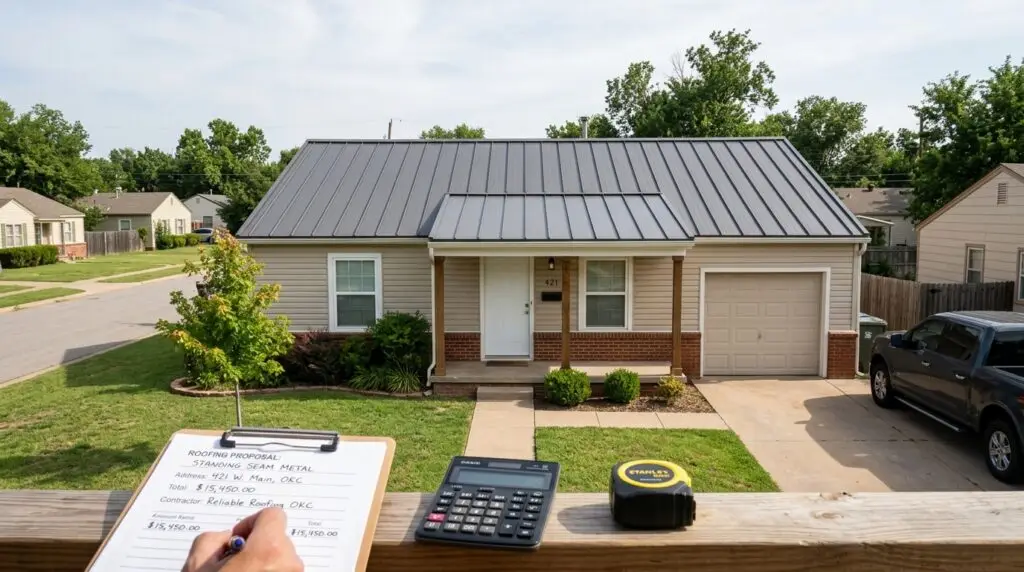
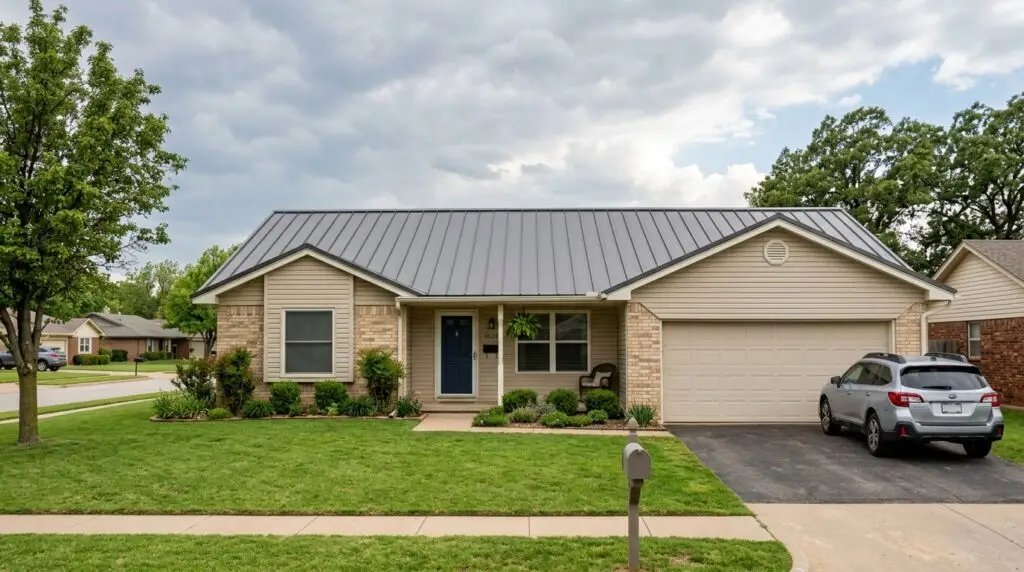
Standing seam is the gold standard for commercial metal roofing. Panels interlock at raised seams, and the fasteners are completely concealed beneath the surface. That design matters because it eliminates the most common failure point in metal roofing systems: exposed fasteners degrading over time.
Lifespan range: 40 to 70+ years with quality installation and periodic maintenance. In our experience, well-installed standing seam systems on commercial buildings hold up exceptionally well over decades, even in storm-prone environments like central Oklahoma, because the system is engineered to flex with thermal movement rather than resist it.
For most OKC commercial properties, standing seam is the system we recommend first. The upfront cost is higher, but the math over a 30- to 40-year ownership horizon almost always works in its favor.
Exposed Fastener (Screw-Down) Metal Roofs
Exposed fastener systems fasten panels directly to the roof deck through rubber-washered screws. They cost less upfront and install faster. For agricultural buildings, warehouses with short ownership horizons, or budget-constrained projects, they’re a reasonable choice.
Lifespan range: 20 to 30 years, and that’s with diligent maintenance. Here’s the mechanical problem: metal expands and contracts with temperature changes. In a screw-down system, the panels can’t move freely, so that stress cycles through the fastener holes instead. Over time, the holes widen slightly, washers degrade, and water finds its way in. In OKC’s climate, with its dramatic temperature swings, that process runs faster than it would in a milder region.
The bottom line: exposed fastener roofs require active maintenance, fastener re-torquing, washer inspections, and sealant upkeep, to reach the upper end of their lifespan range.
Metal Type Lifespan at a Glance
- Galvanized steel: Solid lifespan range, widely used in commercial applications, cost-effective
- Galvalume (aluminum-zinc alloy): Stronger corrosion resistance than standard galvanized; performs well in OKC humidity
- Aluminum: Lightweight, naturally corrosion-resistant, somewhat more prone to denting from large hail
- Copper / Zinc: Premium options with century-long lifespans; less common in commercial applications due to cost
For most OKC commercial buildings, Galvalume-coated steel with a quality PVDF (Kynar 500) paint system delivers the best combination of durability, UV resistance, and long-term performance.
Why Oklahoma City’s Climate Is Harder on Commercial Roofs Than Most Places Admit
Here’s something most generic roofing guides won’t tell you: a commercial metal roof rated to last 50 years in Seattle or Phoenix operates under completely different stresses than the same roof installed on a warehouse off the I-35/I-40 interchange in OKC. The climate here is genuinely more demanding.
Living in Tornado Alley: What Straight-Line Winds Do to Metal Panels
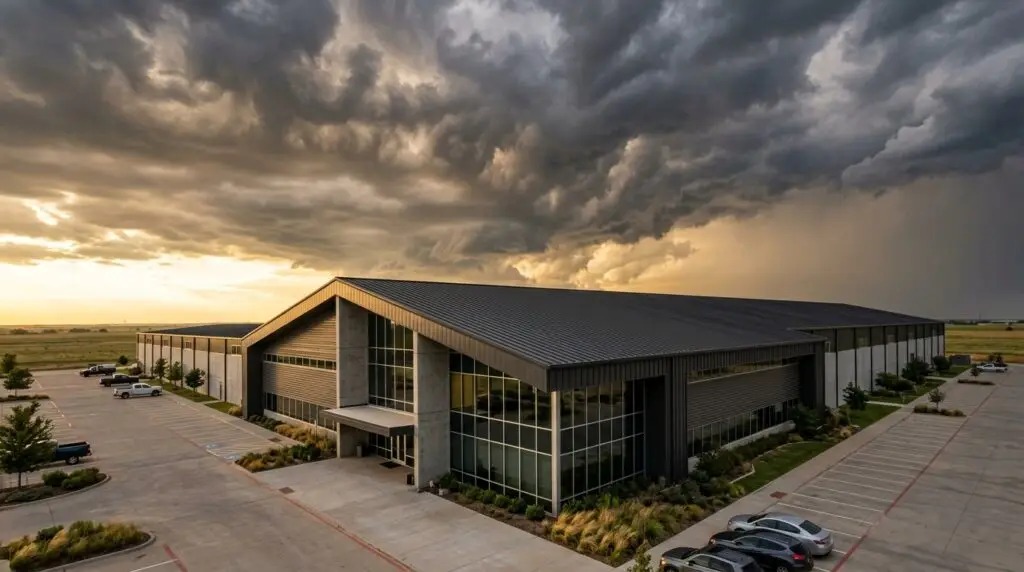
Oklahoma City sits squarely in Tornado Alley, where warm Gulf air collides with cold fronts pushing south from the Rockies. The resulting storm systems are intense. And while tornado damage gets the headlines, it’s actually the straight-line winds from ordinary severe thunderstorms that cause the most frequent roofing damage across the metro.
Straight-line winds during OKC storm events routinely reach 60 to 80 miles per hour. Those aren’t tornado-level speeds, but they create significant uplift pressure at roof edges, ridge caps, and panel corners, the exact spots where a poorly installed or aging roof starts to fail. In our experience inspecting commercial roofs after OKC storm seasons, wind damage is almost always cumulative. One storm loosens a seam. The next one finds it.
Communities like Moore, Midwest City, Edmond, Yukon, Norman, and Mustang all experience this pattern regularly. If your commercial building is in any of these areas, post-storm inspections aren’t optional, they’re essential to protecting the roof’s full lifespan.
Central Oklahoma’s Hail Problem, And Why Your Roof’s Impact Rating Matters
OKC averages multiple significant hail events per spring storm season, and the metro sits within one of the most hail-active corridors in the United States. Large hail, golf ball size and above, shows up here more than most commercial property owners want to think about.
What makes it worse is the combination with wind. Wind-driven hail doesn’t fall straight down. It strikes roofing surfaces at an angle, which means the impact force often exceeds what standard material ratings assume. That’s why Class 4 impact resistance (tested under the UL 2218 standard) matters specifically for OKC commercial buildings. A Class 4-rated panel can absorb the impact of a 2-inch steel ball dropped from prescribed heights without cracking or losing structural integrity.
On a metal roof, hail typically causes cosmetic denting and, on harder impacts, coating damage. The dent doesn’t necessarily leak. But chipped paint or coating exposing bare metal creates a rust initiation point. Left unaddressed through post-storm maintenance, that rust shortens the roof’s life faster than any other wear mechanism.
Thermal Cycling, The Hidden Wear Factor in OKC’s Climate
Oklahoma summers regularly exceed 100°F. Winter cold fronts can drop temperatures dramatically within a matter of days. That rapid temperature swing is called thermal cycling, and it stresses every component of a roofing system.
For standing seam roofs, thermal cycling is largely managed by design, the floating panel system allows expansion and contraction without forcing stress through fastener points. For screw-down systems, that same thermal movement has nowhere to go. It cycles through the screw holes instead, accelerating fatigue. In OKC’s climate, this is a meaningful reason why the gap in lifespan between standing seam and exposed fastener systems tends to be wider than national averages suggest.
The Five Factors That Determine How Long Your Commercial Metal Roof Actually Lasts
1. Installation Quality
This one is non-negotiable. Even the highest-quality metal panels won’t deliver their rated lifespan if the installation is poorly executed. Improper flashing at penetrations, under-torqued fasteners, incorrect panel alignment, and insufficient sealant at critical points are all issues that show up as leaks and premature failure, often within the first few years of installation.
When evaluating commercial metal roofing contractors in OKC, ask specifically about their experience with commercial systems, their approach to flashing details, and whether they pull permits. A contractor who skips the permit process is a contractor who doesn’t want their work inspected.
2. Metal Grade and Coating System
The paint system on a commercial metal panel isn’t cosmetic, it’s the first line of defense against UV degradation, moisture, and corrosion. PVDF coatings (sold under brand names like Kynar 500) significantly outperform standard polyester paints in long-term UV resistance. In OKC’s intense summer sun, that difference compounds over decades.
3. Roof Slope and Drainage Design
Low-slope commercial roofs, common on the warehouse and distribution facilities along the I-35/I-40 corridor and in OKC’s industrial zones, face different drainage demands than steep-slope systems. Standing water is the enemy of any roofing material. A metal roof on a well-designed drainage system lasts considerably longer than the same roof fighting chronic water accumulation.
4. Maintenance Frequency
Most commercial metal roofs are genuinely low-maintenance. But ‘low-maintenance’ doesn’t mean no maintenance. Sealants around penetrations, fastener integrity on exposed systems, and debris accumulation in valleys all need periodic attention. In our experience, the roofs that fall short of their expected lifespan almost always had one thing in common: they were ignored between major visible problems.
5. Post-Storm Inspection Habits
This is the factor most unique to OKC commercial property owners. The cumulative damage model is real, each storm weakens the system incrementally, and the next storm finds the compromised points. Commercial roofs that receive professional inspections after significant storm events consistently outperform those that don’t, simply because small issues get addressed before they become expensive ones.
Standing Seam vs. Exposed Fastener: Which One Should OKC Commercial Property Owners Choose?
The short answer: if your building will be in service for 30 or more years and you want the roof to last without significant mid-life repair costs, standing seam is the right choice for the OKC climate. Here’s why the math works out that way.
An exposed fastener system costs less upfront. But it requires active maintenance, fastener inspections, washer replacements, sealant upkeep, on a schedule that experienced OKC roofing contractors estimate at roughly every 5 to 10 years. Factor in those recurring costs, the shorter replacement cycle, and the greater vulnerability to thermal cycling and storm damage, and the total cost of ownership over 40 years often exceeds what standing seam would have cost with minimal upkeep.
Between you and me, the decision usually comes down to how long you plan to hold the property. For a building you’re developing to sell within 10 to 15 years, an exposed fastener system may make financial sense. For a long-term hold, an owner-occupied warehouse, a medical facility, a retail center, standing seam pays for itself.
How Commercial Metal Roofs Compare to Other Commercial Roofing Systems in OKC
To put the lifespan question in context, here’s how commercial metal roofing stacks up against the other systems commonly used on OKC commercial buildings:
| Roofing System | Est. Lifespan | OKC Climate Notes |
| Commercial Metal (Standing Seam) | 40–70+ years | Best storm resilience; Class 4 impact options available |
| TPO / PVC Membrane | 20–30 years | UV-sensitive in OKC summers; common on flat commercial |
| EPDM | 15–25 years | Vulnerable to OKC thermal cycling; lower upfront cost |
| Built-Up Roofing (BUR) | 15–20 years | Older stock still common in OKC; shorter service life |
| Modified Bitumen | 20–30 years | Mid-range option; less durable under hail events |
The lifespan advantage of commercial metal roofing, particularly standing seam, is substantial. The frequency-of-replacement difference alone often justifies the higher initial investment. A commercial building that needs two or three membrane roof replacements over 60 years pays more in total than one that installs a well-specified metal system once.
Common Mistakes That Shorten a Commercial Metal Roof’s Life in OKC
Skipping Post-Storm Inspections
This is the mistake we see most often. A storm comes through, the roof doesn’t actively leak, and the property manager marks it off the list. The problem is that metal roofs can sustain coating damage from hail impacts that doesn’t leak immediately but initiates rust over the following months. That rust spot becomes a penetration point 18 to 24 months later, often after the insurance claim window has closed.
On metal roofs, post-storm inspection means looking at flat panel sections and ridge caps for denting and coating damage, not just checking for active leaks.
Choosing the Wrong System for the Building Type
Large-footprint commercial buildings, 50,000 square feet and up, experience significant thermal movement across their total roof area. Exposed fastener systems on buildings of this size face amplified stress at every fastener point. This is a mismatch that shows up as widespread fastener issues 10 to 15 years into the roof’s life, right around the time most property owners assume they shouldn’t be having major problems yet.
Hiring on Price Alone
Commercial metal roofing is a specialized trade. The details, flashing geometry at HVAC curbs, proper panel alignment, sealant selection at penetrations, matter enormously for long-term performance. Contractors who win bids by cutting margin on labor often cut corners on exactly those details. The roof may look fine at installation. The problems show up in year three or four, when weather gets into the compromised areas.
Neglecting Coating Maintenance
Reflective coatings on commercial metal panels serve two functions: they protect the metal substrate and they reduce cooling loads in OKC’s extreme summer heat. When coatings degrade, which they do over time, faster without maintenance, both functions diminish. Recoating at appropriate intervals extends panel life and maintains energy efficiency benefits that OKC commercial buildings can genuinely take advantage of during peak cooling season.
How to Make Your OKC Commercial Metal Roof Last as Long as Possible
Annual Inspection Schedule
At minimum, schedule two professional inspections per year: one before storm season begins (late February or early March is ideal) and one after the peak storm season closes. Pre-season inspection catches anything that deteriorated over winter and ensures the roof is in the best possible condition before hail and wind season starts. Post-season inspection documents any storm-related damage while it’s fresh and while insurance reporting windows are still open.
Storm Response Protocol
After any significant storm event in the OKC metro, follow this sequence: First, do a ground-level perimeter walk and document what you observe, gutters, HVAC units, soft-metal surfaces. Denting on HVAC condenser fins or aluminum gutters is a reliable proxy for roof impact severity. Second, take date-stamped photos and video before anyone touches the roof. Third, contact a qualified commercial roofing contractor for a professional inspection, not a quick drive-by assessment, but a documented inspection with photos.
If there’s active water intrusion or visible structural exposure, emergency tarping protects both the building interior and the insurance claim documentation. Don’t make permanent repairs before an adjuster has reviewed the damage.
Fastener and Sealant Maintenance
For exposed fastener systems: fasteners should be inspected every 5 to 7 years for proper torque and washer condition. Failed washers are the primary entry point for moisture in these systems. Replacing washers proactively is far less expensive than repairing water damage to roof decking or building interiors.
For all systems: sealant around penetrations, HVAC curbs, skylights, vents, pitch pans, degrades faster than the metal panels themselves. Most sealants need attention every 10 to 15 years. Ignoring sealant maintenance is one of the most common causes of ‘premature’ metal roof failure that is actually just deferred maintenance.
What a Commercial Metal Roof Replacement Costs in OKC, And How Long the Investment Pays Off
Roofing costs vary significantly based on building size, system type, roof slope, access complexity, and current material pricing. Because those variables are substantial, we won’t publish a specific per-square-foot figure that may be outdated by the time you read it, any OKC commercial roofing contractor worth hiring will provide a detailed, site-specific estimate at no cost.
What we can tell you is how the investment pays off over time:
- Fewer replacement cycles: A standing seam roof installed today may outlast two or three membrane roof replacements on the same building, each of which carries its own installation cost, business disruption, and disposal expense.
- Insurance premium implications: Class 4 impact-rated metal roofing can qualify Oklahoma commercial properties for meaningful reductions on commercial property insurance premiums. Given OKC’s hail exposure, this is worth a direct conversation with your insurance carrier.
- Energy efficiency: Reflective metal roofing reduces cooling loads in OKC’s 100°F+ summers. That savings accumulates month over month across the roof’s lifespan.
- Asset documentation: A metal roof with documented installation quality, maintenance records, and remaining warranty life is a tangible asset in a commercial real estate transaction or lease negotiation, particularly in a market like OKC where storm damage history is well understood by buyers and lenders.
Signs Your OKC Commercial Metal Roof Is Failing Before Its Time
Commercial metal roofs don’t typically fail overnight. They show warning signs first. Know what to look for:
- Rust initiation at fastener points or cut edges, surface staining that looks orange or brown and isn’t washing off
- Panel movement or visible seam separation, particularly noticeable after temperature extremes
- Interior water stains on ceiling tiles, insulation, or near HVAC equipment, these often indicate a roof penetration problem, not panel failure
- Post-hail coating damage on flat panel sections and ridge caps, visible as chipped paint or bare metal at impact points
- Flashing separation at penetrations, HVAC curbs, skylights, vents, and pipe boots are the highest-risk areas
- Clogged interior drains causing standing water on low-slope sections
Most of these issues, caught early through regular inspections, are repair-level problems. The same issues discovered after they’ve caused secondary damage, to decking, insulation, or building interiors, become replacement-level events. Early detection is the entire game.
Ready to schedule a professional commercial metal roof inspection in OKC? Our team serves Oklahoma City, Edmond, Moore, Norman, Yukon, Midwest City, Mustang, and surrounding communities. Contact us for a no-cost assessment.
Frequently Asked Questions
How long does a commercial metal roof last in Oklahoma City?
In OKC’s climate, well-installed standing seam commercial metal roofs typically last 40 to 70+ years. Exposed fastener systems generally deliver 20 to 30 years before requiring significant repairs or replacement. Local storm exposure, hail, straight-line winds, and thermal cycling, makes installation quality and post-storm maintenance more critical here than in milder climates.
What is the most durable commercial metal roofing system for hail-prone areas like OKC?
Standing seam metal with a Class 4 impact rating (UL 2218 standard) is the most durable option for hail-active markets like the Oklahoma City metro. Concealed fasteners eliminate the most common failure point, and Class 4 panels are engineered to absorb impacts without compromising waterproofing.
How often should I have my OKC commercial metal roof inspected?
At minimum, twice yearly, before and after Oklahoma’s spring storm season (March through June). After any significant hail or wind event, schedule a professional inspection within 24 to 48 hours, regardless of whether you can see visible damage from the ground.
Can commercial metal roofs be damaged by Oklahoma hail?
Yes, though the damage mechanism differs from asphalt systems. Moderate hail typically causes cosmetic denting without compromising waterproofing. Large hailstones can chip paint coatings, exposing bare metal to rust initiation. Class 4-rated panels significantly reduce this risk. Post-storm coating inspections are important on all metal roofs in hail-active areas.
When should an OKC commercial building replace versus repair a metal roof?
Repair is typically the right call when damage is isolated, the system is under 20 years old, and the panels are structurally sound. Replacement makes more financial sense when repair costs approach 25 to 30 percent of replacement cost, fastener or coating failures are widespread, or the system is approaching the end of its service life heading into another storm season.
Does a commercial metal roof increase property value in Oklahoma City?
Yes, in most cases. A documented metal roof with remaining warranty life is a recognized asset in commercial real estate transactions in OKC, particularly given how well-understood storm damage costs are in central Oklahoma. Buyers and commercial lenders increasingly request roof documentation as part of due diligence.
Is metal roofing worth the higher upfront cost for commercial buildings in OKC?
For most long-term commercial property holders in the OKC metro, yes. The combination of fewer replacement cycles, potential insurance premium reductions for Class 4-rated systems, energy efficiency benefits during extreme Oklahoma summers, and lower long-term maintenance costs typically makes standing seam metal roofing the more economical choice over a 30- to 40-year ownership horizon.