If you’ve started researching metal roofing in Oklahoma City, you’ve probably run into two names more than any other: standing seam and corrugated metal. Both are metal roofs. Both outperform asphalt shingles in storm resistance. But they are not the same product and choosing the wrong one for your home or property can cost you in ways that aren’t obvious until years down the road.
Here’s what most homeowners don’t realize: the difference between these two systems isn’t just about looks. It comes down to how each panel is fastened, how it handles Oklahoma’s extreme weather swings, and what kind of maintenance commitment you’re signing up for. This guide breaks it all down clearly so you can make a confident, informed decision.
Standing seam metal roofing uses concealed fasteners and interlocking raised seams, making it more watertight and longer-lasting. Corrugated metal uses exposed fasteners and costs significantly less upfront. For Oklahoma City homeowners dealing with hail, high winds, and brutal summer heat, the right choice depends on your budget, property type, and long-term plans. Read on for a complete breakdown.
What Is Standing Seam Metal Roofing?
How Standing Seam Panels Are Built
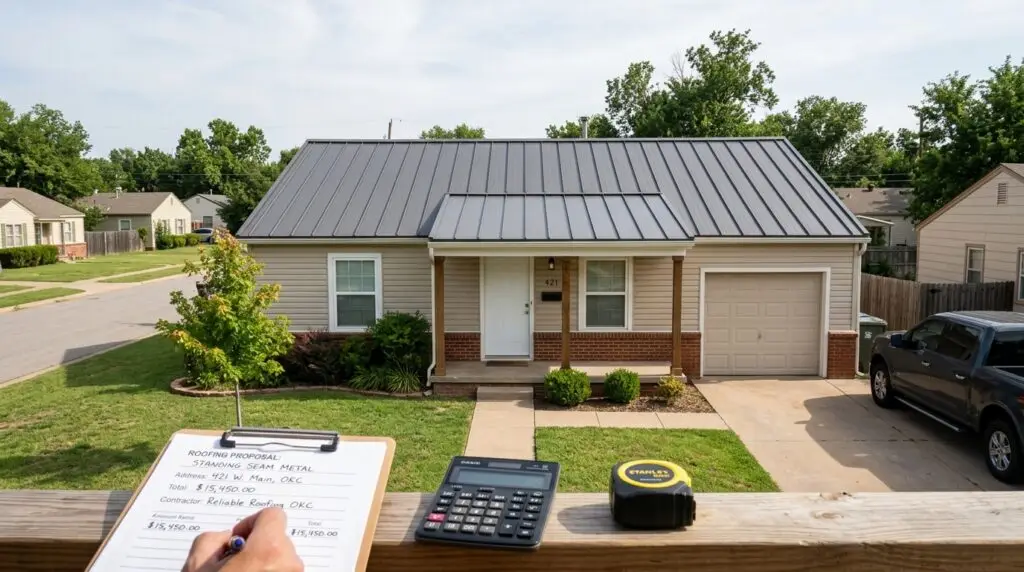
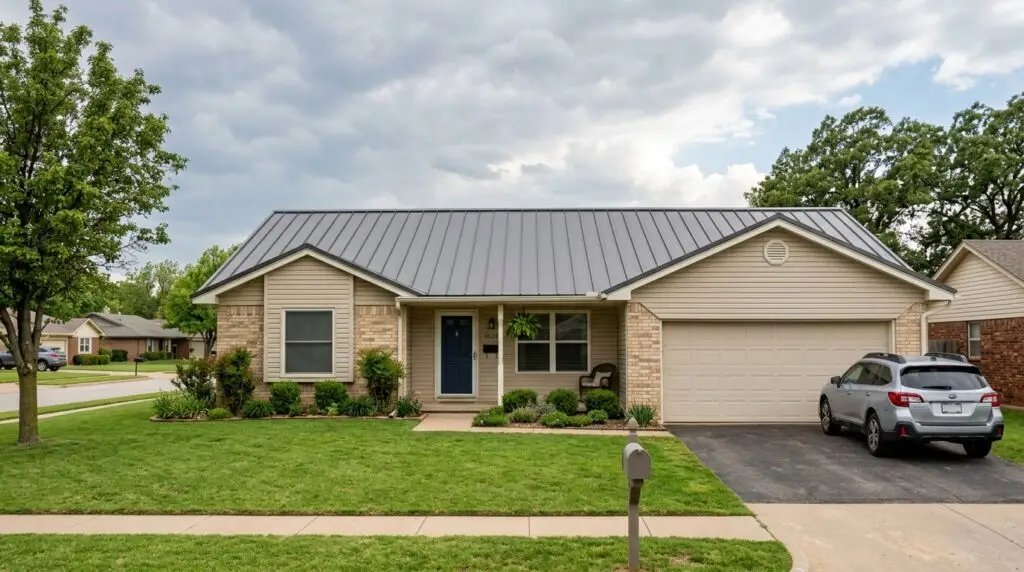
Standing seam metal roofing is a system where vertical metal panels run continuously from the eave to the ridge of your roof. The defining feature is the raised seam typically one to two inches high where adjacent panels interlock. Crucially, the fasteners that hold each panel to the roof deck are hidden beneath these seams. No screws, no exposed hardware, no penetrations through the panel surface.
Panels are usually roll-formed from steel or aluminum at gauges ranging from 22 to 24 (remember, lower gauge = thicker metal). They come in widths of roughly 12 to 18 inches, and each panel runs in one continuous piece from the bottom edge to the peak of the roof. That single-piece design matters a lot when heavy rain starts falling sideways across the Oklahoma City metro.
Why Oklahoma Contractors Often Recommend It
The concealed fastener system is the key advantage in our climate. Every screw or nail that penetrates a roofing panel is a potential future leak point. Over time, fasteners loosen, and the rubber washers that seal them degrade. In a state that sees regular hailstorms, dramatic freeze-thaw cycles, and triple-digit summer temperatures, that degradation happens faster than homeowners expect.
Standing seam sidesteps that problem entirely. Panels are secured with floating clips that allow the metal to expand and contract with Oklahoma’s extreme temperature swings from below freezing in January to well over 100°F in August without putting stress on the fastener points or warping the panels.
Standing seam also pairs well with Oklahoma’s FORTIFIED™ Roof program, backed by the Oklahoma Insurance Department, which is designed to strengthen homes against hail and high winds. Qualifying roofs may be eligible for insurance premium discounts. That’s a long-term financial benefit that corrugated systems don’t always unlock.
| Contractor perspective: “When we’re reroofing a home in Edmond or Moore after a hail event, standing seam is almost always what we recommend for homeowners who plan to stay put long-term. The upfront cost is real, but so is the performance difference when the next storm rolls through.” |
→ See also: Standing Seam Metal Roof Installation Oklahoma City
What Is Corrugated Metal Roofing? (An Honest Assessment)
The Anatomy of a Corrugated Metal Panel
Corrugated metal panels have a wave-like or ribbed profile that distinctive rippled shape created by roll-forming the sheet metal into repeated curves. Unlike standing seam, corrugated panels overlap at their edges and are fastened directly through the metal surface into the roof deck. Those fasteners are exposed, sitting on top of the panel, sealed with rubber washers.
Corrugated panels typically run at 26 to 29 gauge thinner than standing seam. They install faster, require less specialized labor, and cost considerably less per square foot. That makes them a legitimate, widely used roofing solution in the right context.
Where Corrugated Metal Makes Real Sense Around OKC
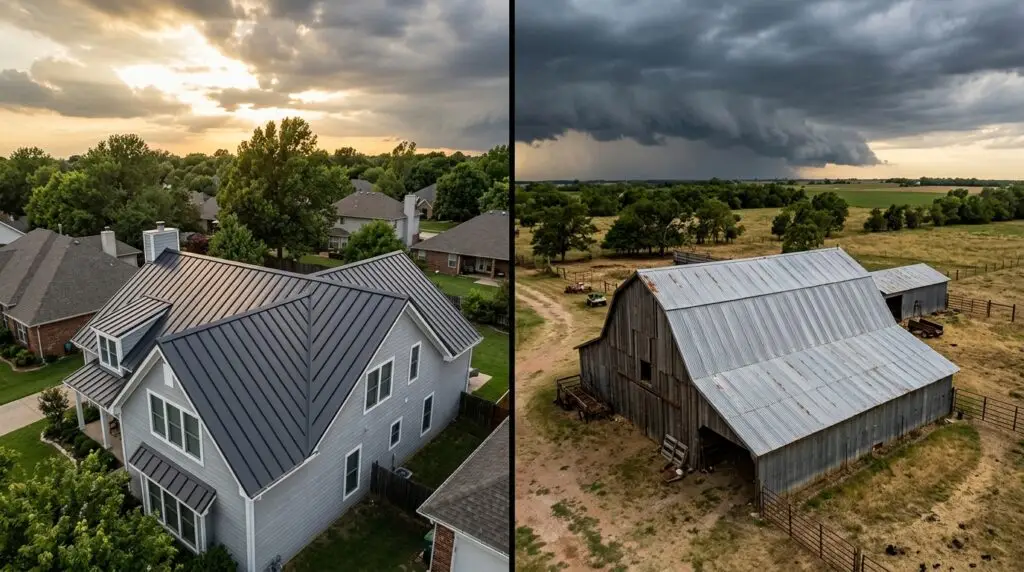
In our experience, corrugated gets a bad reputation it doesn’t fully deserve as long as it’s used in the right application. Corrugated metal is an excellent choice for outbuildings, barns, and agricultural structures common in rural areas west and south of Oklahoma City places like Yukon, Mustang, Chickasha, and the farming communities beyond. It also works well for detached garages, workshops, and residential structures where budget is the primary driver and premium aesthetics aren’t the goal.
Where it runs into trouble is when it’s installed on a primary residence and then left without regular maintenance. Oklahoma’s weather doesn’t give exposed fasteners an easy life. Hail impacts can loosen or crack washers. UV intensity accelerates rubber degradation. And when those washers fail, water finds its way in slowly often before any visible interior damage signals there’s a problem.
Bottom line: corrugated metal isn’t an inferior product when used correctly. It’s a legitimate system that has protected Oklahoma structures for generations. But it demands more ongoing attention than standing seam.
→ See also: Metal Roof Repair Oklahoma City All Panel Types
Standing Seam vs. Corrugated Metal Roofing Head-to-Head Comparison
Let’s put both systems side by side across the factors that matter most to Oklahoma City homeowners. This is the comparison most websites skim over we’re not going to do that.
| Feature | Standing Seam | Corrugated Metal |
| Fastener System | Concealed clips zero panel penetrations | Exposed screws with rubber washers |
| Storm Performance | Superior wind uplift; hail impacts metal only | Washers vulnerable to hail and UV degradation |
| Thermal Expansion | Floating clip allows free movement | Rigid fastening can cause panel stress over time |
| Lifespan | Generally 40–70+ years | Generally 25–45 years with maintenance |
| Upfront Cost | Higher material + labor investment | Significantly lower upfront cost |
| Maintenance Needs | Minimal; annual visual inspection | Annual inspection + fastener/washer checks required |
| Curb Appeal | Clean, modern, high-end look | Rustic, utilitarian; great for rural properties |
| HOA Suitability | Accepted in most OKC-area HOAs | May not meet suburban HOA requirements |
| Minimum Roof Slope | As low as 1:12 in some configurations | Minimum 3:12 slope recommended |
A few things worth emphasizing from that table: the maintenance gap is bigger than most homeowners anticipate. Standing seam’s minimal upkeep is a genuine advantage. And the lifespan difference potentially 15 to 25+ years matters considerably when you calculate total cost over time.
How Oklahoma City’s Weather Should Drive Your Decision
Why Oklahoma Is One of the Toughest Roofing Environments in the Country
This is the section that most national roofing websites skip entirely and it’s arguably the most important one for any Oklahoma City homeowner reading this.
Oklahoma sits squarely within what meteorologists call “Hail Alley” a corridor of the Central Plains that sees some of the highest hail frequency in the world. The Oklahoma City metro, along with communities like Moore, Midwest City, Del City, and Edmond, experiences multiple significant hail events each year. One-inch-plus hailstones are common. Two-inch hailstones happen. And when that hail arrives, it doesn’t come alone it usually travels with straight-line winds and, occasionally, tornado-adjacent conditions.
On top of that, Oklahoma’s temperature extremes put roofing materials through repeated thermal stress. Sub-freezing winter nights followed by 100°F summer days mean your roof expands and contracts significantly over any given year. For metal roofing, how a system accommodates that movement through floating clips or rigid fasteners makes a real difference in long-term performance.
What Hail Does Differently to Each Roof Type
Both metal roofing types resist hail penetration far better than asphalt shingles that’s not in question. But here’s what the surface-level comparisons miss: the risk with corrugated metal after a hail event isn’t the panels themselves. It’s the exposed fasteners.
When large hailstones strike the area around a screw head, they can crack or compress the rubber washer that creates the waterproof seal. That damage doesn’t always cause an immediate leak it may develop slowly over months, allowing water to infiltrate your roof deck and insulation long before you notice a stain on your ceiling. After any hail event of 1 inch or larger in the OKC area, corrugated roofs should be professionally inspected with specific attention to washer integrity.
Standing seam systems, by contrast, have no exposed hardware for hail to compromise. An inspection after a storm is still smart practice checking for dents or seam integrity but there’s no fastener vulnerability to worry about.
Insurance Implications for OKC Homeowners
This is a conversation worth having with your insurance carrier before you choose a system. Oklahoma homeowners face some of the highest wind and hail insurance premiums in the country, and your roofing choice can influence what you pay.
Standing seam may qualify for better insurance terms, especially when installed to FORTIFIED™ Roof program specifications. Corrugated roofs with exposed fasteners can face more scrutiny during claims if washer failure contributed to water intrusion. Some carriers view exposed-fastener systems differently than concealed-fastener systems when evaluating claim causes. Getting clarity from your insurer upfront can save significant headaches later.
→ See also: Storm Damage Roof Inspection Oklahoma City & Surrounding Areas
Installation: What OKC Homeowners Need to Know Before Hiring
Why Standing Seam Requires Specialized Installation
Not every roofing contractor in Oklahoma City is qualified to install standing seam correctly and this is not a knock on general roofers. Standing seam is a specialized system. It often requires on-site roll-forming equipment to fabricate panels to precise lengths. The clip spacing, seam crimping technique, and edge detailing must be done right. Improper installation creates the exact vulnerabilities the system is designed to eliminate.
When interviewing contractors for a standing seam job, ask directly: “How many standing seam roofs have you installed in the last 12 months, and can I speak with a couple of those homeowners?” A qualified installer will answer that question without hesitation. If they’re vague, keep looking.
Common Installation Mistakes on Corrugated Roofs in Oklahoma
Corrugated metal is more accessible for a wider range of contractors, but that accessibility comes with its own risk: the installation is simpler in principle, so corners sometimes get cut. The mistakes we see most often on corrugated jobs in the OKC area include over-tightening fasteners (which cracks the washer immediately), insufficient panel overlap on lower-pitch roofs (which allows wind-driven rain to travel uphill under the lapped edge), and using the wrong fastener material for the panel metal, which creates galvanic corrosion between dissimilar metals.
Skipping the ice-and-water barrier layer is another problem one that Oklahoma building codes address, but that not every contractor takes seriously. If your contractor isn’t pulling a permit for a full roof replacement, that’s a major warning sign. Unpermitted roofing can void insurance claims and create complications when you sell your home.
Permits and Code Compliance in OKC and Surrounding Cities
Oklahoma City, Edmond, Moore, Yukon, Midwest City, and most surrounding municipalities require building permits for full roof replacements, regardless of material. Metal roof installations also have specific decking requirements under Oklahoma residential code. A licensed contractor will pull the permit as a standard part of the job. If someone offers to do the work without a permit to save you money decline. The liability that comes with an unpermitted roof is not worth any short-term savings.
→ See also: Metal Roof Installation Oklahoma City, Edmond, Moore, Yukon & More
Long-Term Cost of Ownership: The Number That Actually Matters
Thinking Beyond the Initial Quote
Most homeowners compare roofing bids based on the initial project cost, which makes sense it’s the number in front of them. But between you and me, that’s not the most useful comparison for a roofing system that’s supposed to last decades.
Standing seam carries a higher upfront investment in both materials and labor. There’s no way around that. But its maintenance requirements are genuinely minimal. No annual fastener checks, no washer replacement cycles, no vulnerability to hail-related seal failures. Over a 30-to-40-year lifespan, the total cost of ownership often looks very different than the initial quote suggests.
Corrugated metal’s lower upfront cost is real and meaningful especially for budget-constrained projects. But factor in the cost of annual professional inspections, periodic fastener tightening and washer replacement (especially in Oklahoma’s storm-heavy environment), and potentially a shorter overall lifespan, and the long-term cost gap narrows considerably.
Resale Value Considerations in the Oklahoma City Market
Oklahoma homebuyers are storm-savvy. They know what a hail season looks like, and a quality metal roof is a genuine selling point particularly in higher-value neighborhoods like Nichols Hills, Deer Creek, or established Edmond communities. Standing seam, with its clean lines and premium profile, communicates a meaningful upgrade to a buyer. Corrugated metal on a residential home may be viewed neutrally or negatively depending on the neighborhood and buyer profile. On a rural property outside the metro, that calculus flips entirely.
Which Metal Roof Is Right for Your Oklahoma City Property?
It depends on several factors but it doesn’t have to be a complicated decision once you know what to weigh. Here’s a straightforward framework.
Choose Standing Seam If:
- You plan to stay in the home for 10 or more years
- Your home is in a suburban OKC neighborhood (Edmond, Deer Creek, Norman, Yukon, or similar)
- You’ve experienced repeated storm damage and want the most durable long-term solution
- You want minimal maintenance and maximum manufacturer warranty coverage
- You want to potentially qualify for FORTIFIED™ Roof program insurance benefits
- Your budget allows for a higher upfront investment with lower lifetime costs
Choose Corrugated Metal If:
- You’re roofing an outbuilding, barn, detached garage, or agricultural structure
- Budget is the primary constraint and the structure doesn’t require premium performance
- The property is in a rural area west or south of OKC Mustang, Chickasha, rural Yukon where the aesthetic fits
- The roof has a pitch of 3:12 or steeper, allowing water to shed quickly
- You’re committed to and capable of performing annual maintenance inspections
| Neither option is wrong. The wrong choice is picking the system that doesn’t match your property, your budget, and the reality of Oklahoma City’s storm environment. When in doubt, get a professional assessment from a licensed OKC metal roofing contractor who can evaluate your specific roof structure and walk you through the options honestly. |
→ See also: Metal Roof Inspection Oklahoma City & Surrounding Service Areas
Frequently Asked Questions
These are the questions Oklahoma City homeowners ask most often about standing seam vs. corrugated metal roofing. Answers are designed to be clear, practical, and honest.
Q: Is standing seam metal roofing worth the extra cost in Oklahoma?
A: For most Oklahoma City residential homeowners planning to stay in their home long-term, yes. The concealed fastener system eliminates the most common leak point in any metal roof, and the thicker panel gauge holds up better against Oklahoma’s frequent hail and high-wind events. The higher upfront cost is offset over time by lower maintenance requirements and a longer expected service life.
Q: How long does corrugated metal roofing last in Oklahoma’s climate?
A: Corrugated metal roofing generally lasts 25 to 45 years. In Oklahoma’s climate with its freeze-thaw cycles, UV intensity, and frequent hailstorms longevity depends heavily on whether annual maintenance is performed and whether fasteners and washers are replaced as they degrade. Neglected corrugated roofs in the OKC area often underperform that range.
Q: Can corrugated metal roofing handle Oklahoma hailstorms?
A: Both metal roof types resist hail penetration far better than asphalt shingles. However, corrugated roofs have exposed rubber-washered fasteners that can be compromised by large hail impacts, creating slow leak points. After significant hail events especially those with 1-inch or larger stones common in the OKC metro corrugated roofs should be professionally inspected for washer damage.
Q: Which metal roof performs better in Oklahoma wind events?
A: Standing seam generally provides superior wind uplift resistance due to its concealed clip system and thicker panel gauge. Corrugated panels can also perform well in wind if properly installed, but exposed fasteners can loosen over time from repeated high-wind stress. For homes in higher-risk corridors like Moore, Del City, and Midwest City, standing seam is the stronger recommendation.
Q: Does Oklahoma have any programs or discounts for metal roofing?
A: Yes. Oklahoma’s FORTIFIED™ Roof program, supported by the Oklahoma Insurance Department, is a voluntary re-roofing standard that strengthens homes against hail and high winds. Qualifying roofs may receive homeowners insurance premium discounts. Both metal types can potentially qualify, but installation must meet specific FORTIFIED™ specifications. Consult with a licensed OKC roofing contractor to determine eligibility.
Q: What is the minimum roof pitch for corrugated metal roofing?
A: Corrugated metal roofing generally requires a minimum slope of 3:12 that’s 3 inches of rise for every 12 inches of horizontal run. It is not suitable for low-slope or flat applications. Standing seam systems can often be installed on slopes as low as 1:12, making them more versatile for a wider range of roof designs.
Q: Can I install corrugated metal roofing myself on my Oklahoma City property?
A: Corrugated metal is more DIY-accessible than standing seam, but most Oklahoma City municipalities require building permits for full roof replacements. Non-permitted work can void insurance claims and complicate home sales. For outbuildings or detached structures that don’t require a permit, an experienced DIYer may be able to handle corrugated installation but for a primary residence, hiring a licensed contractor is strongly recommended.
Explore Our Metal Roofing Services in Oklahoma City
Whether you’re ready to get a quote or still doing your research, our team is here to help you make the right decision for your property and your budget. We serve Oklahoma City and surrounding communities including Edmond, Moore, Yukon, Midwest City, Norman, and beyond.
- Metal Roof Installation Standing Seam & Corrugated
- Storm Damage Inspection & Metal Roof Repair
- Metal Roofing Cost Guide for Oklahoma Homeowners
- Service Areas: OKC, Edmond, Moore, Yukon, Norman, Midwest City