If you live in Oklahoma City, you already know what the sky can do. Hailstorms that dent cars, wind gusts that strip shingles off rooftops, and severe thunderstorms that seem to arrive on a schedule every spring. Choosing the best metal roof for Oklahoma storms is one of the most important home decisions you can make and it deserves a more specific answer than most websites give you.
This guide breaks down every metal roof type worth considering in Oklahoma, explains the technical specs that actually matter in a hailstorm, and gives you the straightforward guidance a local contractor would share over a cup of coffee. No fluff. Just what you need to make the right call for your home.
Why Oklahoma Storms Demand More Than a Standard Roof
What OKC Homeowners Are Really Up Against
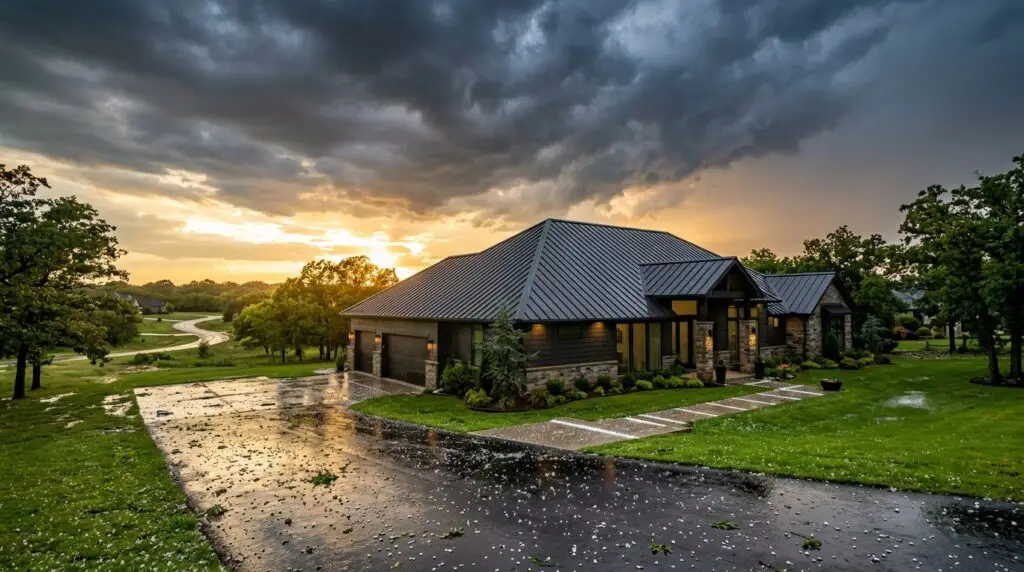
Oklahoma sits squarely in one of the most active severe weather corridors in the country. Central Oklahoma including Oklahoma City, Moore, Edmond, Norman, Yukon, and Mustang has absorbed repeated catastrophic storm events over the years. The combination of large hail, straight-line winds exceeding 70 to 100 mph, and the occasional tornado makes this region uniquely demanding on roofing materials.
Here’s something most homeowners don’t fully appreciate: it’s not just the big events that wear down a roof. Oklahoma’s thermal cycling is brutal. Attic temperatures can soar during the summer while sudden hard freezes arrive in winter, sometimes within the same week. That constant expansion and contraction degrades roofing materials faster than almost anywhere else in the country.
On top of the weather itself, Oklahoma consistently ranks among the states with the highest homeowners insurance premiums. Your roofing choice directly affects what you pay every year and whether your insurer will give you a meaningful discount.
Why Asphalt Shingles Often Fall Short in Central Oklahoma
This isn’t about talking you out of a budget option. Standard asphalt shingles are installed on millions of homes, and they work. But in Oklahoma’s climate, many homeowners find they’re replacing shingle roofs more frequently than the rated lifespan would suggest. Wind damage, granule loss from repeated hail impacts, and thermal cycling all take their toll. That’s the honest context for why metal roofing has grown steadily in this market.
The Three Types of Metal Roofs Worth Considering in Oklahoma
Most articles will tell you metal roofing is durable and call it a day. In our experience, the more useful conversation is about which type of metal roof performs best here, because they are not equal not in storm performance, not in cost, and not in how they age in this specific climate.
Standing Seam Metal Roofing The Storm-Ready Standard
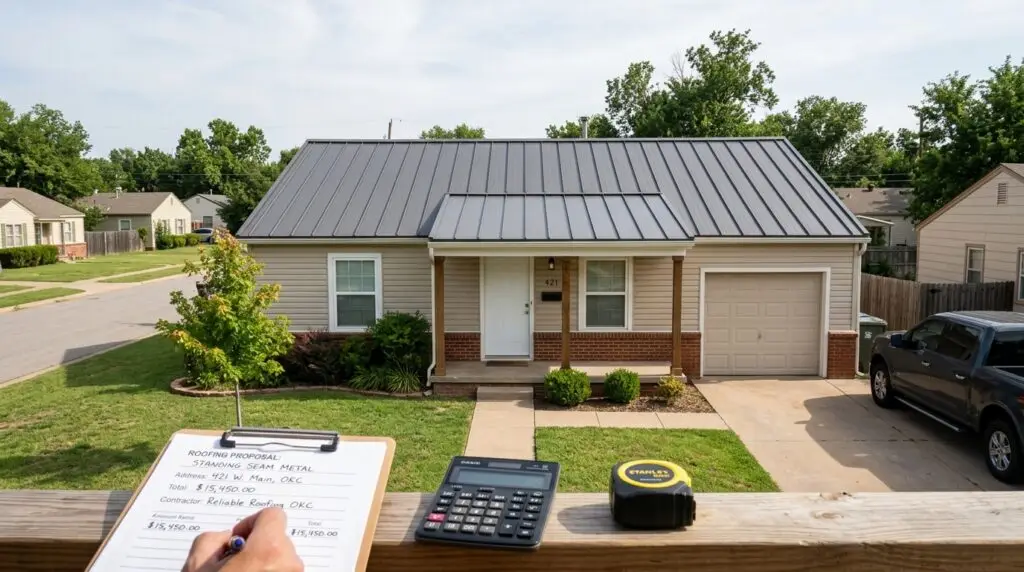
Standing seam is widely considered the top tier of metal roofing, and for good reason. The panels connect through raised interlocking seams, and this is the key part there are no exposed fasteners penetrating the panel face. Instead, hidden clips hold the panels to the decking and allow them to float slightly, accommodating thermal expansion without compromise.
In Oklahoma’s wind environment, properly installed standing seam systems routinely carry ratings of 140 mph or higher. The concealed fastener design means there are no weak points where screws can back out over time or where rubber washers can degrade and let water in.
The tradeoff is cost. Standing seam sits at the higher end of the metal roofing investment range. It also requires an experienced installation crew a standing seam roof improperly installed loses most of its performance advantages. For homeowners planning to stay in their home long term, or for higher-value properties in neighborhoods like Edmond or the north OKC corridor, it’s the most defensible investment.
Stone-Coated Steel The Hail Fighter with Curb Appeal
Stone-coated steel panels consist of a galvanized or Galvalume steel core bonded with an acrylic coating and finished with stone granules embedded into the surface. That layered construction serves a specific purpose: the granule texture absorbs and disperses hail impact energy rather than concentrating it.
For Oklahoma homeowners, this translates into genuine Class 4 impact resistance without the smooth-panel aesthetic of standing seam. It also means cosmetic denting which does happen on smooth metal panels in heavy hail is far less visible. The roof can take a hit and still look presentable.
A practical note: the 24-gauge steel core is the standard to look for in this category. Anything thinner and you’re giving up hail performance for cost savings you’ll likely regret. Stone-coated steel is also a strong choice for neighborhoods with HOA restrictions, since it can closely mimic the look of traditional shingles or shake without compromising on storm durability.
Exposed Fastener Panels An Honest Assessment
Corrugated or ribbed exposed fastener panels are the most affordable metal roofing option, and you’ll see them everywhere from storage facilities to agricultural buildings across Oklahoma. For primary residences, though, we want to be straight with you about the limitations.
Every screw hole in an exposed fastener system is a potential leak point. In a climate with Oklahoma’s temperature extremes, those screw holes expand and contract repeatedly over years. The rubber washers under each fastener degrade. Eventually, water finds a way in. It’s not a matter of if it’s a matter of when, and how well your original installation was done.
There’s also the noise factor. During a heavy hail event, an exposed fastener corrugated roof without sound-deadening underlayment will let you know about it. For a workshop or barn, that’s tolerable. For a bedroom at 2 a.m. in a storm, it’s a different story.
Legitimate use cases: outbuildings, detached garages, agricultural structures, or budget-constrained accessory structures where long-term performance is less critical. For a primary residence in the OKC metro, it’s not a recommendation we’d make.
Gauge, Coating, and Class Ratings The Specs That Actually Matter in a Hailstorm
Here’s where most roofing articles drop the ball. They’ll say “metal roofs are impact resistant” and leave it there. But impact resistance is not a single dial it’s a combination of gauge thickness, coating system, and certification standard. Understanding each one helps you evaluate a contractor’s quote intelligently.
Steel gauge: Gauge works inversely a lower number means thicker metal. 24-gauge steel is the widely recommended minimum for Oklahoma homes in active hail zones. Thinner 26-gauge panels exist at a lower price point, but they sacrifice meaningful impact resistance to get there. For the Oklahoma City area, 24-gauge is the baseline, not the premium.
Class 4 impact rating: The UL 2218 standard tests roofing materials by dropping steel balls of increasing size from defined heights to simulate hail. Class 4 is the highest rating available. Not every metal panel earns it you need to ask for documentation, not just assurances.
Galvalume vs. galvanized coatings: Galvalume (an aluminum-zinc alloy coating) generally outperforms traditional galvanized steel in Oklahoma’s moisture and freeze-thaw conditions. It offers better long-term corrosion resistance, which matters for a roof you’re expecting to last 40 to 70 years.
Paint finish systems: PVDF (Kynar) coatings significantly outperform standard polyester finishes in UV resistance and color retention. Oklahoma’s intense summer sun degrades cheaper paint systems noticeably over time. If a contractor is quoting you a premium metal roof with a standard polyester finish, that’s worth questioning.
| Quick spec checklist for Oklahoma City homes: 24-gauge or better steel | Class 4 UL 2218 impact rating | Standing seam or stone-coated style | Galvalume corrosion coating | PVDF (Kynar) finish system |
How Oklahoma’s Weather Stresses Each Metal Roof Type Differently
High-Wind Events and the Roof Edge Vulnerability
Most people think about metal roofing and wind as a straightforward contest the stronger the roof, the better. That’s partially true. But in our experience, where metal roofs fail in wind events isn’t in the field panels. It’s at the edges, eaves, and ridge caps.
Standing seam clip systems allow thermal movement without creating uplift vulnerability. The panels don’t rely on face fasteners to hold them down, so there’s no grid of potential failure points across the entire roof surface. Properly detailed edge metal and ridge caps, installed with storm-rated adhesive, complete the system. A standing seam roof with a poorly installed ridge cap is still a weak system installation integrity matters at every point.
Hail Impact Denting vs. Actual Damage
This is one of the most misunderstood aspects of metal roofing, and it’s worth clearing up. Cosmetic denting from hail is not structural failure. A metal roof that shows dimples after a hailstorm is still doing its job keeping water out and protecting your home. The steel hasn’t cracked. The coating hasn’t failed. The roof is fine.
What cosmetic denting does mean is a potential insurance claim. Many Oklahoma carriers treat hail-caused cosmetic damage to metal roofing as a covered loss. Documenting your roof’s pre-storm condition with photos gives you a clean baseline for any future claim. This is actually a financial advantage of metal roofing that most homeowners don’t realize until after their first storm.
Stone-coated steel conceals denting far better than smooth standing seam panels due to its textured surface. If aesthetics matter to you after a storm event, that’s a real factor in the decision.
Oklahoma’s Thermal Cycling Problem
Between scorching summer heat and sudden hard freezes, Oklahoma roofs experience extreme thermal cycling. A roof panel that expands in July and contracts in January does so repeatedly, year after year. Exposed fastener systems bear the brunt of this each screw point is a stress concentration where the metal moves against the fastener.
Standing seam’s clip-based attachment system is specifically engineered to accommodate this movement. Panels can expand and contract freely without stressing the attachment points. Over a 40-year lifespan in Oklahoma City’s climate, that design difference compounds into a significant leak-prevention advantage.
What Does a Metal Roof Cost in Oklahoma City? Honest Ranges
We’re not going to give you a precise number, because a precise number without context is misleading. Installed metal roofing costs vary based on roof complexity, pitch, material choice, and current material pricing. What we can give you is a framework.
Exposed fastener corrugated panels sit at the lower end of the metal roofing cost spectrum. Stone-coated steel systems fall in the mid-to-upper range. Standing seam with premium coatings typically represents the highest installed cost per square foot of the three.
The comparison that matters more than upfront cost is total cost of ownership. A high-quality standing seam system is engineered to last 40 to 70 years. If you replace an asphalt shingle roof every 15 to 20 years in Oklahoma’s climate which is a reasonable expectation you’re looking at multiple replacement cycles over the same period, each with its own labor and material costs. That math often shifts the long-term value calculation toward metal.
On the insurance side: many Oklahoma carriers offer meaningful premium discounts for Class 4 impact-rated roofing. The exact discount varies by insurer and policy, so call your carrier before committing to a material. Getting the answer could influence your decision and your annual costs significantly.
It’s also worth knowing that the Strengthen Oklahoma Homes Act, signed in 2024, created grant funding for homeowners implementing FORTIFIED construction standards through 2027. Metal roofing frequently qualifies as part of a FORTIFIED designation. Checking your eligibility before your project starts could offset a meaningful portion of your investment.
Installation Quality Is the Variable That Determines Storm Performance
Between you and me, this is the section most roofing articles skip entirely. They’ll compare material specs all day, but the uncomfortable truth is that a poorly installed standing seam roof will underperform a properly installed stone-coated steel roof in a storm. The panel you choose matters but the crew installing it matters just as much.
What Separates a Storm-Ready Install from a Problem Install
- Underlayment selection: synthetic underlayment outperforms felt in Oklahoma’s climate. Ice-and-water shield at eaves and valleys is essential in freeze-thaw zones.
- Fastener density at the roof perimeter: edge and eave areas need tighter fastener patterns than field panels. This is where wind uplift begins.
- Ridge cap installation: storm-rated adhesive and proper overlap are non-negotiable. The ridge cap is the roof’s most wind-exposed element.
- Decking condition: a premium metal panel installed over rotted or undersized decking is only as strong as its foundation. A thorough pre-installation decking inspection is part of a quality job.
- Flashing details at walls, chimneys, and penetrations: the most common origin point for leaks on any roof metal included is poorly executed flashing, not panel failure.
Red Flags to Watch for When Hiring a Metal Roofer in OKC
- A contractor who quotes corrugated panels for your primary residence without explaining the thermal cycling tradeoffs
- No mention of underlayment type or specification in the written bid
- No discussion of how thermal movement is accommodated in the chosen system
- A crew with no verifiable local Oklahoma City address or local warranty standing storm chasers move on after the season
- No manufacturer certification documentation or product warranty paperwork offered as part of the job
Metal Roofing and Oklahoma Homeowners Insurance What You Need to Know
Most roofing articles stop at “metal roofs are durable.” Few explain how your roofing material affects your insurance situation here in Oklahoma, and that’s a real gap.
Class 4 impact-rated metal roofing can qualify for premium discounts with many Oklahoma insurers. Not all carriers offer the same discount, and some require specific documentation from your installer confirming the Class 4 rating. Always ask your agent directly before choosing materials the annual savings can be substantial over time.
The FORTIFIED Home program, administered by the Insurance Institute for Business & Home Safety, designates homes that meet specific resilience standards. Metal roofing meeting the right specifications frequently contributes to a FORTIFIED Roof designation. Some Oklahoma insurers offer additional discounts or policy advantages for FORTIFIED certified homes beyond the standard Class 4 credit.
A practical step most homeowners miss: photograph your roof thoroughly before and after installation, document the Class 4 certification paperwork your installer provides, and keep a copy with your insurance file. If a hailstorm causes cosmetic denting, that paper trail supports your claim clearly.
Which Metal Roof Is Actually Best for Your Oklahoma City Home?
Here’s the direct answer: for most Oklahoma City homeowners who plan to stay in their home long term and want maximum protection from the area’s hail, wind, and thermal conditions standing seam metal roofing in 24-gauge steel with concealed fasteners is the strongest all-around choice.
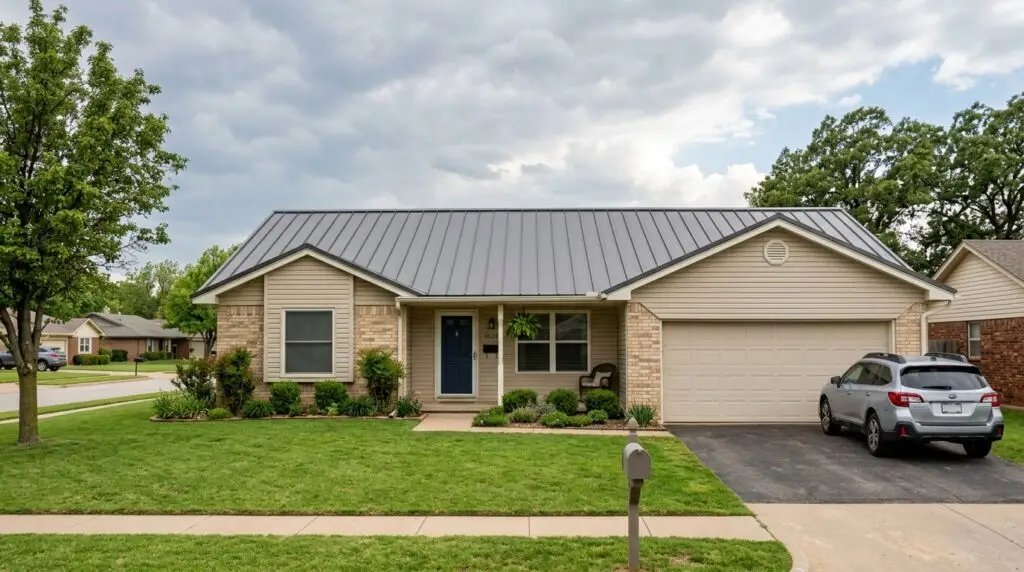
It offers the best combination of wind resistance, leak prevention through thermal cycling, and long-term durability. If aesthetics and hail dent concealment matter more than lowest possible cost, stone-coated steel in 24-gauge is an excellent alternative that performs well in Oklahoma conditions and looks more traditional on the roof.
The decision matrix below maps common homeowner situations to the most appropriate metal roof type:
| Your Situation | Best Metal Roof Type |
| Maximum storm protection, long-term stay | Standing seam, 24-gauge, concealed fastener |
| Traditional look + hail resistance | Stone-coated steel, 24-gauge |
| Outbuilding or detached structure | Exposed fastener corrugated panel |
| Budget-conscious, mid-term home | Consult locally consider Class 4 rated alternatives |
It depends on several factors unique to your property: roof pitch and complexity, your timeline in the home, HOA requirements, and your insurance situation. A good local contractor will work through each of those with you rather than defaulting to one recommendation regardless of context.
Maintaining Your Metal Roof After Oklahoma Storms
Metal roofing requires far less maintenance than asphalt shingles, but ‘less maintenance’ doesn’t mean ‘no maintenance’ especially in a climate as active as central Oklahoma’s.
After any significant storm, do a visual inspection from ground level. Look for obvious panel displacement, damaged ridge caps, or debris that’s accumulated at valleys and gutters. Don’t walk the roof yourself without the right footwear and safety equipment call a professional for anything beyond a visual check.
Spring is the critical maintenance window in OKC. Before severe weather season hits in earnest, have your flashing points, ridge cap condition, and any fastener-accessible areas checked. Tree branches overhanging the roof are a genuine and often overlooked risk both as a falling hazard and as a source of persistent moisture and debris accumulation.
For stone-coated steel, inspect the granule coating periodically. Early-stage granule loss or coating separation is far cheaper to address than a full panel replacement later. For standing seam, watch for any coating or finish system changes at low-slope transitions or near HVAC penetrations where thermal stress concentrates.
Frequently Asked Questions
What is the best metal roof for hail in Oklahoma?
For hail specifically, stone-coated steel and standing seam systems in 24-gauge are the strongest performers. Look for Class 4 UL 2218 impact-rated panels that’s the highest rating available and the benchmark for Oklahoma’s active hail climate.
Will a metal roof hold up in a tornado?
No roof is tornado-proof. However, properly installed standing seam metal roofing rated for 140+ mph winds provides significantly better resistance to severe wind events than standard shingles. The installation method matters as much as the material itself proper edge and ridge detailing is critical.
Is a metal roof louder than shingles during a hailstorm?
With proper synthetic underlayment and standard attic insulation, most Oklahoma homeowners report noise levels comparable to their previous shingle roofs. The noise concern is most valid for exposed fastener corrugated metal without sound-deadening underlayment beneath it.
Does metal roofing reduce homeowners insurance in Oklahoma?
Many Oklahoma insurers offer premium discounts for Class 4 impact-rated roofing, including qualifying metal systems. The exact discount varies by carrier and policy. Always verify directly with your insurance provider before choosing materials the potential savings are worth the phone call.
How long does a metal roof last in Oklahoma’s climate?
High-quality standing seam and stone-coated steel systems are engineered to last 40 to 70 years. Oklahoma’s thermal cycling and UV exposure can affect lower-grade materials faster, which is why gauge, coating quality, and installation standards matter significantly in this specific climate.
What gauge metal roof is best for Oklahoma hail?
24-gauge steel is the widely recommended minimum for Oklahoma homes in active hail zones. Thinner 26-gauge panels exist at a lower price but offer less impact resistance. For the OKC metro area, 24-gauge is the baseline, not the upgrade.
Is standing seam or stone-coated steel better for Oklahoma?
Standing seam offers superior long-term leak prevention and wind performance through its concealed fastener design. Stone-coated steel is better at hiding hail denting cosmetically and suits homeowners who prefer a traditional aesthetic. Both are strong performers in Oklahoma conditions the right choice depends on your priorities and budget.