If you’re weighing aluminum vs. steel metal roofing for your Oklahoma City home, here’s the honest answer most national articles won’t give you: the coastal comparisons that dominate this topic online don’t apply to where you live. Oklahoma’s climate fierce hailstorms, dramatic temperature swings, and relentless summer heat creates a completely different set of demands. The right choice here is not the right choice in Miami or Seattle.
This guide gives you the local perspective, the roofing expertise, and the practical decision-making framework you actually need.
Why This Decision Matters More in Oklahoma Than Almost Anywhere Else
Oklahoma Sits in the Heart of Hail Alley
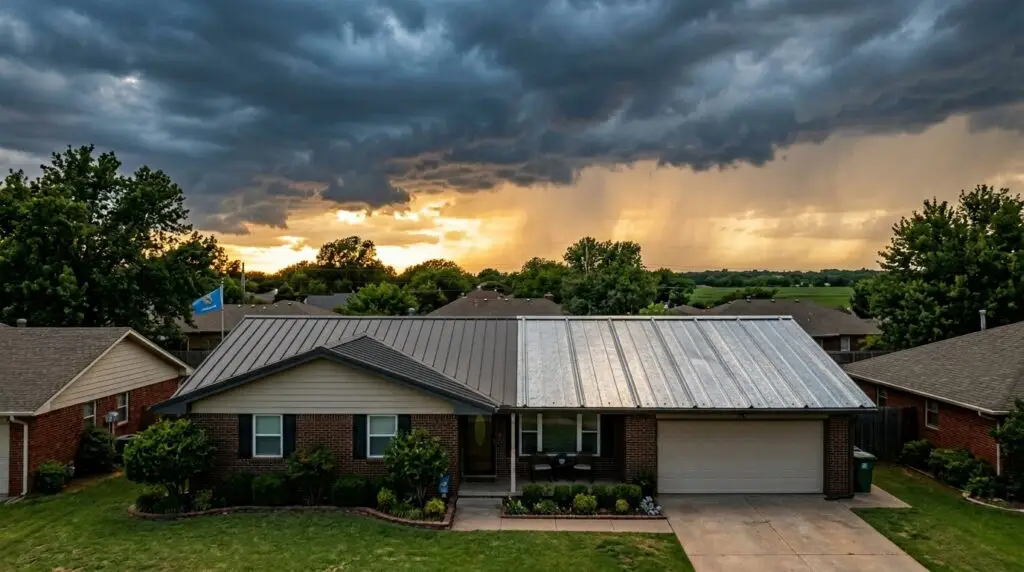
Most homeowners don’t realize that Oklahoma sits squarely in one of the most hail-prone corridors in the world. Hail Alley runs from Alberta, Canada through the central plains and into north Texas and Oklahoma City is right in the middle of it. Communities like Edmond, Moore, Norman, Midwest City, and Yukon have all experienced repeated hail events across a wide range of severity.
This isn’t a minor weather consideration. It’s the single most important factor in choosing a metal roofing material. A decision that makes sense for a homeowner in a low-storm coastal market may be a poor choice for a home that takes a direct hit from a two-inch hailstorm in May.
What Oklahoma’s Climate Demands from a Metal Roof
Oklahoma’s climate is genuinely demanding. Summer temperatures regularly push past 100°F. Spring brings some of the most severe storm activity in North America. Winter delivers freeze-thaw cycles that stress roofing materials at the seams and fasteners. And through all of it, UV exposure is intense.
Here’s the thing a lot of content online about aluminum vs. steel metal roofing is written with coastal markets in mind. The argument for aluminum leans heavily on corrosion resistance in saltwater environments. That argument has very little relevance in Oklahoma City. What matters here is impact resistance, thermal durability, and long-term performance through storm season after storm season.
Aluminum vs. Steel Metal Roofing A Plain-English Comparison
What Is Steel Metal Roofing?
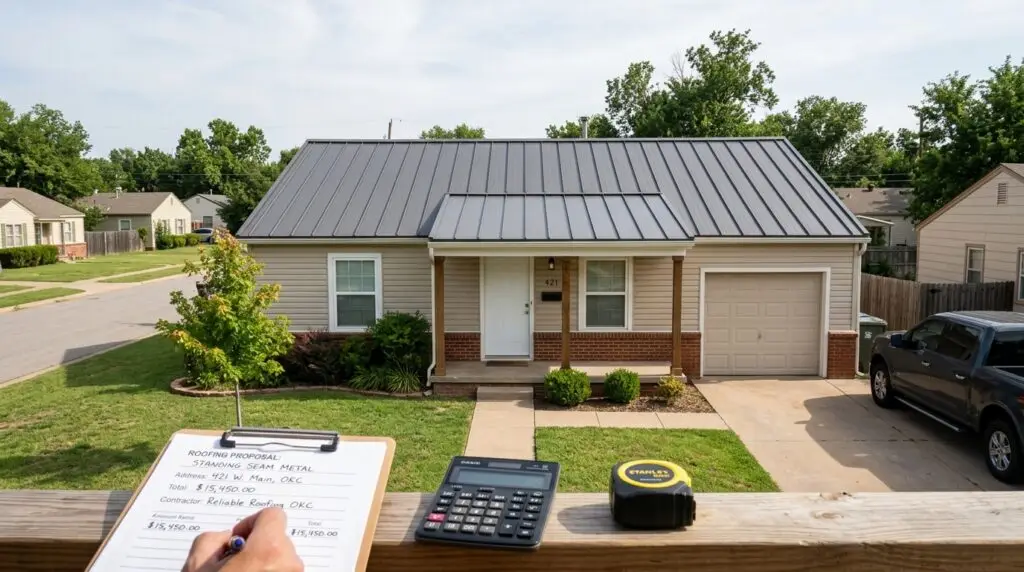
Steel metal roofing starts with a cold-rolled steel base that’s coated to protect against corrosion. The two most common coating systems are galvanized (zinc coating) and Galvalume (an aluminum-zinc alloy coating). Galvalume has become the dominant standard for residential standing seam metal roofing, and for good reason it outperforms basic galvanized steel in most real-world conditions.
Residential steel panels typically come in gauges ranging from 22 to 29. In the OKC market, 24-gauge and 26-gauge are most common. Steel carries a Class A fire rating without requiring special underlayment, and it’s available in both standing seam and exposed fastener profiles.
What Is Aluminum Metal Roofing?
Aluminum is a naturally corrosion-resistant metal that develops a self-healing oxide layer on its surface. It doesn’t rust the way uncoated steel can. It’s also significantly lighter roughly 30% lighter than comparable steel which makes it appealing for older homes with structural weight constraints.
The trade-off is softness. Aluminum is a much softer metal than steel. To compensate, aluminum roofing panels require a heavier gauge to achieve comparable impact performance. This adds cost and still doesn’t fully close the hardness gap. Aluminum also typically requires specific underlayment systems to achieve a Class A fire rating, which can affect total project cost.
Side-by-Side Comparison
| Steel (Galvalume) | Aluminum | |
| Hail Resistance | Excellent harder, denser | Moderate dents more easily |
| Weight | Heavier | Lighter (~30% less) |
| Corrosion Resistance | Very good (Galvalume coating) | Excellent (self-healing oxide) |
| Cost (Material) | Lower | Typically 20–30% more |
| Fire Rating | Class A (inherent) | Requires specific underlayment |
| Lifespan (OKC) | 40–50+ years | 40–50+ years |
| Thermal Expansion | Moderate | Higher needs expert install |
| Availability in OKC | Wide | Moderate |
| Best For OKC Homes? | Yes top recommendation | Select situations only |
Hail Resistance The #1 Factor for OKC Homeowners
Why Steel Outperforms Aluminum in Hail Events
Steel is harder and denser than aluminum. In practical terms, that means it resists denting better when a hailstone makes contact. This is the decisive difference for most Oklahoma City homeowners.
In our experience, aluminum panels show more visible denting after large hail events particularly for stones at or above one inch in diameter. OKC regularly sees hail at 1–2.5 inches, and severe events have produced stones well beyond that. A dented aluminum roof isn’t necessarily structurally compromised, but it does affect resale value, curb appeal, and how insurance adjusters assess the damage. Steel especially at 24-gauge handles these impacts noticeably better.
Contractor insight: Cosmetic denting on aluminum may not trigger a full insurance replacement, while the same storm event on a steel roof may show little to no visible damage. This distinction matters when you’re filing a claim after a major OKC storm.
What Gauge Steel Should You Choose for Oklahoma Storms?
Gauge is one of the most important specifications in a metal roofing quote and it’s one that contractors sometimes leave out of initial discussions. Here’s how to think about it for Oklahoma’s market:
- 24-gauge: Recommended for most storm-exposed OKC homes. Stronger impact performance and better long-term durability.
- 26-gauge: Adequate for areas with lower direct storm exposure, or for budget-conscious projects where 24-gauge isn’t feasible.
- 29-gauge: Generally not recommended for primary homes in the OKC metro area. Too thin for Oklahoma’s hail frequency and severity.
Always ask your contractor specifically which gauge they’re quoting. Comparing a 26-gauge bid from one company against a 24-gauge bid from another is an apples-to-oranges comparison.
Does a Metal Roof Dent from Hail? The Honest Answer
Yes any metal roof can dent under severe enough impact. What varies is the degree and visibility. Steel dents less easily and less visibly than aluminum in most Oklahoma storm scenarios. Standing seam profiles with stiffening ribs or an embossed texture also help mask minor denting better than flat, smooth aluminum panels.
Stone-coated steel is another option worth knowing about it adds an aggregate layer over the steel panel that provides additional protection and completely hides any minor surface impact.
Cost Comparison What Oklahoma Homeowners Actually Pay
Upfront Installation Cost Differences
Steel (Galvalume standing seam) generally comes in at a lower cost per square foot than comparable aluminum. Aluminum typically carries a material price premium in the range of 20–30% over equivalent steel. Total project cost depends on multiple variables: roof size, pitch, panel profile, gauge, flashing complexity, and labor.
It’s worth noting that OKC-area labor rates are their own factor, separate from material costs. Get at least two to three quotes from local contractors and make sure each quote specifies the same gauge, panel profile, and underlayment system before you compare numbers.
Long-Term Cost Considerations
Both materials deliver comparable lifespans 40 to 50-plus years with proper installation and maintenance. The long-term cost calculation is more nuanced than just upfront price.
- Insurance premiums: Impact-rated steel roofing may qualify for meaningful homeowner insurance discounts in Oklahoma. Verify with your carrier and provide product documentation after installation.
- Energy savings: Both materials reflect radiant heat better than asphalt shingles. Over a full Oklahoma summer, this adds up both in comfort and utility costs.
- Maintenance: Both require periodic post-storm inspections, but aluminum’s self-healing oxide layer means it needs less attention to surface condition over time.
Hidden Costs Contractors Don’t Always Mention
Most homeowners don’t realize how quickly “extra” costs accumulate in a metal roofing project. A few to watch for:
- Structural support: Heavier gauge steel may require additional framing support on older OKC homes with lighter roof decks.
- Fastener compatibility: Aluminum panels require aluminum or stainless steel fasteners. Using steel fasteners creates galvanic corrosion that accelerates deterioration it’s a common mistake on low-bid installations.
- Underlayment: Noise control and energy performance both depend on underlayment selection. It’s not a place to cut corners in Oklahoma’s climate.
- Roof complexity: Valleys, dormers, penetrations, and custom flashing all increase labor time and cost, regardless of panel material.
Which Metal Roof Performs Better in Oklahoma’s Specific Climate?
Steel Is the Stronger Choice for Inland Oklahoma Conditions
Between you and me and this is something a lot of national content gets wrong the primary argument for aluminum over steel is corrosion resistance in coastal saltwater environments. Oklahoma City is as inland as it gets. That argument simply doesn’t apply here.
Galvalume steel handles Oklahoma’s heat, UV exposure, wind loads, and hail better than aluminum in most real-world scenarios. It’s more widely available through OKC-area distributors, which means faster project timelines and more competitive pricing. And its superior hardness directly addresses the number one roofing threat in this market: hail impact.
When Aluminum Still Makes Sense in the OKC Area
Aluminum isn’t a poor material it’s just not the optimal choice for most OKC homes. There are situations where it makes sense:
- Older homes where weight reduction is critical: If your roof structure has limitations, aluminum’s lower weight can be a deciding factor.
- Complex architectural applications: Aluminum’s malleability makes it easier to work with in curved or unconventional shapes.
- Low-slope custom fabrication: In certain commercial or architectural applications, aluminum’s characteristics are genuinely advantageous.
What About Galvalume? The Hybrid Option Most Competitors Skip
Here’s something the national comparison articles consistently miss: most standing seam metal roofs installed in Oklahoma aren’t technically “pure steel” or “pure aluminum” they’re Galvalume.
Galvalume is a steel substrate coated with a combination of roughly 55% aluminum and 43% zinc. It combines the structural strength of steel with significantly improved corrosion resistance the best of both worlds for inland Oklahoma homes. When a local contractor quotes you a “steel roof,” they almost certainly mean Galvalume.
Understanding this helps you ask smarter questions and compare quotes more accurately.
Installation Differences That Affect Performance and Warranty
Thermal Expansion Why It Matters More With Aluminum
All metal expands and contracts with temperature changes. Aluminum does this at a significantly higher rate than steel. Oklahoma’s climate with sub-zero winter lows and 100°F-plus summer highs creates some of the most demanding thermal cycling conditions in the country.
When aluminum panels aren’t installed with proper expansion allowances, you get panel buckling, fastener failure, and eventually, seam separation. This is why installer experience with aluminum is critically important in Oklahoma’s climate. Steel is more forgiving under these conditions, which is one more reason it dominates the local market.
Fastener Compatibility and Galvanic Corrosion Warnings
This is a detail that separates quality installations from problematic ones. Aluminum panels must be installed with aluminum or stainless steel fasteners. Mixing steel fasteners with aluminum panels creates galvanic corrosion an electrochemical reaction that accelerates deterioration of both materials at the contact point.
In our experience, this mistake shows up most often in low-bid installations where material specifications aren’t tightly controlled. Standing seam systems with concealed fasteners reduce this risk on both aluminum and steel, since the fasteners aren’t directly exposed to weather. It’s worth asking your contractor to specify fastener type in writing.
Contractor Experience Matters as Much as Material Choice
It depends on several factors and one of the biggest is who’s installing it. Oklahoma-specific installation knowledge matters in ways that are easy to underestimate. Local contractors understand the wind uplift requirements, the hail frequency, the temperature extremes, and the permit process in OKC and surrounding communities.
When evaluating contractors, ask directly: What gauge are they recommending, and why? What underlayment system do they use? Are they licensed in Oklahoma, and do they carry manufacturer installation certifications? A contractor who can’t clearly answer these questions isn’t giving you a complete picture.
Be cautious of any contractor who suggests skipping permits or can’t specify the gauge and fastener system in their quote. For metal roofing in Oklahoma City, Edmond, Moore, Norman, Yukon, and surrounding areas, permits are required and for good reason.
Maintenance, Lifespan, and What to Expect After the Warranty
How Long Do Each Last in Oklahoma’s Environment?
Both aluminum and Galvalume steel offer realistic lifespans of 40 to 50-plus years with quality installation. In Oklahoma City’s inland climate, that lifespan gap between the two materials is minimal the corrosion advantage aluminum holds in coastal markets largely disappears here.
Where the difference shows up is in post-storm performance over time. Steel’s harder surface accumulates less visible hail damage across multiple storm seasons. Aluminum’s self-healing oxide layer is a real maintenance advantage for surface integrity, but it doesn’t offset the hail vulnerability in a market like OKC.
Post-Storm Inspection Checklist for Metal Roofs
After any significant hail event in your area, a quick inspection pays dividends:
- Visually scan for dents, lifted panels, or visible seam separation from ground level.
- Check flashings around chimneys, vents, pipe boots, and skylights these are the most common failure points.
- Inspect gutters for metal shavings, sealant fragments, or granule-like debris that may indicate coating damage.
- Document everything with photos before filing any insurance claim timing matters.
- Schedule a professional inspection after any storm producing hail at one inch or larger in your immediate area.
Common Maintenance Mistakes OKC Homeowners Make
- Walking on aluminum panels without plywood boards underneath it causes denting on sections that didn’t sustain storm damage.
- Using aggressive pressure washer nozzles on painted steel panels it strips the coating and accelerates edge rust.
- Ignoring scratched or chipped paint on steel edges untreated scratches can allow rust to migrate under the coating.
- Failing to trim overhanging tree branches falling limbs dent aluminum more severely than steel and can void certain warranties.
Insurance, Permits, and Oklahoma-Specific Considerations
Will a Metal Roof Lower My Homeowners Insurance in OKC?
In many cases, yes but the specifics depend on your carrier, your current policy, and the specific metal roofing product you install. Impact-rated metal roofing, particularly steel panels carrying a Class 4 designation, may qualify for meaningful premium discounts from Oklahoma insurers.
Aluminum’s denting history can sometimes create friction with insurance adjusters after a storm. If a roof shows widespread cosmetic damage, carriers may approach the claim differently than they would with a steel roof that shows minimal impact evidence. It’s worth discussing this with your insurer before selecting your material.
After installation, keep copies of your product spec sheets, gauge certifications, and manufacturer warranty documentation. These support future claims and help establish the roof’s impact rating on record.
Oklahoma Building Codes and Permit Requirements
Metal roofing installations in Oklahoma City and surrounding communities including Edmond, Moore, Norman, Yukon, Mustang, and Midwest City require permits. Both aluminum and steel are code-compliant materials, but the installation system must meet Oklahoma’s wind uplift design requirements.
A licensed OKC roofing contractor should pull permits on your behalf. It’s a standard part of the process, not an optional extra. If a contractor suggests skipping permits to save time or money, that’s a significant red flag about the quality of the entire installation.
The Honest Answer: Which Should Oklahoma City Homeowners Choose?
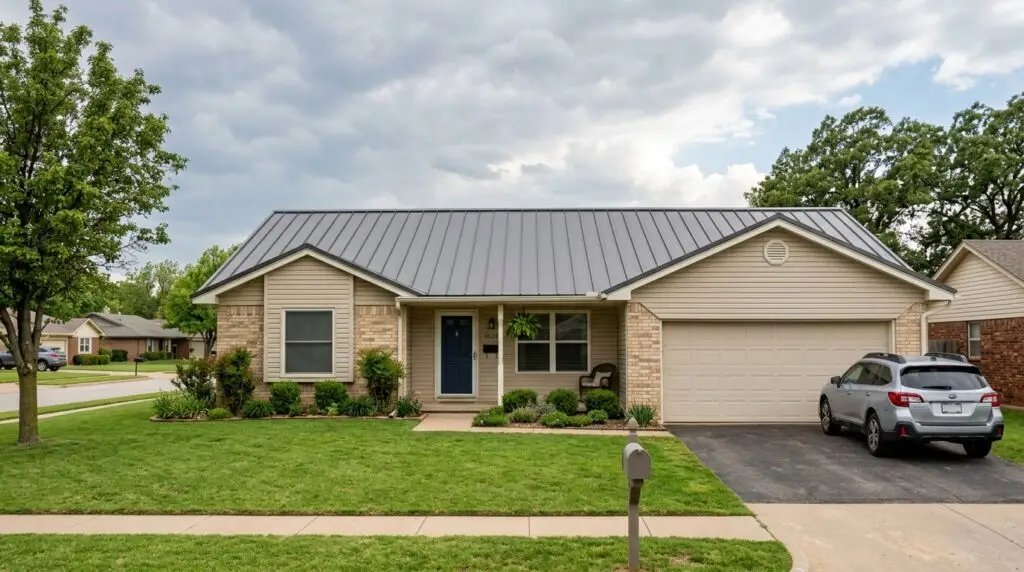
For the majority of Oklahoma City homeowners, Galvalume steel is the superior choice. It’s stronger against hail impact, less expensive than aluminum, inherently Class A fire rated, and purpose-built to perform in Oklahoma’s inland climate. The corrosion arguments that make aluminum appealing in coastal markets simply don’t apply here.
Aluminum makes sense in specific situations: older homes with structural weight limitations, complex architectural profiles, or certain low-slope commercial applications. But for a standard OKC residential installation? Steel is the practical, storm-smart choice.
Here’s the most important thing to keep in mind: the material decision matters, but the installer’s experience with Oklahoma’s specific climate conditions may matter just as much. A properly installed 24-gauge Galvalume standing seam system, installed by a licensed Oklahoma contractor who understands local code and storm exposure, will outperform a better material installed by an inexperienced team.
Don’t let coastal-focused national content push you toward aluminum for corrosion reasons. That argument doesn’t hold in Oklahoma City. Ask your contractor about gauge, fastener spec, and wind uplift compliance and get it in writing.
Explore Our Metal Roofing Services in Oklahoma City
Whether you’re researching your first metal roof or dealing with storm damage from a recent hail event, we’re here to help. Explore our services:
- Metal Roof Installation standing seam and exposed fastener systems for OKC homes
- Metal Roof Repair panel replacement, seam sealing, and post-storm restoration
- Metal Roof Inspection professional assessment after hail and wind events
- Storm Damage Services insurance documentation, emergency response, and damage evaluation
- Service Areas Oklahoma City, Edmond, Moore, Norman, Yukon, Mustang, Midwest City, and surrounding communities
Frequently Asked Questions: Aluminum vs. Steel Metal Roofing in Oklahoma
| Is aluminum or steel better for hail in Oklahoma City? | Steel is the stronger choice. Its greater density and hardness resist denting better under the 1–2.5″ hailstones common in OKC. Galvalume steel at 24-gauge is what most experienced local contractors recommend for storm-exposed homes across the metro. |
| Does a metal roof lower homeowners insurance in Oklahoma? | It can. Many Oklahoma carriers offer premium discounts for impact-rated metal roofing. Steel panels with a Class 4 impact rating tend to qualify for the largest reductions. Always verify directly with your insurer and keep your product documentation handy. |
| What is Galvalume and is it better than regular steel or aluminum? | Galvalume is a steel panel coated with a blend of aluminum and zinc. It combines steel’s structural strength with improved corrosion performance. For inland Oklahoma homes, it’s generally the optimal choice and it’s what most “steel roof” quotes in OKC actually include. |
| How long does a steel metal roof last in Oklahoma? | With quality installation and regular post-storm inspections, a Galvalume steel standing seam roof can realistically last 40–50+ years in Oklahoma’s climate. Material longevity is closely tied to installation quality and gauge selection. |
| Will an aluminum roof dent from Oklahoma hail? | Yes aluminum is softer than steel and more susceptible to visible denting. In Oklahoma’s severe hail environment, this is a real concern, especially for larger stones. Thicker gauge aluminum reduces the risk but doesn’t eliminate it. |
| Can I install a metal roof over my existing shingles in OKC? | In many cases, yes but it depends on your roof deck condition, local building code, and structural load capacity. A licensed Oklahoma roofing contractor should assess your specific home before any overlay installation is considered. |
| Which metal roof is more energy efficient for Oklahoma summers? | Both steel and aluminum reflect radiant heat and significantly outperform asphalt shingles for energy efficiency. Aluminum dissipates heat slightly faster, but both materials paired with proper insulation and ventilation perform well in Oklahoma’s hot climate. |
Ready to get a quote for your OKC home? Contact our team for a free metal roofing consultation.
Serving Oklahoma City · Edmond · Moore · Norman · Yukon · Mustang · Midwest City