Metal roofing is one of the best investments an Oklahoma City homeowner can make. It handles hail better than asphalt, sheds wind-driven rain, reflects summer heat, and when properly maintained lasts for decades. But here’s the thing most homeowners don’t fully grasp when they install a metal roof: low maintenance does not mean zero maintenance. Especially not in Oklahoma.
Oklahoma’s climate puts more stress on a roofing system than most people realize. You’ve got 100-plus-degree summers baking the panels, ice storms in January, spring hailstorms that arrive fast and hit hard, and wind events that test every fastener and seam on the roof. A metal roof installed in Portland or Dallas faces a completely different set of conditions than one sitting over a home in Edmond, Yukon, or Midwest City.
This guide walks you through exactly what it takes to maintain a metal roof in Oklahoma’s climate season by season, system by system. Whether you have a standing seam roof on your home or an exposed fastener system on a workshop, you’ll find practical guidance here that most competitors simply don’t cover.
Why Oklahoma’s Climate Creates Unique Demands on Metal Roofs
Before you can maintain a metal roof properly, you need to understand what it’s up against.
Oklahoma sits in the heart of Tornado Alley. Spring storms bring hail ranging from pea-sized to baseball-sized or larger. Summers push roof surface temperatures well above air temperature panels on a south-facing slope can reach temperatures that most homeowners would find surprising. Then winter arrives with ice storms, freeze-thaw cycling, and occasional heavy snow loads.
The result is a roofing environment defined by thermal cycling the repeated expansion and contraction of metal panels as temperatures swing dramatically between seasons, and even between morning and afternoon on a single day. This movement is completely normal. Metal is supposed to expand and contract. But when a roof hasn’t been installed with adequate allowance for that movement, or when fasteners and sealants haven’t been checked in years, that thermal cycling starts causing problems.
Oklahoma also ranks among the highest states nationally for hail frequency. That matters because even a metal roof that resists functional hail damage meaning it keeps water out can sustain coating damage that opens the door to corrosion if left unaddressed. Oklahoma’s humidity after a storm creates the conditions for that corrosion to move fast.
In our experience, homeowners who understand these dynamics take maintenance more seriously. And roofs that get periodic attention simply perform better, longer.
Your Oklahoma Metal Roof Maintenance Calendar: What to Do Each Season
Most maintenance guides hand you a generic checklist. We’re going to do it differently tied to what Oklahoma’s weather actually does to your roof throughout the year.
Spring (March–May): Your Most Important Maintenance Window
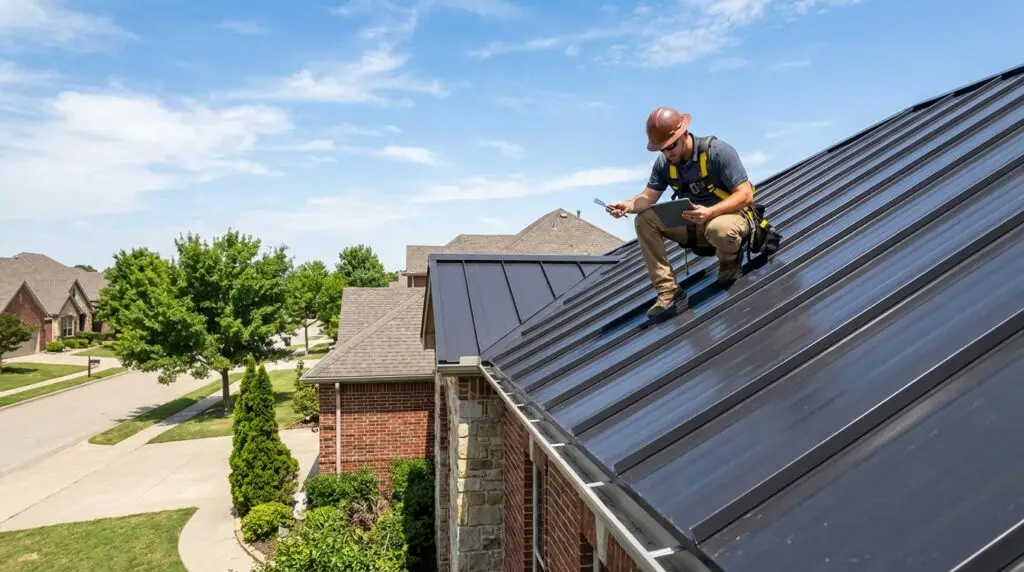
Spring is the critical window. Before severe weather season hits in earnest, get eyes on your roof. Specifically, check flashing condition around any roof penetrations, inspect ridge cap integrity, and if you have an exposed fastener system look for any fasteners that are backing out or showing deteriorated washers.
Spring is also when you should clear any debris that accumulated over winter. Leaves and small branches trapped in roof valleys hold moisture against the metal surface. Over time, that creates the conditions for surface rust and coating breakdown.
If you haven’t had a professional inspection in the past year, schedule one before May. That’s when Oklahoma’s most active hail and tornado weather arrives.
Summer (June–August): Heat Expansion and Coating Watch
Oklahoma summers are hard on roof coatings. UV exposure at this intensity accelerates the breakdown of lower-grade finish systems. If your roof has a Kynar 500 (PVDF) coating, you’re in good shape it’s the industry standard for UV and humidity resistance. If your roof was finished with a standard polyester paint system, summer is when you’ll see it show wear sooner.
During summer, also check that your gutters are flowing freely. Heavy afternoon thunderstorms are common in OKC, and a clogged gutter during a downpour can back water up against the fascia and roof edge. That edge detail is a vulnerability on any metal roofing system.
Fall (September–November): Post-Storm Assessment and Pre-Freeze Prep
By September, you’ve made it through the worst of storm season. But don’t skip the fall inspection. This is when you review any coating damage from summer hail events, check sealant condition around penetrations before it gets too cold to apply new product, and clear the gutters of fall leaf accumulation.
If you haven’t documented the roof’s condition going into winter, you’re leaving yourself exposed if a storm hits in the off-season and you need to file a claim.
Winter (December–February): Ice, Ventilation, and Condensation
Most metal roof failures in winter trace back to one of two things: ice load building in areas where drainage was restricted, or condensation developing in the attic space due to inadequate ventilation. Check your attic for moisture signs staining, mold growth, or frost on the underside of the deck before temperatures drop hard.
Metal conducts cold. If your attic isn’t properly ventilated and insulated, you can end up with condensation issues that have nothing to do with the roof panels themselves, but everything to do with the system as a whole.
Fastener and Seam Maintenance: The Most Overlooked Problem in OKC Metal Roofs
Here’s where most homeowners and even some roofing contractors miss something critical.
Not all metal roofing systems have the same maintenance needs. The type of system on your roof determines exactly what you should be checking and how often.
Exposed Fastener Systems
On an exposed fastener metal roof the kind commonly used on garages, shops, workshops, and many Oklahoma homes the screws pass through the panel into the decking or framing beneath. Each screw has a neoprene washer that creates a seal at the penetration point.
Over time, Oklahoma’s thermal cycling causes those screws to work back and forth in their holes. The washer degrades. The seal weakens. And eventually, water finds its way in not because the panel failed, but because a fastener detail that was never checked finally gave out.
Most homeowners don’t realize this is happening until they see water staining on the ceiling. By then, the intrusion has likely been occurring for a while.
With exposed fastener systems, have a qualified contractor check fastener condition every few years and always after a significant hail or wind event. Do not simply crank screws tighter yourself. Overtightening compresses the washer unevenly and can actually accelerate failure.
Standing Seam Systems
Standing seam systems use concealed clips rather than face fasteners. The clips allow the panels to float and move with thermal expansion which is why standing seam performs better than exposed fastener systems over long time horizons in Oklahoma’s heat cycling environment.
That said, standing seam isn’t maintenance-free either. The areas to watch are the transitions: ridge caps, eave edges, and any HVAC penetrations or curbs on the roof surface. These transition details rely on sealants and flashing, both of which degrade over time regardless of the panel system beneath them.
How to Inspect Your Metal Roof After an Oklahoma Hailstorm
Oklahoma’s spring supercell thunderstorms are a different animal from typical hailstorms. The rotational dynamics produce hail that travels at a significant horizontal angle sometimes nearly parallel to the ground. That means impact forces that standard ground-level inspections almost always underestimate.
Here’s what to do after a significant storm hits your area:
Start from the ground. A pair of binoculars can tell you a lot look for obvious panel deformation, lifted ridge caps, or displaced flashing. But understand what you’re seeing and what you’re not. You cannot assess coating integrity, fastener condition, or seam stress from the ground. Ground-level observation is a starting point, not a conclusion.
Know the difference between cosmetic and functional damage. A metal roof with surface dents from hail is not a failed roof. The panel is still shedding water. Cosmetic denting is not the same as a leak-producing breach and your insurance policy likely treats them differently. What you’re looking for functionally is: coating damage that exposes bare metal, flashing that has separated, fasteners that have backed out or lost washer integrity, or seams that have shifted.
Act on coating damage within 30–60 days. When hail chips or scratches a metal panel’s coating whether it’s a Galvalume finish, Kynar paint system, or stone-coated aggregate bare metal is exposed to Oklahoma’s humidity. That’s when corrosion starts. Touch-up coating is inexpensive. Waiting is not.
Call a metal roofing specialist, not a general roofer. An inspector whose daily work is asphalt shingles is evaluating granule loss, tab bruising, and cracking. None of those apply to metal. They may completely miss fastener backing, seam stress, or coating micro-damage that a metal-experienced contractor would catch immediately.
Flashing, Sealant, and Penetration Maintenance in Oklahoma’s Wet Storm Season
If fasteners are the most overlooked maintenance item on metal roofs, flashing is a close second.
Flashing covers every transition on your roof around chimneys, vent pipes, HVAC curbs, skylights, and roof edges. These are the points where two different planes or materials meet, and they’re sealed against water intrusion with metal flashing and sealant.
Oklahoma’s wind-driven rain hits these transitions at angles that standard rainfall doesn’t replicate. A seam that’s watertight in a vertical rainstorm may allow intrusion when wind is driving water horizontally at 60 miles per hour. This is why flashing failures are so common after Oklahoma storms and so often the source of post-storm leaks.
Sealants in Oklahoma don’t last as long as they do in milder climates. The UV intensity and extreme heat cycles accelerate the breakdown of most sealant products. In our experience, sealant around penetrations should be visually inspected every year and proactively replaced on a schedule that accounts for Oklahoma’s climate not a national average lifespan from a product data sheet.
Signs to watch: sealant that has cracked, pulled away from the flashing surface, or turned brittle. If it’s starting to look dried out, it’s already partway to failure.
Keeping Your Metal Roof’s Coating Intact: What Oklahoma Humidity Does to Scratches and Chips
Most people think of rust as a slow problem. In Oklahoma, it doesn’t always move slowly.
When a metal panel’s protective coating is breached by hail impact, a falling branch, foot traffic from a technician installing HVAC equipment, or even debris dragged across the surface during a storm bare steel is exposed. Oklahoma’s post-storm humidity creates ideal conditions for surface oxidation to begin. Left unaddressed, a small scratch can become a rust track that compromises the panel over time.
Between you and me, this is one of the most preventable problems we see on metal roofs in the OKC area. Touch-up paint matched to your roof’s coating system is inexpensive. The window to act is roughly 30–60 days before Oklahoma’s humidity starts working against you.
Cleaning Without Damaging Your Coating
Keeping your metal roof clean is part of maintaining its protective system. But cleaning it wrong causes the very damage you’re trying to prevent.
Use a soft brush or cloth with a mild detergent solution. Rinse with a garden hose. That’s it. Never use a pressure washer on a metal roof the pressure can compromise panel seams, strip coating, and force water behind flashing in ways that show up as leaks days or weeks later. Also avoid abrasive scrubbing materials that scratch the finish.
Check your manufacturer’s warranty documentation for approved cleaning methods. Using unapproved products or methods can void coverage you’ve paid for.
Tree Branches: A Frequently Ignored Coating Hazard
In Oklahoma City neighborhoods with mature tree canopy areas like Nichols Hills, Edmond’s established subdivisions, or parts of Moore near older residential streets overhanging branches are a real coating risk. When a branch rubs against a metal panel repeatedly in wind, it acts like sandpaper. It doesn’t take long to create a scratch that exposes bare metal.
Trim any branches that overhang or contact the roof. This is one of the simplest and most effective maintenance steps available to a metal roof owner.
Gutter System Maintenance That Protects Your Metal Roof’s Edge and Fascia
Metal roofs shed water efficiently that’s one of their advantages. But where that water goes matters.
Gutters direct roof runoff away from your foundation and away from the roof’s edge and fascia detail. When gutters clog, water backs up. On a metal roof, that backup can push water behind the drip edge, saturate the fascia board, and create a chronic moisture problem at the roof’s perimeter the same area where flashing and panel edges meet.
In OKC, plan to clean gutters at minimum twice per year: once in late spring after storm season debris accumulates, and once in late fall after the leaves are down. If you have large trees near the home, quarterly cleaning may be warranted.
Also check that downspouts are directing water far enough from the foundation. This is a whole-system issue not just a roofing issue but it starts with keeping your gutters clear.
When Maintenance Isn’t Enough: Elastomeric Coating Restoration for Aging Metal Roofs
At some point, routine maintenance reaches its limits. Sealants have been replaced multiple times. The panel coating is showing age. Fastener areas on an exposed fastener system are developing chronic leak points.
Before you jump to full replacement which is a significant expense elastomeric coating restoration is worth understanding.
Elastomeric coatings are liquid-applied systems that create a seamless, rubber-like membrane across the entire roof surface. They seal over fastener penetrations, cover seam areas, and provide a fresh waterproofing layer. Critically, elastomeric coatings are designed to stretch and recover with thermal movement which makes them well suited to Oklahoma’s dramatic temperature swings.
For metal roofs showing age-related wear but with structurally sound panels, elastomeric coating can extend the roof’s useful life meaningfully at a fraction of full replacement cost. Silicone-based systems offer strong UV resistance and perform well in Oklahoma’s heat. Acrylic coatings are more budget-friendly but less effective in ponding water situations.
It depends on several factors panel condition, system type, slope, and drainage so have a qualified contractor evaluate whether restoration is the right path or whether replacement is the better long-term investment.
Maintenance Records, Insurance Claims, and Protecting Your Metal Roof’s Warranty
This section matters more than most homeowners expect, and most competitors don’t cover it at all.
Oklahoma’s insurance market is challenging. Homeowners here pay among the highest insurance premiums in the country, largely because of storm exposure. Documented roof maintenance is one of the things that works in your favor when a claim arises.
When you file a claim after a hail or wind event, an adjuster will evaluate the roof’s condition. A well-maintained roof with documented inspection records, prompt post-storm repairs, and a clear history is a much easier claim to support than a roof with no maintenance record. Documentation shows you’ve been a responsible owner and that the damage is storm-related not the result of deferred maintenance.
Keep a simple log: date, what was done, who did it, any storm events observed. Photographs with timestamps are valuable. This doesn’t require a complicated system. A folder on your phone or a basic document works.
Equally important: understand your manufacturer warranty. Most metal roofing warranties require periodic professional inspections and prompt repair of any damage. Letting coating damage sit unaddressed, or using unapproved cleaners, can give a manufacturer grounds to limit warranty coverage. Read the documentation that came with your roof and maintain accordingly.
Common Metal Roof Maintenance Mistakes Oklahoma Homeowners Make
Avoiding mistakes is as important as doing the right things. Here are the ones we see most often.
Waiting for a leak before inspecting. By the time water appears inside your home, the intrusion has usually been developing for a while. Proactive inspections find problems when they’re small.
Using a pressure washer. We’ve addressed this, but it bears repeating pressure washing a metal roof causes damage that voids warranties and creates the exact moisture vulnerabilities you’re trying to prevent.
Assuming “low maintenance” means “never maintain.” Metal roofs require far less maintenance than asphalt, but they aren’t self-managing. Thermal movement, UV exposure, and Oklahoma’s storms create wear over time that needs periodic attention.
Hiring the wrong inspector after hail. A general roofing contractor experienced in asphalt work will evaluate your metal roof using the wrong criteria. Find a contractor with documented metal roofing experience for post-storm inspections.
Ignoring a coating scratch or chip. In Oklahoma’s humidity, exposed bare metal after a storm should be treated within 30–60 days. Leaving it is a slow-moving but preventable mistake.
Frequently Asked Questions About Metal Roof Maintenance in Oklahoma
How often should I have my metal roof inspected in Oklahoma?
Twice per year ideally in spring before hail season and in fall before winter plus after any significant storm. Oklahoma’s weather is active enough that annual inspections alone aren’t sufficient for a system you expect to last 40–70 years.
Does a metal roof really need maintenance if it’s supposed to last so long?
Yes. Longevity depends on how the system handles years of thermal movement, UV exposure, and storm impact. Fasteners loosen, sealants degrade, and coatings sustain damage over time. Periodic maintenance is what makes the difference between a roof that reaches its expected lifespan and one that develops chronic problems well before it should.
What should I check on my metal roof after a hailstorm in OKC?
Focus on five areas: coating integrity at impact points, flashing condition around all penetrations, fastener and washer integrity on exposed fastener systems, ridge cap seating, and any visible seam separation. Start from the ground with binoculars, then call a metal-experienced contractor to evaluate what you can’t see.
Will my metal roof rust in Oklahoma’s climate?
Not if the protective coating stays intact. Galvalume and Kynar 500 coatings are designed to resist corrosion under normal conditions. The risk rises when coating is scratched, chipped, or damaged by hail or debris and left unaddressed. Oklahoma’s post-storm humidity accelerates that process which is why prompt touch-up after coating damage matters here more than in drier climates.
How do I clean a metal roof without damaging it?
Use a soft cloth or brush with a mild detergent and water, then rinse with a garden hose. Avoid pressure washers, abrasive materials, and any cleaning product not approved by your panel manufacturer. Cleaning the wrong way can strip coating, void warranties, and cause seam issues.
Does maintaining my metal roof affect my Oklahoma homeowner’s insurance?
Yes in two important ways. Documented maintenance supports your position in a storm damage claim by showing the damage is weather-related rather than deferred maintenance. Additionally, some Oklahoma insurers offer premium reductions for impact-resistant roofing systems, and keeping your roof well maintained preserves the system’s ratings and certifications that qualify you for those discounts.
What’s the cost range for metal roof maintenance in Oklahoma City?
Routine professional inspections typically run in the range of a few hundred dollars. Sealant reapplication around penetrations varies depending on the number and complexity of roof features. Elastomeric coating restoration for an aging metal roof is a larger investment generally a fraction of full replacement cost and is worth evaluating when a system is showing age-related wear. Get a specific assessment for your roof rather than relying on general estimates, as slope, system type, and condition all affect cost significantly.
Need a professional metal roof inspection in Oklahoma City or the surrounding area? Contact our team to schedule an assessment we specialize in metal roofing systems and understand what Oklahoma’s climate demands from your roof. See our Metal Roof Installation, Storm Damage Services, Metal Roof Repair, and Service Areas pages for more information.