Oklahoma City sits squarely in one of the most storm-aggressive roofing environments in the country. If you own a metal roof here in OKC, Moore, Norman, Edmond, Yukon, or anywhere across the metro your roof is working harder than almost anywhere else in the United States.
Metal roofs are built to last 40 to 70 years. But here’s the thing: they’re not maintenance-free, and they’re certainly not immune to the specific punishment that Oklahoma weather dishes out. Hail the size of golf balls. Straight-line winds hitting 70-plus miles per hour. Rapid temperature swings that can go from 100°F in July to a hard freeze by November. All of that takes a toll.
Understanding the most common metal roof problems and knowing exactly how to fix them is the difference between a roof that lives up to its potential and an expensive repair bill nobody saw coming. This guide covers everything: from leaks and fastener failure to hail damage, rust, and oil canning. We’ll also tell you when to call a professional and when you can handle something yourself.
Why Oklahoma City Metal Roofs Face Unique Challenges
Oklahoma’s Place in ‘Hail Alley’
Most homeowners don’t realize how extreme Oklahoma’s storm exposure actually is. The state sits at the heart of ‘Hail Alley,’ a high-risk corridor stretching from the Central Plains into Canada. Oklahoma consistently ranks among the top five states nationally for hail frequency, and the OKC metro is right in the thick of it. Communities like Moore, Norman, Edmond, Yukon, and Mustang all fall within the same high-exposure zone.
What makes OKC storms especially damaging isn’t just the hail it’s the combination. Storms here regularly pair large hailstones with straight-line winds reaching 60 to 80 mph. When wind-driven hail hits your roof at an angle, rather than straight down, the impact exceeds what most standard material ratings are tested for. The result is damage patterns that look different from what most national guides describe.
Thermal Stress From Oklahoma’s Temperature Extremes
Beyond storms, Oklahoma’s rapid temperature swings create constant stress on metal roof systems. Metal expands in the summer heat and contracts when it cools. In a climate where summer days regularly hit triple digits and winters bring hard freezes, that expansion-contraction cycle is extreme. Over time, it puts serious strain on fasteners, seams, and panel coatings especially if the system wasn’t installed with adequate allowance for thermal movement.
Understanding these local factors is the starting point for everything else in this guide.
Metal Roof Leaks: Tracking Down the Source
Why Metal Roofs Leak (And It’s Usually Not the Metal)
When a metal roof leaks, most homeowners assume the panels themselves have failed. In our experience, that’s rarely the case. The metal isn’t the problem it’s almost always a fastener, flashing, or sealant issue.
The most common sources of leaks on metal roofs are: failed or deteriorated sealant at penetrations (pipes, HVAC curbs, chimneys), over-tightened or under-tightened fasteners that have created gaps, improperly lapped panel seams, and flashing that wasn’t installed to move with the metal.
There’s an OKC-specific wrinkle here that most national articles miss entirely. Oklahoma storms drive rain at steep angles not straight down. A panel overlap or flashing detail that’s rated for vertical rainfall can still allow wind-driven water to get underneath. That’s why leaks often show up after severe storms even on otherwise solid roofs.
Exposed Fastener vs. Concealed Fastener Systems: The Repair Difference
Not all metal roofs are the same, and the type of system you have determines how you find and fix a leak.
Exposed fastener (screw-down) systems have visible screws along the panel ribs. These are easier to inspect and repair you can actually see which screws have backed out or lost their washers. Concealed fastener systems (like standing seam) hide all fasteners under the metal, making them more weathertight by design but more complex to troubleshoot when something does fail.
If you have a screw-down system and notice rust streaks running down from screw locations, that’s your leak source. On a standing seam system, the culprit is usually a seam that’s partially lifted or a clip that’s corroded.
Temporary Fix vs. Professional Repair
If you’ve confirmed a leak and need to buy time before a contractor can get out, butyl tape applied over the affected seam or screw location is the best short-term option. Elastomeric sealant works as a temporary bridge around pipe boots and penetrations. Be honest with yourself about what ‘temporary’ means here these aren’t permanent solutions.
Call a professional when: you have active water intrusion reaching the decking below the panels, you notice a musty smell that could indicate mold inside the roof assembly, or you can’t identify the source from a safe ground-level and gutter inspection.
| Expert Tip:
Before climbing onto any wet or storm-damaged metal roof, survey soft-metal surfaces at ground level first. Dents in your gutters, HVAC condenser fins, and window screens tell you a lot about hail size and they keep you safely on the ground while you gather that information. |
Fastener Failure and Panel Movement
What Happens When Metal Roof Screws Back Out
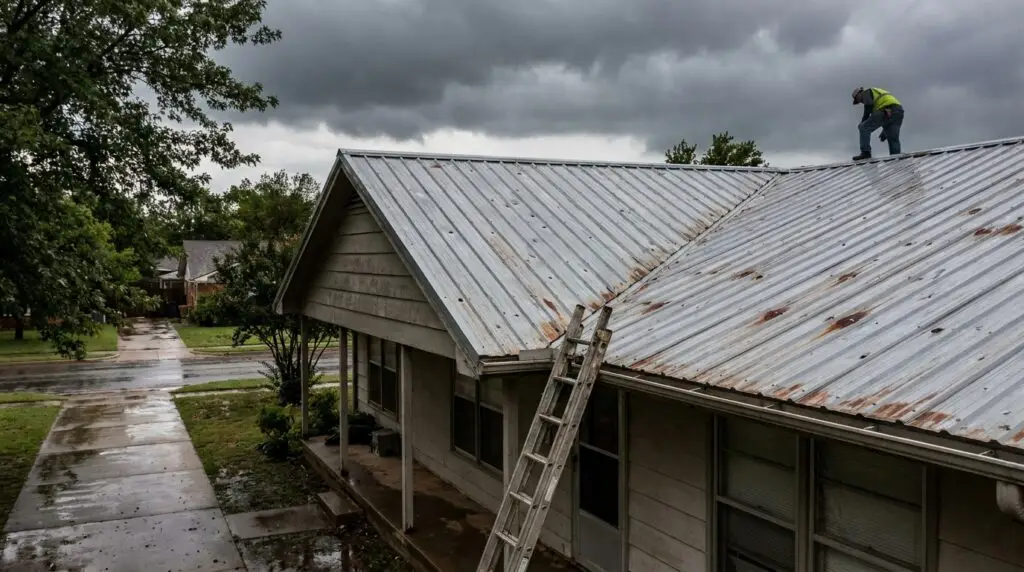
This is probably the most underappreciated metal roof problem, and it’s one we see constantly on OKC homes with older screw-down systems. Over time and especially in a climate like Oklahoma’s thermal expansion and contraction causes screws to gradually back out of the decking below. When a screw backs out even a fraction of an inch, the EPDM rubber washer beneath the screw head loses its compression seal, and you have a potential water entry point.
Signs to look for: small rust streaks below screw heads when viewed from the ground, any visible lifted panel edges along the seams, or interior drip spots that appear specifically during or just after rainfall.
The Washer Problem Most Homeowners Don’t Know About
EPDM rubber washers the little rubber gaskets under each exposed screw have a limited lifespan. In Oklahoma’s intense UV environment, those washers can harden, crack, and lose their seal well before the metal panels themselves show any wear. This is one of the primary reasons screw-down metal roofs develop leaks after 10 to 15 years even when the metal is otherwise in good shape.
The fix is re-torquing screws and replacing damaged washers. Important note: never re-use an EPDM washer once it’s been removed. The compression set is permanent that washer won’t seal properly again no matter how tight you run the screw.
If you have a standing seam system, the failure mode is different. Look for clip corrosion at panel attachment points, or ‘panel walk’ where panels have shifted laterally over time due to thermal movement without adequate clip allowance.
Hail Damage on Metal Roofs: What It Actually Looks Like
Real Hail Damage vs. Normal Surface Wear
This is where a lot of OKC homeowners get confused and where a lot of insurance claims either succeed or fall apart. Not all marks on a metal roof are hail damage, and not all hail damage looks the same on metal as it does on asphalt shingles.
On metal, hail creates visible surface dents on flat panel areas and ridge caps. It may chip or crack the paint coating at the impact point, exposing bare metal beneath. On ribbed or corrugated panels, impacts are partially absorbed by the profile geometry the damage may be less visible but still present in the form of micro-fractures in the coating.
Normal surface wear, by contrast, looks like gradual chalking or fading of the finish uniform across the roof surface, not concentrated in circular impact patterns. Scratches from debris or foot traffic are typically linear, not round.
The Hidden Risk: How Hail Starts Rust
Here’s something most homeowners don’t realize until it’s too late. When hail chips the protective coating on a metal panel, it creates a bare metal exposure point. In Oklahoma’s humid summers, that exposed metal becomes a rust initiation site and rust can spread laterally under the remaining coating before it’s ever visible on the surface.
That’s why hail damage on metal roofs needs to be addressed even when it doesn’t immediately cause a leak. The structural timeline looks fine right after the storm. Six months later, you’re dealing with corrosion spreading outward from every impact point.
Functional Damage vs. Cosmetic Damage: What Matters for Your Insurance Claim
Oklahoma homeowner insurance policies typically cover hail damage that is ‘functional’ meaning it compromises the roof’s ability to protect the structure. Purely cosmetic denting, where the paint is intact and there’s no coating breach, is often not covered under standard policies.
This distinction matters enormously when you’re dealing with an adjuster. Before any contractor touches your roof, document soft-metal damage at ground level: gutters, HVAC condenser fins, window screens. These are your best proxy evidence for hail size and impact force, and they’re the documentation that supports a functional damage determination.
| OKC Storm Warning:
Oklahoma’s peak hail season runs April through June. Hailstones reaching 4 to 6 inches in diameter have been recorded across the metro area. At that size, even premium metal panels can sustain functional damage. Don’t wait for a leak to appear before scheduling an inspection after a major storm. |
Rust and Corrosion: Causes, Warning Signs, and Fixes
The Four Types of Corrosion on Oklahoma Metal Roofs
Not all rust is the same. Understanding which type you’re dealing with determines the right fix.
Standard surface oxidation develops when a protective coating is scratched, worn, or breached the metal substrate is exposed to oxygen and moisture. This is the most common type and the most fixable if caught early.
Underside corrosion occurs when moisture becomes trapped beneath the metal panels without adequate ventilation. In Oklahoma’s humid summers, this can develop faster than most homeowners expect, especially in roofs with poor vapor barrier installation.
Flow-accelerated corrosion happens when high-velocity wind and rain physically strip the protective layer from the metal surface over time a particular concern in OKC’s storm-heavy climate.
Galvanic corrosion is the one nobody talks about. This occurs when two dissimilar metals come into contact with each other in the presence of moisture. It’s an electrochemical reaction, and it’s destructive. On OKC homes, the most common culprit is copper drain lines from rooftop HVAC units making contact with steel roof panels. The copper and steel react, and the steel loses. We’ve seen this damage panels much faster than any weather exposure alone.
How to Treat Surface Rust Before It Becomes Structural
If you catch surface rust early small patches, no deep pitting, coating intact around the edges the repair process is straightforward. Wire-brush the affected area to remove loose rust and scale. Apply a rust-inhibiting primer rated for metal roofing, let it cure fully, then finish with a metal-matched topcoat. Color matching matters both aesthetically and practically a quality topcoat adds UV protection back to the repaired zone.
When rust has progressed to the point where you can feel structural thinning or the metal flexes where it shouldn’t that’s panel replacement territory. Surface treatment won’t stop corrosion that has compromised the metal’s thickness.
Oil Canning and Panel Warping: Is It a Problem?
What Oil Canning Actually Is
Oil canning is one of those terms that causes a lot of homeowner anxiety and in most cases, that anxiety is unnecessary. Oil canning is simply visible waviness or rippling in the flat areas of metal panels. It’s a characteristic of light-gauge metal under stress, not a defect, and it doesn’t affect the weathertightness of the roof in most situations.
It occurs when metal panels are over-stressed whether from manufacturing (extreme pressure during coiling), improper installation tension, insufficient thermal expansion allowance, or substrate irregularity beneath the panels. In Oklahoma, where summer heat can push panel temperatures well above ambient air temperature, oil canning that’s barely visible in March may become more pronounced by July.
When to Take It Seriously
Between you and me, most oil canning is a visual issue and nothing more. However, if oil canning appeared shortly after installation especially if it’s pronounced and accompanied by stress sounds during temperature changes it may indicate that the panels don’t have adequate room to expand and contract. Over time, that can translate to fastener stress and eventual seam problems.
Post-installation options are limited. A matte finish coating reduces the visual appearance significantly (shiny surfaces show waviness more dramatically). Some panel profiles incorporate small striations or ribs specifically to interrupt the flat plane and reduce visible oil canning. If you’re still in the selection phase, this is worth discussing with your contractor before panels are ordered.
Flashing Failures: The #1 Preventable Cause of Metal Roof Leaks
Why Flashing Deserves More Attention Than It Gets
Ask any experienced OKC metal roofing contractor where most leak callbacks originate, and the answer is almost always flashing not the metal panels. Flashing is the system of metal components and sealants that bridges the transition between your roof panels and any penetration: chimneys, plumbing vents, HVAC curbs, skylights, and roof-to-wall connections.
Oklahoma homes have a lot of rooftop HVAC equipment. Each unit requires a custom-fit curb flashing that allows for the thermal movement of the metal panels around it. When that flashing is rigid, improperly sized, or relies too heavily on sealant as the primary water barrier, it fails often within just a few years of installation.
Signs Your Flashing Is Failing
Water staining on interior ceilings adjacent to a chimney or HVAC unit is the most obvious sign. But visible sealant cracking around pipe boot flashings those rubber-booted collars around plumbing vents is a warning sign you can catch from the ground with binoculars. Look also for any visible daylight around chimney aprons or any flashing that has lifted away from the wall or roofing surface.
What Proper Flashing Looks Like
Good metal roof flashing uses two-piece counter-flashing at chimneys and walls, proper step flashing where a roof meets a vertical surface, and boot flashings with adequate collar height at pipe penetrations. Sealant should be a secondary water barrier not the primary one. Any contractor who answers ‘caulk’ when you ask how they’re flashing your chimney should raise a red flag.
Noise, Condensation, and Ventilation Problems
Why Metal Roofs Are Louder During Oklahoma Hailstorms
No point in sugarcoating this one. Metal roofs are louder than asphalt shingles during rain and hail, and in Oklahoma where hailstorms are frequent and sometimes intense that’s a real consideration. The fix isn’t something you can apply after the fact very easily; the most effective noise reduction comes from proper underlayment selection at installation. Closed-cell spray foam, rigid insulation boards, or acoustic-rated underlayment all significantly dampen sound transmission.
If you have an existing metal roof and the noise is a problem, adding insulation to the attic space below can help, though it won’t eliminate the sound entirely.
Condensation: Oklahoma’s Humidity Creates a Hidden Moisture Problem
Oklahoma’s humid summer air carries significant moisture vapor. When that vapor moves through a roof assembly and contacts the underside of cool metal panels, it condenses and that moisture buildup inside the roof system mimics a leak without any water ever getting through the panels themselves.
The fix is a properly installed vapor barrier beneath the metal panels, combined with adequate attic ventilation typically ridge vents paired with soffit vents to create continuous airflow. If your metal roof was installed directly over existing decking without a vapor barrier, and you’re seeing unexplained moisture on the attic side, this is worth investigating before assuming you have a panel leak.
Oklahoma City Metal Roof Maintenance Schedule
Spring Inspection (March–May): Post-Storm Season Readiness
Spring is the most critical maintenance window for OKC metal roofs it’s both the season with the highest storm risk and the right time to assess anything winter left behind. Walk the perimeter of your home. Use binoculars to look at flashing conditions, screw head rust streaks, and any visible panel lifting. Check gutters for granule accumulation (a sign the coating is degrading) and for any dents that indicate hail size from recent events.
After any significant OKC hail event, document soft-metal surfaces first gutters, HVAC unit exterior, window screens with date-stamped photos before calling anyone. This documentation is your insurance claim foundation.
Summer Maintenance for Oklahoma Heat
Summer heat in OKC accelerates coating degradation, especially on south- and west-facing roof sections that take the most direct UV exposure. Check that HVAC condensate drains are clear and draining away from the roof surface standing condensate water is an underrated corrosion accelerant. Clear any debris accumulation in panel ribs or valleys, which traps moisture and organic material against the metal.
Fall and Pre-Winter Checks
Clear gutters before leaf season sets in backed-up gutters create ice dam risk and water ponding against roof edges. Check ridge cap seals before freeze-thaw cycles begin. Any sealant that’s cracked or pulling away should be replaced before winter, not after. Inspect valley flashing for debris accumulation, which can divert water into seams during ice events.
After Any Major OKC Storm
The 24 to 48 hours after a significant storm are critical. Don’t climb onto a wet or debris-covered roof use ground-level assessment first. If you observe obvious damage from the ground or document hail impact on soft-metal surfaces, schedule a professional inspection promptly. Many Oklahoma homeowner policies have a filing window that closes well before the damage manifests as an interior leak.
Repair vs. Replace: How to Make the Right Call
Signs Your Metal Roof Can Be Repaired
Isolated panel damage from a single impact, fastener failure concentrated in a specific section, localized coating loss without underlying corrosion, or a single-point flashing failure all of these are repair scenarios. If the damage is limited and the rest of the system is structurally sound, repair is almost always the better financial decision on a metal roof, given how long these systems last.
When Replacement Makes More Financial Sense
It depends on several factors. Widespread panel corrosion especially if it’s the underside type from a ventilation failure means you’re likely replacing panels across a significant portion of the roof. Repeated leak callbacks in multiple unrelated locations suggest a systemic installation problem that can’t be patched location by location. Storm damage covering a large percentage of the roof surface may reach the threshold where your insurance claim makes a full replacement more economical than partial repair.
What to Expect on Repair Costs in Oklahoma City
Minor repairs sealant replacement, washer re-torquing, single flashing correction typically fall in the low-to-mid hundreds of dollars range. Panel section replacement or multi-point flashing repair runs higher, into the mid-to-high hundreds or low thousands depending on scope and access difficulty. Full replacement is a multi-thousand dollar investment that varies significantly with roof size, panel type, and pitch.
Get multiple quotes. Ask specifically whether each contractor has metal roofing experience not just general roofing experience. A shingle crew attempting metal roof repair is the single most common cause of improper installation callbacks in OKC, and it’s entirely preventable.
Navigating Your Insurance Claim After Storm Damage
Document before anyone touches anything. Date-stamped photos and video, capturing both the roof (safely, from ground or ladder at the edge) and all soft-metal surfaces, are the backbone of any successful claim. Report to your insurer promptly Oklahoma storm damage claims typically have a filing window, and missing it can cost you coverage even on legitimate damage. Understand the functional vs. cosmetic distinction before your adjuster arrives, and don’t let any contractor start work before the claim is approved unless you’re managing emergency water intrusion.
How to Choose a Metal Roofing Contractor in Oklahoma City
After a major OKC storm, the city fills with roofing contractors many of them out-of-state storm chasers who show up, take deposits, and disappear. Some are legitimate. Many are not. Here’s how to tell the difference.
Questions to Ask Before You Hire Anyone
- Do you have specific experience installing and repairing metal roofing systems, not just shingle roofs?
- Can you show me metal-specific project references in the OKC metro area?
- Do you offer a workmanship warranty that’s separate from the material manufacturer warranty?
- Do you have a local physical address not just a phone number?
- Can you explain the difference between an exposed fastener and a standing seam system?
Red Flags to Watch For
Be skeptical of any contractor who knocks on your door unsolicited after a storm and pressures you to sign immediately. Be equally skeptical of quotes requiring full payment upfront. A contractor who can’t clearly explain flashing methodology or who says they’ll ‘just caulk around it’ doesn’t have the metal roofing experience the job requires.
Metal roofing is a specialty. The skill set for installing or repairing a standing seam system is genuinely different from shingle work. The stakes of getting it wrong are high both for the roof’s performance and for your ability to make warranty claims if something fails later.
| Our Recommendation:
Choose a contractor with documented metal roofing experience in Oklahoma City’s specific storm environment. Ask for references from OKC-area homeowners with metal roofs, not just general roofing customers. A contractor who understands local storm patterns, local building codes, and local insurance processes is worth finding before you need them urgently. |
Frequently Asked Questions
Do metal roofs leak more than shingles?
Metal roofs don’t inherently leak more than shingles. When they do leak, the source is almost always a fastener, flashing, or sealant failure not the metal panel itself. A properly installed metal roof with regular maintenance can go decades without a leak.
How long does a metal roof last in Oklahoma City?
A properly installed and maintained metal roof in the OKC climate typically lasts 40 to 70 years, depending on panel type, coating system, and storm exposure history. Galvalume steel and aluminum panels with quality coatings perform especially well here.
Does hail damage a metal roof?
Yes. Hail can dent metal panels, crack or chip the protective coating, and create rust initiation sites at impact points. In OKC, where hailstones can reach several inches in diameter, even premium metal panels can sustain functional damage that warrants inspection and repair.
Why is my metal roof making popping and creaking sounds?
Thermal expansion and contraction. Metal expands when heated and contracts when it cools. In Oklahoma’s climate with extreme summer heat and winter freezes this movement is significant. Some noise is normal. Persistent loud cracking may indicate fasteners that aren’t allowing adequate panel movement.
Is oil canning on my metal roof a sign something is wrong?
Not usually. Oil canning visible waviness in flat panel areas is a common characteristic of metal roofing that doesn’t affect weathertightness in most cases. If it appeared immediately after installation and is severe, discuss it with your contractor as it could indicate improper panel tension.
How soon should I get my metal roof inspected after an OKC hailstorm?
Within 24 to 48 hours when possible. Prompt inspection allows you to document damage before subsequent weather worsens it, and earlier documentation protects your insurance claim timeline. Photograph soft-metal surfaces at ground level before the roof itself.
Does my Oklahoma homeowner’s insurance cover metal roof hail damage?
Most standard Oklahoma HO policies cover hail damage that is functional meaning it compromises the roof’s protective ability. Purely cosmetic denting with no coating breach is often not covered. Document damage thoroughly before any repairs and file within your policy’s claim window, typically one year from the storm date.