If you manage a commercial property in Oklahoma City, you already know the weather doesn’t play around. Hailstones the size of golf balls. Straight-line winds that push 75 mph. Tornado warnings interrupting Tuesday afternoons like clockwork. And through all of it, your metal roof is the first and last line of defense protecting everything underneath.
Here’s the thing, most commercial property owners in OKC don’t think seriously about commercial roof maintenance planning until something goes wrong. A ceiling tile soaks through. An HVAC unit starts pulling water inside. A tenant calls at 6 a.m. after a storm. By that point, a straightforward maintenance issue has become an expensive emergency.
This guide is built specifically for Oklahoma City property managers and building owners. Not generic advice recycled from a national roofing blog written for Phoenix or Portland, real guidance for the specific storms, temperature swings, and roofing challenges this market throws at you every single year.
Why Commercial Roof Maintenance Planning Is Non-Negotiable in Oklahoma City
Oklahoma City’s Place in Hail Alley — What It Means for Your Roof
Oklahoma City doesn’t just experience severe weather. It sits squarely inside what meteorologists call “Hail Alley” one of the most hail-active regions in the entire country. From 2016 through 2025, the city recorded over 170 hail reports within a 10-mile radius of downtown alone. Years like 2024 and 2025 each produced dozens of separate hail events, compared to far quieter stretches just a few years earlier.
In May 2025, a swath of two- to four-inch hail cut directly through the OKC corridor. That’s not a minor event you shrug off and monitor. That’s the kind of storm where a professional inspection isn’t a question of whether damage exists, it’s a matter of documenting exactly what it is before your insurance adjuster walks the property.
For commercial metal roof owners, this storm frequency changes the entire math on maintenance. You’re not just protecting against one bad season. You’re managing cumulative exposure across dozens of events per year.
The Real Cost Gap Between Planned and Reactive Maintenance
In our experience, the property managers who resist maintenance budgets are almost always the ones paying the highest emergency repair invoices. That’s not a coincidence.
Reactive repairs consistently cost far more than planned maintenance, not just in direct repair costs, but in tenant disruption, inventory or equipment damage, and the cascading cost of water intrusion that goes undetected. A known issue that got deferred from last fall doesn’t improve over winter. It gets worse, often silently.
Planned maintenance creates predictable costs. Emergency repairs do not.
How Oklahoma’s Thermal Cycling Punishes Commercial Roofs
Oklahoma City experiences some of the most dramatic temperature swings in the continental U.S. Sub-freezing winters followed by summers that regularly push past 100°F, that temperature range is brutal on metal roofing components over time. Every heating and cooling cycle causes panel materials to expand and contract. Fasteners back out gradually. Sealants crack and separate at penetrations. Seams shift.
None of this happens overnight. And none of it is inevitable with the right maintenance approach. But it will absolutely happen if you’re not watching for it.
How Metal Roofing Changes Your Maintenance Approach
Not all commercial roofing maintenance programs are the same, and that’s an important point most generic guides miss entirely. Metal roofing has a fundamentally different maintenance profile than TPO membranes, EPDM, or built-up roofing systems. Understanding that difference is what separates a well-designed maintenance plan from a generic checklist that doesn’t actually protect your investment.
What Metal Roofs Do Better — And Where They Still Need Attention
A properly maintained commercial metal roof can last 40 to 70 years or more. That longevity is one of the primary reasons so many Oklahoma City property owners choose metal for warehouses, office buildings, retail strips, and industrial facilities. The service life advantage is real.
But longevity is earned through active management, not assumed. The three pillars of metal roof maintenance are: fastener and seam integrity, coating system health, and drainage performance. Let those three things slide, and even the best metal roof will fail well before its time.
Standing Seam vs. Exposed Fastener Panels: Two Different Maintenance Profiles
Most property managers don’t realize this, but the type of metal panel on your building affects what your maintenance plan should look like.
Exposed fastener panels use screws that penetrate the panel surface. Those fasteners need periodic inspection, they back out over time due to thermal movement, and the rubber washers underneath them degrade from UV exposure and Oklahoma’s heat. Catching a compromised fastener before it becomes a leak point is simple and inexpensive. Missing it is how you end up with water damage inside a structure.
Standing seam panels don’t have exposed fasteners, which reduces one maintenance concern. But they have their own monitoring requirements, seam integrity, clip condition, and panel movement all need attention, especially after significant hail or wind events.
Know which system you have. Build your plan around it.
Components That Demand Regular Attention
Beyond panel type, commercial metal roofs share a set of components that need consistent monitoring:
- Ridge cap and hip flashings, highest wind exposure point on any roof
- Penetration boots around HVAC units, vents, and pipes
- Valley and transition flashings where roof planes meet
- Gutters, downspouts, and internal drains, blocked drainage is a leading cause of premature metal roof failure
- Roof coating system, UV protection, corrosion resistance, and reflectivity all depend on coating integrity
Building Your Commercial Roof Maintenance Schedule for OKC’s Climate
Generic advice says “inspect twice a year, spring and fall.” That’s not wrong, but it’s incomplete for an Oklahoma City property. Here’s how to build a schedule that actually reflects what this climate demands.
The Oklahoma Seasonal Maintenance Calendar
Spring (March through May) Most Critical Window This is the season that matters most. Spring is when OKC’s hail and tornado activity peaks, and it’s your last opportunity for a full professional inspection before storm season opens in earnest. Drain clearing is essential, one blocked scupper before a heavy spring rain can mean ponding water and unnecessary structural load. Complete your professional inspection in March if possible.
Summer (June through August) High heat, UV exposure, and increased rooftop traffic from HVAC contractors define summer maintenance. Check coating condition, the Oklahoma sun degrades protective coatings faster than most manufacturers’ national specs anticipate. Any rooftop work by HVAC vendors should be logged, and penetration areas should be checked afterward. Dropped tools and dragged equipment are a leading cause of preventable metal roof damage.
Fall (September through November) After storm season closes, it’s time for your post-season assessment. Document any storm-related findings, clear drains before winter, and check all sealants and caulking before freeze-thaw cycles begin. This is also the time to prioritize any deferred repairs, work completed in fall costs less and disrupts less than emergency work in January.
Winter (December through February) Minimal active maintenance, but not zero. Confirm drainage is functioning. Monitor interior ceilings for any new staining after rain or ice events. If OKC gets a significant ice or snow accumulation, less common but not rare, verify your drainage plan is working and there’s no unusual load buildup near drains or valleys.
What Your In-House Team Can Manage
Facility staff can and should handle ground-level visual checks and interior monitoring. After any rain event, a quick walk of interior ceilings looking for new staining costs nothing and catches problems early. Gutter observation from the ground, debris monitoring, and logging any rooftop vendor access are all appropriate for in-house management.
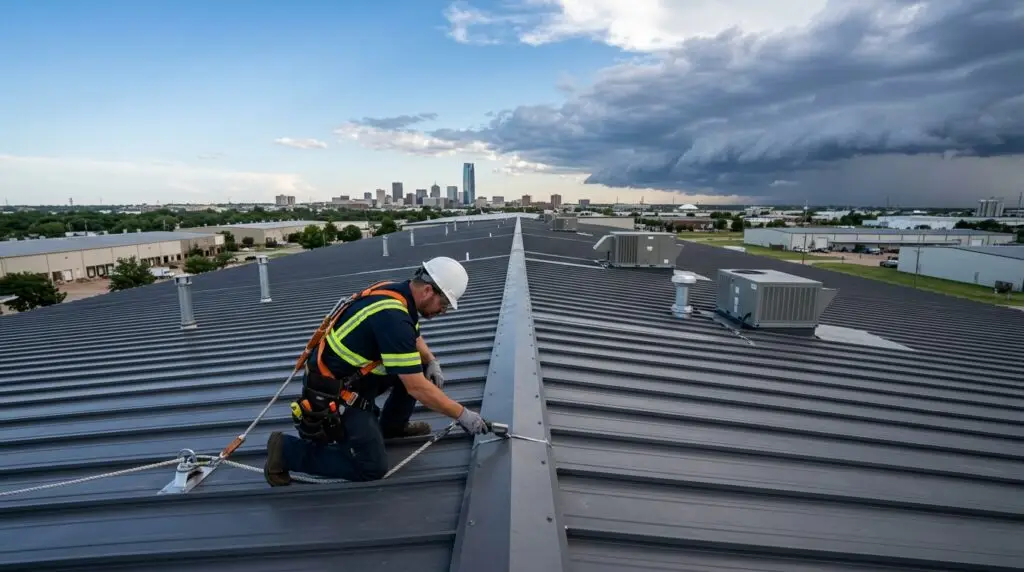
What they shouldn’t do: walk the roof surface without proper fall protection, assess seam or fastener integrity, or attempt to evaluate storm damage for insurance purposes. Those tasks require licensed commercial roofing contractors with metal-specific training.
Oklahoma City Storm Season — Your Post-Event Inspection Protocol
This section is the one most national roofing blogs skip entirely. And it’s arguably the most important for OKC property owners.
Hail Thresholds That Warrant an Immediate Professional Inspection
In the Oklahoma City market, field practice treats one inch of hail as an inspection trigger. That’s roughly quarter-size. At golf-ball size, 1.75 inches and above, a professional inspection isn’t optional. It’s necessary.
The reason is simple: metal panel coating systems can be compromised by hail impacts that don’t leave visible structural damage. A coating breach you can’t see from ground level will cause premature corrosion. Two or three years later, you have an expensive problem that traces directly back to an uninspected hail event.
For reference, the May 2024 OKC area events included one- to 1.75-inch hail with 75 mph winds near southwestern Oklahoma City. That’s exactly the profile that warrants a professional inspection, even if the building appeared fine from the parking lot.
What Hail Does to a Metal Roof (Versus Asphalt)
Metal and asphalt respond to hail very differently. Asphalt shingles lose granules and crack. Metal panels dent. That denting distinction matters for how you evaluate damage.
Cosmetic denting, a dimpled appearance without coating breach or seam distortion, may not affect function. But denting near seam locations, at panel edges, or anywhere that affects water-shedding geometry is a functional concern. Coating damage at impact points, even without visible denting, is a corrosion risk over time. A qualified inspector can tell the difference. Most property managers cannot, and shouldn’t have to.
Wind Damage Checkpoints After a Severe Weather Event
High-wind events, which accompany the vast majority of OKC hail storms, have their own damage profile. After any storm producing 60+ mph winds, check these areas:
- Ridge caps and hip flashings, most exposed point on the roof
- Panel edge seams, wind lifts from the edge and works inward
- All penetration boots, wind stress can unseat even properly installed boots
- Interior ceiling for new staining, water infiltration from wind-driven rain can enter at points that wouldn’t leak in a standard rain event
Don’t wait a week to check. Water that enters during a storm event begins causing secondary damage immediately.
Documentation That Protects Your Insurance Claim
Here’s something most property managers only learn the hard way: the strength of your insurance claim after storm damage depends heavily on the documentation you have before the adjuster arrives.
Adjusters move quickly. If you don’t have a professional inspection report documenting storm-specific damage, separate from any pre-existing conditions, you’re negotiating from a weak position. Insurance carriers have every incentive to classify damage as maintenance neglect rather than storm causation.
A maintained log of inspection dates, contractor credentials, findings, and work performed is the difference between a paid claim and a disputed one. Start that log now, not after the next storm.
What a Professional Metal Roof Inspection Actually Covers
If you’re going to pay for a professional inspection, know what you’re getting. A thorough commercial metal roof inspection isn’t a 20-minute walk-around, and if that’s what you’re receiving, you’re not getting what you paid for.
A Proper Visual Inspection Checklist
A qualified contractor should be evaluating:
- Panel surface condition and coating integrity across the entire field
- Fastener condition and seating on exposed fastener systems
- Seam integrity on standing seam panels
- All flashing conditions, ridge, hip, valley, wall, and penetration
- Drainage system function and physical condition
- Gutter attachment, alignment, and debris load
- Rooftop equipment mounts and all penetration boots
- Any areas showing rust, corrosion, or coating failure
Non-Destructive Testing Worth Asking About
Beyond visual inspection, ask whether your contractor offers infrared thermal imaging. This technology detects moisture trapped beneath panels or in insulation layers, moisture you can’t see and won’t find until it’s already caused damage. Not every contractor offers this, but for roofs over 15 years old or following significant storm events, it’s worth asking about specifically.
What a Quality Inspection Report Looks Like
You should receive a written report that includes dated photographs of all findings, a location map or diagram identifying issue areas, a clear priority ranking (immediate action vs. within 90 days vs. monitor), warranty compliance notes, and cost estimate ranges for any recommended repairs. If the report is a one-page summary with two photos and a list of what needs replacing, ask for something more thorough, or find a contractor who provides it.
Commercial Roof Maintenance Costs: What OKC Property Managers Should Budget
Let’s be direct about costs, because most guides dance around this completely.
What Drives Maintenance Costs on OKC Commercial Metal Roofs
It depends on several factors, and they’re all worth understanding before you get your first bid:
- Roof square footage and pitch, larger roofs and steeper pitches both increase labor requirements
- Panel type and age, older exposed fastener systems typically require more intensive maintenance than newer standing seam installations
- Number of penetrations, every HVAC unit, vent pipe, and skylight is a potential failure point that needs inspection
- Current condition, a roof with deferred maintenance costs more to bring current than one that’s been consistently maintained
- Contractor location, roofing services to properties in Yukon, Mustang, or rural Canadian County may carry travel differentials compared to central OKC
Preventive maintenance agreements, where a contractor commits to scheduled visits at agreed rates, typically cost significantly less per event than emergency or one-time service calls. The planning value is real, and so is the financial value.
The Actual Cost of Skipping Maintenance
Between you and me, the math on skipping maintenance never works out in the property owner’s favor. A single emergency repair call following a storm, a water intrusion event that damages tenant inventory, a voided manufacturer warranty because inspections weren’t documented, any one of those outcomes costs more than years of planned maintenance.
The most expensive roof is the one that surprises you.
Protecting Your Metal Roof Warranty Through Documented Maintenance
This is a piece that even experienced property managers frequently overlook. Most manufacturer warranties on commercial metal roofing systems include maintenance documentation requirements. That means the warranty you paid for, and that protects a significant capital investment, can be voided by a lack of paperwork.
“I maintained the roof but didn’t document it” is not a position that holds up in a warranty claim review.
What Warranty Documentation Actually Requires
Review your specific warranty language. Most require:
- Periodic professional inspections at defined intervals
- Documentation of all inspections including dates and findings
- Timely repair of identified deficiencies
- Evidence that repairs were performed by qualified contractors
Ask your installation contractor on Day 1 what the warranty documentation requirements are. Don’t wait until you need to file a claim to find out.
Building a Maintenance Record That Works
A simple digital maintenance log, accessible to facility staff and stored somewhere that survives staff turnover, should include:
- Inspection date and contractor name, license number, and insurance status
- Summary of findings
- Photos documenting conditions found
- Work orders for any repairs performed
- Sign-off confirmation that repairs were completed
This same record strengthens your position with insurance adjusters after storm events. It’s dual-purpose documentation that takes minimal effort to maintain consistently.
Common Mistakes OKC Commercial Property Managers Make With Roof Maintenance
In our experience, the same patterns show up repeatedly, and they’re all avoidable.
Waiting for a Leak to Signal a Problem
By the time water appears inside your building, the roof has typically been compromised for weeks or months. Metal roofs are particularly deceptive in this regard, they can channel water horizontally along panels, through insulation, and across decking before it finds a penetration point and drips. The visible leak location almost never marks the actual entry point. If you’re only inspecting after a visible problem, you’re consistently reacting too late.
Letting HVAC Contractors Onto the Roof Without a Protocol
HVAC service is one of the most common and preventable sources of commercial metal roof damage. Dropped tools, dragged refrigerant lines, wrong foot placement on panels, all of it happens. And none of it gets reported back to you.
Establish a simple rooftop access policy: every vendor logs their visit, notes where they accessed the roof, and you or your roofing contractor checks penetration areas after service calls. It costs nothing and can prevent expensive panel damage.
Treating All Contractors as Equally Qualified for Metal Systems
Metal roofing requires specific knowledge that’s distinct from flat membrane systems or residential shingle work. A contractor with extensive TPO or asphalt experience may not understand panel lap geometry, seam specifications, coating systems, or appropriate fastener torque values for a given metal system.
Before you hire anyone to work on a commercial metal roof, ask directly: How many commercial metal roofing systems have you maintained or repaired in the last two years? What types, standing seam, exposed fastener, concealed clip? The answers will tell you quickly whether you’re talking to someone qualified.
Dismissing Sub-Severe Hail Events
Not every hail event looks dramatic. Quarter-size hail doesn’t always make the news. But repeated sub-severe hail events cause cumulative coating damage that accelerates wear in subsequent storms. Oklahoma roofs face multiple significant weather events per season, year after year. That cumulative effect is real, don’t dismiss a “minor” hail event without at least a visual inspection of coating condition.
Choosing the Right Commercial Metal Roofing Maintenance Partner in Oklahoma City
Questions to Ask Before Signing Any Maintenance Agreement
- Are you licensed and insured in Oklahoma for commercial roofing work?
- Do your technicians have specific training in metal roofing systems, and which types?
- What does your inspection report include, and will I receive photographs and written findings?
- How do you handle emergency response during OKC storm season?
- What documentation do you provide for warranty and insurance compliance?
Red Flags to Walk Away From
- No written scope of work before accessing your roof
- Pressure to sign immediately following a storm event (“We’re in your area right now…”)
- Inability to explain the difference between standing seam and exposed fastener maintenance needs
- No liability insurance documentation available on request
- Inspection reports that amount to a paragraph and a price
Why Local OKC Experience Matters
A contractor maintaining commercial metal roofs along the I-40 industrial corridor, in Edmond’s office park developments, or on Moore and Norman’s retail strips understands how OKC’s specific storm tracks, thermal patterns, and local building code environment affect metal roofing decisions. That’s knowledge you don’t get from a national service chain.
Local matters, especially when you need someone on your roof the morning after a storm.
Building a Long-Term Roof Asset Management Strategy
The property managers who get the best outcomes from their commercial metal roofs don’t think in annual checklists. They think in roof life cycles.
Mapping Maintenance Intensity to Roof Age
A 5-year-old standing seam roof in good condition needs consistent, light-touch monitoring. A 20-year-old exposed fastener system on an OKC industrial building needs a more intensive inspection approach, fastener assessment, and potentially a coating evaluation. The maintenance investment should scale with the roof’s age and condition profile.
Years 1–15: Annual professional inspections plus post-storm assessments. Maintain clean documentation from day one.
Years 16–30: Increase inspection depth. Add thermal imaging to your rotation. Evaluate coating system condition and restoration options before problems develop.
Year 30+: Engage your roofing contractor in a lifecycle conversation. Roof coatings can extend service life significantly on structurally sound systems. Full replacement planning should be on your capital schedule.
When to Consider Coating vs. Repair vs. Replacement
This is a decision worth having with a qualified contractor before it becomes urgent:
- Roof coatings restore UV protection and corrosion resistance on structurally sound panels. They’re typically viable when the deck and structure are solid but the surface coating system has aged.
- Targeted repair addresses localized failures, a compromised flashing, a section of failed sealant, damaged panels from a specific storm event.
- Full replacement is warranted when substrate damage is widespread, when repair costs approach replacement costs on a lifecycle basis, or when the system has reached the end of a reasonable service window.
A well-maintained commercial metal roof should never reach emergency replacement, it should reach planned replacement on your schedule, not the roof’s.
Frequently Asked Questions About Commercial Roof Maintenance Planning in Oklahoma City
How often should a commercial metal roof be inspected in Oklahoma City?
At minimum, twice per year, spring before storm season and fall after it closes. Any hail event of one inch or greater, or winds above 60 mph, should trigger an additional professional inspection regardless of your regular schedule.
Does my metal roof warranty require professional maintenance inspections?
Most manufacturer warranties on commercial metal roofing systems do require documented periodic inspections to remain valid. Review your specific warranty language and maintain a log of all inspection dates, contractor credentials, findings, and work completed.
What hail size actually damages a commercial metal roof in Oklahoma?
Metal roofs handle hail differently than asphalt, they dent rather than lose granules. Coating damage can occur at smaller sizes; functional structural damage becomes more likely at golf-ball size (1.75 inches) and above. Cumulative sub-severe events also degrade coatings over time. When in doubt, have it inspected.
How much does a commercial roof maintenance plan cost in Oklahoma City?
Costs vary based on roof size, panel type, age, and scope of service. Preventive maintenance agreements are consistently more cost-effective than reactive repair calls. Get at least two local bids from contractors with verifiable commercial metal roofing experience and compare scope, not just price.
Can my building’s maintenance staff inspect the commercial metal roof?
In-house staff can handle ground-level visual checks and interior ceiling monitoring. Actual rooftop inspection, seam integrity assessment, fastener evaluation, and storm damage documentation require a licensed commercial roofing contractor with metal-specific training and proper fall protection.
How do I document roof maintenance for an insurance claim in Oklahoma?
Maintain a digital log with dates, contractor credentials, photos, and work orders for every inspection and repair. After any storm, obtain a professional inspection report before your adjuster’s visit. Documented pre-storm condition history significantly strengthens claim outcomes.
What makes metal roofing maintenance different from flat roof maintenance?
Metal roof maintenance centers on fastener integrity, panel seam condition, coating system health, and drainage at panel laps. Flat membrane systems like TPO or EPDM focus on membrane seams and ponding water. These are different systems with different failure points, make sure you’re working with a contractor who understands the difference.