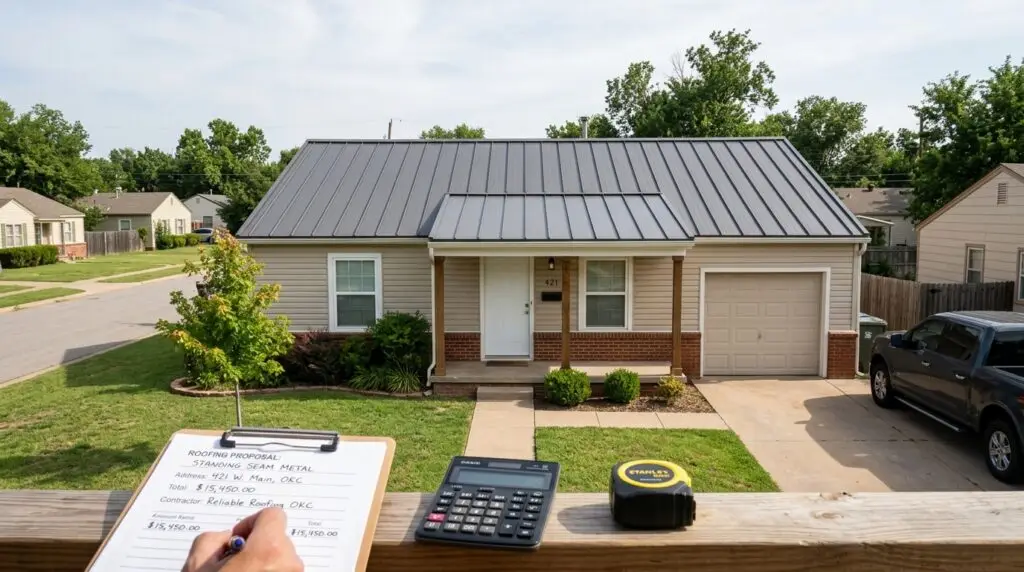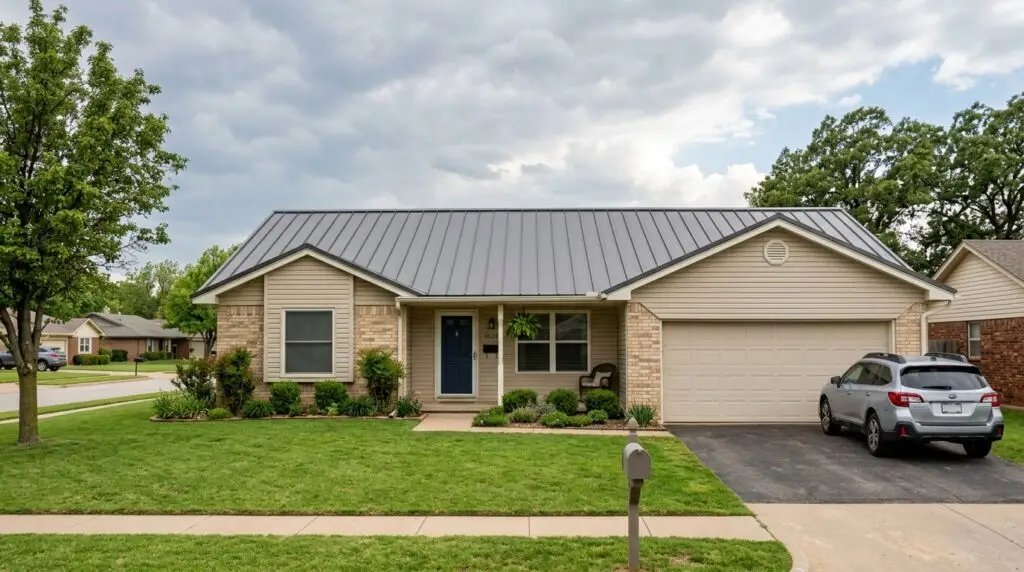
Oklahoma City sits squarely in the heart of Tornado Alley. If you own a home here — in Moore, Edmond, Yukon, Midwest City, or anywhere in the OKC metro — severe weather isn’t a distant possibility. It’s a seasonal certainty. And if you have a metal roof, knowing how to identify storm damage quickly can be the difference between a straightforward insurance claim and a costly, drawn-out repair down the road.
Here’s the thing: metal roofs are genuinely tough. They outperform asphalt shingles in nearly every storm category. But that doesn’t mean they’re immune to damage. It means the signs of storm damage on a metal roof look different — and if you don’t know what to look for, it’s easy to miss them until a much bigger problem develops.
This guide breaks down exactly what to look for, how Oklahoma’s specific storm patterns affect your metal roof, and when to call a professional.
Why Metal Roofs Respond to Storms Differently Than Asphalt Shingles
Most storm damage content online was written with asphalt shingles in mind — missing granules, cracked tabs, curling edges. If you own a metal roof and search for storm damage signs using that information, you’ll miss the real warning indicators every time.
Metal roofing systems respond to hail, wind, and debris impact in fundamentally different ways. Understanding that difference starts with one critical distinction.
The Two Types of Metal Roof Storm Damage: Cosmetic vs. Functional
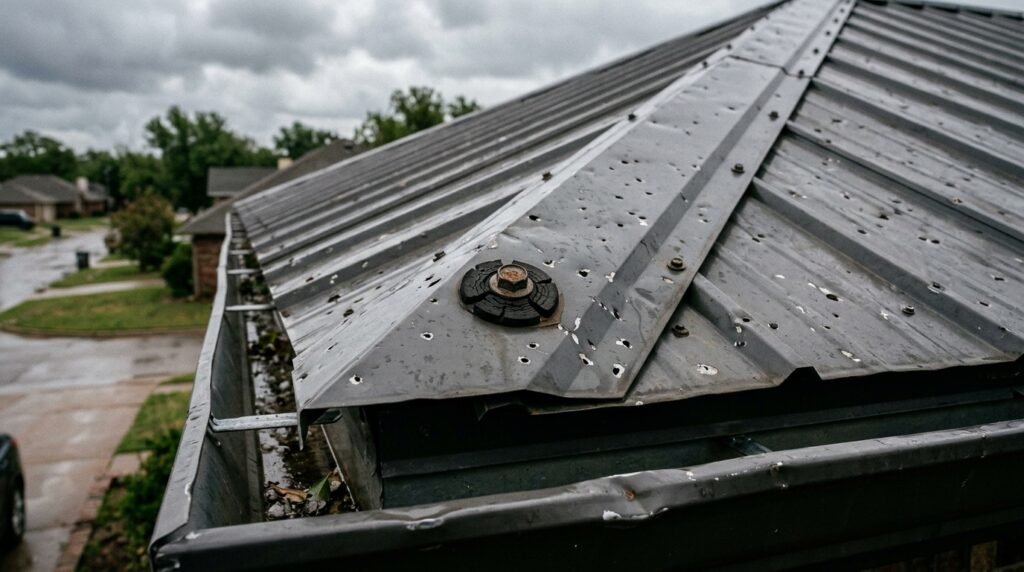
Cosmetic damage includes surface dents, paint chips, minor scratches, or scuffs that affect the appearance of your roof panels but don’t compromise their ability to shed water or protect your home. A small dent from a golf ball-sized hailstone? That’s cosmetic.
Functional damage is where things get serious. This includes compromised seams, loose or missing fasteners, distorted panels, lifted flashing, or any condition that creates a path for water infiltration. Functional damage requires prompt repair.
This distinction matters enormously for Oklahoma homeowners — and here’s why: some insurance policies include a cosmetic damage waiver, meaning hail dents that don’t compromise performance may not be covered. If you’re filing a claim, you need to know which category your damage falls into before you sit down with an adjuster.
How Oklahoma City’s Storm Pattern Affects Metal Roofing Specifically
OKC storms are not gentle. Central Oklahoma sits at the convergence of warm, moist air pushing up from the Gulf of Mexico and cold upper-level air moving down from the Rockies. That combination produces not just hail, but wind-driven hail — often falling at steep angles rather than straight down.
Why does that matter for your roof? Angled hail puts direct stress on vertical seam joints, flashing edges, and the edges of panels in ways that straight-down impact doesn’t. Straight-line winds in OKC thunderstorms commonly reach 60 to 80 mph — enough to create serious uplift pressure at eave edges and stress attachment points across the entire roof surface.
And because OKC sees multiple significant hail events per season, cumulative stress on fasteners and seams can weaken a roof gradually — without any single storm event being dramatic enough to trigger an immediate call to a contractor.
OKC Note: Hail in Central Oklahoma frequently falls at an angle, putting disproportionate stress on vertical seam joints and flashing edges. This is why a post-storm inspection by someone who knows what they’re looking for matters more here than in most parts of the country.
7 Signs of Storm Damage on a Metal Roof (From Ground to Attic)
Most homeowners don’t realize how many storm damage indicators are visible without ever stepping foot on the roof. Let’s walk through each sign methodically — starting with what you can see from the ground and finishing inside your attic.
1. Visible Dents, Dings, or Depressions on Panels
Hail over roughly one and a half inches in diameter can leave visible marks on steel panels. On aluminum panels or soft-metal accessories, smaller hail can dent the surface. Where you see dents matters as much as whether you see them — check flat panel surfaces, ridge caps, hip caps, and low-slope sections where impact energy concentrates.
Ribbed or corrugated panels hide minor dents better than the flat faces of standing seam profiles. If you can’t clearly see the panel surface from the ground, use binoculars. Better yet, have a contractor assess.
Pro Tip: Use a flashlight held at an angle across a panel surface. Dents that are invisible in flat ambient light become immediately obvious under raking light. This is a standard field technique and it works.
Important clarification: dents alone do not necessarily mean functional damage. Context matters. A single small dent on a panel center is very different from denting along a seam line or at a fastener location.
2. Loose, Backing-Out, or Missing Fasteners
If your home has an exposed fastener metal roof system — corrugated panels or an R-panel profile — fastener condition is your single most important inspection point after any storm. Hail and wind energy concentrate at the attachment screws that hold panels to the deck.
What to look for: screws that are visibly tilted rather than perpendicular, rubber washers that appear cracked, compressed flat, or missing, or screws that have backed out from the panel surface by even a fraction of an inch.
Why it matters: even a slightly backed-out fastener with a compromised washer creates a water infiltration point. It won’t necessarily leak during the storm itself — but the next rain event, and every one after it, has a direct path into your roof structure.
OKC Note: After consecutive OKC storm seasons, fastener integrity on older exposed-fastener roofs should be assessed as routine maintenance, not just emergency response. This is especially true for homes built with R-panel roofing in areas like Choctaw, Mustang, and the rural OKC periphery where agricultural-style metal roofing is common.
3. Damaged or Lifted Seams, Ridge Caps, and Panel Edges
Seams, ridge caps, eave trim, and gable edge trim are the most common functional failure points after a significant OKC storm. Wind uplift pressure enters at the eave edge and travels under panels — creating suction forces that even well-installed roofs can experience in straight-line wind events above 70 mph.
Look for: seams that no longer sit flat against the panel, visible gaps at panel overlaps, ridge caps that have shifted or lifted slightly at the ends, and flashing that appears pulled away from wall or chimney surfaces. Any of these conditions is a functional concern, not a cosmetic one.
4. Scratched, Chipped, or Peeling Protective Coating
Metal roofing panels are protected by a paint system — most quality panels use either a Kynar/PVDF fluoropolymer coating or a high-grade polyester finish. Hail impacts chip or fracture these coatings, exposing bare steel to the elements.
In Oklahoma’s climate — hot summers, humid springs, and freeze-thaw cycles — exposed bare steel begins surface oxidation within weeks. The early warning sign is orange-brown rust streaking below a dent or along a scratch line.
This isn’t just a cosmetic issue over time. Progressive coating failure accelerates corrosion, shortens panel lifespan, and can eventually compromise the galvanized layer beneath the paint. Early touch-up with a compatible coating is a simple fix. Ignoring it for two or three seasons is not.
5. Flashing Failure Around Chimneys, Vents, and Penetrations
Flashing is thin-gauge metal — typically aluminum or galvanized steel — installed around any roof penetration: chimneys, pipe boots, HVAC curbs, skylights, and vent fans. Because it’s thinner than your main roof panels, it dents, lifts, and separates more easily.
In our experience, flashing around pipe boots and HVAC curbs is where we find functional post-storm damage most frequently on OKC residential metal roofs. A slight lift or separation at the sealed edge of a pipe flashing may look minor but allows water to infiltrate the deck below on every subsequent rain.
Make it a habit to visually trace every penetration on your roof after any significant storm. If you can see it from a ladder at the eave, do so safely. If not, add it to your professional inspection checklist.
Pro Tip: Check your HVAC equipment caps and aluminum combustion vent covers after a storm. If these soft-metal components are dented, the storm was severe enough that your main roof surfaces warrant a professional inspection.
6. Interior Water Stains, Damp Insulation, or Attic Odors
Here’s something most homeowners miss: functional storm damage often doesn’t produce an immediate, obvious leak. Water entering through a compromised seam or a backed-out fastener may travel horizontally along an underlying felt layer or roof deck before dropping. It can take days — sometimes weeks — before it presents as a visible stain on your ceiling.
Warning signs to watch for after any storm: new brown or yellow staining on ceilings, a musty smell coming from the attic space, or insulation that feels damp or appears matted down when you inspect it.
Check your attic after every significant rain event that follows a storm. Bring a flashlight and look for rust streaking on any fasteners that penetrate through the deck, daylight penetrating through unexpected locations, and any new water marks on rafters or sheathing.
OKC Note: Some OKC homeowners first notice storm damage months after the event — only when interior staining finally becomes visible. By that point, the insurance claim window may be narrowing. This is why a post-storm professional inspection within 30 days is worth far more than waiting for a leak to tell you there’s a problem.
7. Soft-Metal Proxy Indicators
This one is practical field knowledge that doesn’t show up in most guides. Before you ever get on the roof — or have a contractor up there — check the soft metals around your property. HVAC condenser fins, gutters and downspouts, aluminum window trim, decorative metal caps, and outdoor patio furniture all tell a story about how hard a storm hit.
If your car hood shows hail dents or your HVAC fins are visibly crushed, the hail that caused that damage was significant enough to have affected your ridge caps, flashing, and any exposed fasteners on your roof. Dented gutters are especially telling — if the gutter edge is dented, the eave edge of your roof panels received the same impact forces.
Between you and me, this is one of the first things an experienced OKC metal roofing contractor checks before climbing up. The ground-level soft metals calibrate the severity of the event before we ever see the roof itself.
Delayed Signs of Storm Damage That Appear Days or Weeks Later
One of the most important things to understand about metal roof storm damage — and something competitors rarely discuss — is that many signs don’t appear immediately after the storm. They develop over time.
Fasteners that held during the storm may begin to back out gradually as thermal expansion and contraction cycles work on panels in the weeks that follow. Seams that appeared intact may separate after the first significant heat cycle of an OKC summer. Paint micro-fractures from hail impact can progress to visible rust streaking over a period of four to eight weeks. Interior moisture can build behind wall cavities before presenting as visible staining.
The practical takeaway: schedule a professional inspection within 30 days of any significant OKC storm event — not just in the days immediately after. The 30-day window captures both immediate and delayed damage indicators before they evolve into larger problems.
Standing Seam vs. Exposed Fastener: Does Your Metal Roof Type Change What to Look For?
It does — significantly. The two most common residential metal roof systems in OKC have different vulnerabilities and require different inspection approaches.
Standing seam systems use concealed clips to attach panels, distributing stress more evenly and eliminating the exposed fastener points that are the primary vulnerability in other systems. For a standing seam roof, focus your inspection on seam integrity, panel edge conditions, ridge and eave trim, and flashing — not fasteners.
Exposed fastener systems — corrugated panels and R-panel profiles — concentrate stress at every attachment screw. Fastener condition is the primary inspection concern for these roofs. Rubber washer compression, screw backing, and panel surface cracking around fastener holes are the early warning indicators after a hail event.
Metal shingles and shake profiles use interlocking seam connections. The priority here is interlocking seam integrity — a damaged interlock may allow wind-driven water infiltration even when individual shingle panels appear visually intact.
OKC Note: Exposed fastener metal roofing is common on OKC-area residential and agricultural re-roof projects, particularly in communities like Mustang, Choctaw, and the broader rural OKC periphery. If your roof uses this system, fastener inspection after every hail event above one inch is not optional — it’s basic protective maintenance.
How to Safely Inspect Your Metal Roof After an OKC Storm
Ground-Level Inspection (Safe for Any Homeowner)
Before doing anything else, walk the full perimeter of your home. Look for displaced ridge caps, debris resting on the roof surface, dented or detached gutters and downspouts, and any visible panel distortion at the eave edge. Use binoculars to examine panel faces, seam lines, and flashing at the ridge and gable edges.
While you’re outside, check your HVAC equipment and all soft-metal vent covers. Document everything with photos before moving or cleaning up any debris — insurance adjusters want to see the post-storm condition, not a cleaned-up version of it.
Attic Inspection (Interior View)
Pull down your attic access and bring a good flashlight. Look for any daylight coming through the deck (rare but serious), water staining on rafters or sheathing, rust streaking on fasteners penetrating through the deck, and any damp or compressed insulation. Note any new odors — mustiness in a previously dry attic space is a meaningful indicator.
When to Call a Professional Instead of Going on the Roof
There are situations where the roof is not safe for a homeowner to access — and others where a professional inspection simply produces far better results.
- After any tornado-adjacent event or straight-line wind event above 60 mph
- If you see visible panel displacement or any structural shift at the ridge or eave
- If gutters or downspouts are detached — the structural integrity of the edge may be compromised
- Before filing any insurance claim — a contractor’s documented assessment strengthens your case significantly
- Any time you’re uncertain about what you’re seeing — the cost of a professional inspection is minimal compared to the cost of a missed damage claim
OKC Note: Storm chasers from out of state flood the OKC market after every major weather event. Protect yourself: use a locally licensed, insured contractor with a verifiable OKC-area physical address, documented local project history, and active Oklahoma state licensing. Ask for their license number and verify it.
Understanding Your Homeowner’s Insurance Claim for Metal Roof Storm Damage in Oklahoma
This is where a lot of OKC homeowners lose money they’re legitimately owed — not because their damage isn’t real, but because they don’t understand how the claim process works for metal roofing specifically.
Oklahoma homeowners insurance policies generally cover functional storm damage. Cosmetic-only damage coverage varies by policy. If you signed a cosmetic damage waiver when your policy was written — and many homeowners do without fully understanding the implications — hail dents that don’t compromise waterproofing may not trigger coverage.
Know your policy before you file. Pull it out and look for any language around cosmetic damage exclusions. If you’re not sure, call your agent directly and ask.
Oklahoma policies typically require you to file within 12 to 24 months of a storm event, depending on your specific insurer and policy terms. Don’t let time slip by assuming the roof is fine. Many OKC homeowners file — and win — claims 6 to 10 months after a storm when delayed damage signs finally become visible.
One practical move before your adjuster arrives: have an independent metal roofing contractor inspect and document the damage first. A documented contractor assessment that clearly distinguishes functional from cosmetic damage gives you a much stronger position in the adjuster conversation.
Pro Tip: Request storm date and hail size verification data from NOAA’s storm events database or ask your contractor to pull it. Tying documented roof damage to a specific recorded weather event significantly strengthens your claim.
Metal Roof Storm Damage Repair: What’s Fixable vs. What Requires Replacement
Not every storm-damaged metal roof needs to be replaced. But some do. The distinction depends on the type of damage, how widespread it is, the age of the roof, and what system type you have. Here’s how to think through it.
Repairs That Are Usually Sufficient
- Isolated fastener replacement on exposed-fastener systems — straightforward and relatively inexpensive
- Flashing re-sealing or replacement at penetration points — a targeted repair that resolves specific infiltration risk
- Localized panel replacement on exposed fastener systems — panels can often be matched if the profile is still available
- Touch-up coating applied to scratched or chipped areas before corrosion sets in — simple and effective when done early
- Ridge cap or edge trim replacement where wind has displaced components without affecting main panel integrity
When Replacement Makes More Sense
- Widespread seam distortion across large panel areas — localized repairs won’t address systemic structural change
- Systemic fastener failure across the majority of the roof surface — this isn’t an isolated repair situation
- Multiple hail events have cumulatively compromised the coating system across most of the roof — repair cost approaches replacement cost at that point
- Roof age combined with storm damage — the cost-benefit math of repeated repairs on an older system rarely favors continued repair
In our experience, the most common scenario we see in OKC is homeowners repairing the same exposed fastener roof two or three times over successive storm seasons — each time spending money on targeted fixes that don’t address the cumulative degradation of the system as a whole. At some point, a standing seam replacement becomes the smarter 20-to-30-year investment.
Post-Storm Maintenance Steps to Protect Your Metal Roof Until Repairs Are Made
If you’ve identified damage and repairs are scheduled but not yet complete, there are practical steps you can take to minimize further risk.
- Clear debris from valleys, gutters, and downspouts immediately — standing water at the roof edge accelerates corrosion and can force its way under panel seams
- Apply roofing tape or compatible sealant over any exposed fastener holes where washers are cracked or missing — this is a temporary measure, not a permanent fix, but it reduces infiltration risk
- Do NOT pressure wash a storm-damaged metal roof — even at low pressure, this can force water under compromised seams and into the deck structure
- Keep the attic ventilated and monitor it after each subsequent rain event until repairs are complete
- Take timestamped photos of all documented damage before any cleaning or temporary repairs — maintain a photo record for the insurance file
Frequently Asked Questions About Metal Roof Storm Damage
Can hail damage a metal roof?
Yes, though metal roofs are far more hail-resistant than asphalt shingles. Most hail damage to metal roofs is cosmetic — surface dents or paint chips that don’t compromise waterproofing. Functional damage involving seams, fasteners, or flashing is less common but does occur, especially in OKC where wind-driven hail falls at steep angles and exerts disproportionate force on seam joints and edges.
How do I know if my metal roof was damaged in a storm?
Start by checking soft-metal proxy indicators: gutters, HVAC caps, and aluminum vent covers. If those are dented, the storm was significant enough to warrant a professional roof inspection. Also look for visible dents on flat panel surfaces, rust streaking below scratches, loose screws on exposed-fastener systems, and new staining in your attic or on interior ceilings. Many signs appear days or weeks after a storm, not immediately.
Does homeowner’s insurance cover metal roof storm damage in Oklahoma?
Generally yes for functional storm damage. Cosmetic-only damage may be excluded, particularly if you signed a cosmetic damage waiver. Oklahoma policies typically require filing within 12 to 24 months of the storm event. Document all damage before any repairs begin, and consider having an independent contractor inspection completed before your adjuster visit.
What is the difference between cosmetic and functional metal roof damage?
Cosmetic damage — surface dents, paint chips, minor scratches — affects appearance but not performance. Functional damage compromises the roof’s ability to shed water: loose fasteners, distorted seams, damaged flashing, or panel punctures. Insurance coverage, repair urgency, and long-term implications differ significantly between the two categories.
How soon should I inspect my metal roof after an Oklahoma storm?
Within 30 days of any significant hail or wind event, even if the roof looks undamaged from the ground. Delayed damage signs — rust progression at coating chips, seam separation during heat cycles, slow moisture infiltration — are common and often don’t appear in the immediate aftermath of a storm.
Is a metal roof worth it in Oklahoma for storm protection?
Metal roofing consistently outperforms asphalt shingles in Oklahoma’s severe weather environment. Unlike shingles, metal does not lose impact resistance as it ages. It handles higher sustained wind speeds, resists uplift better, and eliminates the granule loss and tab cracking that makes shingle roofs so vulnerable in Tornado Alley. For most OKC homeowners, it represents a strong long-term investment in storm resilience.
Can I repair storm damage on a metal roof myself?
Minor targeted fixes — tightening a few exposed fasteners, applying sealant around a pipe boot — are possible for experienced homeowners comfortable on a ladder. However, post-storm damage assessment should always be conducted by a qualified metal roofing contractor before any insurance claim is filed. Improper repairs can void warranties, complicate claims, and create new infiltration paths where the original repair didn’t fully address the underlying issue.
Explore Our Metal Roofing Services
If you’re seeing any of the signs discussed in this guide, or if you’ve recently experienced a significant OKC storm event, these resources can help:
- Metal Roof Installation
- Storm Damage Inspection
- Metal Roof Repair Services
- Standing Seam vs. Exposed Fastener Metal Roofing
- OKC Insurance Claim Guidance for Roof Damage
- Our Service Areas: OKC, Edmond, Moore, Yukon & Surrounding Communities