If you’ve started researching metal roofing in Oklahoma City, you’ve probably run into two systems: exposed fastener (screw-down) panels and standing seam. Most articles out there treat it like a simple cost-versus-quality debate. Pick the budget option or pick the premium one. Done.
Here’s the thing, that framing misses what actually matters for an OKC homeowner. You’re not in Seattle. You’re not in Phoenix. You’re in one of the most storm-active metros in the country, where hail shows up in spring like it has a calendar invite and straight-line winds don’t ask permission. The fastener system you choose determines how your roof handles all of that, not just on day one, but year five, year fifteen, and beyond.
This guide breaks down both systems honestly, including the option most articles skip entirely, so you can make a decision that makes sense for this climate and your specific property.
What’s the Real Difference Between Exposed Fastener and Standing Seam Metal Roofs?
The distinction comes down to one question: where are the fasteners?
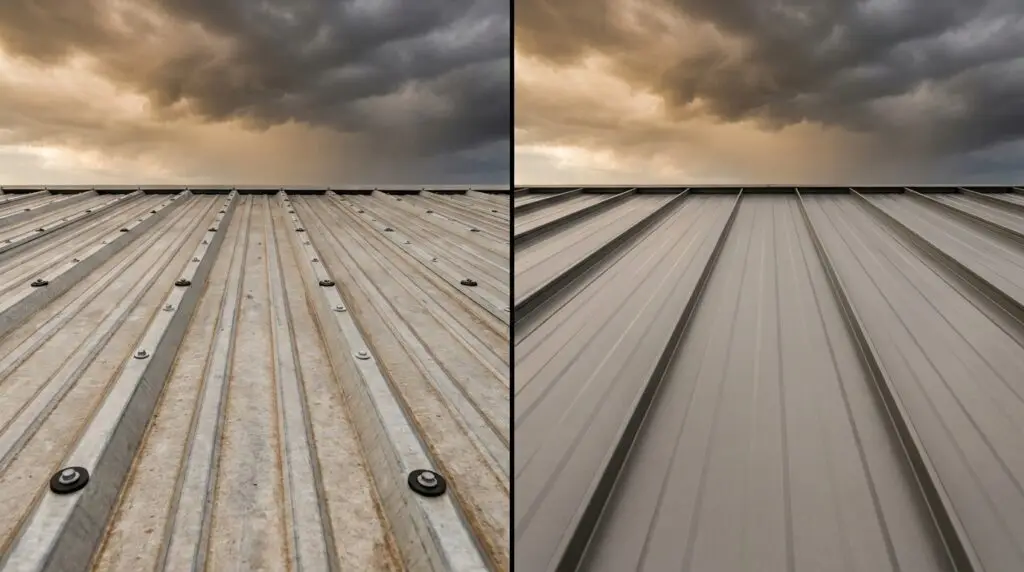
Exposed fastener systems (also called screw-down panels) use screws that drive directly through the metal panel surface into the roof deck or purlins below. The screw heads sit on top of the metal, visible across the entire roof. Each screw is sealed with a neoprene washer, a small rubber gasket that creates a watertight barrier around the penetration.
Standing seam systems work differently. Panels are attached using concealed clips or a fastener flange hidden beneath raised vertical seams, those distinctive ridges that run from the eave to the ridge. No screws penetrate the panel surface. The fasteners are tucked inside the seam where weather, UV, and hail can’t reach them. Panels sit on floating clips that allow the metal to expand and contract freely as temperatures change.
Then there’s the option most articles skip: nailstrip panels. Sometimes called nail-flange or snap-lock panels, these sit between the two systems. They use a hidden fastener flange nailed to the deck, with the next panel snapping over it to conceal the connection. They look similar to full standing seam, cost less, and offer more weather protection than exposed fasteners. The trade-off is that they don’t float thermally the way clip-supported standing seam does, which, as you’ll see, matters a lot in Oklahoma.
How Oklahoma City’s Climate Changes the Entire Comparison
This is where local knowledge separates a good decision from a regrettable one.
What “Hail Alley” Actually Means for Your Fasteners
Oklahoma City, Moore, Midwest City, Del City, and Edmond sit squarely in one of the highest hail-frequency corridors in the world. One-inch hailstones are routine. Two-inch events happen. And when those storms roll in, they don’t come straight down, they come sideways.
Oklahoma’s supercell thunderstorms are a different animal from a typical afternoon shower. The rotational dynamics and high winds drive hail at significant horizontal angles. That angular impact hits seams, panel edges, flashing, and, critically, fastener locations with concentrated force. These are already the highest-stress points on any roofing system.
On an exposed fastener system, every one of those screw locations is a direct impact point. The washer takes the hit. The seal compresses. Over repeated storm seasons, that matters.
Standing seam sidesteps this entirely. There are no exposed penetrations for wind-driven hail to compromise. The attachment hardware is protected inside the seam.
Oklahoma’s Temperature Swings and Thermal Movement
Most homeowners don’t realize how extreme OKC’s thermal cycling actually is. Sub-freezing winters. Summer days that push well past 100°F. Hard freezes followed by rapid warm-ups in the same week during shoulder seasons. Your roof is constantly expanding and contracting.
Metal moves a surprising amount across that temperature range. A 40-foot panel can shift close to half an inch between a cold January night and a hot July afternoon.
On an exposed fastener system, every panel is locked down through the surface. The metal wants to move, but the screws hold it rigid. That force has to go somewhere, and it goes into the screw holes. Over time, the panels work against their own fasteners. The washers fatigue. The screws can loosen slightly (a condition called “fastener back-out”). Water finds the gap.
Standing seam floating clips are designed specifically to handle this. Panels slide in the clips, expanding and contracting without putting stress on any attachment point. In Oklahoma’s climate, that mechanical freedom isn’t a luxury, it’s a functional requirement for long-term performance.
Straight-Line Winds and Wind Uplift
Severe OKC thunderstorms regularly produce straight-line winds in the 60–80 mph range. Wind uplift, the force that tries to peel your roof off from the edges, is a real concern. Standing seam systems with continuous concealed clip attachment offer strong, distributed uplift resistance. Exposed fastener systems depend on individual screw integrity across the entire roof surface. One backed-out or corroded fastener is a wind uplift vulnerability. In a climate that tests your roof every spring, that distinction compounds over years.
Cost Comparison, What Oklahoma Homeowners Actually Pay
Let’s be direct about this: standing seam costs more upfront. That’s true everywhere, and it’s true here.
Exposed fastener systems use wider panels, thinner gauge metal (often 26- or 29-gauge), simpler trim components, and faster installation. Less labor time, fewer specialty parts, more contractors qualified to install it. The lower cost is real.
Standing seam systems require thicker gauge metal (24-gauge is the recommended minimum for OKC residential), more trim components per roofing condition, specialized installation equipment, and trained labor. That adds up.
The cost factor most homeowners miss: insurance.
Oklahoma homeowners already pay some of the highest wind and hail insurance premiums in the country, that’s the reality of living in this corridor. What many people don’t know is that a Class 4 impact-rated standing seam system can qualify for meaningful insurance premium discounts with many carriers operating in Oklahoma.
The FORTIFIED™ Roof program, backed by the Oklahoma Insurance Department, is designed to strengthen homes against exactly the kind of storms OKC faces regularly. Standing seam systems more commonly qualify for FORTIFIED designation, which can unlock insurance savings that genuinely narrow the upfront cost gap over time.
In our experience, homeowners who run that long-term math, upfront cost difference minus potential insurance savings minus avoided maintenance and early repair costs, are often surprised how much closer the two systems become financially.
Talk to your insurance carrier about discount eligibility before you choose a system, not after installation.
Lifespan and Long-Term Performance in OKC Storm Conditions
Exposed Fastener Lifespan in Oklahoma
With proper maintenance, exposed fastener metal roofs typically last 20–30 years. That range is accurate, but there’s a meaningful OKC-specific caveat.
Neoprene washer degradation accelerates in Oklahoma’s heat. The same sustained summer temperatures that make your attic feel like an oven work on those rubber seals from the outside. Add freeze-thaw cycling and repeated hail events stressing the washers, and the realistic inspection and maintenance demand on an exposed fastener roof here is higher than in milder climates. Skip annual inspections, and the back end of that lifespan range becomes optimistic.
Standing Seam Lifespan and Why OKC Suits It
A properly installed standing seam roof in OKC generally delivers 30–50+ years of service life. Concealed fasteners aren’t exposed to UV, moisture, or direct hail impact. Thermal float reduces the chronic mechanical fatigue that shortens exposed fastener roof life.
One important caveat: the lifespan advantage depends entirely on installation quality. A standing seam roof installed by an unqualified contractor, panels locked down incorrectly, improper clip spacing, wrong gauge, can underperform a well-installed exposed fastener roof. The system is only as good as the hands that put it on.
The Maintenance Schedule Difference
- Exposed fastener: Inspect fasteners and washers at least annually. Plan for potential fastener tightening or replacement within 10–15 years. Post-storm inspections after any significant hail or wind event are not optional.
- Standing seam: Inspect seam integrity and flashing twice annually, once before storm season opens (late February/early March) and once after it closes (late October). No washer degradation to track, but ridge cap sealant and valley flashing deserve consistent attention.
Both systems benefit from keeping debris out of valleys and gutters clear of obstruction. Metal roofing handles Oklahoma weather well. It doesn’t handle neglect any better than anything else.
Storm Damage, Insurance Claims, and What Inspectors Actually Look For
Most people picture hail damage as a dent you can see from the street. On a metal roof, the more important damage often isn’t visible from thirty feet below.
What Happens to Exposed Fasteners in a Major OKC Storm
Wind-driven hail can stress individual fastener washers at the seal point, sometimes without leaving dramatic surface damage on the panel itself. After a major event, a qualified inspector checks:
- Fastener seating: have any screws worked loose from wind uplift?
- Washer condition: is the seal still intact, or has it compressed/cracked?
- Panel movement at attachment points: are panels shifting at the screws?
These findings don’t always announce themselves as immediate leaks. They announce themselves six months later during the next heavy rain. That delay is exactly why post-storm inspection discipline matters so much with this system type.
What Inspectors Look For on Standing Seam After a Storm
The inspection focus shifts with standing seam. No washers to assess. Instead, inspectors evaluate:
- Seam integrity: are the interlocked seams still fully engaged?
- Clip condition and panel edge uplift at eaves and rakes
- Flashing at penetrations, which can shift under wind-driven impact even when panels hold firm
- Coating micro-fractures from repeated impact, these don’t cause immediate leaks but can accelerate corrosion at impact sites if left unaddressed
Between you and me, the most common inspection mistake we see is a roofer with asphalt shingle experience assessing a metal system. They’re looking for granule loss, bruising, and tab cracking, none of which apply. Metal failure indicators are different, and missing them has real consequences when insurance claims are involved.
Red Flags After OKC Storm Events
After any significant storm in the OKC metro, out-of-state contractors show up fast. Some are reputable. Many are not. Watch for:
- Anyone assessing your metal roof exclusively from the ground
- Contractors unfamiliar with Oklahoma building codes and local insurance claim practices
- Pressure to sign cosmetic damage waivers before your panel gauge or system type has been reviewed
- Anyone who doesn’t ask what type of fastener system your roof uses before starting an inspection
Installation Quality — Why It Matters More in Oklahoma
In our experience, most metal roof failures in Oklahoma City aren’t material failures. They’re installation failures.
That’s a blunt statement, but it holds up. The problems we see most often, panels warping, fasteners loosening, leaks appearing where they shouldn’t, trace back to installation shortcuts, not the metal itself.
What Good Exposed Fastener Installation Looks Like
- Fastener spacing calculated for local wind load requirements, not a generic pattern
- Quality screws and neoprene washers, not the cheapest available in bulk
- High-temperature-rated underlayment (standard products break down faster in sustained OKC heat)
- Correct panel overlap for this region’s precipitation intensity
- Conscious planning for thermal movement even in a fixed system
What Good Standing Seam Installation Requires
- Floating clips installed to allow panel movement, never double-pinned without specific engineering justification
- Correct seam height for roof pitch and drainage requirements
- Specialized installation equipment and properly trained labor
- Roof deck verified for integrity before panels go down
- Ventilation accounted for, ignoring this causes moisture and temperature stress from beneath that even good panels can’t fully overcome
- Manufacturer certification reviewed: improper installation typically voids weathertight warranties
The single most common standing seam mistake we see is contractors locking panels down too tightly. It seems counterintuitive, shouldn’t a tighter connection be stronger? But a locked panel can’t accommodate thermal movement. The stress has to go somewhere. It goes into the seam, the clip, and eventually the panel itself. The roof that was supposed to last 40 years starts showing stress damage in 10.
Choosing the Right System for Your Oklahoma City Property
Here’s a practical decision framework rather than a vague “it depends.”
Choose Exposed Fastener If:
- The structure is a shop, detached garage, barn, agricultural building, or outbuilding
- Budget is the dominant constraint and you have a plan for regular maintenance
- The project has a short timeline and specialty standing seam contractors aren’t available
- You fully understand the inspection requirements and are committed to them
Choose Standing Seam If:
- The roof covers a primary residence or a heated, occupied commercial building
- Long-term performance with minimal maintenance is the priority
- You’re in Moore, Midwest City, Del City, or other corridors with documented high storm frequency
- You want to pursue Class 4 impact rating, insurance discounts, or FORTIFIED™ Roof designation
- You plan to own the property for 15+ years and want to avoid a re-roofing cycle within that window
Questions to Ask Any OKC Metal Roofing Contractor
Before you sign anything, ask these:
- What gauge do you recommend for this system in OKC, and why?
- Are you installing floating clips or nailstrip panels, and what’s the thermal movement plan?
- What underlayment product do you use, and is it rated for sustained high-temperature exposure?
- Can you provide the manufacturer’s UL 2218 impact rating documentation for this system?
- Are you familiar with FORTIFIED™ Roof installation requirements?
A qualified contractor answers all five without hesitation. Vague answers on any of them are worth paying attention to.
What OKC Contractors Wish More Homeowners Understood
A few honest observations from the field:
Gauge matters as much as the fastener system. A 29-gauge standing seam roof doesn’t automatically outperform a 24-gauge exposed fastener roof. Thicker metal handles hail impact better and supports longer coating life. For OKC residential installations, 24-gauge is the recommended starting point for both systems.
The cheapest quote usually means three compounding compromises: exposed fastener panels, 29-gauge metal, and budget underlayment. Each is a reasonable individual trade-off. Together, in this climate, they tend to surface problems sooner than expected.
Most metal roof leaks don’t come from the panel. They come from fasteners, flashing, or sealant. A properly installed metal roof, either system, with consistent maintenance can go decades without a leak. The panel is rarely the weak point.
Your system choice affects your insurance position. Knowing whether you have exposed fasteners or standing seam before a storm, and having documentation of the panel gauge and impact rating, puts you in a significantly better position when an adjuster visits. Many homeowners can’t answer basic questions about their own roof, and it costs them during claims.
FAQ, Metal Roof Fasteners vs Standing Seam in Oklahoma City
What is the main difference between exposed fastener and standing seam metal roofing?
Exposed fastener systems use visible screws that penetrate through the panel surface. Standing seam systems use concealed clips beneath raised panel seams, no exposed penetrations. The difference affects leak risk, thermal performance, maintenance requirements, and long-term durability, especially in storm-prone climates like OKC.
Which metal roof system holds up better to Oklahoma City hail and wind?
Standing seam outperforms exposed fastener systems in OKC storm conditions. Concealed fasteners have no exposed penetration points for wind-driven hail to compromise, and floating clips handle thermal stress from Oklahoma’s extreme temperature swings better than rigidly fastened panels.
How long does an exposed fastener metal roof last in Oklahoma?
With proper annual maintenance, exposed fastener metal roofs typically last 20–30 years. In OKC’s climate, neoprene washer degradation from sustained heat and freeze-thaw cycling can shorten the effective lifespan if inspections are skipped.
Can a standing seam metal roof qualify for insurance discounts in Oklahoma?
Yes, Class 4 impact-rated standing seam systems may qualify for premium discounts with many Oklahoma carriers. The FORTIFIED™ Roof program, backed by the Oklahoma Insurance Department, is also worth discussing with your insurer before installation. Confirm eligibility before purchasing, not after.
Is an exposed fastener roof a bad choice for an OKC home?
Not for every situation. For secondary structures, outbuildings, and budget-constrained projects with consistent maintenance plans, it’s a legitimate option. For primary residences with long-term ownership goals, standing seam generally delivers better total value given this region’s storm exposure.
What is a nailstrip standing seam panel?
A nailstrip panel is a type of standing seam where the fastener flange is nailed to the deck, with the adjacent panel snapping over it to conceal the connection. It costs less than full floating-clip standing seam and offers more protection than exposed fasteners. The trade-off is that it doesn’t float thermally, a consideration in OKC’s extreme temperature range.
How do I know if my metal roof fasteners were damaged after a storm?
Fastener damage is often invisible from the ground. Signs include new leaks, visible screw back-out, and washer deterioration found during close-up inspection. After any significant hail or wind event in the OKC metro, a professional inspection by a metal roofing specialist, not a general roofer, is the only reliable way to assess actual fastener condition.
Serving Oklahoma City, Moore, Edmond, Yukon, Midwest City, Del City, and surrounding communities. For a professional metal roof inspection, installation, or storm damage assessment, contact our team to schedule your evaluation.
Related reading: Metal Roof Installation in Oklahoma City | Hail Damage Roof Repair OKC | Storm Damage Roof Inspection | Metal Roof Maintenance Guide