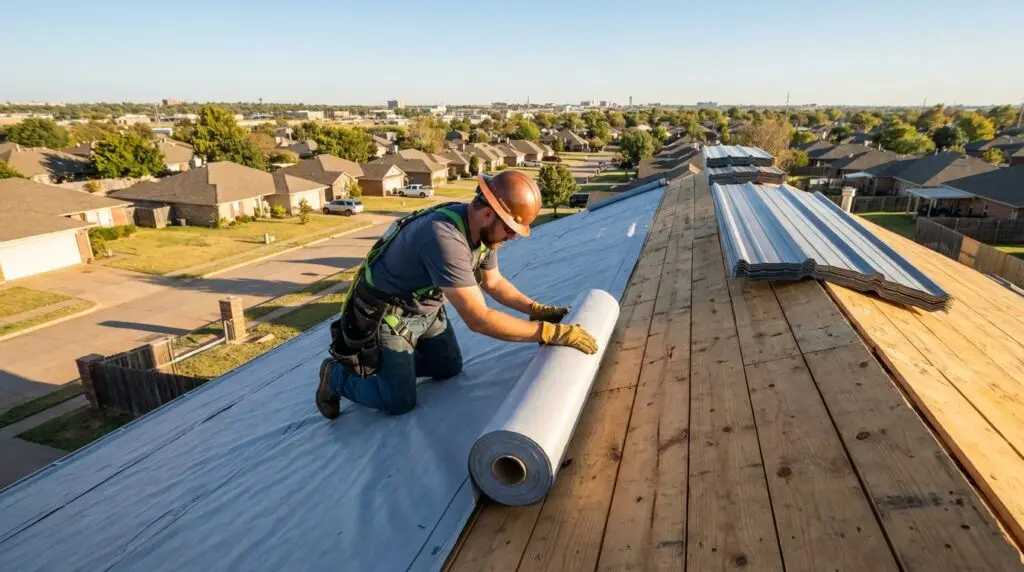
Metal roof underlayment is the protective membrane installed between your roof deck and your metal panels. Most homeowners never see it. Most homeowners never think about it. And that’s exactly the problem.
Here’s the thing, when everything is working correctly, underlayment does its job completely out of sight. But when a storm rolls through Oklahoma City with wind-driven hail and gusts pushing 70 mph or more, that hidden layer of protection becomes the difference between a roof that holds and a roof deck that’s silently rotting behind metal panels nobody has thought to inspect.
This guide covers what metal roof underlayment actually does, why Oklahoma’s specific weather conditions make your choice of underlayment more important than in most parts of the country, which types perform well here and which don’t, what the building code requires, and what every OKC homeowner should ask a contractor before a single panel goes up.
What Metal Roof Underlayment Actually Does (And Why the Metal Panels Alone Aren’t Enough)
The Secondary Barrier Principle
A metal roof does an impressive job of shedding water, deflecting hail, and resisting wind. But no roofing system, metal or otherwise, is perfectly sealed. Thermal expansion creates microscopic gaps along panel seams. Fastener holes exist wherever panels are attached to the deck. Panel edges at ridges, rakes, and eaves are transition points where wind-driven rain can find its way through.
Your roof deck, usually plywood or OSB, is sitting underneath all of that. And if moisture reaches it with any regularity, you’re looking at rot, mold, and structural damage that’s invisible until it’s expensive.
Metal roof underlayment is the secondary barrier that catches what the panels miss. Think of the panels as your first line of defense and the underlayment as your backup. You hope you never need the backup. But in central Oklahoma, you’re going to need it.
The Five Core Functions of Metal Roof Underlayment
Understanding what underlayment actually does helps you make a smarter decision when a contractor quotes you a job. Each of these functions matters independently, together, they make or break a metal roofing system.
1. Moisture barrier. Prevents water intrusion from reaching the roof deck when panels are compromised, whether by storm damage, fastener movement, or simple age.
2. Condensation control. Manages the vapor that naturally forms when warm attic air meets the cold underside of metal panels. Without a proper vapor management layer, this condensation drips directly onto your roof deck, and nobody outside the attic ever notices.
3. Thermal buffer. Reduces direct heat transfer between the hot metal surface and the structure below, contributing to attic temperature management and overall energy efficiency.
4. Noise dampening. Absorbs and deadens the sound of rain and hail striking the metal surface, which we’ll address more specifically later, because it’s one of the most common questions we hear from OKC homeowners.
5. Deck protection during installation. Before the metal panels go on, the underlayment protects your roof deck from rain exposure during the installation window. In Oklahoma, where a clear morning can turn stormy by afternoon, this matters more than most people realize.
If you’re planning a metal roof installation in Oklahoma City, the underlayment specification deserves as much attention as the panel system itself.
Oklahoma City Weather Makes Underlayment Selection Critical, Here’s Why
Most underlayment guides are written for a generic national audience. They’ll tell you underlayment protects against moisture and leave it at that. That’s not good enough for Oklahoma City homeowners, because our weather patterns create stresses that mild-climate underlayment products simply aren’t built to handle.
Hail Comes in at an Angle Here, Not Straight Down
Most people picture hail falling vertically. That’s not how it works in a central Oklahoma supercell.
Our storm systems sit at the convergence of warm, humid Gulf air and cold upper-level atmospheric systems. The result is powerful updrafts and intense wind shear that launch hailstones at steep, sometimes nearly horizontal angles. Wind-driven hail doesn’t just hit the flat surface of a panel, it hammers seams, edges, and fastener points where stress concentrates differently than a vertical impact.
For homes in Midwest City, south OKC, and other areas where ranch-style construction means flatter roof pitches, this is especially significant. A low-slope roof presents more surface area at the angle where wind-driven hail hits hardest. When those impacts stress panel seams or shift fasteners over time, the underlayment is what stands between the event and your roof deck.
Golf ball–sized hail, roughly 1.75 inches in diameter, is common enough in Oklahoma City storm events that experienced local contractors plan their specifications around it. That’s not the worst case. It’s the baseline.
Temperature Extremes Degrade the Wrong Underlayment Fast
Oklahoma City summers regularly push past 100°F, and attic temperatures can reach significantly higher. Felt underlayment, the old asphalt-saturated tar paper that’s been used for decades, softens under that sustained heat. Over time it can become adhesive against the underside of metal panels, and when panels try to expand and contract with temperature changes (which metal does constantly), the stuck underlayment resists that movement. That resistance creates tension at fastener points and seams.
Then winter arrives. Freeze-thaw cycling works at any adhesion compromise that heat created. Ice events, which OKC gets more often than people outside the region might expect, add additional stress.
Add in Oklahoma’s dramatic humidity swings between seasons, and you have an environment that accelerates condensation risk under metal panels whenever the wrong underlayment material or an improperly specified vapor retarder is in place.
In short: underlayment that performs fine in a mild climate will underperform here. Specification matters. If you’ve had storm damage and are wondering about your current system, a professional storm damage metal roof inspection is the right starting point.
The Three Types of Metal Roof Underlayment, What Oklahoma Contractors Actually Recommend
Felt (Asphalt) Underlayment, The Budget Option With Real Drawbacks
Felt underlayment has been around for a long time. It’s widely available, low-cost, and familiar to many contractors. For certain applications, it’s still acceptable.
For metal roofing in Oklahoma City, it’s usually the wrong choice.
In our experience, the degradation problem is real. Sustained heat above 90°F softens asphalt-based felt, and Oklahoma summers are well above that threshold for months at a time. Beyond the heat issue, felt absorbs moisture, which creates exactly the kind of ongoing wet-dry cycling at the roof deck surface that causes the premature deck deterioration metal roofing is supposed to prevent.
The lifespan mismatch is also worth considering. A properly installed metal roof in Oklahoma City can last four to five decades. Felt underlayment is unlikely to perform reliably for that full period. You’re building a long-term system on a short-term component.
Felt may still be appropriate for outbuildings, covered patios, agricultural structures, or projects with very constrained budgets and shorter expected lifespans. For a residential metal roof that’s meant to be your last roof, it’s not the right foundation.
Synthetic Underlayment, The Oklahoma Standard for Good Reason
Synthetic underlayment, typically manufactured from polypropylene or polyethylene, has become the preferred choice for metal roofing across the industry, and especially in Oklahoma’s demanding climate.
The reasons are practical. Synthetic underlayment doesn’t absorb moisture. It maintains dimensional stability under high heat without softening or becoming adhesive against panel undersides. It’s lightweight, which makes installation faster and safer. The tear resistance is significantly better than felt, which matters in Oklahoma where wind can stress a partially installed roof during multi-day jobs. It’s UV-stable, so if installation is interrupted by weather (a common reality here), the exposed underlayment holds up without degrading.
One important note for homeowners: not all synthetic underlayments are rated for metal roofing applications. Some products are designed for asphalt shingle systems and don’t account for the thermal movement characteristics of metal panels. When reviewing a contractor quote, verify that the specified product is explicitly rated for metal roofing. This isn’t a minor detail, it affects both performance and warranty compliance.
Self-Adhering (Peel-and-Stick) Membrane, Best for Vulnerable Zones
Self-adhering membrane, commonly called ice-and-water shield, creates a true watertight seal against the roof deck without relying on separate fasteners. It bonds directly to the decking surface and seals around any penetration point.
This product is essential at specific locations on any Oklahoma City metal roof: valleys, eaves, around pipe penetrations and chimneys, and at any low-slope section. These are the areas where water concentrates, where wind-driven rain finds entry points, and where the consequences of underlayment failure are most severe.
Oklahoma’s adopted building code (the IRC 2015 with state amendments) requires double underlayment layers on roof sections with a pitch below 4:12. Self-adhering membrane typically satisfies this requirement and provides superior performance compared to two layers of a lesser product. For ranch-style homes throughout Midwest City, Moore, and south OKC, where low-slope sections are common, this isn’t a luxury upgrade. It’s a code-compliant necessity.
The cost is higher than synthetic underlayment used in field areas. The protection it provides at critical zones is worth the difference.
| Type | Heat Performance | Lifespan Match | Oklahoma Suitability |
|---|---|---|---|
| Felt (Asphalt) | Poor above 90°F | Poor (mismatched) | Not recommended for residential |
| Synthetic | Excellent | Strong | Recommended for field areas |
| Self-Adhering | Excellent | Excellent | Required for valleys, eaves, low-slope |
Oklahoma Building Code and Underlayment, What Homeowners Need to Know
Oklahoma has adopted the International Residential Code (IRC 2015) with state-specific amendments. For metal roofing, the code is clear about several things that directly affect underlayment decisions.
Solid sheathing or structural boards are required under metal roofing systems, and the integrity of that deck depends significantly on the underlayment protecting it over time. Wind speed design requirements in the OKC metro mean that underlayment fastening methods also matter: in higher wind zones, cap nails rather than staples are required along overlaps, and specific spacing requirements apply.
Low-slope sections, anything under a 4:12 pitch, require additional underlayment layers. This is non-negotiable.
Here’s why this matters for you as a homeowner beyond compliance: a contractor who skips or cheapens the underlayment specification may be installing a non-code-compliant roof. That has two serious downstream consequences. First, if a storm damages that roof and you file an insurance claim, an adjuster who finds non-compliant installation has grounds to complicate or deny coverage. Second, city inspections triggered by a pulled permit are designed to catch exactly these issues, which means a contractor who discourages you from pulling permits may be protecting themselves, not you.
Always request that permits be pulled. Always ask whether the installation will be inspected.
How the Wrong Underlayment Affects Your Insurance Claim After an OKC Storm
This is the section that most roofing guides skip entirely. It’s also one of the most important for Oklahoma City homeowners, because storm claims are a regular reality here.
When Underlayment Failure Becomes a Claim Issue
Here’s what happens in a worst-case storm scenario. Hail or high winds compromise your metal panels, perhaps stressing a seam, lifting a panel edge, or backing out a fastener. The panels no longer provide a complete weather barrier. Now your underlayment is doing exactly the job it was designed for: stopping moisture before it reaches the deck.
If that underlayment is degraded felt that’s been softening under OKC summers for ten years, it may not hold. Water reaches the deck. Deck rot develops. What began as a panel repair becomes a structural claim that’s dramatically more expensive, and that’s assuming the insurer doesn’t question the installation quality.
Insurers investigate roofing claims. They look at whether the system was installed to code. Substandard underlayment, particularly felt installed where synthetic was required, or missing ice-and-water shield at code-mandated locations, gives an adjuster a legitimate basis to challenge a claim.
Underlayment Quality Can Impact Warranty Validity
Most homeowners don’t realize that their metal panel manufacturer’s warranty often specifies underlayment requirements. Installing an incompatible or below-spec product can void that warranty entirely, not because the panels failed, but because the system around them wasn’t built to manufacturer standards.
Before signing any roofing contract, confirm in writing which underlayment product will be used and verify that it’s listed in the panel manufacturer’s approved system documentation. A reputable contractor will have this information readily available. If they can’t provide it, that’s a meaningful signal.
For guidance on protecting your investment after installation, our metal roof warranty guide for Oklahoma City covers what to document and when to schedule post-storm inspections.
Underlayment and Noise, Let’s Clear This Up Once and For All
One of the most common concerns we hear from Oklahoma City homeowners considering a metal roof is noise. They’ve heard that metal roofs are loud in rain and hail, and they’re not wrong to ask about it, but the full picture is more nuanced than most people understand.
The “loud metal roof” experience is largely tied to older agricultural-style installations: metal panels over open framing, no insulated deck, no underlayment system. That installation type amplifies sound dramatically. It’s also nothing like a modern residential metal roofing system.
A properly installed metal roof on a residential home, solid decking, proper underlayment, attic insulation in place, performs comparably to asphalt shingles in most rain and hail events. Most OKC homeowners who’ve made the switch report that they were expecting noise and didn’t get it.
For households with particular sensitivity to sound, there are underlayment products specifically engineered for noise dampening that go beyond standard synthetic underlayment. This is a worthwhile conversation to have with your contractor if it’s a concern.
Red Flags That Signal Underlayment Shortcuts, Protect Yourself Before Signing
Between you and me, underlayment shortcuts are one of the most common ways that lower bids stay lower. The savings show up in the quote but reveal themselves years later, usually after a storm.
What a Proper Installation Includes
A legitimate metal roof installation should include a thorough deck inspection before any underlayment is laid. Soft spots, damaged sheathing, or deteriorated decking must be addressed before a new system goes over them, otherwise you’re sealing problems in rather than solving them.
Underlayment should be lapped correctly at seams, typically a minimum six-inch overlap, with more required in high-wind zones. Fastening with cap nails rather than staples alone is appropriate for Oklahoma wind conditions. Valley areas, eaves, and any roof penetration should receive self-adhering membrane regardless of what’s used in the field areas. And the underlayment should be installed wrinkle-free, wrinkles beneath metal panels trap moisture and can telegraph visibly through the finished surface.
Warning Signs in the Bid and Installation Process
Watch for these specific red flags when evaluating contractors for your OKC metal roof project:
A bid that doesn’t name the underlayment product. If the quote says “underlayment” without specifying the manufacturer and product, you don’t know what you’re getting. Ask for it in writing.
No mention of low-slope or valley upgrades. If your home has any low-slope sections, common in ranch-style construction throughout Moore, Edmond, and south OKC, and those sections aren’t called out specifically in the scope of work, ask why.
A price significantly below competing bids. Substantial price differences almost always reflect material substitutions. Felt where synthetic was quoted is the most common version of this.
No permit pulled. Permits trigger inspections. Inspections catch underlayment shortcuts. A contractor who discourages permits is removing the accountability structure.
Pressure to start immediately without a written contract. A contractor confident in their materials and methods doesn’t need to rush you past the documentation phase.
For a full breakdown of what separates reliable contractors from risky ones, see our guide on how to choose a metal roofing contractor in Oklahoma City.
Underlayment Cost, What to Actually Budget For
Underlayment is not where you want to cut corners, but it’s also not the most expensive component of a metal roofing project. Understanding the cost structure helps you evaluate quotes intelligently.
As a general framework: felt underlayment sits at the low end of the material cost range per roofing square. Synthetic underlayment costs more, but the premium over felt is modest when viewed against the total project cost. Self-adhering ice-and-water membrane, used in targeted critical zones rather than across the entire field, is the highest-cost option per square foot but is typically applied only where it’s most needed.
The labor cost for installing any of these products is similar. The upcharge from felt to synthetic is a small percentage of total project cost. The potential cost of underlayment failure over a 40–50 year metal roof lifespan is not small.
The honest math: deck rot from moisture intrusion, caused by underlayment failure at year ten or fifteen, involves removing metal panels, replacing damaged decking, reinstalling panels, and addressing any interior damage that developed. That cost will exceed the synthetic underlayment upgrade many times over.
Ask any OKC contractor for an itemized quote that separates underlayment product costs from labor. If they’re reluctant to break it out, that’s worth noting.
Choosing the Right Underlayment for Your Specific Oklahoma City Home
Not every home in the OKC metro has the same underlayment needs. Here’s how to think through your specific situation.
Roof pitch. Low-slope sections below 4:12 require self-adhering membrane in critical zones, full stop. This isn’t a preference; it’s a code requirement and a practical necessity given Oklahoma’s storm exposure.
Deck condition. Older homes in Moore, Norman, and established OKC neighborhoods may have decking that needs evaluation before a new underlayment system goes over it. A thorough deck inspection should precede any underlayment specification.
Your neighborhood’s storm history. Homes along the Edmond and Yukon corridors that have absorbed multiple significant hail events benefit from premium hybrid systems, synthetic in field areas, self-adhering membrane at all critical zones and transitions.
How long you plan to stay. A homeowner who intends to live in their home for the next thirty years and a homeowner who plans to sell in five have different cost-benefit calculations. Both deserve honest guidance from their contractor about the tradeoffs.
Your panel system. Standing seam metal roofs expand and contract differently than exposed fastener systems. The underlayment beneath a standing seam roof needs to accommodate thermal movement without delaminating or restricting panel float. Not all products do this equally well.
Before any final decision, ask your contractor one direct question: “Which specific underlayment product are you installing, and is it rated for metal roofing thermal movement in high-heat climates?”
A contractor who can answer this clearly and specifically, with a product name and documentation, is a contractor who understands what they’re installing. One who can’t is worth reconsidering.
Maintaining Your Metal Roof System, Watching for Underlayment Problems Over Time
Underlayment isn’t a component you’ll inspect visually from the ground. But that doesn’t mean you can’t monitor its performance indirectly.
After any significant storm, particularly hail events that produce golf ball–sized or larger stones, check for lifted panel edges, areas where panels appear to have shifted, or any interior ceiling staining that wasn’t there before. These can indicate that the underlayment has been breached and moisture is reaching the deck.
Annual professional inspections are worthwhile for any OKC metal roof precisely because storm season stress is cumulative. A single hail event might not cause visible damage. Several events over a few years can compound into compromised fasteners, stressed seams, and underlayment that’s being asked to do more than it was designed for.
Synthetic underlayment installed beneath a properly maintained metal panel system can last for decades. Felt underlayment typically degrades much faster, and given that the average metal roof is intended to last the life of the building, that mismatch is a real problem to plan around.
Our metal roof inspection and maintenance service is designed specifically for OKC homeowners who want to stay ahead of storm season rather than react to it.
Frequently Asked Questions About Metal Roof Underlayment
Do you need underlayment under a metal roof?
Yes. Underlayment is essential for all residential metal roofing systems. It protects the roof deck from moisture, manages condensation between the metal panels and the decking, reduces noise, and functions as a critical backup barrier when panels are stressed by storm damage. In Oklahoma City, where hail and high-wind events are routine, underlayment is not optional. It’s a structural necessity.
What is the best underlayment for a metal roof in Oklahoma?
For most Oklahoma City homes, the best approach is a quality synthetic underlayment across field areas combined with self-adhering ice-and-water shield at eaves, valleys, low-slope sections, and penetrations. Felt underlayment is not recommended for metal roofing in Oklahoma, it degrades under sustained heat, is poorly matched to metal’s thermal movement, and has a lifespan inconsistent with a long-term metal roofing investment.
Can you install a metal roof without underlayment?
In limited situations, some open-frame agricultural or outbuilding applications, underlayment may be omitted. For residential metal roofing in Oklahoma, the answer is effectively no. Without underlayment, every fastener hole, seam gap, and panel edge transition becomes a direct moisture pathway to the roof deck. In a storm-prone region with temperature extremes on both ends of the thermometer, that exposure creates serious long-term risk.
Does underlayment reduce noise from rain and hail on a metal roof?
Yes, significantly, when properly installed. The loud metal roof experience is associated with older agricultural installations over open framing. A modern residential metal roof with solid decking, proper underlayment, and attic insulation performs comparably to asphalt shingles in most weather. For households with particular noise sensitivity, sound-dampening underlayment products offer additional reduction.
How does underlayment affect my metal roof warranty?
Many metal panel manufacturers require specific underlayment products, or at minimum, products meeting specific performance criteria, as a condition of their warranty. Using incompatible or below-specification underlayment can void the panel warranty even if the panels themselves never fail. Always confirm the specified underlayment is included in the manufacturer’s approved system before installation begins.
How long does metal roof underlayment last?
Synthetic underlayment installed beneath a well-maintained metal roof system can last for several decades. Felt underlayment typically degrades within ten to fifteen years, a significant mismatch with metal roofing’s expected forty to fifty year service life. Longevity depends on product quality, installation quality, and whether the metal panel system above it remains intact over time.
What should I ask my contractor about underlayment before signing?
Ask for the specific manufacturer name and product name of the underlayment being installed, confirmation that it’s rated for metal roofing thermal movement, documentation of what will be installed at valleys and low-slope sections, and confirmation that the installation will be permitted and inspected. Any contractor unwilling to provide this information in writing is a contractor worth looking at twice.
Ready to talk through your underlayment options for a new metal roof or replacement project in Oklahoma City? Our team works with homeowners throughout OKC, Edmond, Yukon, Moore, Midwest City, and Norman. Contact us for a free inspection and estimate.