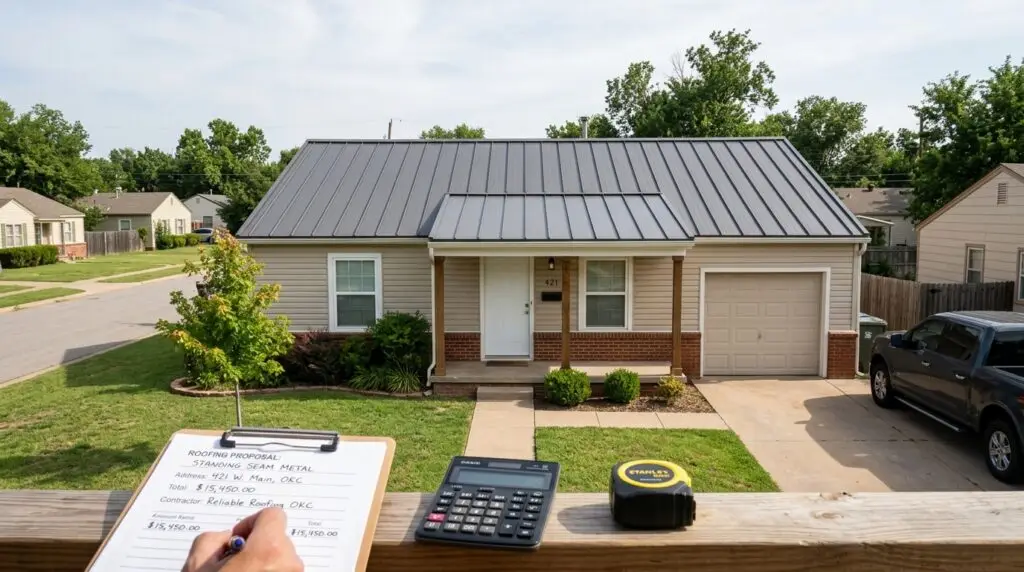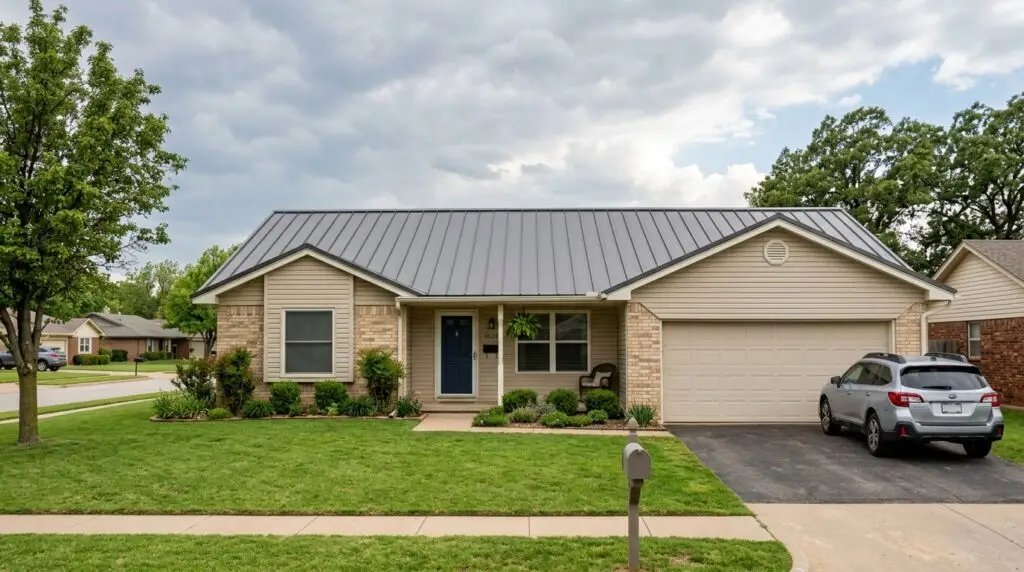
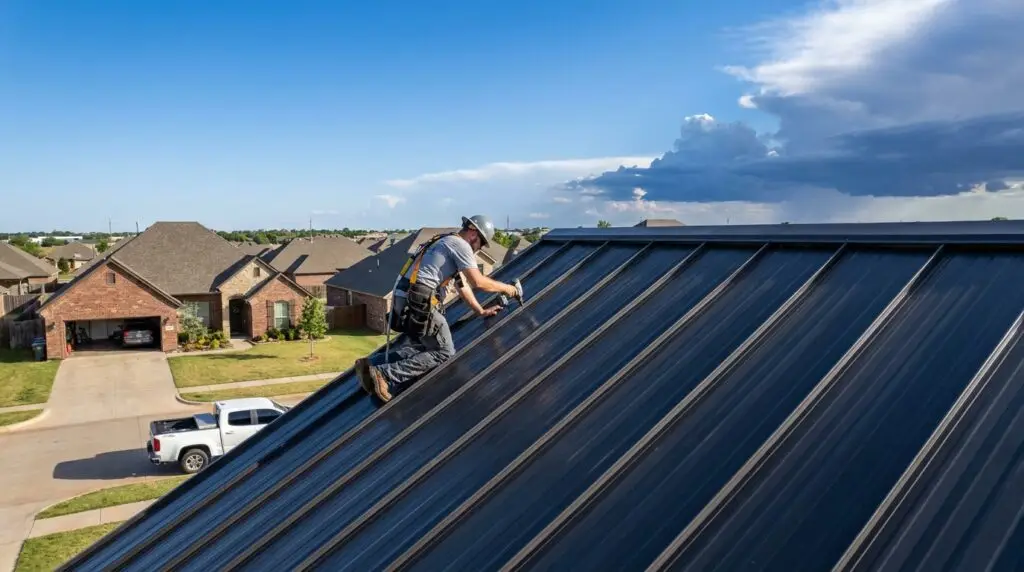
Metal roofing is one of the smartest investments an Oklahoma City homeowner can make. It handles heat, wind, hail, and the kind of storms that roll off the southern plains and park themselves over Moore or Midwest City for what feels like forever. A properly installed metal roof can outlast two or three asphalt replacements without breaking a sweat.
The key phrase there is properly installed.
Every year, homeowners across the OKC metro, from Edmond down to Norman, from Yukon across to Del City, discover their new metal roof is leaking, popping, or worse: failing an insurance claim inspection after a hailstorm. And in most of those cases, the storm didn’t cause the failure. The installation did.
This guide covers the most common metal roof installation mistakes, why they’re especially costly in Central Oklahoma’s punishing weather environment, and what you should know before, during, and after your roof goes on.
Why Installation Quality Matters More in Oklahoma Than Almost Anywhere Else
Here’s something most roofing articles won’t tell you straight: a metal roof that might last 15 years in a mild coastal climate can fail in the first Oklahoma storm season if it was installed incorrectly. The margin for error here is genuinely smaller than it is in most of the country.
Central Oklahoma’s Roofing Environment Is Uniquely Punishing
Oklahoma sits in the heart of severe weather country. The OKC metro sits at the convergence of warm Gulf air moving north and cold atmospheric systems dropping south, and the result is storm activity that produces wind-driven hail at steep, damaging angles, not just the straight-down hail most people picture.
Communities south of Oklahoma City, particularly Moore, and east of the metro in Midwest City and Del City, sit in storm corridors that see some of the most concentrated severe weather in the region. Edmond and Yukon face their own exposure patterns. If your home is anywhere in the greater OKC area, your roof isn’t going to get a gentle break-in period. It’s going to face real conditions quickly.
On top of storm exposure, Oklahoma’s temperature swings between brutal summer heat and winter lows create more thermal expansion and contraction stress on metal panels than a moderate climate ever would. That matters for installation, because a system that isn’t designed to accommodate that movement will show you the problem eventually.
What’s at Stake When Installation Goes Wrong
A botched installation doesn’t just cause leaks. It can void manufacturer warranties, turn a covered insurance claim into a denied one, and accelerate corrosion from the inside out. The financial stakes are real. A roof replacement in Oklahoma is a significant investment, and a bad installation can force you back to that expense far earlier than anyone planned.
Choosing the Wrong Panel Gauge for Oklahoma Weather
This is a mistake we see regularly, and one that most generic roofing articles completely skip over. Gauge selection matters everywhere. In Oklahoma, it matters more.
What Panel Gauge Actually Means
Gauge measures the thickness of the steel panel. Lower gauge number equals thicker metal. The difference between a 29-gauge and a 24-gauge panel might not look dramatic on paper, but under a golf ball–sized hailstone moving at velocity? It’s significant.
Thinner panels absorb hail impact differently. They dent more visibly. Ribbed, striated, or textured panel surfaces distribute impact force more effectively than smooth flat panels because the raised geometry deflects a portion of the energy rather than absorbing it at a single flat point.
The Upgrade Decision That Comes Back to Haunt Homeowners
In our experience, the gauge conversation happens at the estimate stage, gets framed as a cost-saving option, and homeowners choose thinner panels to reduce upfront cost. That’s completely understandable. But after the first significant hail event, and in the OKC area, that’s not a question of if, it’s a question of when, the regret is real.
Standing seam systems, which use concealed fasteners and raised seams, also outperform exposed-fastener systems in high-wind hail conditions because there are fewer vulnerable penetration points exposed on the roof surface. If you’re comparing quotes, pay attention to what panel type and gauge each contractor is proposing. Those aren’t just line items. They’re performance decisions.
Improper Fastener Installation — The #1 Cause of Metal Roof Leaks
Let’s be direct about something: metal itself doesn’t leak. Penetrations in metal leak. And the most common penetration on any metal roof is the fastener.
Over-Driving and Under-Driving Screws
Both mistakes happen, and both create leak points. When a screw is over-driven, the sealing washer underneath compresses and distorts, sometimes blows out entirely, leaving a gap that allows water to work its way in. Under-driven screws leave the fastener head raised, which means the washer never fully seals the hole.
Neither failure shows from the ground. Both show up eventually as water stains on your ceiling.
Wrong Fastener for the Climate or Panel System
Galvanic corrosion is a real concern in Oklahoma’s humidity. When incompatible metals contact each other, for example, aluminum fasteners used against copper flashing, an electrochemical reaction accelerates corrosion at that contact point. Using fasteners without proper corrosion-resistant coatings in Oklahoma’s climate shortens their functional lifespan from the day they’re driven.
Fastener Density and Wind Uplift Risk
Insufficient fastener density is a wind-uplift problem waiting to happen. OKC and surrounding areas regularly experience straight-line winds in the 60–80+ mph range during severe thunderstorms. Improperly fastened panels don’t just cause leaks, they can become partially or fully dislodged during a high-wind event, creating structural exposure that goes well beyond a surface repair.
Failing to Account for Thermal Expansion and Contraction
This mistake is quieter than a leak. It builds over time. And it produces sounds that confuse homeowners and problems that can be expensive to correct.
How Oklahoma’s Temperature Range Stresses Panels
Metal expands when it heats up and contracts when it cools. That’s physics, not a flaw. The question is whether the installation was designed to accommodate that movement.
Standing seam systems use a combination of fixed and floating clips to allow panels to move as temperatures change. When contractors use fixed clips throughout, or improvise clip placement to speed up installation, panels can buckle, oil-can, or begin pulling away from fastener points over time.
The Sounds Homeowners Hear
“My metal roof pops and ticks, is that normal?” It’s one of the questions we hear most often. Some thermal movement noise is expected and harmless. Excessive or irregular popping, especially if it’s concentrated in one area, can indicate that the system isn’t accommodating thermal movement the way it should.
Visible waviness on a panel surface, called oil canning, often traces back to substrate irregularities or improper clip installation. It’s worth noting that oil canning is generally a cosmetic concern, not a structural one, but it is frequently a symptom of underlying installation issues worth investigating.
Flashing Errors — Where Water Actually Gets In
If you ask an experienced metal roofer where water enters a metal roof system, the answer is almost always the same: not through the panels, but through the transitions. Valleys, pipe penetrations, ridge caps, roof-to-wall connections, these are the vulnerable points. And they’re also where installation errors concentrate.
Roof-to-Wall Flashings Installed by Shingle Crews
One of the most consistent real-world failures we see involves shingle-trained crews installing metal roofs without understanding metal-specific flashing geometry. The techniques are different. The overlap requirements are different. The sealant specifications are different.
Shingle installation experience doesn’t transfer directly to metal roofing, and when a crew applies shingle thinking to metal flashing details, the result is gaps, improper overlap, and eventual water intrusion at exactly the points the flashing was supposed to protect.
Valley, Ridge Cap, and Penetration Failures
Valleys, pipe boots, hip caps, and ridge caps are statistically the most common entry points for water in metal roofing systems. In Oklahoma’s storm environment, wind-driven hail hits these transition points at steep horizontal angles, concentrating impact force on surfaces that are already more complex mechanically than open field panels.
How Flashing Mistakes Affect Your Insurance Claim
Here’s something most homeowners don’t learn until it’s too late: if a flashing failure is classified as a workmanship defect rather than storm damage, your insurer may deny the portion of your claim related to that failure. The repair cost shifts from your insurance company to you.
A properly installed roof that takes storm damage is a covered claim. A poorly installed roof that a storm exposed? That’s a very different conversation with your adjuster.
Skipping or Cutting Corners on Underlayment
Underlayment is invisible once the panels go on. That makes it one of the easiest places for installers to cut corners and one of the hardest places for homeowners to catch it.
Why Underlayment Matters Even Under Metal
Metal panels are the primary weather barrier, but they’re not the only one. Underlayment serves as a secondary moisture barrier, a thermal buffer between the panel and the deck, and a noise dampener that reduces the sound of rain and hail inside the home.
Cheap underlayment, improperly lapped seams, or missing coverage at vulnerable locations allows wind-driven rain, and Oklahoma produces genuinely wind-driven rain during severe storms, to migrate under panels and reach the deck.
Ice-and-Water Shield Requirements in the OKC Area
Oklahoma doesn’t experience the sustained ice conditions of northern states, but freeze-thaw cycles do occur in the OKC metro, and the IRC-based building code that applies in Oklahoma City, Edmond, Moore, Norman, and Yukon requires ice-and-water shield at vulnerable eave areas for a reason. Work done without this layer may fail a permit inspection, and work done without a permit creates a different set of problems entirely (more on that below).
Poor Deck Preparation Before the First Panel Goes On
Between you and me, deck preparation is where a lot of contractors lose time and money, and where some make the choice to cut corners. It takes longer than it should, it often surfaces problems the homeowner wasn’t expecting, and it isn’t visible in the finished product.
Installing Over a Compromised Deck
Metal panels telegraph what’s underneath them. Dips, soft spots, delaminating OSB, and dry rot don’t hide under metal panels, they show through as surface irregularities, areas of flex, and eventual failure points. Before installation begins, a thorough deck inspection should identify and address any damaged sections.
An honest roofer checks the deck before the first panel goes up, and tells you what they found before they start the work. If a contractor is pushing to move straight to installation without checking the substrate, that’s a question worth asking directly.
The Hidden Cost of Skipping This Step
Deck rot discovered during installation adds cost and delay. Deck rot discovered after installation, especially after a storm, can trigger a complicated insurance claim dispute if adjusters identify pre-existing damage as a contributing factor. Address it up front, on your terms, with documentation.
Ignoring Local Permit Requirements
Every competitor article on this topic ignores permits entirely. That’s a gap worth filling.
Both Oklahoma City and the surrounding incorporated municipalities require building permits for full roof replacements. Edmond, Norman, Moore, Yukon, and Midwest City all follow similar requirements under their respective building departments.
Unpermitted roof work creates three specific problems: it can complicate the sale of your home (buyers’ lenders flag unpermitted work during underwriting), it can provide grounds for an insurance claim dispute, and it leaves you without meaningful recourse if the installation later fails. When you hire a contractor, ask directly whether they’ll pull the permit, and verify it.
Hiring the Wrong Contractor — What to Verify Before You Sign
Most common metal roof installation mistakes don’t happen because contractors are careless. They happen because the wrong contractor for this specific type of work took the job.
The Shingle Crew Problem
It’s more common than it should be: a roofing company with solid asphalt shingle experience gets a metal roofing job, assigns their regular crew, and the result is a system that looks fine on install day but develops problems over the following months.
Metal roofing has specific technical requirements, for clip type, fastener torque, flashing geometry, thermal design, and panel handling, that shingle experience doesn’t cover. Ask directly: how many metal roofs has this specific crew installed? Not the company overall. The crew doing the work.
Questions to Ask Any OKC Metal Roofing Contractor
These aren’t trick questions. A qualified contractor will answer them without hesitation:
- How many metal roof installations has your crew completed in the OKC area specifically?
- Are you familiar with the permit process in my municipality?
- What manufacturer panel system are you installing, and does your crew have training on that system?
- What workmanship warranty covers installation errors separately from the manufacturer’s material warranty?
- Will you be pulling the required building permit?
The Storm-Chaser Warning
After every major hail event in the OKC metro, out-of-state roofing contractors flood the area. Many arrive with a pickup truck, a temporary address, and aggressive pricing. Some do acceptable work. Many do not. And when problems surface six months later, they’re gone.
A local contractor who operates year-round in Oklahoma City has skin in the game. They’ll be here for the warranty period, for the next inspection, for the follow-up call when something needs attention. That accountability is worth factoring into your decision.
What Happens When These Mistakes Meet an Oklahoma Storm
Installation mistakes that might take years to surface in a moderate climate tend to surface within one Oklahoma storm season. The physics make sense: Oklahoma’s hail comes in hard, at angles, driven by winds that target exactly the points where installation errors concentrate, seams, flashings, fastener locations, and ridge transitions.
A roof with installation defects that then takes significant hail or wind damage faces a real risk of claim complications. Adjusters assessing storm damage are also evaluating the condition of what the storm hit. If they identify flashing that was improperly installed, fasteners that were over-driven from day one, or underlayment that was missing at a critical location, those findings affect how the claim is classified.
The best storm protection for your roof starts before the storm. It starts with the installation.
Frequently Asked Questions
What are the most common metal roof installation mistakes?
The most common metal roof installation mistakes include improper fastener installation (over-driving or under-driving screws), flashing errors at roof transitions and penetrations, failure to account for thermal expansion and contraction, selecting the wrong panel gauge for local weather conditions, using inadequate underlayment, neglecting proper deck preparation, and skipping the required building permit.
How do I know if my metal roof was installed incorrectly?
Warning signs include visible leaks or water stains inside the home, panels that appear wavy or rippled (oil canning), popping or cracking sounds beyond normal thermal movement, visible rust forming at fastener points, panels that have lifted or shifted after a wind event, and flashing that has separated at wall or chimney transitions.
Does a metal roof installation mistake affect my insurance claim in Oklahoma?
Yes. In Oklahoma, if an insurance adjuster determines that a roof failure stems from a workmanship defect rather than storm damage, the repair cost may not be covered under your standard homeowners policy. Improper fastening, flashing errors, and unpermitted work can all provide grounds for a claim dispute.
What gauge metal roof do I need in Oklahoma City?
For the OKC metro’s hail exposure, 24-gauge steel is generally the recommended minimum for residential installations. Thinner 29-gauge panels are more vulnerable to cosmetic damage from the golf ball–sized hail that Central Oklahoma sees on a regular basis during storm season.
Do I need a permit for metal roof installation in Oklahoma City?
Yes. Oklahoma City and surrounding municipalities, including Edmond, Moore, Norman, and Yukon, require building permits for full roof replacements. Work performed without a permit can complicate home sales and create insurance claim complications.
Can a shingle contractor install a metal roof?
Not necessarily successfully. Metal roofing has distinct installation requirements for clip type, fastener torque, flashing geometry, and thermal expansion design that asphalt shingle experience doesn’t cover. Many installation failures trace back to shingle crews attempting metal systems without metal-specific training or manufacturer certification.
Why does my metal roof make popping sounds in Oklahoma?
Some thermal movement noise is normal, metal expands in heat and contracts in cooler temperatures, and that movement creates sound. However, excessive or concentrated popping can indicate that the installation didn’t properly account for thermal expansion, such as using fixed clips where floating clips were required. If the sounds are irregular or localized, a professional inspection is worth scheduling.
If you have questions about a metal roof installation in Oklahoma City, Edmond, Moore, Norman, Yukon, or the surrounding communities, contact our team for an honest assessment. We inspect, repair, and install metal roofing systems throughout the OKC metro, and we pull the permit every time.